

Sudas remembers experiments he undertook as a painter and meditator
From an early age, S. was obsessed with one thought: could he really see something without being influenced by the many similar things he had already seen?
What did he see when he was looking?
He had invented a way of looking at objects as if for the first time, and it often yielded interesting results.
To facilitate this process of ‘estrangement’, he often turned them upside down.
His mother’s expression was priceless when she discovered that everything in his room that could be turned upside down had been indeed turned upside down.
He tried to look at things, he thought, as a painter must do. Take Morandi, for example. He was sure that his bottles, objects he had seen a thousand times, became objects he had never seen before under the artist’s gaze. Unique, untouched by the gaze. Innocent.
Secretly, S. kept an illustrated diary in which he wrote and drew his experiences. Looking at familiar things and people as if he had never seen them before required a certain facial expression that aroused curiosity. ‘Look at the expression on that boy’s face; what is he doing? Sleeping while standing up? Look at his eyes, it looks as if he’s going to fall asleep any minute’.
They did not understand that the boy was trying to see an object without the interference of his mind, so that he was seeing precisely that object and not just any object.
He did what you do with a camera lens: to focus at a distance, you reduce the aperture. It was a pity that with his eyelids half-closed, he did look a bit stupid.
He felt he could do more to see objects as unique, and one day he had an idea that seemed brilliant to him.
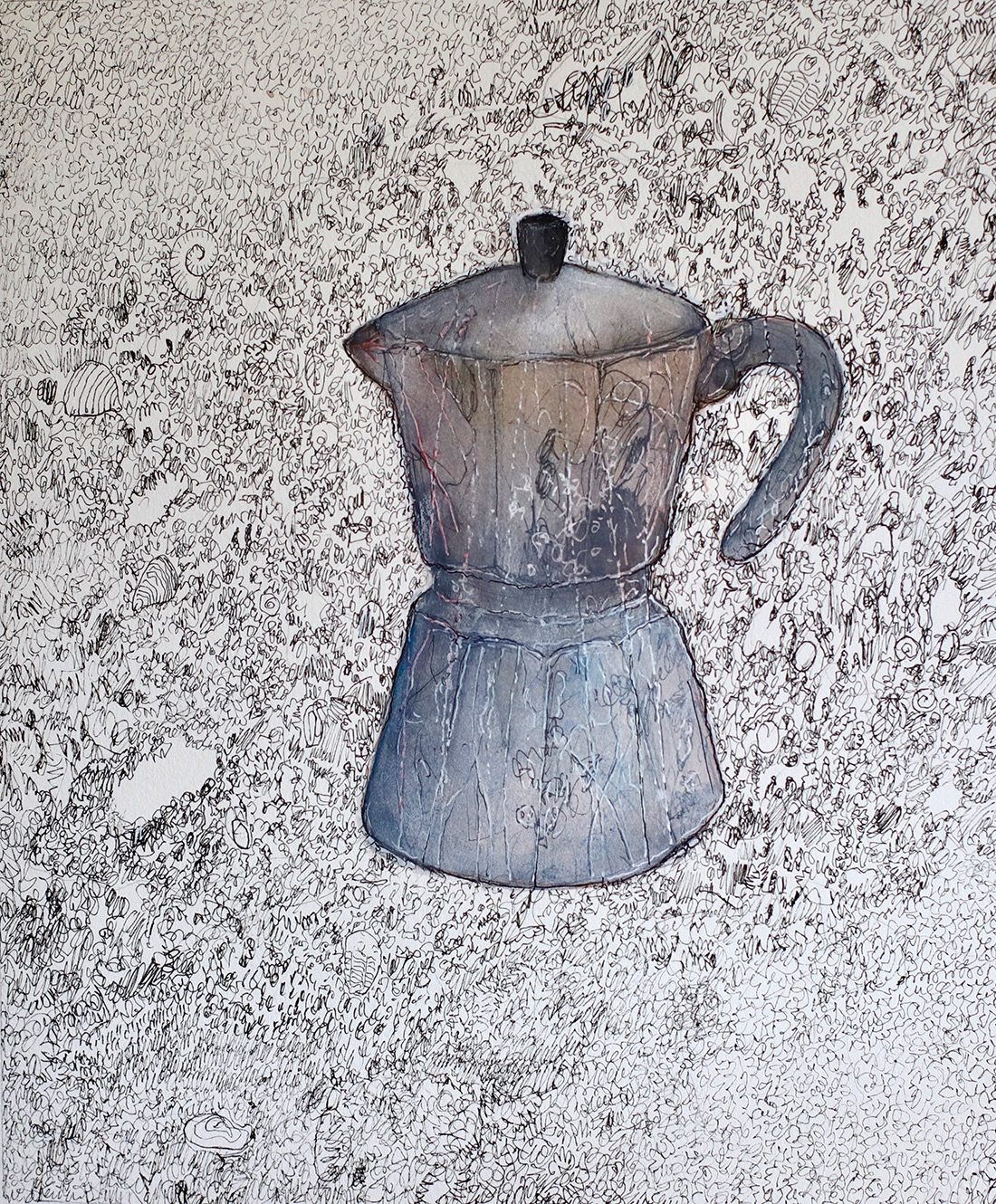
He was particularly attracted by a six-cup Bialetti coffee maker. When he looked at it, it was easy to see it – as if for the first time – its anthropomorphic shape.
So he decided to dress it up.
He began with a white blouse, sporting a classic detachable collar, and an ultramarine-blue flared skirt. Over the blouse he put a cardigan, or a similar garment, also in ultramarine blue.


The result was a moka pot unlike any other in the world. He had no doubt about that. Who knows why it reminded him of his mother?
S. was keen to let people know that he looked beyond appearances. He proved that one day at the seaside when he was lying on the beach with his girlfriend.
He looked at her with lowered eyelids to focus on her, and began to make a list of what he saw.
‘Do you realise that if we make a hasty aesthetic judgement, we overlook a more in-depth view that can reveal, I don’t know, this small scar, this larger one, the enlarged pores, the moles… And what’s this? A pimple? And these constellations of blackheads? Those twisted veins!’
And so it went on, with the ‘X-rayed’ subject decidedly disoriented: no one had ever looked at her so closely and so relentlessly…
S. was an artist, photographer and painter. If he thought that photography could help him in his hypervisual endeavours and that he could easily see things in their virgin aspect, uninterrupted, unique and nameless, he had to think twice.
Photography provided an image of the thing, but it was only an image.
He tried painting and drawing, and something happened when he looked at an object with half-closed eyes to establish empathic contact.
However, the enchantment ended when it came to reproducing it. Then S. realised that art was a hindrance. He had to forget art – which was not easy – but S. was stubborn and, above all, inclined towards a certain asceticism. So he gave up expressing himself artistically and waited.
Giving up his vocation as an artist had several effects.
It was as if the world could no longer find the diaphragm that separated it from S.’s mind, and rushed with the force of a flood where there were no longer any obstacles to inspiration, aesthetic desire, style and all that mental paraphernalia that an artist needs to face the urge to create.
S. felt overwhelmed, but being an expert in metaphors, he understood that he should not take this verb too seriously. All the more so because he was an excellent diver and, metaphorically speaking, he had often found himself swimming in deep waters.
Then, as often happens when you are hopeless and without expectations, something comes up that saves you.
A caver friend gave him a headlamp, which was a revelation.
S. placed himself in front of the drawing board on which he would once have put a painting he was working on – and stared intently, with half-closed eyes, at the circle of light generated by the headlamp.
To an observer it might have seemed strange to see someone looking at nothing but light, but S. had found a way to look at his mental objects, which, once projected, followed one another without pause and disappeared without a trace.
However, the exercise started to bore him, and soon he felt the desire to leave some trace, to define the mental images. He began to trace barely perceptible marks, linear, circular, insignificant things; but over time they acquired more body, more substance.
A language was being born, it was obvious, and S. could explore it or ignore it.
He decided to explore it, and in a short time the circle of light generated uncontrollable shapes, lines and colours.
S. often had the strange impression that it was not he who was looking, but that he was being looked at by the circle of light and the signs that were taking shape. All he had to do was respond to the requests that were made; and he liked to think that he was the only interlocutor. Unique.
It became increasingly clear to him that he did not want to give up his destiny as a painter; it would have seemed an act of arrogance to reject his vocation.
His Master, in Pune, had once told him that he would have to die, and only then he would experience great creativity.
S. wondered how it could be possible to die and at the same time become a very prolific artist.
He also thought that when the Master spoke of death, he did not mean ‘kicking the bucket’, but rather letting certain habits die, certain aspects of his appearance, etc.
But he wasn’t so sure about that!
Translated by Punya with edits by Madhuri, based on the original Italian version edited by Osho Times (March 2024)
Related articles
- More stories by Sudas on Osho News
- My urge to draw the human form – Artwork by Sudas (February 2024)


Comments are closed.