

S D Anugyan on the Emily Dickinson TV show, the Transcendentalists, death and astral travel
Giles: Yes, uh, she’s quite a good poet, I mean for a…
Buffy: A girl?
Giles: For an American.– Buffy the Vampire Slayer, ‘Never Kill a Boy on the First Date’
I have met numerous artists and writers whom the world has never heard of and probably never will, yet appear to have greater talent than most of their well-known peers. Sometimes it is a personal choice, that their art is for their own growth, their own truth; other times it is a failure of the system to recognise them; or a bit of both. With Emily Dickinson it seems to have been largely the former, that she was inclined to be very private, only having a couple of poems published in her lifetime. Mostly she just circulated them among her friends and family. Almost 1800 poems were discovered after the writer’s death. Since then, of course, she has become world famous.
The picture I always had of her was of someone like a New England heroine from a Henry James story, quite conservative and proper, rigid really. The one authenticated photograph of her from 1847 did little to dispel that impression, though there is a nice smile just playing on her lips. Her poetry however revealed an inner world that was dynamic, passionate and colourful – perhaps the source of that smile! I didn’t know much about her but enjoyed what I read of her verse, the way she would upset conventional rhythm with unusual punctuation, the powerful insights conveyed with a simple phrase, and the brevity of each poem, over before you knew it. Reading her was like touching gossamer, I felt, you could never quite grasp it, and were left with an impression of profundity and the beyond. In that way the poems reminded me somewhat of Japanese haikus.
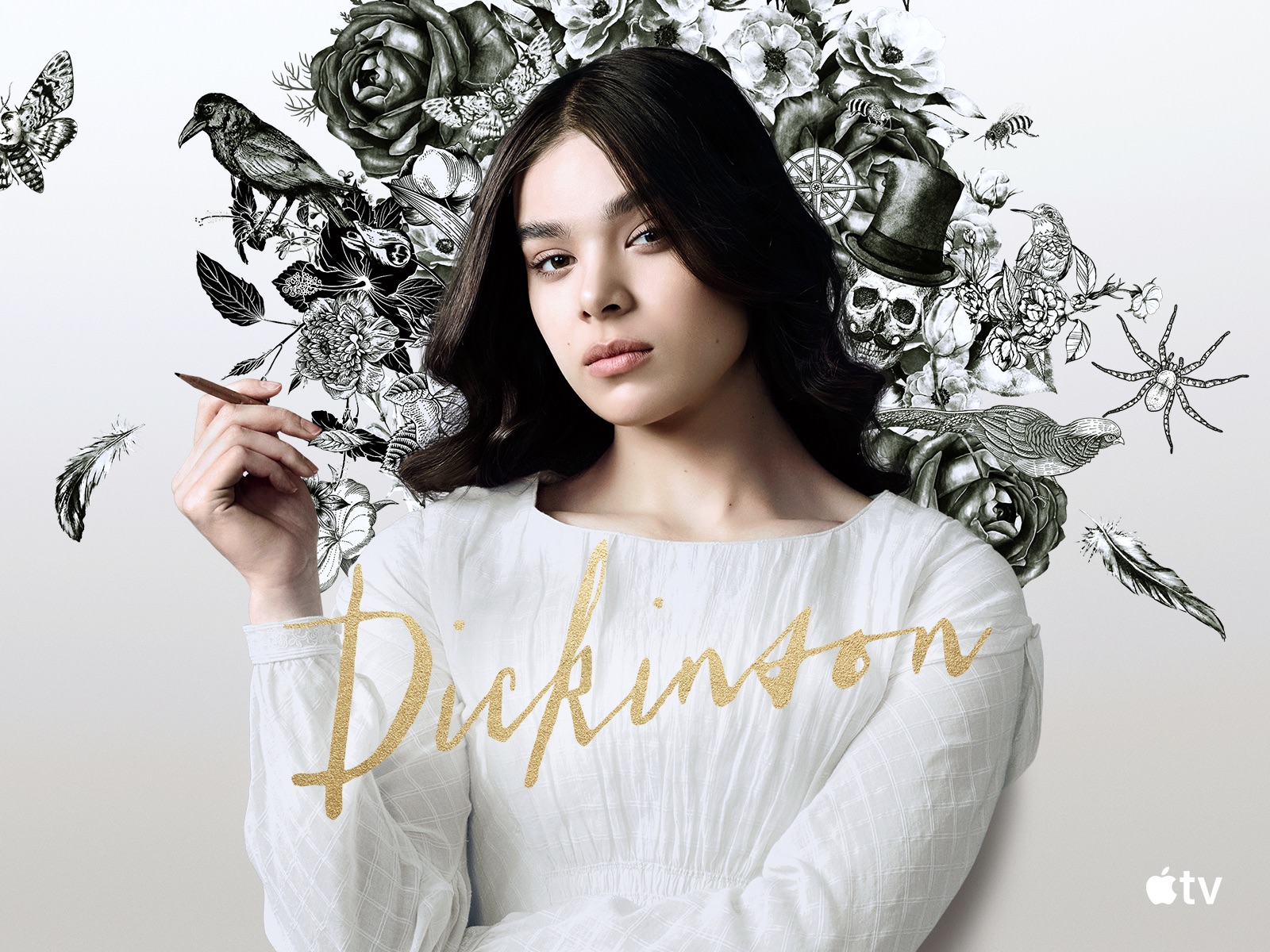
When I heard of the TV show on Apple called Dickinson, I started to watch it mostly so I could learn more about her life. I was expecting another dry costume drama – full of period detail but with nothing really interesting to say. The show defied all my expectations.
Part way into the first episode I found myself taking umbrage already as rap music took over the soundtrack. This seemed a cheap trick to ingratiate itself with younger viewers. Something made me stay however, then it was like a light went on in my head, and I understood. This was a technique Sophia Coppola applied very effectively in Marie Antoinette, using pop music to convey that the queen was really just a teenager and to remind the viewer of that fact.
As much of Dickinson is about emancipation, rap music was very appropriate. Yet the show isn’t a one-trick pony, having a tremendously varied and interesting soundtrack throughout, of which rap is just a part. Furthermore, dancing becomes another language the creators use continuously, adding to the richness, and with so many impressive set pieces there is even a YouTube compilation.
But I get ahead of myself. Back when I was beginning to watch it, I started to appreciate many things about the writing, and thought for a comedy of short episodes each about thirty minutes only in length, it had remarkable heights and depths.
I did feel my umbrage coming on again soon as I felt they were taking too many liberties with the facts merely to be sensational. This was particularly marked when Emily’s relationship with Sue, her sister-in-law, was revealed to be romantic. Yet on doing some research on the subject, I discovered that when some of her more passionate poems and letters were analysed under x-rays they found that a certain name had been erased after her death: Sue. Thus, several times when I doubted the accuracy of the show, research proved the writer to be correct – though naturally, poetic licence is in full flow throughout, otherwise we really would have ended up with a dry costume drama.
This colourful approach is demonstrated early on when Death is revealed as a good friend of Emily’s who turns up in a carriage drawn by horses of white flame. She sits in the carriage and chats with him, able to share her thoughts and feelings in a way that she cannot with anyone else, not even Sue. This relationship is significant in that she is very conscious of death being all around her, no matter how beautiful the world may be. In that way her poetry reminds me somewhat of her namesake across the pond, Emily Brontë, who also dwelt frequently on death-in-life.
Because I could not stop for Death,
He kindly stopped for me
The more fantastical elements of the show, like this one, work extremely well in that they represent accurately her inner world. As I argued previously in The Ninth Art Reborn, television often excels when it taps into the potential offered through fantasy. Yet here the show’s creator Alena Smith manages to ground everything in the evidence the poetry presents. In fact, it’s the only time I’ve seen words written over the screen calligraphically in a show, bringing the viewer both deeper into the story and a greater appreciation of the poems themselves. Thus, it works as both education and entertainment.
Emily’s exposure to the Transcendentalists is particularly illuminating the way it is shown here. For those who don’t know, the Transcendentalists were a group of writers in New England who emphasised spiritual insight and nature over materialism, one of the foremost illuminaries being Henry David Thoreau. When Emily approaches the latter for help in preventing a tree being felled, instead of a high-minded individual living close to nature in order to transcend the grime of humanity, she finds someone more like a spoilt rock star who still gets his laundry done by his mum.
Even more hilarious literary-wise is a visit later to an army field hospital where she finds Louisa May Alcott, writer of Little Women, and Walt Whitman working as volunteers. Whitman is perfectly done, booming, bombastic and way over the top, just like his poetry. “Well, come on, too far!” exclaims Alcott when Whitman kisses a dying soldier on the lips. Alcott herself, only there to get material for her next book, is portrayed as something of a ghoul, fascinated in “…how wounds actually smell bad. Honestly, when some of these guys show up here, it is the vilest odour that has ever assaulted the human nose.”
Whitman is not, strictly speaking, a Transcendentalist, but much of his verse reflects their views. Leaves of Grass is a strange, powerful book, its uniqueness and cosmic perspectives implying to many that Whitman was attempting to describe a satori. Indeed, the editor of the 1997 Barnes and Noble edition of the original text suggests just that. Dickinson being what it is, Whitman is depicted as living his poetry as much as he is spouting it.
“You must know the urge. The urge the urge the urge,” he says to Emily, after she identifies herself as a fellow poet, “Always the procreant urge of the world. To sing the song! To chant the chant! To join in the great and infinite chorus!”
It seems entirely natural that their next step is to the closest nineteenth century New York probably had to a gay bar where, under Whitman’s encouragement, Emily proclaims out loud her love for Sue. Whitman, loving her fervour, simply eggs her on:
“Drink with the drinkers! Dance with the dancers!”
And yes, there are always a lot of exclamation marks whenever Whitman speaks.
Flights of spiritual fantasy are as strong and recurring as those of literary fantasy throughout. In an ironic twist in one remarkable episode ‘I’m Nobody! Who are you?’, just when she has her first poem published, Emily discovers that she has become not only invisible but completely incapable of interacting with the world. She becomes like an astral traveller, moving from scene to scene, always the witness, never the participant.
I’m Nobody! Who are you?
Are you nobody, too?
Then there’s a pair of us – don’t tell!
They’d banish us, you know.
Because of her invisibility she easily manages to infiltrate a barn meeting of the local black community. Despite the fact that many of those present are her friends, she is now able to experience an intimacy normally denied her as a privileged white person. As the political discussion evolves into a wild dance, she can finally let herself go, in stark contrast with the staid party happening in the big house with her family at the same time. Her brother, come to look for her, discovers her dancing ecstatically in a state of undress. The first thing she says to him as he leads her gently away is, “You can see me?” One meaning is clear, that to be herself in the world, she has to be wholly unconventional, and the restrictions of fame may well preclude that.
Fame is a fickle food
Upon a shifting plate
Emily’s consciousness is often liberated from the tyranny of time. As the ominous build-up to civil war occurs, she meets the ghost of a man who has not yet died. They form a bond in the present time but her awareness of his fate becomes his awareness, and he goes forward into war with full consciousness of the price he is about to pay.
In another episode ‘The Future never spoke’ she and her sister are propelled to the future where their house has become a memorial to her writing and they meet Sylvia Plath. I see a reviewer of this episode on IMDB has titled their piece rather appropriately ‘The Future Never Comes for Women (or does it?)’. For Emily in this story gets an answer to what many a creative asks, ‘Is it worth it?’ And she is shown that yes, it definitely is worth it, she makes a difference. None of us know all the differences we make, we can only do what we can within the parameters we are given. There are unknown ripples from our actions. Only in fiction usually like Dickinson is one allowed to actually perceive what those ripples may be. (There is also quite a moving Dr Who episode where the Doctor takes a despairing Vincent van Gogh to the Musée d’Orsay showing his paintings in present day Paris – he too sees that yes, it is worth it, his work counts for something.)
Dickinson moves effortlessly, elegantly, between death and life, as much as it does between comedy and tragedy, showing how apparent contradictions are not actually contradictions at all, but aspects of each other. With Death as her closest confidante, its power to affect is by no means diminished, but the fear we may hold towards it is diminished, for it is too much entwined with Life to be seen as separate.
Bhagawati sent many of us an extract from Osho for Mahaparinirvana Day which seems very relevant, especially in these few words:
Yes, in fact death is only a transmigration – changing your house which has become dilapidated, is almost in ruins, and moving into a new house, fresh, just made, made for you. Death is only a change.
– Osho, From the False to the Truth, Ch 28, Q 6
That Dickinson embraces such powerful themes show just what a major achievement it is, managing to embrace high art along with pure entertainment. I think of Emily’s words from one of her poems…
This is my letter to the world,
That never wrote to me, –
…
Her message is committed
To hands I cannot see;
Here are the unknown effects from an artist’s actions once again, not knowing what they may be, how the world will receive what has been created. There has to be a letting go at some point, an awareness of it being up to the world, what it wishes to do with one’s creation. Emily Dickinson did get a reply, she got many replies, such as in the making of this remarkable television show. They may have been a long time coming, but we know as well as she now that future and past are no more separate than are life and death.


Comments are closed.