

“If you live a fully awakened life, suddenly you live in eternity, timelessness. You have become the whole; now no time exists for you.”
Time exists for us because we live as parts. Space exists for us because we live as parts. They are relative phenomena. For the whole, space doesn’t exist because it is contained in the whole. It cannot go anywhere else, because there is no anywhere else. The whole of space is in the whole. Where can it go? It exists here now, it always exists here now; otherwise has never been the case.
And you are both. If you live a divided life, if you live a partial life, if you live half asleep, almost sleep, then you live in time. If you live a fully awakened life, suddenly you live in eternity, timelessness. You have become the whole; now no time exists for you.
A German mystic, Eckhart, was on his deathbed.
A disciple – a curious, inquiring man, a student of philosophy – asked him, “Master, I know that you are dying, but I would like one question to be answered before you leave the body, otherwise it will haunt me my whole life.”
Eckhart opened his eyes and said, “What is your question?”
The man said, “When you die, where will you go?”
Eckhart said, “There is no need to go anywhere.”
And he closed his eyes and died.
“There is no need to go anywhere,” he said. I don’t think that the man’s inquiry was satisfied but a beautiful answer was given. It needs very deep understanding. Eckhart said, “There is no need to go anywhere.” It means: I am everywhere now. Where is the need to go anywhere?
Buddha was asked the same question again and again – when a Buddha dies where does he go? Buddha always laughed and kept quiet.
At the last moment again the question was raised and Buddha said, “Bring a small candle.”
The candle was brought and Buddha said, “Light the candle.”
The candle was lit and then Buddha said, “Bring it near to me.”
The candle was brought nearer and nearer and then suddenly he blew it out and said, “I ask you where this candle light has gone; where has the flame gone?” The disciples were at a loss.
In Sanskrit the cessation of a flame is called nirvana. So Buddha said, “Just like this, when Buddha dies, he disappears. He becomes one with the whole. So it is irrelevant where he goes, because where can the whole go? Where has this flame gone? It has become one with the whole. Now it no more exists as an individual flame, the individuality is dropped.”
That’s why the word nirvana became most important in Buddhist terminology. It means cessation of a flame, total cessation of a flame. It remains because whatsoever is remains, but you cannot find it. Where will you find a flame which is no more?
Individuality is lost, form is lost. Where will you find it? But can you say it is no more? It is, because how can a thing which was be no more? It disappeared, of course; became one with the formless, of course; became one with the whole, of course – but it is. Now it exists as the whole.
Osho, Tao: The Three Treasures, Talks on Fragments from Lao Tzu’s Tao Te Ching, Vol 1, Ch 8, Q 5
Series compiled by Shanti
All excerpts of this series can be found in: 1001 Tales
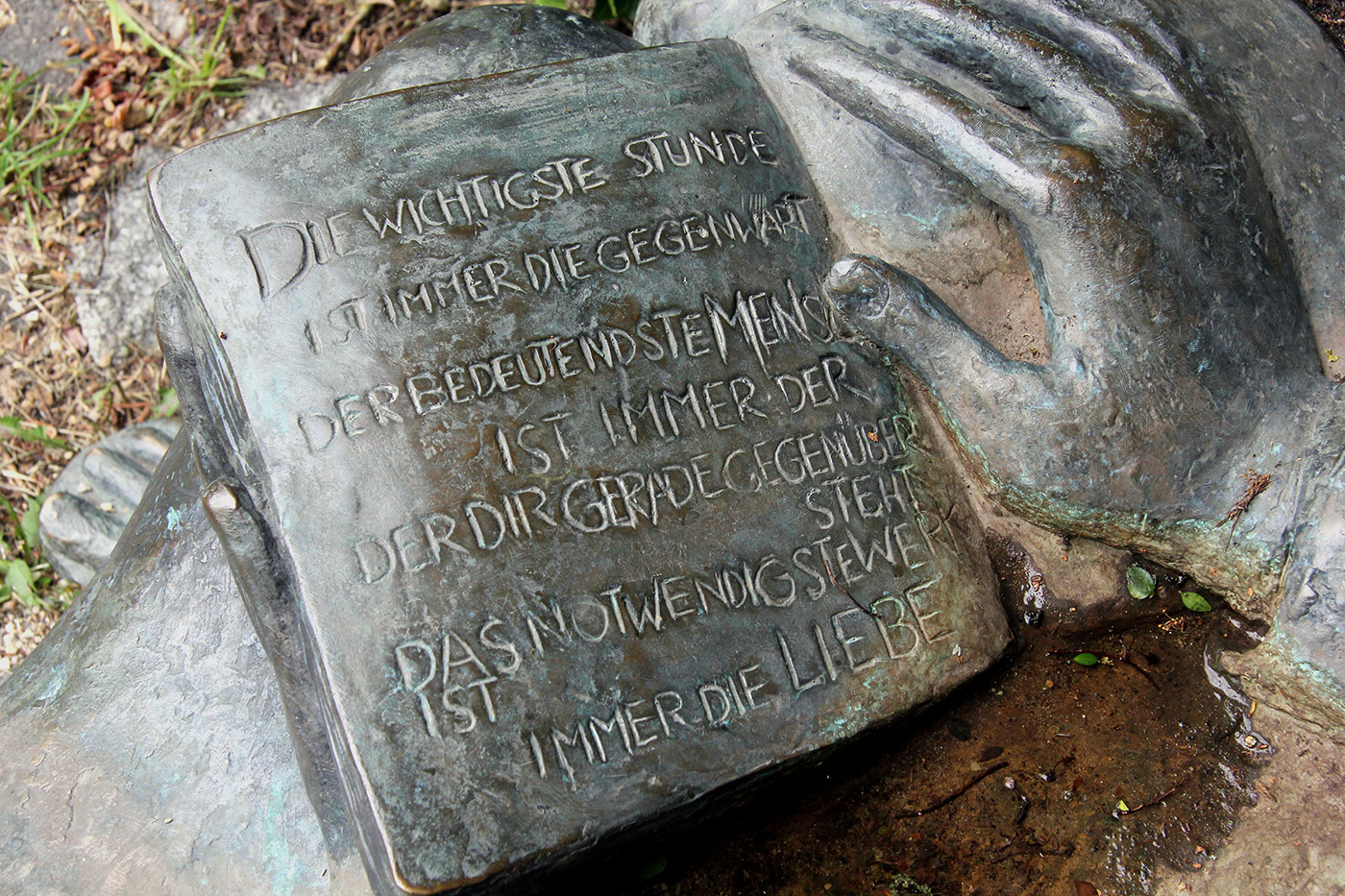
Featured image: Book by Meister Eckhart, sculpture in Bad Wörishofen, Kneippstraße, photo by Lothar Spurzem, commons.wikimedia.org


Comments are closed.