

Satyamurti shares the story behind a restored photograph from Rajneeshpuram – and the freedom of not having to become somebody else
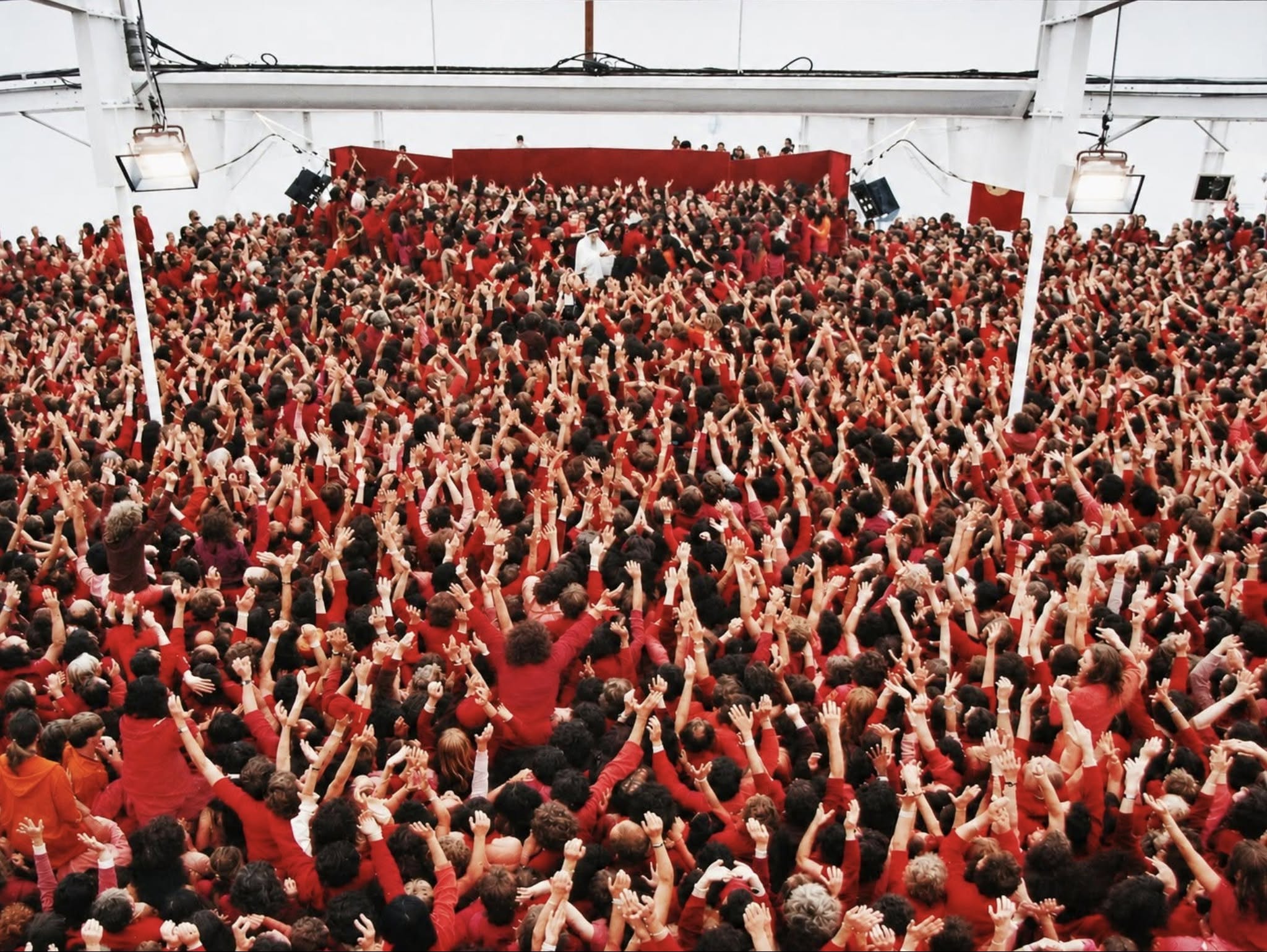
I hesitated for quite some time before deciding to share this photograph. It is very personal to me. As the photograph from Rajneeshpuram I posted a few days ago, I restored this one from an old original. This turns into a somewhat longer post, but this photograph means too much to me to leave its story untold.
I was 19 years old when I first met Osho at Rajneeshpuram. I had grown up in a small town in Germany’s Black Forest, in a rather restrictive Christian environment. My mother was the secretary to the local pastor, my teachers were strict, and so was my father. There were plenty of expectations about how one should behave, what one should believe, and what kind of person one ought to become. Then I encountered Bhagwan Shree Rajneesh.
There is a curious idea, repeated endlessly by people who often never experienced life around him, that we were somehow controlled by Osho, that we had to obey him, do what he wanted, and surrender our individuality. I can only tell you what I experienced, and what countless fellow sannyasins have described to me over the years. It was exactly the opposite.
For the first time in my life, I felt truly seen by someone who expected absolutely nothing from me. I didn’t have to prove anything, become anything, or live up to somebody else’s idea of who I should be. After the childhood I had experienced, that was a really dramatic change. And I believe it was precisely this freedom that brought so many of us together. We came from different countries, cultures, and backgrounds, carrying our own histories, and suddenly found ourselves in a space where we could simply be who we were.
Of course, that didn’t mean everyday life was without responsibilities. Rajneeshpuram was a vast undertaking, and there was work to be done. Lots of it. But the freedom I am talking about was something entirely different. It was the freedom from having to become somebody else. And the immediate response in one’s being was happiness. Simply happiness. Just like that!
Now, the story behind this photograph is rather strange. During my very first satsangs, I began experiencing a powerful pull deep in my belly, something I couldn’t explain at the time. Only much later did I discover the word hara, the center.
During approximately my fifth satsang, one of my first meditation experiences, I was sitting in row 62 or so in Buddha Hall when this sensation became so intense that, towards the very end of the satsang, I felt an irresistible urge to stand up and begin walking towards the podium. I remember noticing other people doing exactly the same thing, mostly from different back rows. Eventually, we all reached the stage. And there I am in the photograph, the tallest young dude standing behind Osho. He turned around, looked at all of us, and began laughing and smiling. Better put, he had a massive ball! I never again came physically that close to him during all my years as a sannyasin. What remained was this overwhelming sense of freedom and gratitude.
Over the years, I have read some extraordinarily harsh judgments about Osho, mostly from people who never met him or seemed to be quite frustrated. I have no objection to criticism, nor do I believe spiritual teachers should be exempt from it. But I sometimes wonder what people actually expect a spiritual teacher to be. Perfect? Sexless? Incapable of anger, contradiction, or human error? And why are these expectations so rarely examined themselves?
Consider Jesus, who, according to the Gospels, overturned the tables of the money changers in the temple in anger, attended feasts, drank lots of wine (like me), and associated with people whom respectable society preferred to condemn. Mary Magdalene, this hot Jewish chick, too, has been surrounded by centuries of speculation about the nature of their relationship, including the possibility that they frequently shared a bed. Jesus fucking Christ, how could he? No condom? Terrible! Where on Earth was the Holy Ghost to intervene in this moral disaster?
Imagine subjecting Jesus, and indeed the entire Christian tradition, to the same psychological scrutiny so enthusiastically applied to Osho. And when it comes to child sexual abuse, take a hard look at the Catholic Church itself. We are not talking about a handful of isolated incidents, but decades of documented child sexual abuse, thousands of allegations against clergy, criminal convictions, and the systematic protection of clergy who sexually abused children. Many perpetrators were priests entrusted with the care and moral guidance of children. Surely that deserves at least as much scrutiny as the spiritual movements people are so eager to condemn. Not to discredit Christianity, and certainly not to excuse wrongdoing anywhere, but to ask a simple question: How much of what we call spiritual judgment comes from understanding, and how much from conditioning, cultural inheritance, and expectations?
We never needed Osho to be perfect. What mattered to us was something much simpler. In his presence, we discovered that we didn’t have to be perfect either. I remember something else from Pune II. During one of his discourses, Osho was asked what he saw when he looked out from his chair at all of us sitting in front of him. His answer was: “I see only enlightened people.” And I believe he meant exactly that. Because enlightenment, as I understand it, is not something reserved for sannyasins, monks, or people who have spent their lives meditating. We have all known moments of it. When we fall in love. When we hold our newborn child and look into those eyes for the first time. When, for a moment, nothing is missing and nothing needs to be different. Not just us sannyasins. Everybody walking this planet.
The astonishing thing is that we have become absolutely brilliant masters at finding the off switch. Our bank balance isn’t quite right. A girlfriend leaves us. The boss is an idiot. Our pension is too small. Too much traffic. And suddenly, the miracle of being alive has to wait until we’ve sorted everything else out. We have become remarkably skilled at forgetting what is never really absent.
And if you find all this difficult to believe, I would like to suggest a little experiment. Step outside into your garden, sit on your balcony, or, if you can’t find a peaceful place anywhere else, go and sit in your car in the garage. Just for ten minutes imagine that nobody wants anything from you. Nobody expects you to achieve anything, prove anything, improve anything, or become anybody other than who you already are. Imagine that you are absolutely okay, exactly as you are, right now. Nothing to fix. Nothing to defend. Nothing to live up to. And then simply notice what happens inside you, just from allowing yourself that thought. You don’t need to believe me, Osho, or anybody else. Just see for yourself what happens.
And that brings me to the words Osho spoke at the end of his last public discourse, quoting Gautama Buddha’s final message:
“Sammasati. Remember that you are a Buddha.”
Both men meant all human beings, not just us red-clad weirdos and a few dozen daring Indians. And now, enough talk. Have a great and happy day!
This article was first posted on Facebook – reproduced here with the author’s permission.


Comments are closed.