

S D Anugyan is having a bad hair day
So Punya forwards me a posting from Facebook about the esoteric and deeper aspects of hair and suggests I write something about it, particularly relating to women’s hair and power. Her intuition was spooky as this was something of interest to me, and I had read about and been exposed to a lot of interesting aspects of this from around the world. So writing an article on the subject should be easy.
You’d think so anyway. I had the information, and the sources. I know how to introduce a subject, expand, bring in a segue or two, playing with some loose ends, yet always returning to the main body, and bringing it all together at the end, neat and tidy.
Immediately I run into difficulties. The first thing, if I were honest with myself, was an innate discomfort being an older white man, with not that much hair left, writing about mostly women’s hair and predominantly ethnic women’s hair. I didn’t even have the expertise of a hairdresser, though I’ve known quite a few, and talked with them at length (no pun intended).
I could, I thought, draw on writers I respect such as Emma Dabiri – but then, there’s a drawback in that her most relevant book Don’t Touch My Hair happens to be one I haven’t read.
Already the strands are loose and getting out of control! I’ll just have to relinquish control, dive in and see where I end up.
What happens on our heads is a lot more exciting than fashion.
These days trends are often manipulated for financial reasons. Anita Bhagwandas in Ugly, for example, tells us how hairy armpits were never an issue until Gillette ‘launched its first anti-underarm hair campaign in 1915 and its first women’s safety razor’, thus eliminating an ‘embarrassing personal problem’ that had never been embarrassing or a problem until then. (Now I get a note from Punya that Indian women have always had to cover their pit hair, as it’s supposedly too similar to pubes. Where am I going to fit that in elegantly? No pun intended here either.)
The hair on our heads though has a much more interesting story that is timeless.
Particularly with less and less to work with up top in my later years, when I go to a barber I tend to sit in the chair and say, ‘Do what you like,’ and hope for the best. It was always pretty much like that for me, even when there was more volume available. This attitude extended to women’s hairstyles which I would note only in passing. Like many men I paid the price when failing to notice the dramatic changes any women in my life would make simply by having a new hairstyle. You’d think I would have paid better attention, considering that even when I was a teenager, a girl could wield considerable power over me through a flick of her hair, a certain look…
The very bloke-ish comedy series Red Dwarf has an ongoing thing about haircuts, with one character Rimmer arguing that that’s where the answer to winning a battle is, with short back-and-sides triumphing every time. The reason Napoleon lost at Waterloo, apparently, was that his army had been marching for days and neglected to groom properly: ‘On the eve of the battle the French forces looked like auditionees for a 1960s nude musical.’ Rimmer is meant to be ridiculous, and his theory ridiculous, but in a way it’s a man’s acknowledgement of the power of hair – even if a bit backward.
It was another comedian, Chris Rock, who opened my eyes that there is a lot more going on with hair than men generally may have acknowledged. His film Good Hair is a stunning exploration of the multi-billion dollar industry in African-American hairstyles. Some of what he reveals is quite shocking, such as the brutal oppression black women often experienced in schools by having to conform their hair to white standards. Several women testified to the pain they were subjected to when their mothers forced them to use hair-straightener in order to ‘fit in’. There are some nasty chemicals involved.
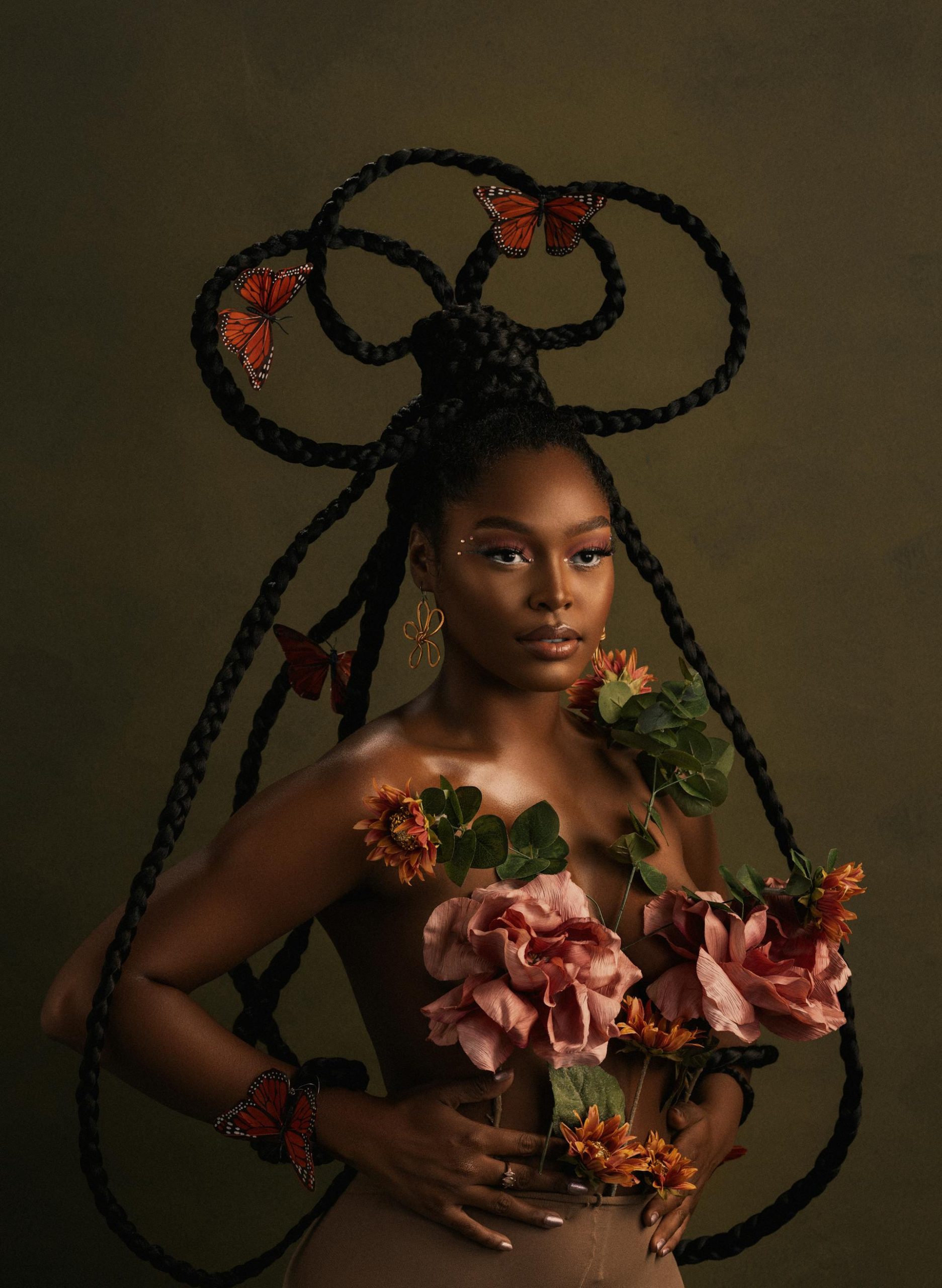
The film touches on the positive side of all this attention on hair, by way of individual and creative expression. The docu-series Hair Tales (available on Disney) goes a lot further in that way, with some incredible examples of just what black women are capable of creatively with their hair. That which they had been taught to be ashamed of, turns out to be a powerful and beautiful asset. An interesting aspect of this is that it is strongly reminiscent of African hair before colonisation.
Early European encounters with indigenous culture tended to be objective, the Venetian Alvise Cadamosto in the fifteenth century commenting that ‘Both sexes go bare-footed and uncovered, but weave their hair with beautiful tresses, which they tie in various knots, though it be short.’ Over time however, European obsession with African ‘idleness’ marked a change in tone. Before colonisation and having to pay high taxes, people had time and energy for grooming. (Ah ha! The Cadamosto quotation is from Don’t Touch My Hair. So I got the book in after all. No need to mention it’s a quote of a quote of a quote, as I read it in Ugly by Ms Bhagwandas. One loose strand is in place – for the time being anyway.)
There is strong social importance attached to this, for men as well as women, where time is spent in caring for one another, and communication is shared. This is cross-cultural, evident in barbershops and hair salons around the world today. As short a time as it takes to cut my hair, I learn a lot about the local community, and a lot more, from whoever is doing it. A few weeks ago my barber happened to be an Iraqi migrant who provided insights into what it’s really like in his family’s part of Iraq, details I could not have got from the news in any trustworthy form.
This association of hairdressing with communication and community is celebrated in comedy films such as Barbershop and Beauty Shop, yet this is a tradition with more serious roots. Barbers were seen as dangerous centres of sedition by the FBI during the Civil Rights movement and were constantly under surveillance. There is an esoteric aspect of this, in that for some cultures, such as the Sufi, hair is considered a form of antenna, picking up subtle energies and information from the environment. The simple act of getting a haircut may be a way of fine-tuning that antenna!
(What follows next is actually a segue, a break from the previous paragraph. If I don’t mention it, it will just be a split end no one will probably notice. Hold on…)
There is a Japanese ghost story where a man discovers his lover is a ghost, and that the only physical remains of her is that of a skeleton and long black hair. Japanese ghosts are nearly always women, and vengeful women at that. It’s been theorised that this is because in such a strong patriarchal system, there is a deep subconscious fear of what women are actually feeling. This is encapsulated in the Ringu films by Hideo Nakata, where the simple act of a woman brushing her long hair has an ominous quality that is terrifying, indicative of a rage that is coming from beyond the grave.
The evolutionary biologist Ella Al-Shamahi described the day she dropped her faith to become a scientist, and took off her headscarf. When visiting a petrol station she expected the men to react violently. Instead nothing happened. ‘Part of her was disappointed to be ignored,’ she admitted in an Observer interview.
I wonder where this terror of women’s hair comes from in men, that they wish it to be kept, literally, under wraps. Could it be alike to my teenage self, completely in a girl’s thrall because of the way she looked at me through wisps of her beautiful tresses? If so, it implies an emotional immaturity in those who run the world. (Okay, I can hear some of you all shouting that I’m stating the bleedin’ obvious. It just helps to write it out clearly, see it for what it is.)
I read that some traditions claim long hair can be used to protect the crown chakra at the top of the head. This has a personal resonance for me, in that during a series of meditations many years ago, I kept being shown African dancers using elaborate head-gear to enhance chakras above the crown i.e. the eighth and higher chakras. I had no idea these chakras even existed! The extraordinary hairstyles one sees around the world could be a way of tapping into that higher chakra energy. Shiva with his chignon perhaps.
It’s tempting to over-simplify the symbolism of hair-length, that short hair is conformist, logical and methodical, long hair rebellious and intuitive (‘let one’s hair down’), but then one falls into the Rimmer way of thinking. Plus, it varies considerably between cultures. Although for teenagers like me in the seventies long hair was associated with complacency and tedious indulgent guitar solos, what does seem fairly consistent is the association of long hair with vitality. (What? Really? Many girls I knew in the seventies cut their hair short to be rebellious, and they were pretty vital. Shh. Don’t complicate matters.) Hence not only the moderation enforced on women within patriarchal societies, but generally the association of unrestrained tresses with rebellion. Way back when I saw a business advisor about starting my Feng Shui business, he recommended I got a haircut in order not to scare the Oxford housewives. (It’s not that simple though. Women also cut their hair short to be different, in order to… Oh be quiet. Some strands need to be lost, or it really will mess up the overall style I’m looking for here. It will upset my elegant locks.)
So does that mean as we get older and lose our hair, our lives are over? Women have expressed a mourning of their once-luscious locks to me, that they ‘are not what they once were’. And of course, there is a global industry dedicated to providing means of retaining a look of colour and vitality i.e. covering the grey, which men are prone to do as much as women, often hilariously with the use of a head-rug aka a toupée.
Going back to the antenna idea, I’m wondering if the losing of one’s hair is a way of shutting down externalities, an emphasis on going within, as is practised in various religions and known as tonsure. For many of us as we get older it’s not even a choice, we’re going to have to go within one way or another.
Looking at all this variation in approaches to hair, its spiritual, social and aesthetic significance all around the world, one may ask, ‘What is the best thing to do with my hair?’
To which, the only appropriate response is:
Whatever you like. It’s your hair. Cut it, grow it, colour it, style it, have fun with it, get rid of it, put strange objects in it, celebrate it, wear a wig, have fun, be serious with it, enjoy it. Celebrate its absence also. It’s an expression of your individuality – even if you choose to conform.
(There. That wasn’t too bad. Looks quite interesting, playful, informative and stylish even if I say so myself. Time for a blow-dry and then it can go out into the world. Hopefully people will appreciate how it looks. Deep breath…)
Featured image by Folajimi Famosaya via pexels.com
Related
- “Whose girl is this?” – Osho tells the story when his father cut his hair


Comments are closed.