

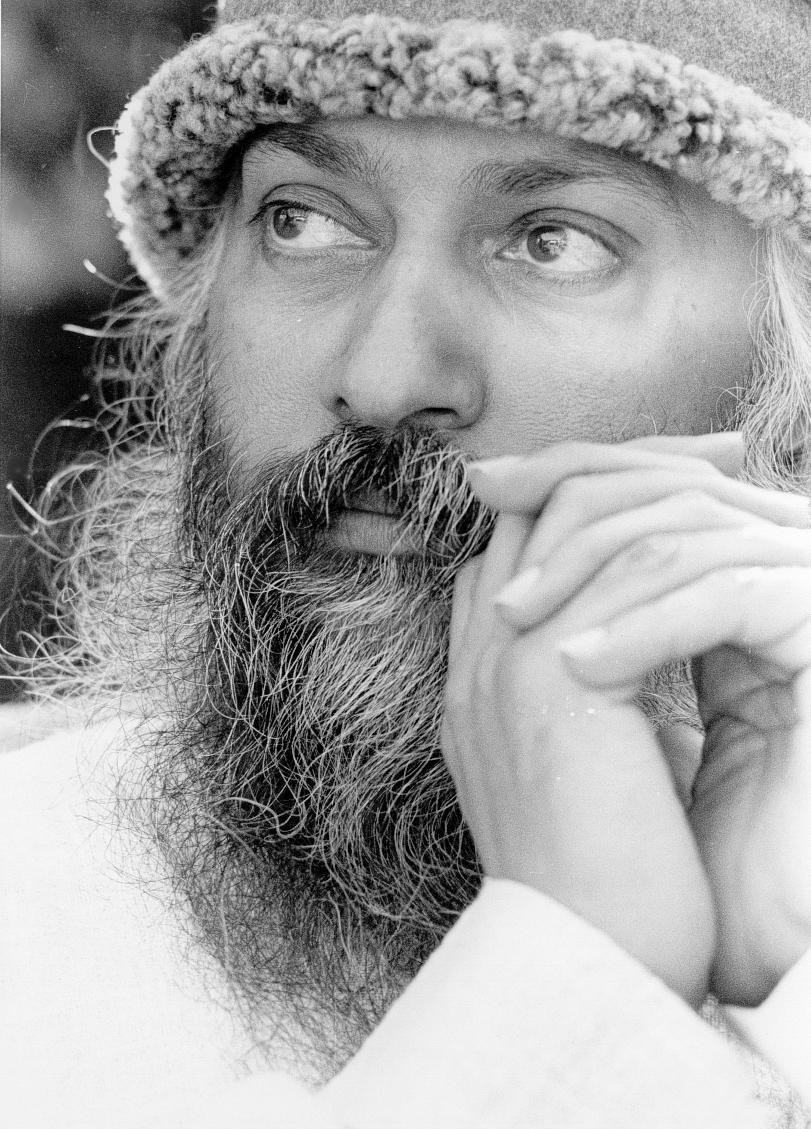
Osho mentions Siddhartha as depicted in Hermann Hesse’s eponymous book
God is not a noun but a verb. Let this sink deeply into your heart: that God is not a noun but a verb. In fact, the whole existence is a verb. Change all your nouns into verbs and you will be on the right track, because everything is alive and flowing – how can you call it a noun? A noun gives a fixed idea. A noun is always dead and a verb is always alive.
Drop that God!
And God is alive. He is alive in you, he is alive in me, he is alive in the birds. Wherever life is, God is; God is synonymous with life. […]
The very word ‘God’ has created trouble. Start using ‘godliness’, ‘divineness’, ‘love’. Drop that God! The word ‘God’ looks like a dead rock: no flow, no movement, no growth. Let your God become a river.
Remember Hermann Hesse’s Siddhartha: he learned the deepest realms of meditation by living on the shore of a river, seeing the river in different moods, in different seasons. In the summer it was so thin, like a silver line, and in the rains it was so overflooded. And sometimes it was so silent and so musical, and sometimes it looked so angry, in a rage; sometimes it was so compassionate, and sometimes it was so cruel. Just sitting on the bank of the river, slowly slowly he became aware of the great life of the river, its emotions, its moods….
The first thing my own father taught me – and the only thing that he ever taught me – was a love for the small river that flows by the side of my town. He taught me just this – swimming in the river. That’s all that he ever taught me, but I am tremendously grateful to him because that brought so many changes in my life. Exactly like Siddhartha, I fell in love with the river. Whenever I think of my birthplace I don’t remember anything except the river.
The day my father died I only remembered the first day he brought me to the riverbank to teach me swimming. My whole childhood was spent in a close love affair with the river. It was my daily routine to be with the river for at least five to eight hours. From three o’clock in the morning I would be with the river; the sky would be full of stars and the stars reflecting in the river. And it is a beautiful river; its water is so sweet that people have named it Shakkar – shakkar means sugar. It is a beautiful phenomenon.
I have seen it in the darkness of the night with the stars, dancing its course towards the ocean. I have seen it with the early rising sun. I have seen it in the full moon. I have seen it with the sunset. I have seen it sitting by its bank alone or with friends, playing on the flute, dancing on its bank, meditating on its bank, rowing a boat in it or swimming across it. In the rains, in the winter, in the summer….
I can understand Hermann Hesse’s Siddhartha and his experience with the river. It happened with me: so much transpired, because slowly slowly, the whole existence became a river to me. It lost its solidity; it became liquid, fluid.
And I am immensely grateful to my father. He never taught me mathematics, language, grammar, geography, history. He was never much concerned about my education. He had ten children… and I had seen it happen many times: people would ask, “In what class is your son studying?” – and he would have to ask somebody because he would not know. He was never concerned with any other education. The only education that he gave to me was a communion with the river. He himself was in deep love with the river.
Whenever you are in love with flowing things, moving things, you have a different vision of life. Modern man lives with asphalt roads, cement and concrete buildings. These are nouns, remember, these are not verbs. The skyscrapers don’t go on growing; the road remains the same whether it is night or day, whether it is a full-moon night or a night absolutely dark. It doesn’t matter to the asphalt road, it does not matter to the cement and concrete buildings.
God is not a thing
but a process
Man has created a world of nouns and he has become encaged in his own world. He has forgotten the world of the trees, the world of the rivers, the world of the mountains and the stars. THERE they don’t know of any nouns, they have not heard about nouns; they know only verbs. Everything is a process.
God is not a thing but a process. But words can mislead you. This word ‘God’ has misled millions of people. It gives you an idea, a very childish idea of course, but once it settles in you, you carry it your whole life. You have an idea of God: some very ancient-looking man with a long white beard, sitting on a golden throne up in the skies, ruling, ordering, commanding the whole world. And whoever disobeys him has to suffer much – a very dictatorial father. He has not yet forgiven Adam and Eve because they disobeyed him. […]
This is a very childish concept of God, anthropocentric. But millions of people are still living with this idea of God. It is a sheer misunderstanding. Children can be forgiven, but you cannot be forgiven.
Old Lindley sat down at the doctor’s desk.
“What is your problem?” asked the physician.
“Well, Doc, after the first, I am very tired. After the second, I feel all in. After the third, my heart begins to pound. After the fourth, I break out in a cold sweat. And after the fifth, I am so exhausted I feel I could die!”
“Incredible!” said the M.D. “How old are you?”
“Seventy-six.”
“Well, at seventy-six, don’t you think you should stop after the first?”
“But Doctor,” exclaimed old Lindley, “how can I stop after the first when I live on the fifth?”
Words can be very deceptive – and the word ‘God’ has deceived millions. Buddha is the first to recognize this fallacy. Hence I say we should divide history by Buddha, not by Christ – before Buddha, after Buddha – because he brings such a total and new vision to humanity. He brings a new idea of God: the idea of godliness. With Buddha, humanity becomes mature; it drops its childhood concepts.
Osho, The Dhammapada: The Way of the Buddha, Vol 5, Ch 3


Comments are closed.