

Amido and Purushottama visit India in 2005 – a pilgrimage to places where masters and holy men have lived (Part 1)
When we were on a safari in Tanzania prior to our boat ride to Madagascar (see A journey through time), one of our companions – we were only four people; he was from Spain, I remember – asked Purushottama if there was a place that he would like to revisit. In that moment he replied: India!
My heart responded with a deep thrill at the thought of returning to that land that has given rise to the most remarkable of men and women. And so, when in Antananarivo, we booked a flight to Bangkok, Thailand, knowing we could easily find an onward ticket to India.
It is from such small beginnings that the course of one’s life is set!
We landed in Kolkata in late December 2005. We had finally returned to India for the first time since we had left in 1981. The coming year was one when all the stars aligned and grace descended.
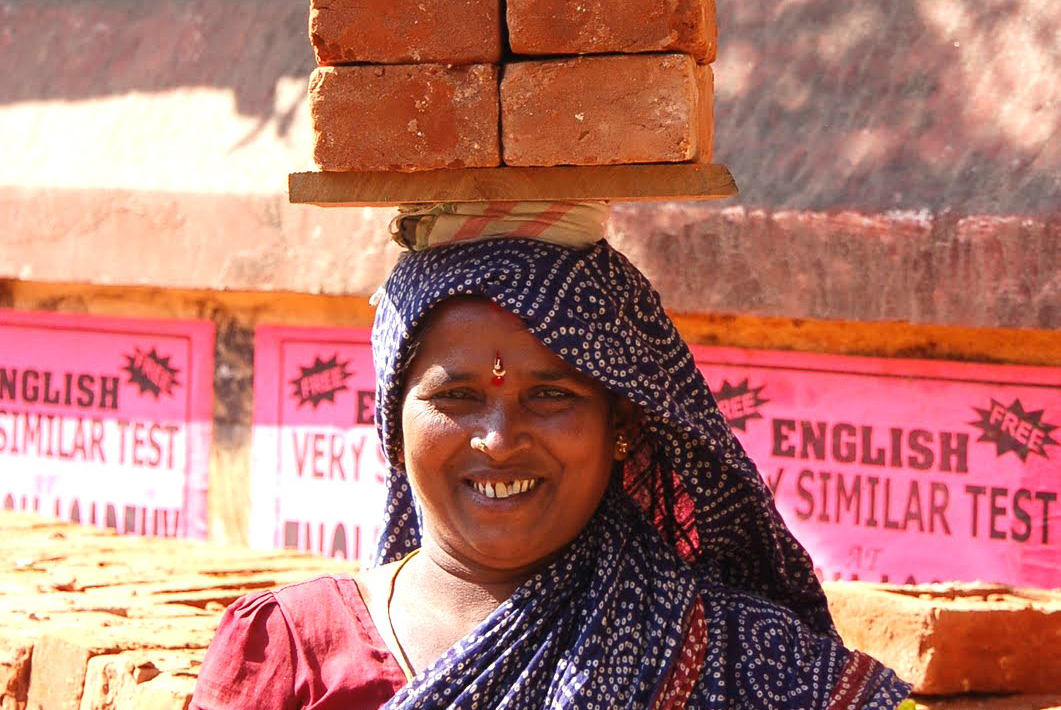
Such a welcoming face and place. The timelessness of India. (click on images to see fullscreen)
Kolkata
Purushottama found Kolkata significantly changed since his last visit in 1976 when the sidewalks were inundated with people creating makeshift homes for themselves and their families. The 1971 War of Independence, in which Bangladesh gained independence from Pakistan, was the cause: millions of people had been seeking refuge from the violence.
On the journey to Kolkata, Purushottama tried to prepare me for how it had been – so that it wouldn’t be too much of a shock – only to find that Kolkata was now doing much better economically! The refugee issue had been resolved in the intervening thirty years!
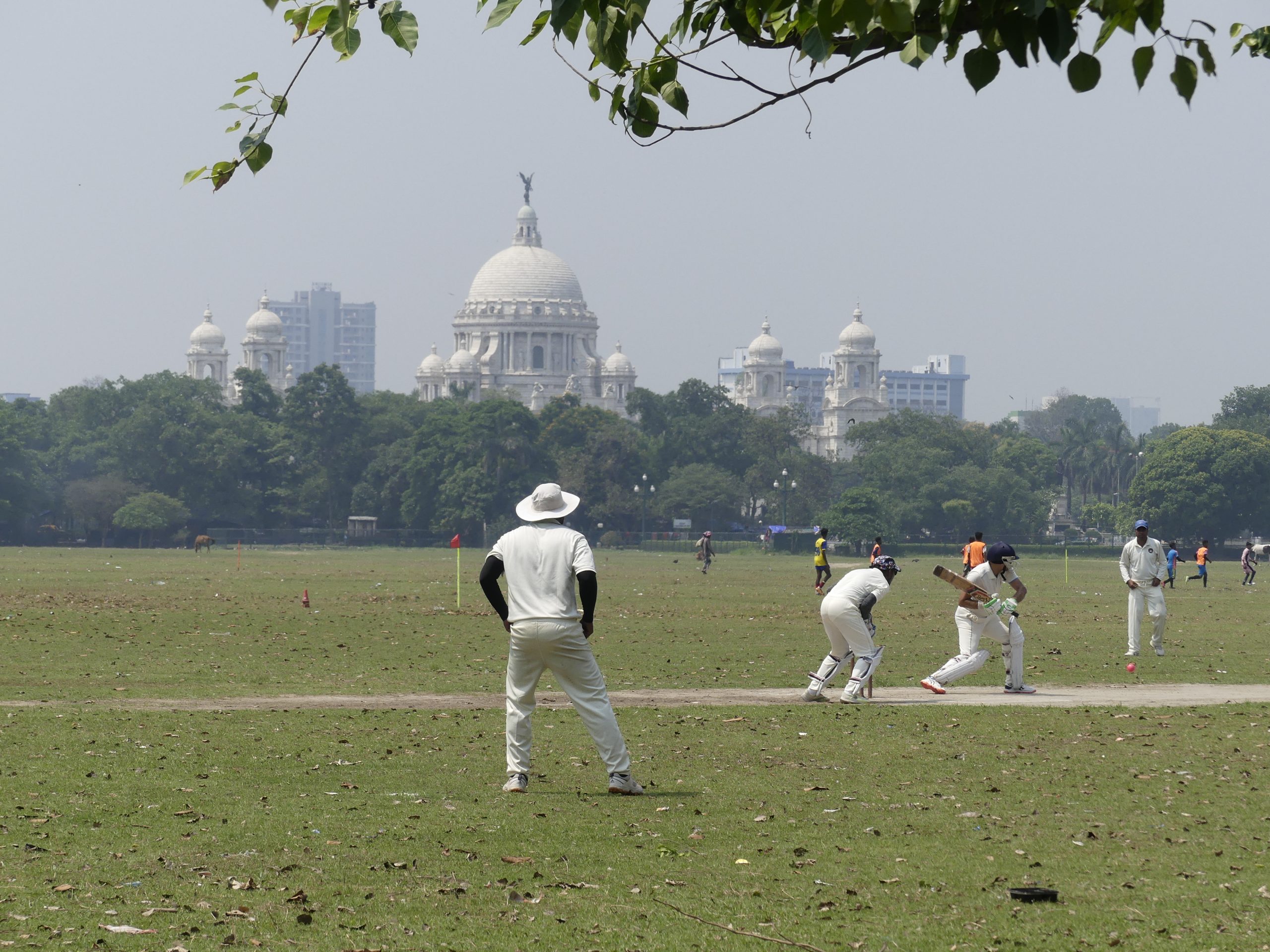
This huge maidan (open field) survives in the middle of Kolkata, a city with a population at this time (2006) of about 13 million. I am full of admiration that, despite the pressure on land, this vast open space remains. A soccer game was going on nearby; in the shade of trees, lovers were spending time together in relative privacy; an occasional horse could be seen grazing; and of course the highlight, a cricket match, was in progress. In the background is the Victoria Memorial built by the British Raj after Queen Victoria died in 1901. Kolkata was the capital of India until 1911; after which it was moved to Delhi.
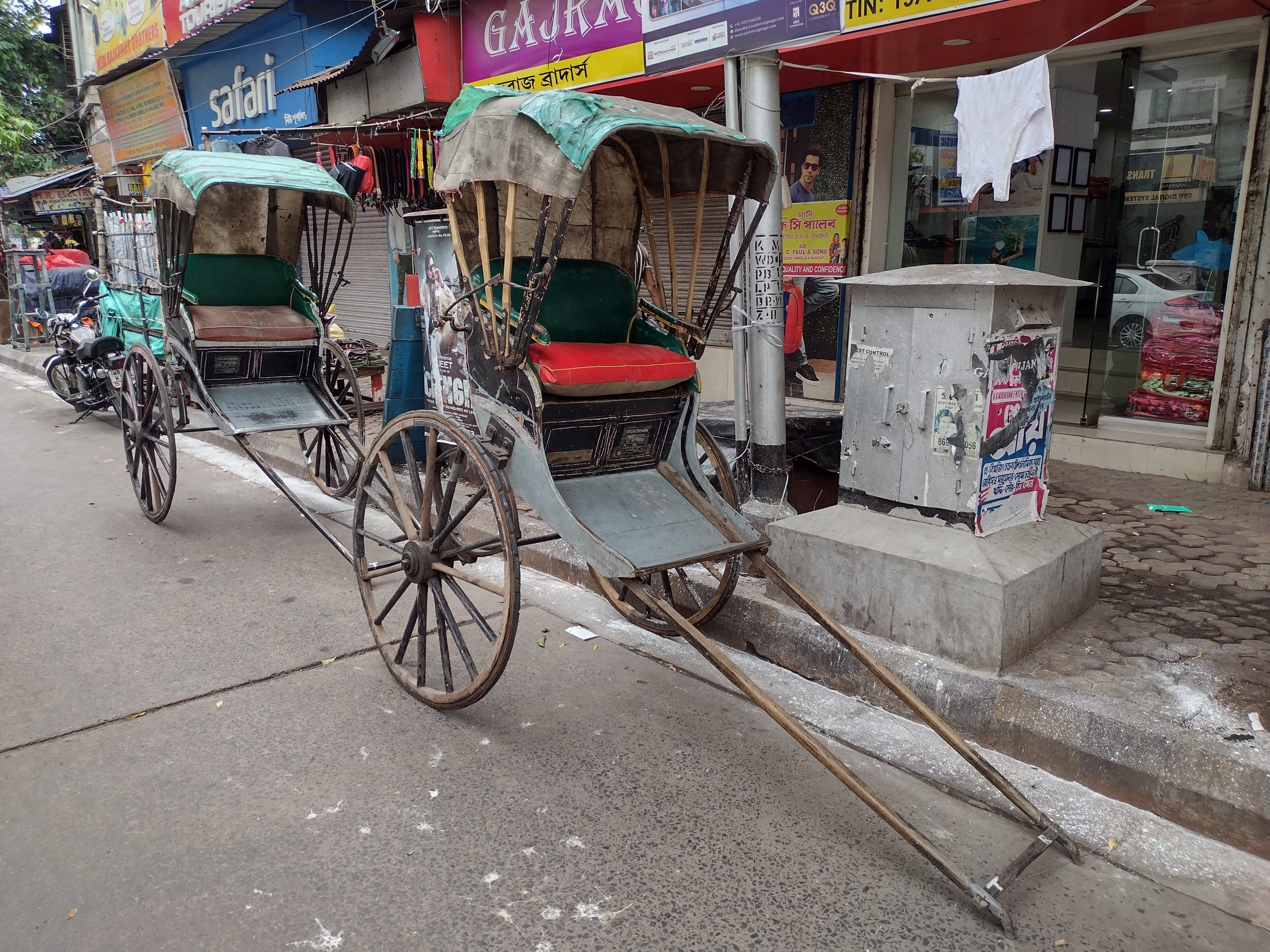
Man-pulled rickshaws continue to transport customers for short distances through the city. They navigate narrow streets well and are an effective means of transportation through the flooded streets during the monsoon season. They were introduced in Kolkata at the turn of the nineteenth century. There is an ambivalence about using them; a reluctance to be pulled by a fellow human being, but also the desire to support their livelihood. Kolkata spreads along the banks of the Hooghly River. Its average elevation is 17 feet (5 meters), so the terrain is flat, an advantage for the men pulling the rickshaws.


L: Relaxed but intense conversation. C: A well-chosen spot to set up a chai and snack stand in the shade of a banyan tree. R: A place called home.


L: Finding stillness in the chaos, whether to meditate or to sleep. R: His reading and writing services are still needed to this day.
Southward bound
We broke the long train ride to Chennai, Tamil Nadu, with a stop in Puri, Odisha, over Christmas. We stayed in a young Maharaja’s house which had been converted into a guest house; the grounds were lovely and so was he. He put on a sumptuous Christmas dinner for his guests.
Then we resumed the journey to Chennai; the distance was now 780 miles (1,250 kilometers) and took about 20 hours.
Chennai
We had a strong urge to visit J. Krishnamurti’s home in Chennai, having heard Osho talk about him in several discourses. I had only skimmed a few of Krishnamurti’s books but had devoured several biographies by Mary Lutyens; I found him fascinating. We had some difficulty finding a rickshaw driver who knew of Krishnamurti and could take us to his house, but persistence paid off!
We arranged to stay at Vasanta Vihar, the headquarters of the Krishnamurti Foundation India, starting the next day and, in the meantime, since we were close to the Theosophical Society’s Headquarters in Adyar, we caught a rickshaw there and spent several hours wandering the grounds.
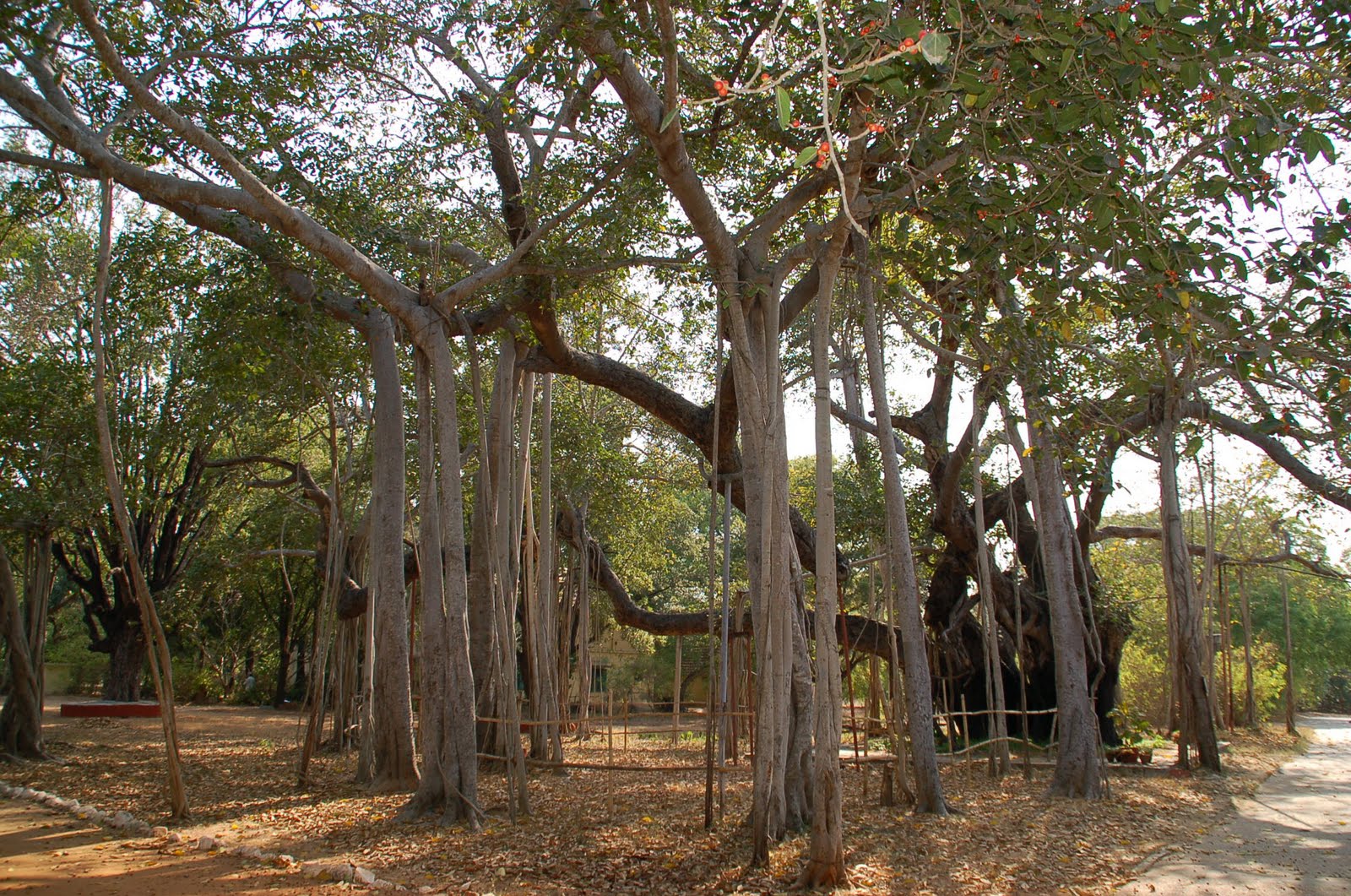
The grounds of the Theosophical Society’s complex are extensive with plenty of room for this ancient 450-year-old banyan tree to grow. Under its spreading branches Mahatma Gandhi, Maria Montessori, and of course Krishnamurti have given discourses.
The Theosophical Society was founded in 1875 by Helena Blavatsky. Theos is the Greek word for god or divinity and sophia means wisdom. The intention was to encourage humanity to understand the unity of all life, the perennial wisdom underpinning all religions and to live from that understanding.
One of its goals was to find someone they could prepare to be the World Teacher. To further this goal, Annie Besant, the leader of the Theosophical Society, organized the “Order of the Star in the East” to prepare for his coming.
Charles Leadbeater, a prominent member of this organization, spotted Jiddu (J) Krishnamurti and his brother, Nityananda, playing on the beach in front of the Theosophical Society Headquarters. He saw something special about the boys, and he arranged with their father to take charge of their education. Subsequently, Annie Besant took the brothers to England to further their studies. Remarkably, J. Krishnamurti reached a profound understanding of reality, of consciousness – in fact, became enlightened – whether because of, or despite being prepared to be the chosen one.
When the time came to declare J. Krishnamurti the World Teacher, he completely rejected the whole concept – very publicly – at a large gathering of the Society’s membership in the Netherlands. He was 29 years old. Below is an extract from his speech that day.
“I maintain that Truth is a pathless land, and you cannot approach it by any path whatsoever, by any religion, by any sect. That is my point of view, and I adhere to that absolutely and unconditionally. Truth, being limitless, unconditioned, unapproachable by any path whatsoever, cannot be organized; nor should any organization be formed to lead or to coerce people along any particular path. If you first understand that, then you will see how impossible it is to organize a belief. A belief is purely an individual matter, and you cannot and must not organize it. If you do, it becomes dead, crystallized; it becomes a creed, a sect, a religion, to be imposed on others.” (The whole speech can be read by following this link: Krishnamurti: Order of the Star Dissolution Speech · 3 August 1929)
J. Krishnamurti did in fact become a World Teacher, traveling tirelessly and sharing his wisdom and understanding of the pathless path. His work continues through the schools he founded, the study centers and, most importantly, his books, talks, and dialogues.

J. Krishnamurti on the beach in Adyar in the 1980s – the very beach where he was “chosen” when a child in 1909. (© Courtesy of the Krishnamurti Foundation Trust)
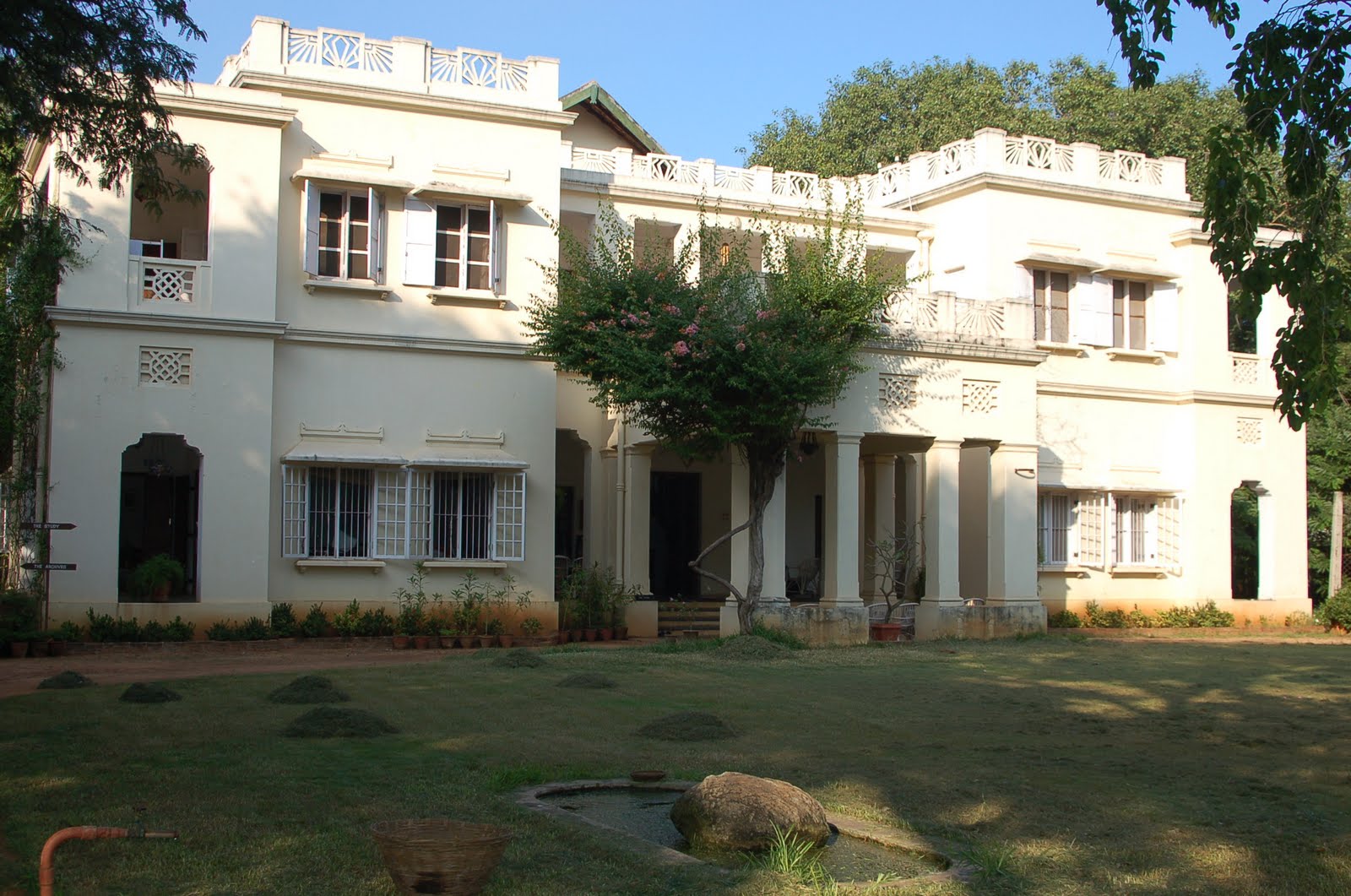
Vasanta Vihar, the headquarters of the Krishnamurti Foundation India, where Krishnamurti lived when in Chennai and where he gave talks in the garden. In fact, he gave his last talk in the garden here. It is also a retreat and study center.
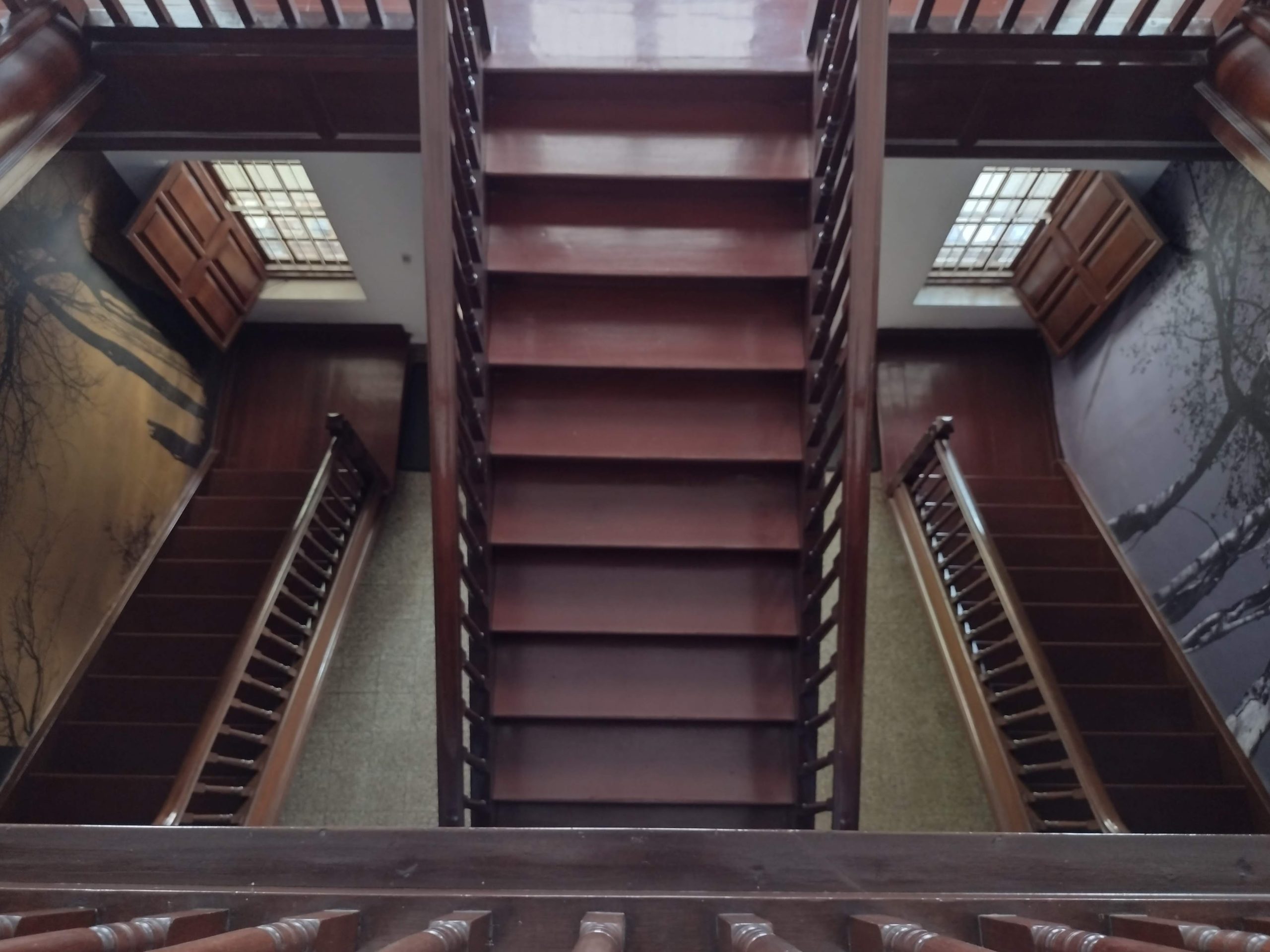
The interior of Vasanta Vihar. Stairs leading to the library.
When we returned to Vasanta Vihar the next day, we were given the most perfect little flat. Chai was prepared by the cook for early risers and meals were scheduled at regular intervals. Conversation over meals was riveting – we chatted at length with people who had been with Krishnamurti for years. We spent our days in the Study Center browsing through his books in the library, watching a film of his life, and immersing ourselves in his teachings. The sacred feeling of his presence permeated house and garden. Both Purushottama and I found ourselves strongly affected by his book entitled The Flight of the Eagle.
Early one morning, I took myself and my chai to the garden to sit and sense this place where he had sat and given talks. It was lovely; but there had been a recent flood, and the mosquitoes had to be seen to be believed. They ate me alive!
(When we eventually returned to the States in 2007 and I was again working as a registered nurse, I would get home earlier than Purushottama and for a time, listened to the talks between J. Krishnamurti and Dr. Alan Anderson, a professor at the University of California, San Diego. It was so beautiful to feel the loving presence and friendship that suffused their conversation and how helpful and supportive Krishnamurti was of Dr. Anderson’s teaching and insights. The pauses are so poignant.)
It was the following year that a lovely young woman living in Ajja’s Ashram in Puttur, Karnataka (more on that story in Part 2), informed us of a Meher Baba Center in Chennai, The Temple of Silence, where he had planted a bodhi tree. We made our way there and found three remaining siblings of the family Meher Baba used to visit. They are still living in the house – elderly by this time – but so loving and welcoming. We also spent time with the tree. These blessed bodhi trees; what they hold and nurture and share.


L+C: The Temple of Silence. On the blue box you can read, “Don’t worry, be happy,” and “Every heart is my temple.” R: Meher Baba planted the tree in the 1950s and subsequently visited it several times. Here he is in its embrace.
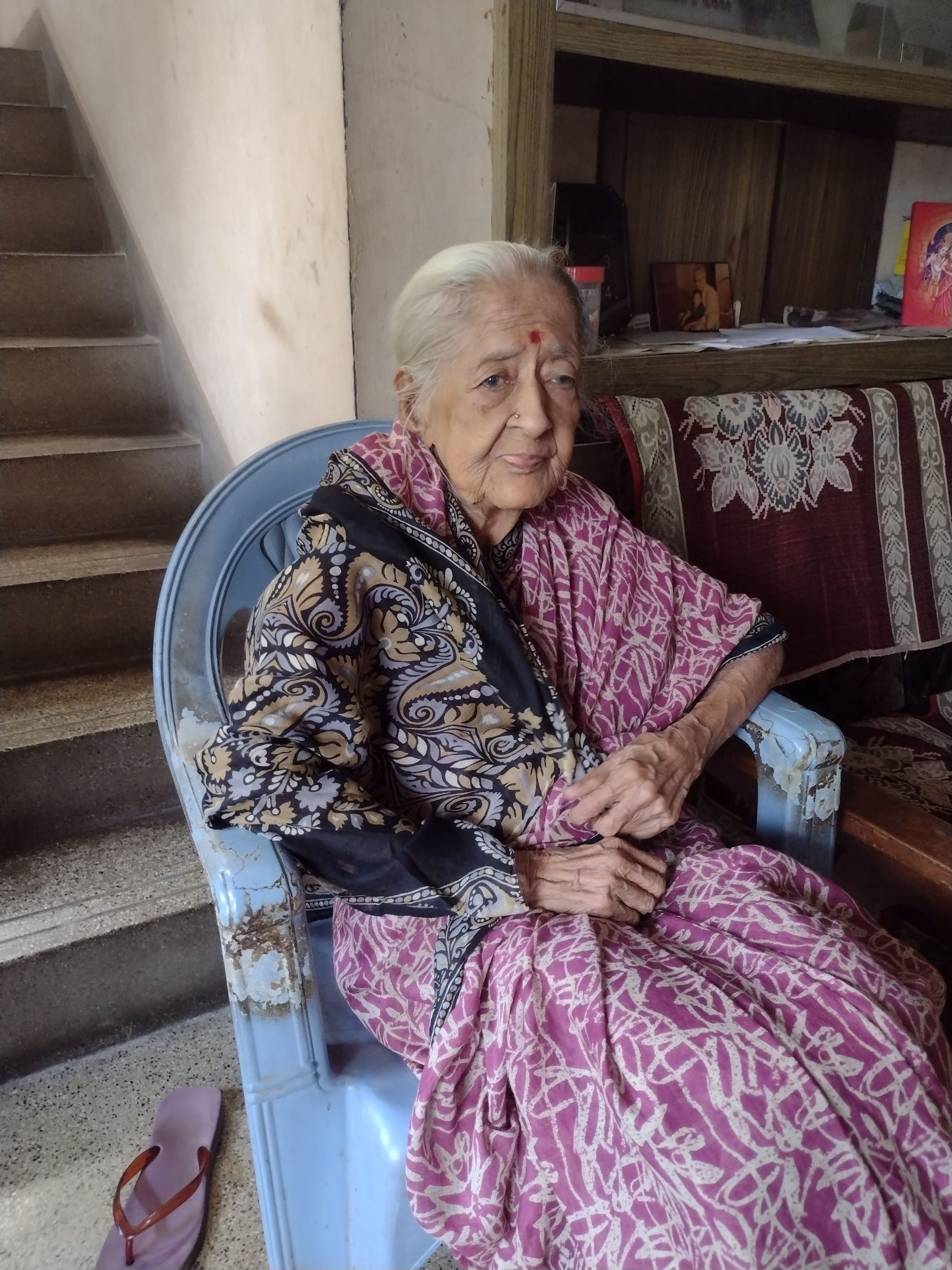 And because this is a never-ending story and, therefore, tends to spiral around and revisit former and future haunts, I am going to jump forward to the next visit to Chennai – in 2023. We returned to the house only to find it in a sorry state. The tree was still alive but had been brutally pruned. It saddened our hearts.
But joy of joys, the youngest sister (in photo, now in her eighties?) lived in a flat across the street and invited us in. She shared stories of growing up in Meher Baba’s loving grace and gave us each a book about The Temple of Silence. The last of the three siblings. Still totally in love with Meher Baba. Still sharing her heart and her beautiful presence.
Her son had finally persuaded her to come and live with him in Bombay. She was leaving imminently. We were so lucky to catch her. After we left, we heard someone running after us and calling out; she had sent her caregiver to give us prasad.
Not far from The Temple of Silence, is St. Thomas Cathedral Basilica / San Thome Church, yet another of Chennai’s treasures. It is located in the San Thome neighborhood and built over the tomb of St. Thomas (the apostle) who is considered to have brought Christianity to India. There is some uncertainty about the exact details of his history in India. After all, it happened more than 2,000 years ago. Traditional accounts of the Saint Thomas Christians of India state that “Apostle Thomas landed in Muziris (Cranganore) in present-day Kerala in 52 CE, and was martyred in Mylapore, near Madras [Chennai] in 72 CE.” (Thomas the Apostle – Wikipedia)
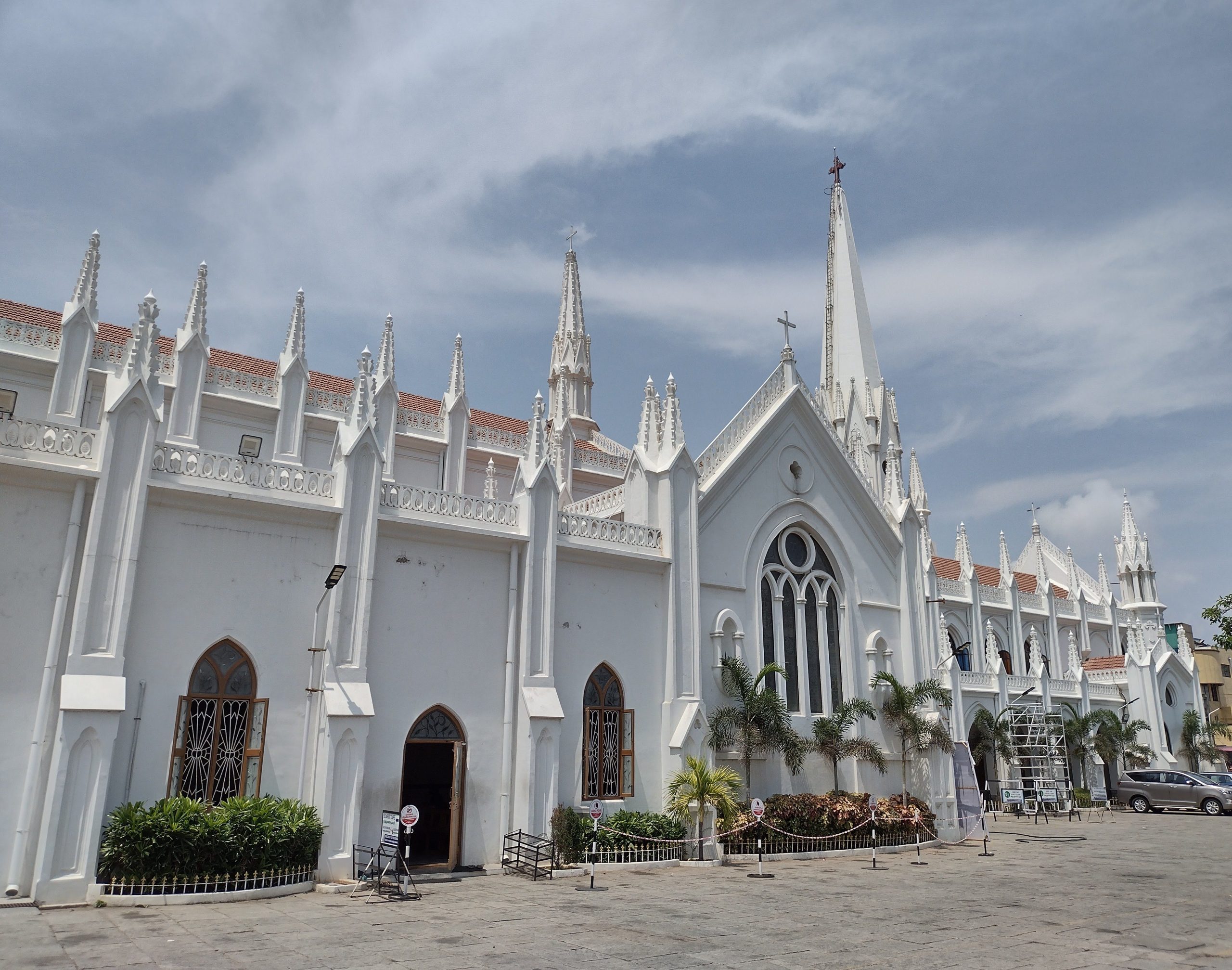
A magnificent structure gleaming white in the strong South Indian sun. This particular iteration of a church on this site was built by the British in 1896. The first church was built in 1523 by the Portuguese.
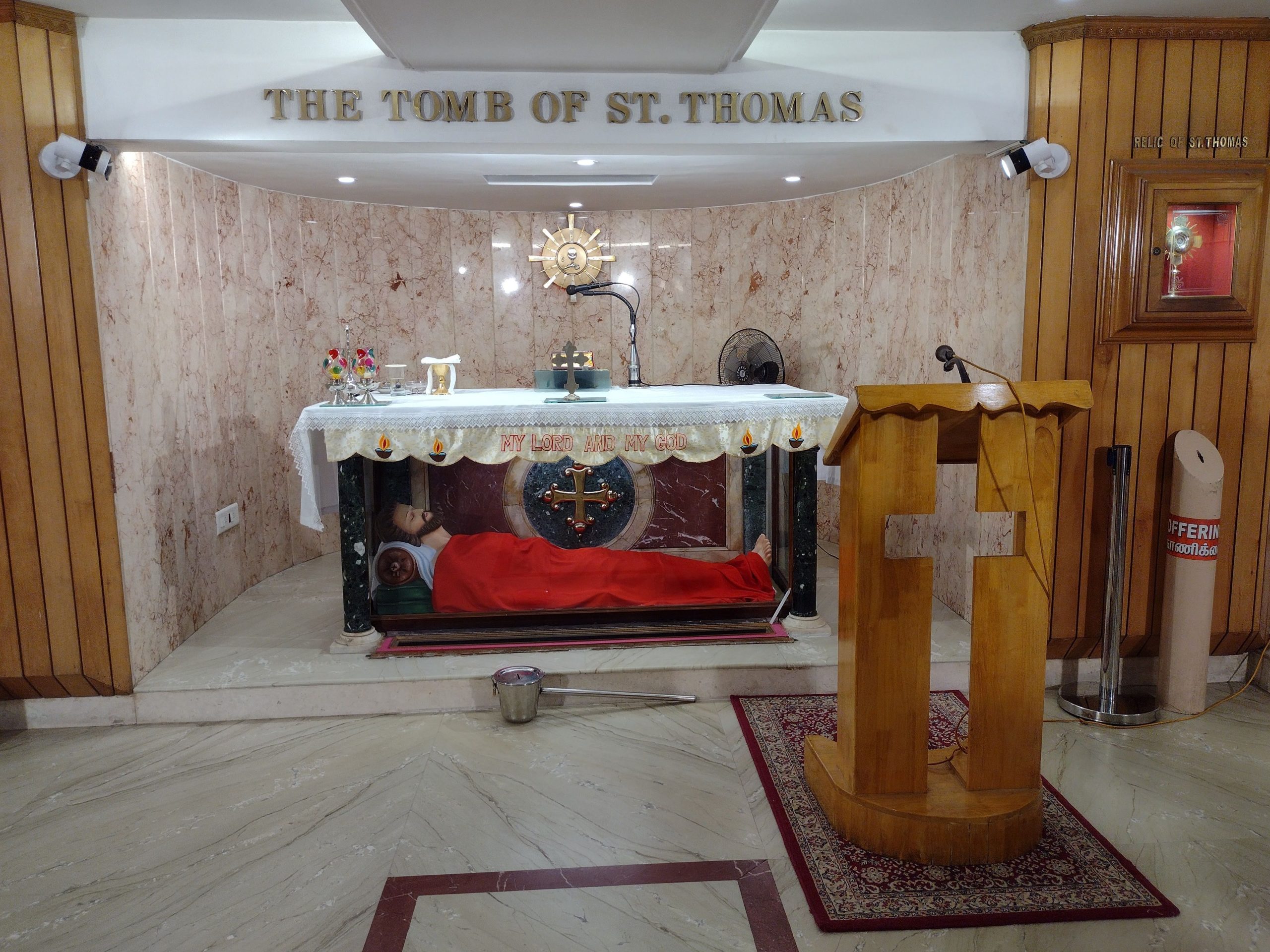
The tomb of St. Thomas. A religious service was in progress when we visited this section of the church. We stayed until it was over in order to take photographs and to be here in stillness and silence.
From Chennai we hopped, skipped, and jumped down the coast by bus and train stopping here and there to marvel at the scenery…
Tiruvannamalai
…until we arrived in Tiruvannamalai to imbibe the presence of Ramana Maharshi. We had the good fortune to meet – quite by accident – some friends from Pune here, some attracted by Ramana Maharshi and a variety of teachers of various depths. Tiru is something of a magnet for both spiritual teachers and seekers.
Traipsing in the cool of the morning to the early meditation and distribution of prasad… then evening meditation in the main hall… chanting… trying to silently enter the Meditation Hall for silent sitting (only to be foiled by the screen door)… wandering the grounds to see his room… read stories of those he had helped to achieve… visiting with some of our friends who have become a part of this ashram… and behind it all the mountain, Arunachala, adding to the grace and mystery of Ramana Maharshi’s life. Similarly with Krishnamurti, it was Osho through his discourses who had introduced us to Ramana.
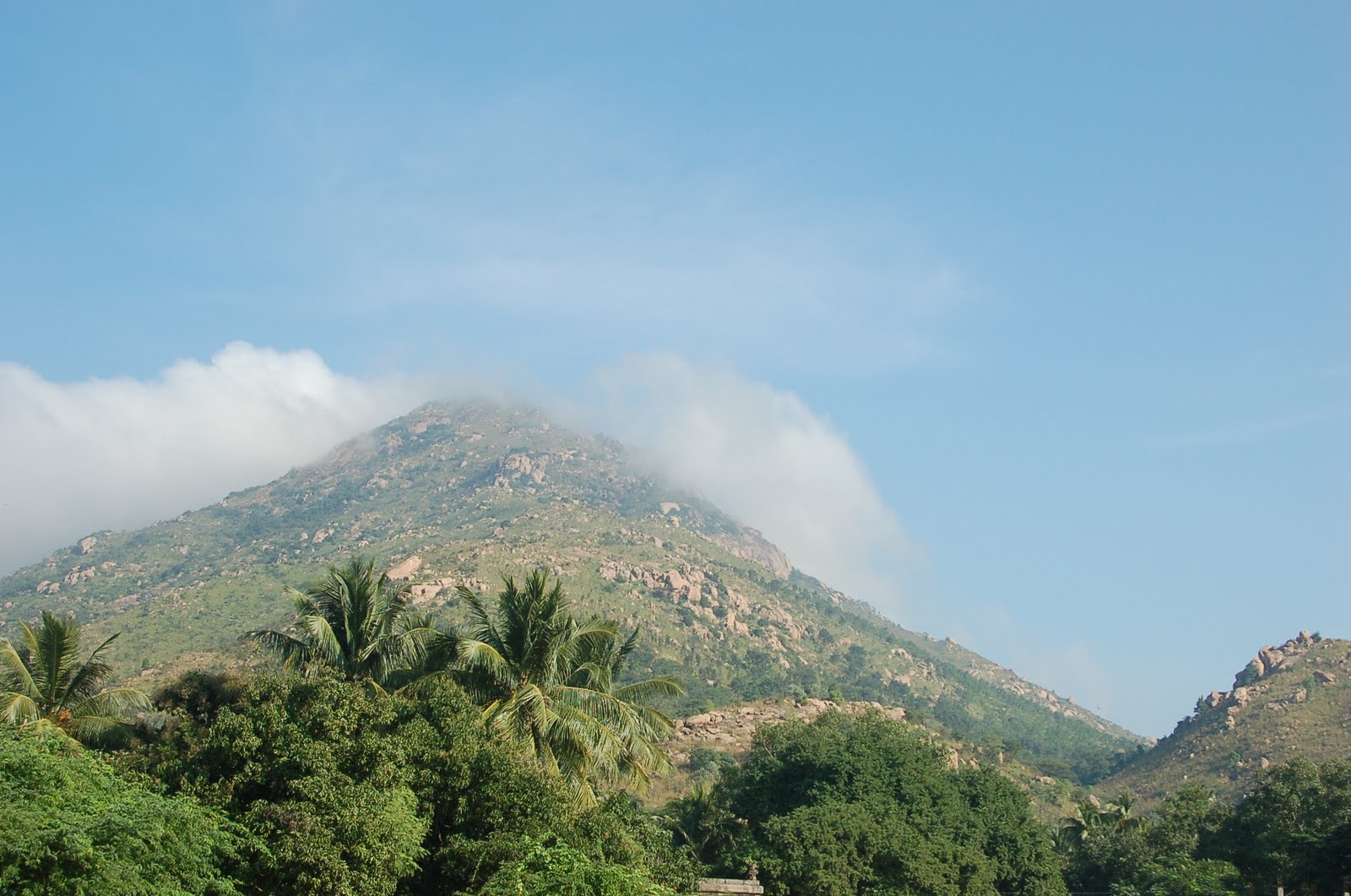
Arunachala played a significant role in Ramana’s life. He referred to it as the heart of the universe.


Ramana Maharshi lived for a short time in this small room in the Arunachalesvara Temple (also known as the Shiva Temple). He was pestered by rodents, insects and mischievous boys until rescued by Sri Seshadri Swamigal who recognized that he was lost in the Self, the whole, in Bliss. To this day, lovers of Ramana Maharshi sit outside this small cellar-like room to absorb his presence.
For many years Ramana lived in different huts or caves on the slopes of Mount Arunachala.


L: Virupaksha cave, named after the sage whose samadhi lies within, provided Ramana with shelter for seventeen years. R: These stairs lead to Skandasramam cave, another of Ramana’s places of refuge.


L: Alagammal is the name of his mother. Her Samadhi is here. She became enlightened through Ramana’s grace. Sometime after her passing, Ramana moved to this shrine, until the Sri Ramanasramam came into being around him. R: On the eastern slope of Arunachala, looking out over the Shiva Temple complex below.
Madurai
And our final destination in Tamil Nadu was Madurai. A holy city with a rich spiritual and cultural heritage. It has a one of the largest Hindu temple complexes in the world and attracts millions of pilgrims every year. Ramana Maharshi was born in a village not far from Madurai. He moved there to live with an uncle after his father died when he was twelve years old.
Mount Arunachala always had a fascination for Ramana Maharshi. In his mid-teens “a longing arose in him to emulate the spirit of renunciation and devotion that constituted the essence of saintly life.” When he was sixteen or so, and at home alone, he had a transformative experience. He was overcome by a profound fear of death and took the opportunity to deeply explore physical death. He went beyond his fear, and through this, he realized that he was deathless.
His life at his uncle’s – going to school, studying – seemed increasingly meaningless. He felt drawn to Arunachala, so he secretly left his home and took a train to Tiruvannamalai.
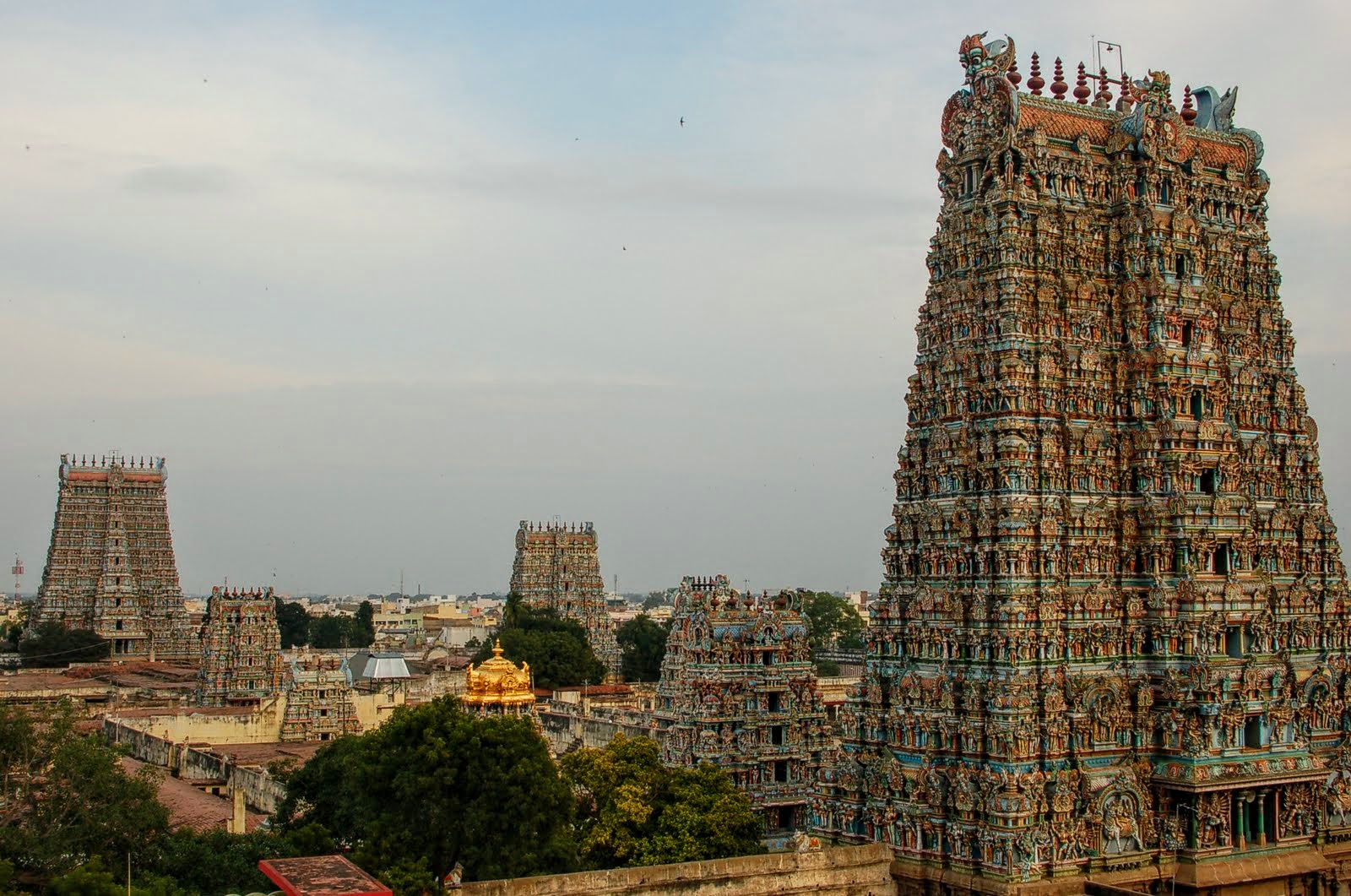
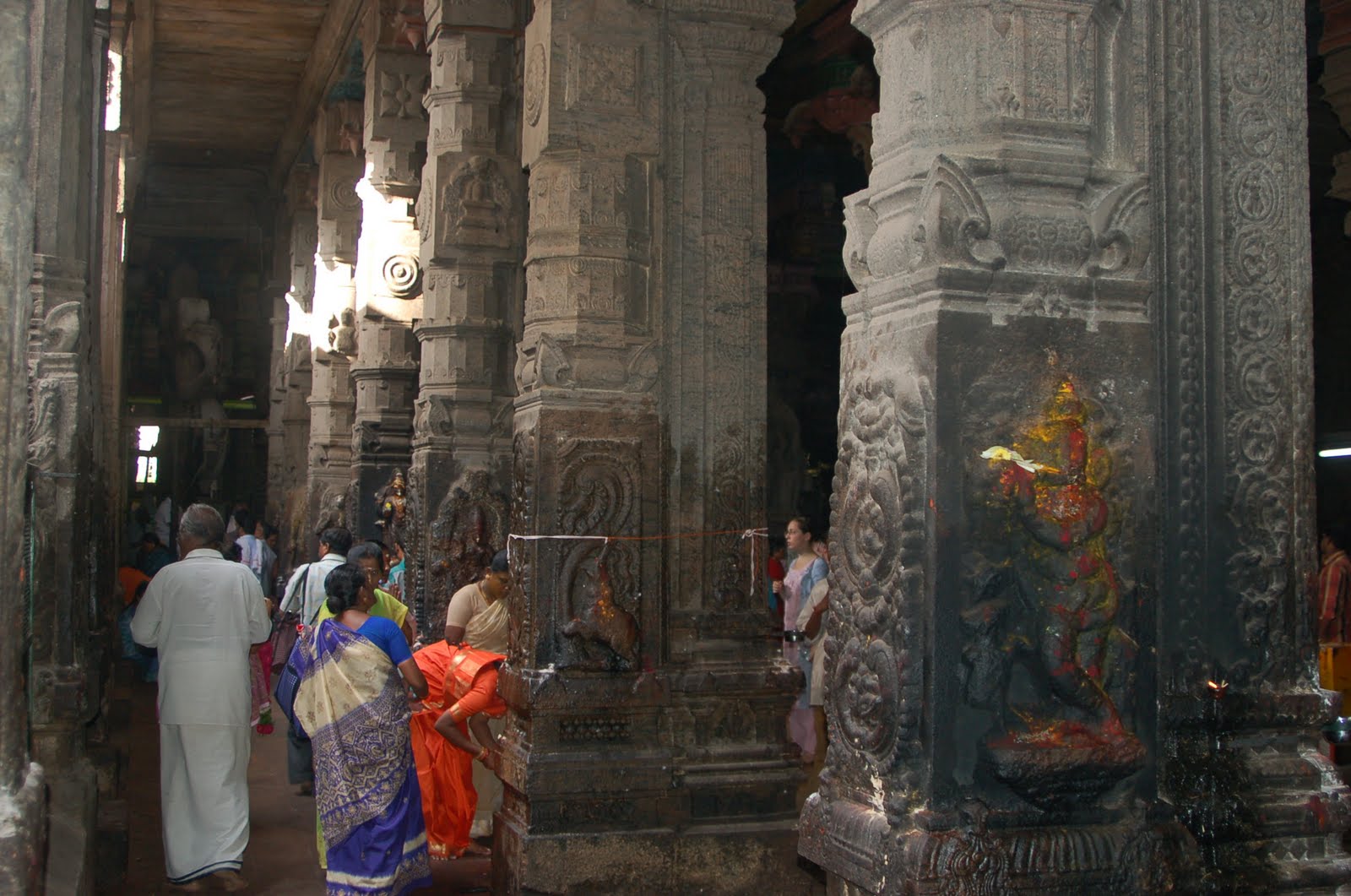
The Meenakshi Sundareswaran Temple in Madurai is dedicated to the goddess Meenakshi (a form of Parvati) and her consort Sundareswarar (a form of Shiva). It dates from the sixth century CE and is a vast complex of several concentric enclosures with huge stone walls – big enough to allow a living elephant to walk around inside! The temple elephant’s name is Parvati. We saw her but sadly no photo.


L: There are many alcoves with statues and in this case a shiva lingam. Ramana Maharshi visited the shrines of this temple daily after his experience of death and deathlessness. R: The colors of the saris, the women sitting together with their uniform braids, the men standing apart, and then the light showering on them from the sun god… who could resist trying to capture this moment on camera.
As we reflect on this journey from Kolkata, we feel showered with light. And there is so much gratitude for the people we met, and the places visited that retain something of the fragrance of those who tirelessly shared their understanding.
We traveled by bus across the country to the west coast and then northward… and the inner and outer exploration continues…
References
- Madagascar: A journey through time | Osho News
- Poverty in Kolkata: Political Unrest, Loss of Industry
- The Theosophical Society
- Photos of J. Krishnamurti
- Thomas the Apostle – Wikipedia
- Life of Sri Ramana Maharshi
- Meenakshi Temple – Wikipedia


Comments are closed.