

Arpita talks to Punya about her time working in the sewing room making Osho’s robes and shoes and more… (Part 1)
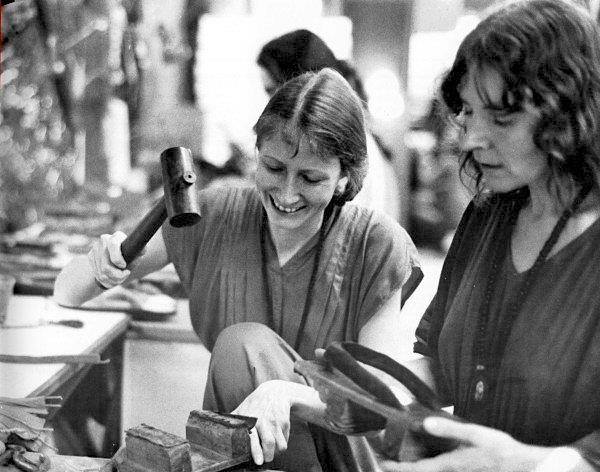
I would like to hear your stories about you making shoes for Osho. Why were you chosen? Had you been involved in designing clothes or shoes before?
Well, I don’t think I was chosen. It just happened.
This must have been beginning of 1978. I had just come back from a three-month turnaround abroad and was sitting on the bidi wall across from the ashram gate. There I met Asheesh, who was the boss of the mala shop, and also my friend, and asked him if they needed more workers. He said to me, “We don’t have any vacancies; we don’t need anybody right now.” But then – I could feel there was something hanging in the air – he added, “We have just started making sandals. You could work there.”
My immediate response was, “Absolutely YES!” There was even more of a yes for that than for the mala shop. They did not only make malas but also jewellery, musical instruments, inlay woodwork, boxes that were given as a present from Osho. I’ve been a shoe freak all my life and hadn’t even known they were making sandals!
Then Asheesh asked, “Well, when do you want to start?” My reply was, “Now.” I was utterly ready. It must have been during lunch break, so he said, “Well, I appreciate your vigour, but how about tomorrow morning?”
It was quite unusual that one could go and chose one’s job.
Yes, very unusual. But as I knew Asheesh, I checked in with him. And that’s how it came. And at that time things didn’t always go through the main office.
During my first year I had done the usual commune jobs; cleaning toilets, kitchen and various other jobs like that. But on my return I thought, “I am ready for something else, for a different kind of work.” I asked myself, “Where would I like to go?” And “I’d like to go to the mala shop,” came as an answer.
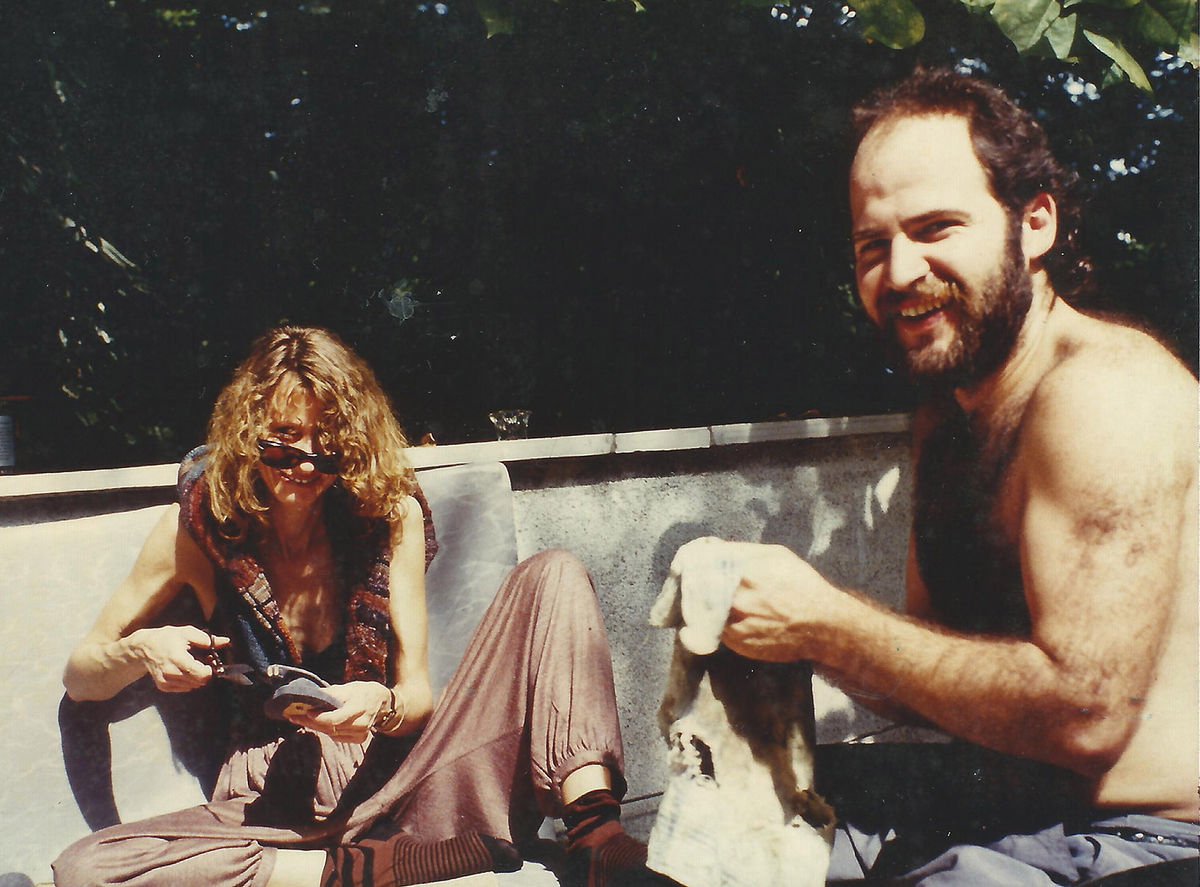
Would you want to describe the sandals you made? What did they look like?
When I joined, it was very very fresh. They had started only four weeks before. So it was all still in an experimental stage and the sandals hadn’t been fully developed yet.
As some people might remember, the first sandals were made with little slats made from bamboo. We literally had to split the bamboo to make these slats. They were no more than a centimetre wide. The bamboo, being round, gave each slat a little curve. The slats were then glued onto hessian cloth first and then onto rubber; and holes were drilled for the straps. It was all still pretty experimental because the glue didn’t work or the slats came off again. People constantly came back with, “Hey, one of my slats has come off.” So we were always trying to improve on our design. I remember that my passion for design became totally alive.
What were the straps made of?
It could have been that already the first model had velvet straps. I remember that we put foam inside and the foam was wrapped in plastic, so that if the sandals got wet the straps wouldn’t soak through. Then this plastic sausage had to be inserted into the velvet tube. In the middle we added a tiny toe strap, and the three ends were then inserted into the holes of the bamboo sole. The complete thing was then glued to the rubber sole. There were a lot of little details to make the sandal comfortable to wear, and at the same time durable. We experimented a lot and I dived right into it all.
When I saw that these slats were always coming off, I thought, “OK, this needs some improvement. What else can we use?” And as I said, my creativity was just flying… I loved the sandals with the tatami-like matting that came out of Japan. The foot is more square, you might remember. But the problem with those was that the sole was very soft. If you wore them for a week the whole sandal lost its shape. Moreover, if you had wet feet – when you came out of the shower or during monsoon – the matting would rub off in no time because it was very fine and thin. Then I thought, “Wait a minute, we have a lot of matting here.” We all know these mats, they look like beach mats with a cotton piping around, but they are much stronger. In India we have them on floors and walls. “I am going to try that!” So I experimented with this material, modified the shape of the sandal and made the patterns for all the different sizes.
Were the sandals then sold in the main boutique?
First people came around to the mala shop where we took their foot print and actually made a pair for them individually. But later on, when our sandals became very popular we went into full production with 5-6 people working six hours a day. We had various sizes for men and women with different colours for the straps, and then they were sold in the main boutique.


Do you know that if you Google ‘Osho Sandals’, they are still being produced and sold in India?
Yes, I know. And the original design was mine!
When we came back from America in 1987 they were on the market. It had taken them all that time to imitate them, although usually they were very fast in copying an idea that would make money. Some of the sandals that are sold today are exactly the same shape that I had designed. I had to laugh when I first saw them.
Did you study fashion design before you came to India?
No, but I used to design and sew my own clothes. For my second stay in India I had even brought a sewing machine with me. It was a tiny Elna, a travel sewing machine that had newly come on the market; it was the first of its kind. It just fitted in my little luggage bag. I brought it with me without knowing that I was going to use it that much. I remember when I first started with the sandals I kept saying, “OK, I can experiment with so many different fabrics,” because I had my sewing machine. Even at night, at home, I’d be bent over the sewing machine trying things out. I was on fire!
When were you asked to make Osho’s shoes?
Somehow, some plasticised material came to us; it was comfortable and nice and not sweaty. It was still early days for that kind of fabric. Asheesh and I then had the idea to make a pair of sandals for Nirvano’s birthday out of that, with a bit of an eye on Osho, because we knew that he was going to see them. We made them in the shape similar to the Japanese sandals that Osho was wearing. He, of course, saw them, really liked them and said, “I want one of those.” Our little trick had worked! That’s how I started to make the first sandals for Osho, and more followed…
Did you go and see Osho personally or did the message come through Nirvano?
Originally the messages always came through Nirvano, but I once or twice went in to see him personally to check how the sandals fitted.
Did Nirvano give you the measurements or did you see Osho in person?
I told Nirvano exactly how she should take the measurements, so that we would get it right. Afterwards there were many messages coming from Osho through her about how to improve the fit and the comfort. He often brought in his own ideas, which sometimes worked and sometimes not. And I remember once being asked to go to his room for a personal fitting.
Did you make different designs for Osho?
We didn’t stay with that plasticized fabric. I think there was only one model of that. We then got some fabric from America that was also very new, a velvety fabric; it was basically fake suede. It was available in black, dark blue and white at that time. And then more colours became available when we were in America.
To be continued…


Comments are closed.