

In this article, Marga explores Ra’s approach to the six lines in Human Design, examining the first three lines in depth and their role in shaping relational behavior

Introduction
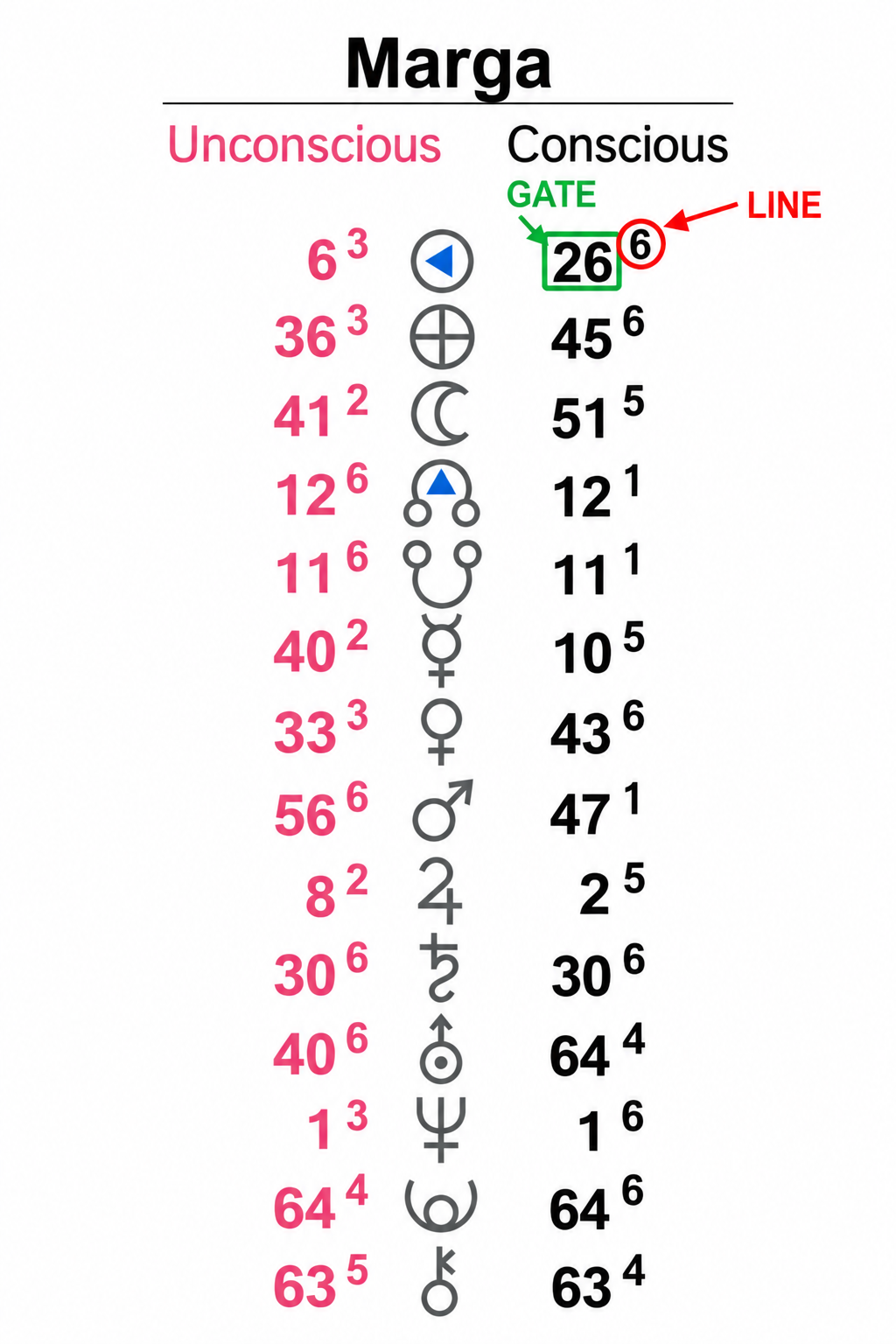 Each Gate in our chart expresses itself not only according to the particular number it carries, but also, and to a great extent, according to the line it bears.
In a Human Design chart, each activated Gate is identified by a number followed by a decimal point and another number, from 1 to 6. The number before the decimal point identifies the Gate, while the number after the decimal point identifies the Line. For example, in 45.3, 45, Gathering Together, is the Gate and 3 is the Line. You can find both numbers next to the planetary symbol in the columns that are usually on either side of your chart.
For example, in my chart I have Gate 26, Accumulation, with the 6th Line. I usually relate quite well to everyone I meet who has also Gate 26 activated, regardless of their line, but I will certainly resonate more with someone who has a different Gate but shares my line, for example, 18, Improving, with the 6th Line (see picture above). This illustrates just how important the lines are in relationships, often creating a deeper resonance than the gates themselves, because the lines represent a common underlying theme in how we approach life and interact with others, regardless of which gate they belong to.
This is the foundation of the study of the twelve Profiles – which will be the subject of next year’s twelve articles – where we forget everything about Gates and we only talk about Lines.
So in this and the next two articles we will explore the six lines in greater depth, as a step towards understanding how they combine to make up the twelve Profiles.
The Six Lines of Ra: An Extensive Exploration of Relational Behavior
As we have seen in the previous article, the six archetypes identified by Ra Uru Hu in Human Design are The Investigator, The Hermit, The Martyr, The Opportunist, The Heretic, and The Role Model. Each represents a distinct thematic pattern in a Gate, associated with one of the six lines of a hexagram.
Even though I don’t particularly like the choice of words for some of the lines, I do believe that this part of Ra’s work is one of the most profound and important in understanding the inner functioning of each of us, especially in relating with life, the world, and others. So I decided to delve into it. This exploration examines in depths characteristics, behavioral tendencies, interpersonal dynamics, and potential challenges in relationships, with particular attention to the ways in which each line approaches trust, intimacy, personal space, expectations, and connection.
The Structural Foundation: Six Lines, Six Different Perspectives
In Human Design, the lines describe different ways in which the underlying theme of a Gate expresses itself.
As we have seen in the previous article, the first three lines form the lower trigram of the hexagram, while the fourth, fifth, and sixth form the upper trigram. The lower trigram is associated with a more personal orientation, whereas the upper trigram introduces a greater emphasis on interaction with the external world.
Each line has its own characteristic orientation: Line 1 is foundation, Line 2 is naturalness, Line 3 is experimentation, Line 4 is connection, Line 5 is power, and Line 6 is perspective.
These differences offer a starting point for exploring relationships through several dimensions:
- How a person approaches another individual.
- What makes a relationship feel secure.
- How much personal space is required.
- How trust develops.
- How expectations influence interactions.
- How a person responds when a relationship fails to meet expectations.
- How experience changes the way relationships are approached over time.
The First Line – The Investigator: The need for a secure foundation
The Investigator is associated with foundation, research, introspection, and the need to establish a reliable basis for understanding.
The first line seeks to understand what lies beneath the surface. Rather than relying exclusively on appearances, it investigates the structure of things. Knowledge provides a sense of security because it reduces uncertainty and allows the individual to assess whether something is sufficiently reliable to support further involvement.
This fundamental orientation has significant implications for relationships.
Knowledge as a prerequisite for trust
For The Investigator, trust is closely connected with understanding.
In an interpersonal context, this can manifest as a desire to discover who another person really is, what motivates them, how consistently they behave, and whether their words correspond with their actions.
The Investigator may want to understand the background of a relationship before committing to it. Questions, conversations, observation, and the gradual accumulation of information can all contribute to a sense of security.
This does not necessarily mean that every first-line person asks numerous questions or approaches relationships intellectually. Rather, the underlying theme is the need for a sufficiently solid sense of security and safety.
A relationship that feels poorly understood may generate uncertainty. A relationship that has been explored in depth may offer greater confidence.
The relationship between knowledge and vulnerability
A deeper relational question concerns the relationship between knowing and trusting.
Knowledge can provide a useful foundation, but no amount of investigation can eliminate all uncertainty about another human being. People change, reveal themselves gradually, and sometimes discover aspects of themselves through the relationship itself.
The Investigator therefore encounters an important distinction: understanding another person and controlling the conditions under which a relationship unfolds are not the same thing.
The first can support intimacy. The second can become an obstacle when certainty becomes an absolute requirement.
A further possibility is that the Investigator may feel more comfortable analyzing a relationship than exposing their own vulnerability within it. This dynamic becomes relevant when the search for security takes precedence over participation.
What happens when the foundation is challenged?
When trust is damaged, the Investigator may need to understand what happened before deciding how to proceed.
The questions can become particularly important:
- What did I misunderstand?
- Was the information incomplete?
- Did the other person behave inconsistently?
- What can I rely on now?
- Is the relationship still supported by a solid foundation?
These questions can facilitate clarification. They can also prolong uncertainty if the individual believes that every detail must be explained before a decision becomes possible.
The deeper question is whether knowledge becomes a foundation for intimacy or a condition that must continually be satisfied before intimacy can develop.
The Second Line – The Hermit: Naturalness, privacy, and the need for space
The Hermit is associated with natural abilities, an inward orientation, and the need for space in which those abilities can exist without excessive interference.
In Human Design, the second line is frequently described as possessing natural qualities that the individual may not fully recognize by themselves. Other people may identify these qualities and call upon the person to express them. This dynamic is central to the traditional interpretation of the line.
In relationships, The Hermit introduces a particularly important question: how can intimacy develop without compromising personal space?
Solitude as a relational requirement
The Hermit’s need for privacy does not necessarily indicate a lack of interest in relationships.
Solitude can provide the conditions in which the individual remains connected with their natural way of being. Time alone may be important not because the person wishes to reject others, but because they need freedom from external demands.
This creates a distinctive relational dynamic.
The Hermit may enjoy deep intimacy while resisting the assumption that intimacy requires constant availability. A partner may be important without becoming the center of every activity, decision, or moment of the day.
At the same time, Line 2 tends to favor exclusive, one-to-one relationships, not only in romantic partnerships but also in friendship. These are relationships in which mutual familiarity and intimacy allow the other person to enter the Hermit’s private space without invading it. With the right person, the Hermit can feel completely at home, as though they were alone, without needing to withdraw or protect their space. The other person’s presence does not interfere with their natural way of being; it allows them to remain fully themselves.
The distinction between solitude and rejection is therefore essential.
A person can need distance without wanting to end the relationship. Equally, a partner can desire closeness without intending to restrict the other’s freedom.
Conflict arises when these different needs are interpreted as incompatible.
The role of recognition
The second line’s natural qualities are often recognized by others before the individual fully appreciates them.
In relational terms, this can create a powerful experience of being seen.
Another person may recognize a capacity, quality, or way of being that the Hermit considers ordinary. The recognition can encourage the individual to express something that might otherwise remain in the background.
However, recognition can also become intrusive.
There is a difference between recognizing another person’s qualities and insisting that they must express those qualities whenever someone else wants them to.
The traditional theme of being called out can therefore be explored through the distinction between invitation and demand.
An invitation leaves room for a response. A demand assumes entitlement to the other person’s availability.
The tension between autonomy and intimacy
One of the most interesting relational questions associated with The Hermit is whether closeness can coexist with independence.
A partner may interpret withdrawal as emotional distance, while the Hermit may experience repeated requests for contact as interference.
Neither interpretation necessarily captures the whole situation.
The relationship requires a distinction between the desire for connection and the expectation of continuous access to another person.
The Hermit’s relational challenge, considered through this lens, is not to abandon solitude but to understand how personal space and mutual connection can coexist.
The deeper question is whether a relationship allows both people to remain themselves without interpreting every difference in their need for contact as a threat to the bond.
The Third Line – The Martyr: Experience as the basis of discovery
The Martyr is associated with experimentation, adaptation, and learning through direct experience.
In Human Design, the third line discovers what works by encountering what does not. Its knowledge emerges through practical engagement with life rather than through theory alone. Mistakes and obstacles can become sources of information that allow the individual to adjust their approach.
In relationships, this theme raises questions about change, uncertainty, and the difference between knowing what a relationship should be and discovering what it actually is.
Relationships as lived experience
The Martyr’s approach can be explored through the idea that relationships reveal themselves through participation.
Two people may have compatible values, strong attraction, and similar expectations, yet discover through everyday life that their ways of relating do not work together as anticipated.
Conversely, a relationship that initially appears difficult may develop in unexpected ways as the participants learn to understand one another.
Experience supplies information that anticipation cannot always provide.
For the third line, this process is particularly significant because adjustment is central to its thematic structure.
In a relational context, this may involve discovering boundaries, recognizing incompatibilities, revising assumptions, or finding new ways to communicate.
The meaning of mistakes
The term Martyr has a specific meaning within Human Design.
The third line’s defining theme is experimentation and learning through trial and error. The emphasis is not on suffering for another person or sacrificing oneself to maintain a relationship.
This distinction matters.
A failed relationship does not automatically indicate personal failure. It may reveal that an arrangement was unsuitable, that expectations were unrealistic, or that the participants lacked the conditions required to build a sustainable connection.
The relevant question is what the experience makes possible to understand.
At the same time, the value of experience should not be used to excuse harmful behavior or endless repetition. Learning requires the ability to recognize what an experience has demonstrated and to modify one’s response accordingly.
The tension between experimentation and stability
A relationship can be understood differently by two people.
One may see commitment as a promise to preserve continuity. The other may understand commitment as a willingness to engage honestly with the relationship as it develops, including acknowledging when something does not work.
These positions are not necessarily incompatible. However, they can produce tension when one partner interprets change as a threat and the other interprets the refusal to change as a denial of reality.
The third line offers a useful perspective on this tension because it places experience at the center of understanding.
The question becomes whether the partners can learn from what happens without treating every difficulty as proof that the relationship is doomed or every attempt to change as a betrayal.
The deeper question is whether the relationship allows experience to produce genuine learning rather than becoming a cycle in which the same difficulties repeatedly return without meaningful change.
Get your Human Design chart sent for free to your inbox: humandesignapp.com
Marga offers Human Design readings:
you can contact her on whatsapp 0091 9503332918 or margajee@gmail.com
Related articles
- Marga’s whole series on Osho News: Human Design and Relationship
- Marga’s 12-article series: Three Channels a Month
- List of links to Gates and Channels
- Marga’s monthly Transits
Featured image: photo by the author, slightly altered by the author using ChatGPT


Comments are closed.