

Sugit continues his analysis of Spinoza’s ideas, from Body-Mind to Emotions, to Freedom, and finally to his legacy: Radical Enlightenment (Part 3)
Previous
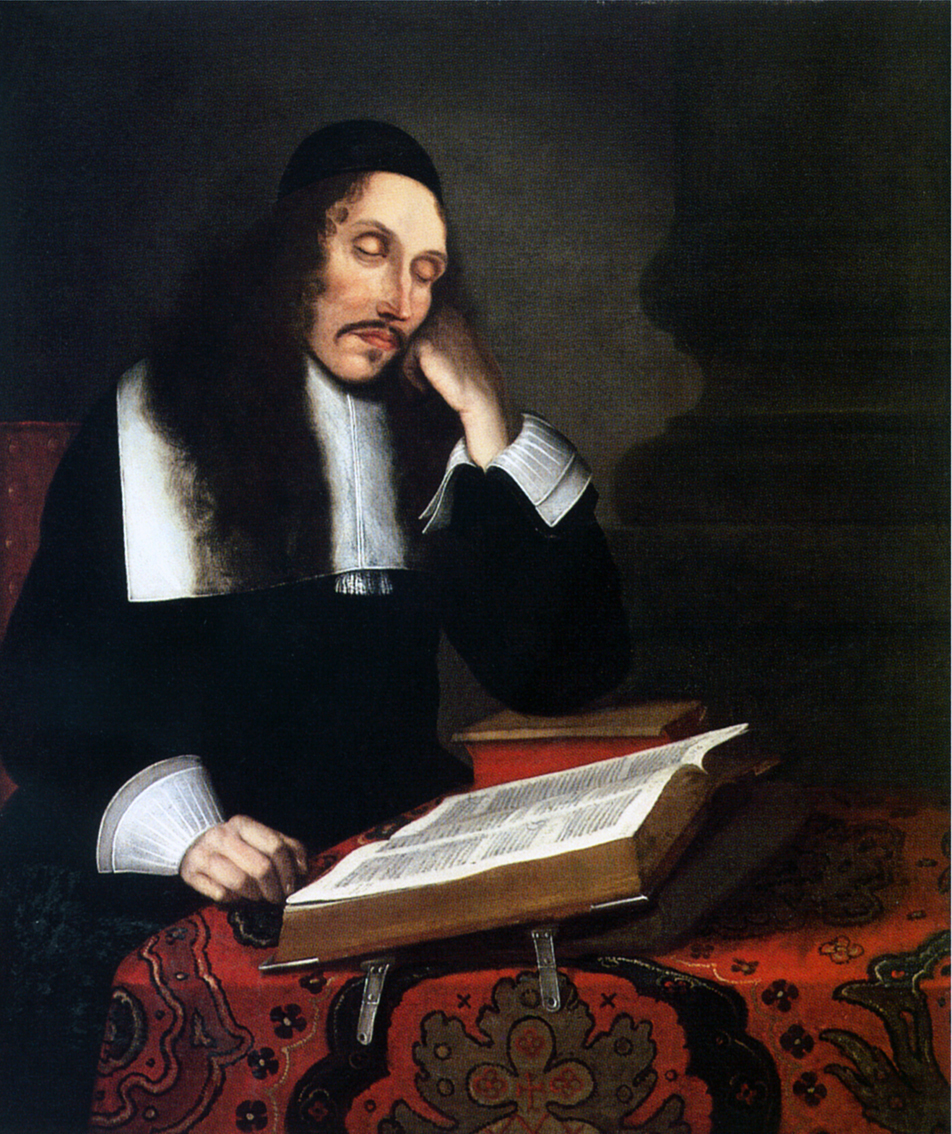
- Spinoza, a rational mystic? – Part 1: Srajan’s introduction to Baruch Spinoza
- Spinoza, a rational mystic! – Part 2: Essay by Sugit (Part A)
Body-Mind
Much of Spinoza’s theory is related to his idea about the relation between body and mind – in humans, in animals and of God. He expresses this in a very abstract way, so please allow me to paraphrase: Body and mind are intimately connected, they are in fact two aspects of the very same thing. Every movement of the body, and every change within the body, is reflected in the mind. Just as every thought has its counterpart in the body. Humans have a human mind, horses have a horse mind. (He implicates that even inanimate objects have this mind-aspect.)
So, after the unity of God and creation, this is his second advaita. This was revolutionary when he wrote it, and it is something that our present science still has not gotten up to speed with.
And it has such subtlety in its consequences. For example: you cannot know yourself, unless you are aware of your body:
The mind does not know itself except insofar as it perceives ideas of affections of the body.
Ethics, Part 2, Proposition 23
And if you are aware of anything outside your body, remember that you always perceive it through the feeling of your own body:
The human mind does not perceive any external body as actually existing except through the ideas of affections of its own body.
Ethics, Part 2, Proposition 26
Determinism…
Body and mind of course brings us to the question of freedom. Is the mind free to move the body, to do what it “wants”? For Spinoza the answer is loud and clear: no! Body and mind are one, and are governed by the physical laws of nature. Every movement has its cause, and cannot be determined by some external mind, outside of the natural laws. What governs your body’s movements, and what determines your mind and feelings is you, your essence and the interactions that you have with the outside world.
Men are deceived in thinking themselves free, a belief that consists only in this, that they are conscious of their actions and ignorant of the causes by which they are determined. Therefore, the idea of their freedom is simply the ignorance of the cause of their actions. As to their saying that human actions depend on the will, these are mere words without any corresponding idea. For none of them knows what the will is and how it moves the body, and those who boast otherwise and make up stories of dwelling places and habitations of the soul provoke either ridicule or disgust.
Ethics, Part 2, Proposition 35, Scholium
In the mind there is no absolute, or free, will. The mind is determined to this or that volition by a cause, which is likewise determined by another cause, and this again by another, and so ad infinitum.
Ethics, Part 2, Proposition 48
The body cannot determine the mind to think, nor can the mind determine the body to motion or rest, or to anything else (if there is anything else).
Ethics, Part 3, Proposition 2
There is one way in which a person can change, and that is by living under the guidance of reason. That is, understanding what is, on the one hand, coming from your essence, and seeing on the other hand where you are being pushed around by forces from the outside.
Part 4 of the Ethics is devoted to this determinism, called Of Human Bondage, or the strength of the Emotions.
[…] Again, the difference between true virtue and weakness can readily be apprehended from what has been said above; namely, true virtue is nothing other than to live by the guidance of reason, and so weakness consists solely in this, that a man suffers himself to be led by things external to himself and is determined by them to act in a way required by the general state of external circumstances, not by his own nature considered only in itself.
Ethics, Part 4, Proposition 37, Scholium 1
… and Freedom!
Then Part 5 is called Of the Power of the Intellect, or of Human Freedom.
For Spinoza, freedom is to realize that one is not identified with “inadequate ideas”, random images, emotions, outside forces, but instead is able to see what is your own truth – comparable to Osho’s “responding” versus “reacting”. Freedom is not the ability to do anything you want, but the freedom from reactions to outside pressures and irrational beliefs:
Osho, Unio Mystica, Vol 1, Ch 4
So by thinking, we cannot change anything. But by using reason and intuition (“intellect”) – we would call it meditation – we can get rid of the identification with inadequate ideas, and the resulting understanding will in fact change ourselves, i. e. our mind and body, and thereby our responses to the outside world.
Finally, I omit all Descartes’s assertions about the will and its freedom, since I have already abundantly demonstrated that they are false. Therefore, since the power of the mind is defined solely by the understanding, as I have demonstrated above, we shall determine solely by the knowledge of the mind the remedies for the emotions – remedies which I believe all men experience but do not accurately observe nor distinctly see – and from this knowledge we shall deduce all that concerns the blessedness of the mind.
Ethics, Part 5, Preface
Insofar as the mind understands all things as governed by necessity, to that extent it has greater power over emotions, i. e. it is less passive in respect of them.
Ethics, Part 5, Proposition 6
An emotion that is related to several different causes, which the mind regards together with the emotion itself, is less harmful, and we suffer less from it and are less affected toward each individual cause, than if we were affected by another equally great emotion which is related to only one or to a few causes.
Ethics, Part 5, Proposition 9
[…] Therefore, he who aims solely from love of freedom to control his emotions and appetites will strive his best to familiarize himself with virtues and their causes and to fill his mind with the joy that arises from the true knowledge of them, while refraining from dwelling on men’s faults and abusing mankind and deriving pleasure from a false show of freedom. […]
Ethics, Part 5, Proposition 10, Scholium
He who clearly and distinctly understands himself and his emotions loves God, and the more so the more he understands himself and his emotions.
Ethics, Part 5, Proposition 15
The greater the number of things the mind understands by the second and third kinds of knowledge [i. e. reason and intuition/intellect], the less subject it is to emotions that are bad, and the less it fears death.
Ethics, Part 5, Proposition 38
By the way, our discussion of freedom brings us to another crucial element in Spinoza – as in Osho’s view – namely the absolute respect for the individual. This is partly explicit, for example where Spinoza discusses the role of the state, namely as safeguarding the freedom of its citizens. But it’s even more embedded in his worldview. The affairs of the world are governed by blind natural laws. The only way things can change in a creative way is by becoming conscious of one’s own mind and body – and the bearer of that consciousness is not some collective, nor a holy scripture, but the ‘reason’ and ‘intellect’ of individual human beings.
The Emotions
Part 4 of Ethics deals largely with emotions. We cannot go into all the details within the limits of this essay, but I cannot resist including a few lines, as the quotes are so refreshing.
Spinoza writes about the full range of emotions, deriving them all from three basic ones: desire, pleasure, and pain. He describes desire as the essence of a human being (or of any thing), pleasure as a transition to greater perfection, and pain as a transition to less perfection.
Humility is not a virtue; that is, it does not arise from reason.
Ethics, Part 4, Proposition 53
Ethics, Part 4, Definitions of the Emotions, 29, Explication
The emotions of hope and fear cannot be good in themselves.
Ethics, Part 4, Proposition 47
Repentance is not a virtue, i. e. it does not arise from reason; he who repents of his action is doubly unhappy or weak.
Ethics, Part 4, Proposition 54
Meditation
When I started to feel that the real purpose of the book was not some philosophical blah blah, but authentic spirituality, there was one big question: where is the meditation? – I did not see any mention of “silence” or “beyond words” or “awareness”.
The key is, I think, the word “Intellect”, which Spinoza uses some 450 times in his works, especially in Treatise on the Emendation of the Intellect, his first book, and in part 5 of the Ethics, which has the title Of the Power of the Intellect, or of Human Freedom.
The word intellect, in the present-day English, is associated with language, rationality, logic. But in Spinoza’s time it had a very different connotation:
“During late antiquity and the Middle Ages, the intellect was considered the bridge between the human soul and divine knowledge, particularly in religious and metaphysical contexts. Thinkers such as Thomas Aquinas and Averroes explored intellect as the means by which humans engage in higher reasoning and theological contemplation. This intellectual tradition influenced both Christian Scholasticism and Islamic philosophy, where intellect was linked to the understanding of divine truth.” (Wikipedia on Intellect)
The intellect he calls the third kind of knowledge, i. e. the direct knowledge of our essence. We would call it nowadays ‘intuition’.
So, the purpose of the book is not some abstract “building world system”, although for us Westerners and for most philosophers, that’s how we see philosophy. No, it is trying to indicate a path: how can you and I find the good life? It’s a method, as Vigyan Bhairav Tantra is a method.
Ethics, Part 2, Proposition 49, Scholium
Blessedness is not the reward of virtue, but virtue itself. We do not enjoy blessedness because we keep our lusts in check. On the contrary, it is because we enjoy blessedness that we are able to keep our lusts in check.
Ethics, Part 5, Proposition 42
This is what I link to meditation, right at the beginning of part 5 of the Ethics:
If we remove an agitation of the mind, or emotion, from the thought of its external cause, and join it to other thoughts, then love or hatred toward the external cause, and also vacillations, that arise from these emotions will be destroyed.
Ethics, Part 5, Proposition 2
What I read here is that if you watch your thoughts, and see them for what they are, namely your own thoughts in reaction to outside forces, then those outside forces will cease to have that force over you. (By the way, the word “thought” in Spinoza is different from our “thought” that in common usage is always verbal. In Spinoza’s terminology, a “thought” can be any mental thing.)
An important pair of concepts is that of “active” and “passive” emotions. Active emotions originate from one’s will, which is the same as one’s essence. Passive emotions are reactions to pressures from outside. This is related to Osho’s “respond” and “react”.
I say that we are active when something takes place, in us or externally to us, of which we are the adequate cause; that is, (by preceding Def.), when from our nature there follows in us or externally to us something which can be clearly and distinctly understood through our nature alone. On the other hand, I say that we are passive when something takes place in us, or follows from our nature, of which we are only the partial cause.
Ethics, Part 3, Definition 2
How can we overcome passive emotions? By being consciously aware of them:
Ethics, Part 5, Proposition 3
There is also a link with determinism, i. e. necessity:
Insofar as the mind understands all things as governed by necessity, to that extent it has greater power over emotions, i. e. it is less passive in respect of them.
Ethics, Part 5, Proposition 6
There is actually a complete self-help book, based on Spinoza’s system. It’s written by American professor of philosophy Neil Grossman: The Spirit of Spinoza, with meditation exercises quite like we use them: “Just watch, without judgment.” Spinoza’s “to form a clear and distinct idea” he calls “second order awareness” (p. 180).
If our natural tendency is to love ourselves and actualize our own essence, then why do we do things that are actually bad for ourselves or others? How can this be? Well, of course because the devil leads us astray. Sounds convincing, because then it’s not our fault.
Again, Spinoza throws these ideas out of the window. In the first place there are no devils, and if you do something bad, then you have to search for the cause in yourself:
By the assertion of what precedes we not only wanted to make known that there are no Devils, but also, indeed, that the causes (or, to express it better, what we call Sins) which hinder us in the attainment of our perfection, are in ourselves.
Short Treatise on God, Man, and His Well-Being, Chapter XXVI, On True Freedom
Another very modern idea is that in Spinoza’s system not only your body, but also your mind, is composed of different parts. Each part can have its own “will” and its own tendency to assert itself. That is why you can do things that are against the interest of you as a whole, like old habits or addiction.
Death
Spinoza speaks about death, as far as I can see, with great subtlety, written in a very abstract way. There is certainly no heaven and hell. It has echos of Eastern philosophy, and I have not yet managed to understand everything he says. This is what it boils down to:
The human mind cannot be absolutely destroyed along with body, but something of it remains, which is eternal.
Ethics, Part 5, Proposition 23
In any case, his focus is on life, and to express this, Spinoza quotes Osho almost verbatim.
A free man thinks of death least of all things, and his wisdom is a meditation of life, not of death.
Ethics, Part 4, Proposition 67
Religion and Politics
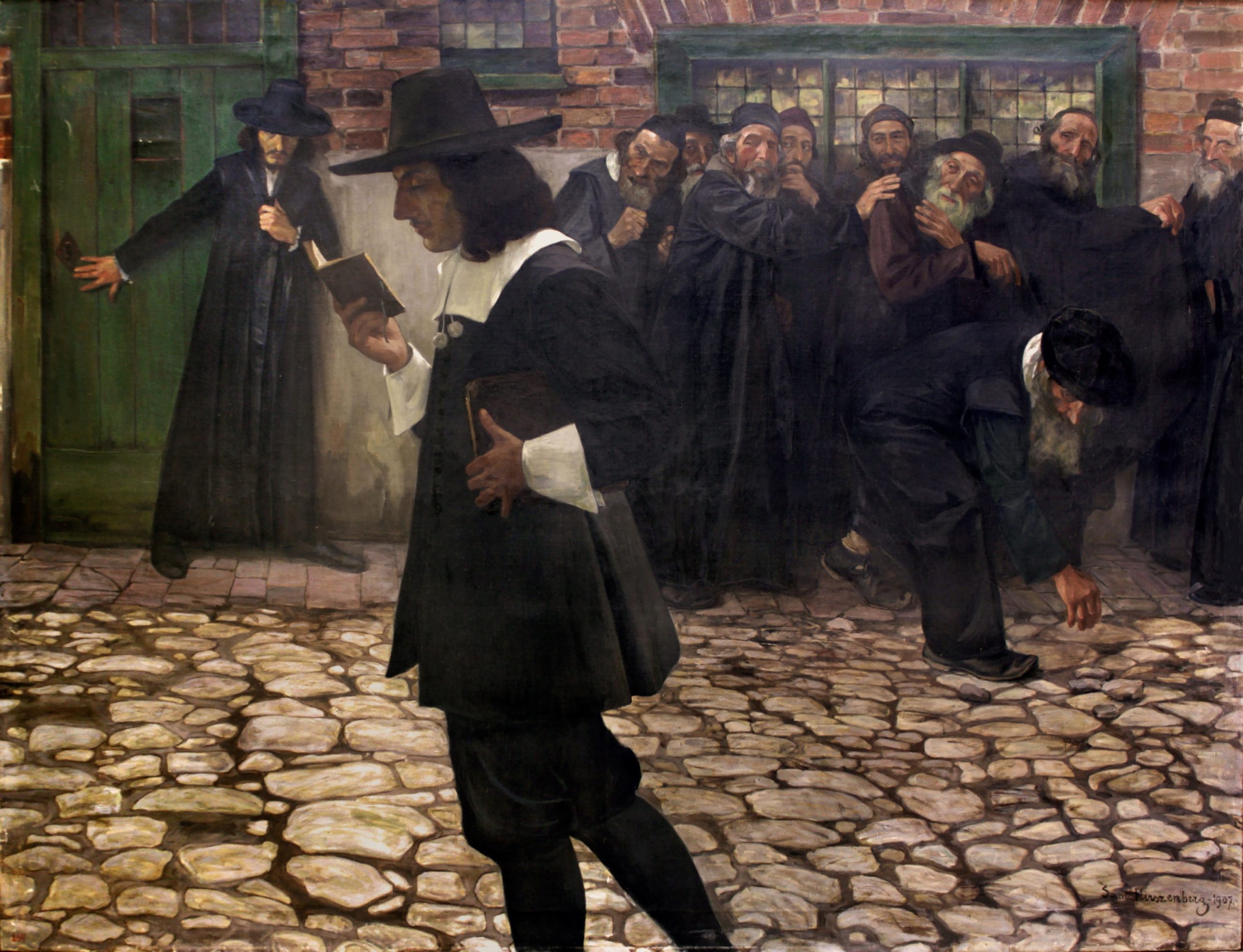
So far we have mainly looked at the Ethica (Ethics), Spinoza’s main work. But he has written several more books, about religion and politics, which have had, so far, more real impact. For instance, in A Book Forged in Hell, Steven Nadler calls Spinoza’s Tractatus Theologico-Politicus “one of the most significant events in European intellectual history” as it lays down the groundwork for ideas about liberalism, secularism, and democracy. In fact, the Tractatus Theologico-Politicus was written in response to the death of his friend Adriaan Koerbagh who had written critical texts about Christianity, and who died in prison for it.
Spinoza is not altogether negative about the ethics of Judaism and Christianity, but he regards those religions as crutches for the ordinary people who have not had the opportunity to think matters through by themselves. In his view, the goal of theology is obedience, whilst philosophy aims at understanding rational truth.
Spinoza sees Judaism as a religion with the specific aim to unify the different tribes of the Jewish people. One idea he has researched extensively – he was fluent in Hebrew – is the claim that the Bible is the direct word of God. He weighs all arguments and demolishes that idea completely. According to him, the Old Testament is a book written by human beings, each with their own perspective and goals.
He discusses his ideas of politics, i. e. the way humans can best organize themselves, so that each individual has the very best possibilities for freedom and to realize themselves.
His ideas here are again radical and modern: humans, if you leave them free from oppression, will endeavor to work together to build a democratic and just society, and he describes exactly why that is so.
On the pedestal of Spinoza’s statue in Amsterdam, it reads in big letters: “Het doel van de staat is de vrijheid” (The goal of the state is freedom).
I should add, however, that he does not explain how such a democracy could be achieved in practice, given the realities of his time. The Dutch Republic was, in fact, an aristocracy at the time. One of its most enlightened statesmen, Johan de Witt, was murdered near where Spinoza lived, and his landlord actually restrained Spinoza from going out to protest, fearing that he might also be lynched.
In any case, it may be noted that Osho likewise did not provide us with a blueprint for establishing a meritocracy.
Legacy: Radical Enlightenment
On my bookshelf I still have the book Radical Enlightenment by Jonathan Israel. The book explores the world of Spinoza’s ideas – his friends and his opponents, before and after him, across the Western world. Israel argues that Spinozism, the most radical form of the Enlightenment, was in fact the backbone of the entire movement.
Those who came after him, beginning with Leibniz, were certainly part of the Enlightenment, promoting individual freedom and science grounded in observation. But they did so in a very moderate form, especially holding on to the duality of Christian belief and accommodating the interests of the aristocracy. It is to this legacy that our thinking is still tied to today – unless we set it free.
As Spinoza shows, this is a task for each individual. That’s why he has such respect for individual humans: each person is the bearer of this possibility. In Spinoza’s reasoning, we only give up part of our freedom to the state because the state serves as a guarantor of that freedom. Yet every individual with the capacity to use “reason” and “intellect” is capable of attaining enlightenment.
I return to the question: why is God so pervasive in his system? Why not just Nature? “Nature alone” (nature seule) was the stance of the 18th-century Encyclopédistes – figures such as Denis Diderot and Baron d’Holbach, among others. It is also the stance of modern science and, indeed, our present culture.
Spinoza is very explicit – at great risk to his own life – about the corrupting influence of the churches, and the ways in which they have used their ideology to wield worldly power and thwart the emancipation of the believers. To me, this seems to prove that his motives were quite different from those of Descartes before him and Leibniz and others after him, who sought to preserve the Christian world view.
That would hardly have been possible, because Spinoza was anyhow regarded as a dangerous atheist by both the Jewish and Christian institutions of power. For centuries, Spinozism itself was a term of abuse!
Also, I think, much of Spinoza’s system could be stated successfully without reference to God or Godliness.
I am not entirely certain, but what we must recognize is Spinoza’s own intuition: the experience that life – the very fact of existence, being born out of the cosmos and, importantly, also creative actors in it – gives rise in him to a profound love for the whole.
Moreover, his system attempts to show that each individual can realize this love by using reason and intuition. In our present culture, we have freed ourselves from the corruption of church ideology, but in doing so have also thrown away something very valuable with the bathwater, namely our intuition of one-ness.
Spinoza attempts to ground his Ethics in logic and science, in a manner as cool and formal as possible – not as an idea that sounds nice, but as an expression of the necessity of nature and as a practical method to “enlightenment”. The first book he wrote, Treatise on the Emendation of the Intellect (i. e. “how to improve your intuition”), represents a similar attempt to the Ethics, but in a more personal style. It starts with these words:
[1] After experience had taught me the hollowness and futility of everything that is ordinarily encountered in daily life, and I realized that all the things which were the source and object of my anxiety held nothing of good or evil in themselves save insofar as the mind was influenced by them, I resolved at length to enquire whether there existed a true good, one which was capable of communicating itself and could alone affect the mind to the exclusion of all else, whether, in fact, there was something whose discovery and acquisition would afford me a continuous and supreme joy to all eternity.
It seems that he made a strong beginning, but powerful forces – both active and passive – stand against his ideas.
It’s now up to us!
OK, one last quote:
Cheerfulness [hilaritas] cannot be excessive; it is always good. On the other hand, melancholy is always bad.
Ethics, Part 4, Proposition 42
Followed by the proof and QED of course.
Many thanks to Sagar Mudra and Srajan for their critical comments.
Photos credit Wikimedia Commons
Related articles
- Spinoza, A Rational Mystic? – Part 1: Srajan introduces Baruch Spinoza, the 17th-century philosopher
- Spinoza, A Rational Mystic! – Part 2: Sugit compares the ideas of the Dutch philosopher Spinoza with Osho’s understanding
- Spinoza, A Rational Mystic – Part 3: Sugit continues his analysis of Spinoza’s ideas
- Seekers from the Low Lands – a four-part series of essays by Srajan




Comments are closed.