

Subhuti recalls the creation of a weekly newspaper on the Oregon Ranch
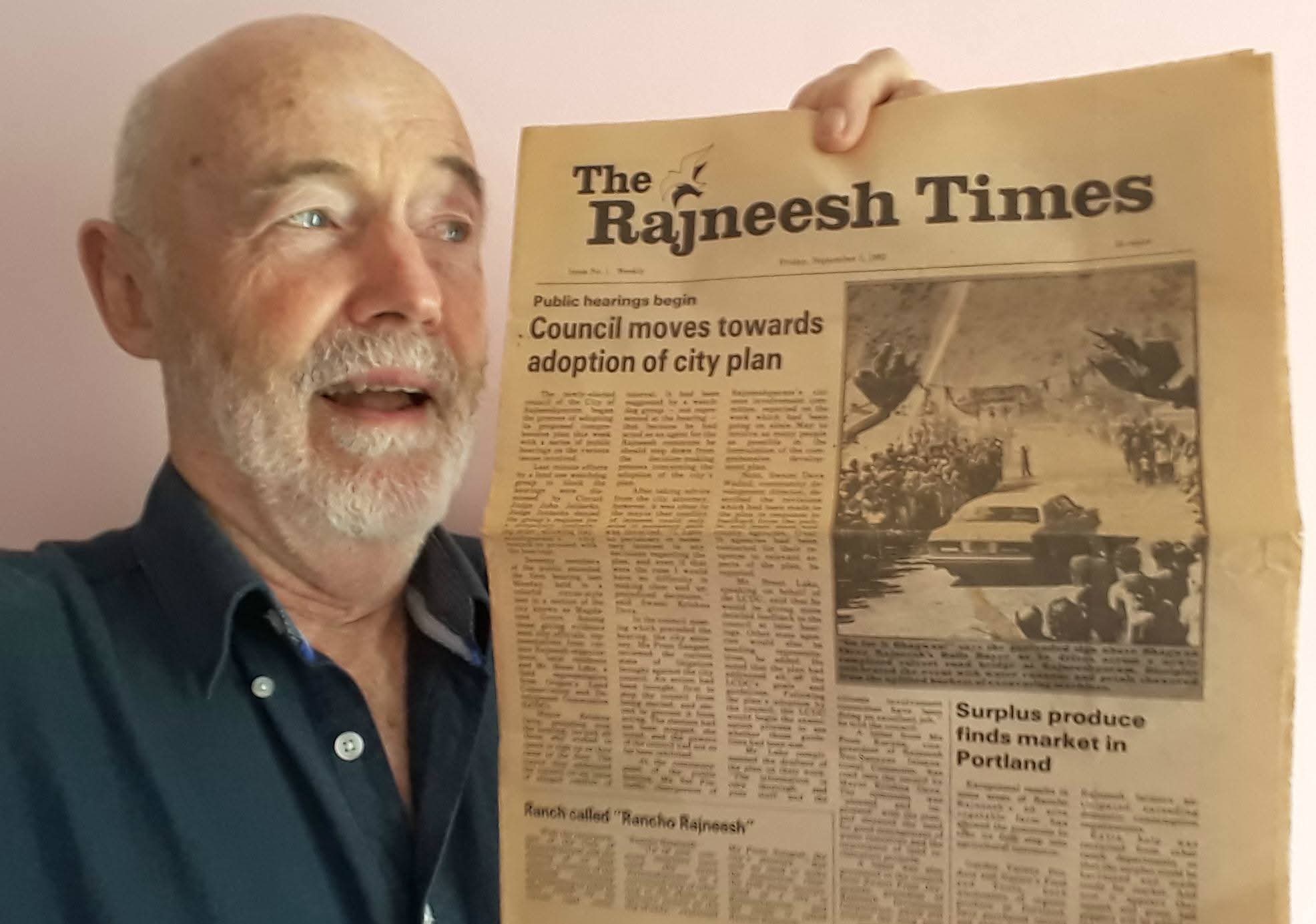
Like the Ranch community it served, The Rajneesh Times newspaper burst into life in Oregon, enjoying a short and hectic career, and then expiring abruptly when the commune fell apart.
If I remember correctly, the first issue was published on September 3, 1982, and the last issue was published on November 29, 1985, shortly after Osho was deported from the USA.
I created the newspaper, but it wasn’t my idea. It was a by-product of incorporating the City of Rajneeshpuram, which was, in turn, a by-product of our need to get as many sannyasins onto the Ranch as possible.
When we purchased the Big Muddy Ranch, it was zoned as farmland, which meant that only a handful of people could legally live there. But when we voted to change the zoning to city status… bingo! Hundreds, indeed, thousands, of people could come and stay.
Our city officials were legally required to place their announcements in a newspaper, so that’s when somebody had the bright idea, “Let’s have our own newspaper!”
Good idea. Except no one knew how to make one. No one, except a former English journalist, who, at that time, was crawling under trailer homes, bolting the two halves together and building foundations with breeze blocks.
That’s how The Rajneesh Times began. I knew, from the outset, it was going to be a high pressure, intensity-driven job, for two reasons:
1) As a registered newspaper, it had to come out every week, on time, or we would lose our official status.
2) The Ranch was a highly complex mix of legal, semi-legal, and illegal activities.
We had to write stories, take photos, check them for political ramifications and still get the paper to bed by Wednesday night each week. Thursday it would be printed in Bend, about 90 miles away, then brought back to the Ranch, and sold in the canteens that evening.
On Friday, our phones would start ringing, with calls from upset Ranch managers, complaining about all the things that should not have gone in the paper. We humorously called it “the Friday massacre”.
More time was needed to check all the stories, but that’s exactly what we did not have. So, it was always a sweat.
In the beginning, I designed a small, tabloid-sized newspaper, like the British variety. Being small, it did not require so much news to fill it – therefore less work for me.
Had I been wise, I would have kept it like that. Big pictures, small captions, lots of ads. I could have given myself a much easier time.
For example, when President Ronald Reagan came to Oregon, we managed to get a great photo of his limo passing a group of sannyasins waving an American flag and greeting him. I could have filled the whole front page with that photo, under the caption: “Hi Ron!”
When a sannyasin came top of his class at Oregon’s police academy, I could have filled the front page with his photo, saying, “Top Cop!”
But every newspaper in Oregon was printed in a large, broadsheet format, with sections, editorials, and features. I wasn’t about to be outdone. We changed to the bigger size, and by the time I was finished, the only thing we didn’t have was a sports section.
We had fun, though. When I saw a group of sannyasins riding through the Ranch on horseback, I asked them to pose for a photo. Not many people remember Zane Grey’s classic Western novel Riders of the Purple Sage, but in the 1980s an American band was enjoying success using the name New Riders of the Purple Sage.
I turned it around and, alluding to our red-coloured clothes, published the photo with the headline “New Purple Riders of the Sage”.
On another occasion, just before our summer festival, I dressed an obliging sannyasin as a cowboy and put him on horseback, high on a ridge, looking down on hundreds of tents, erected for festival goers.
“Strangers in Town?” asked the headline over the published photo.
I’d always wanted to use that corny line from old western movies. Then I added, “Nope, it’s our friends from around the world coming for the Second Annual World Celebration.”
We hadn’t been long in Oregon before someone in the news media suggested Osho was anti-Semitic. So, I gathered all the American Jews living on the Ranch, about 20–30 of them, took a photo and published it under the headline “All the Jews That’s Fit to Print”, parodying the famous motto of The New York Times: “All the news that’s fit to print.”
We also played an April Fools prank on the Oregon public. Shortly after the takeover of Antelope, we published a front-page headline: “Rajneeshnees take over Madras!” Which was a much bigger town, just a few miles away.
“It is not known if the citizens of Madras enjoyed the joke,” commented one Portland television news reporter, who clearly loved our prank.
When we started a nudist colony at Patanjali Lake, I wanted a photo we could publish without being sued or censored, so I called out to everyone lying on their sunbeds, “Okay, everyone please lie on your stomachs for a moment!” They cheerily obliged. Naturally, I also had to strip off.
We had a weekly, full-page ad on the back page saying, “I never go anywhere without The Rajneesh Times”. Sannyasins around the world sent in photos of people reading the paper in all kinds of unlikely situations: sailing in yachts, hanging off mountains, and so on.
Someone sent us a photo of Ronald Reagan as a Hollywood actor with Bonzo, his chimpanzee co-star, sitting on his lap. So, we got the designers to make it look as though Ron and Bonzo were both reading our newspaper, adding the hook line: “I never go anywhere without The Rajneesh Times.” Of course, we sent a copy to the White House.
We had outrageous political cartoons. When Dave Frohnmayer, State Attorney General, started attacking our city, we portrayed him as a Republican elephant, with a German Nazi helmet on his head, dancing in a circus.
Out of his mouth a bubble was saying: “I am not prejudiced against the Rajneeshees!” Out of his rear end, a big gas bubble declared: “Watch me stomp the Rajneeshees into the dirt and get elected governor!” The headline over the cartoon declared “Bimbo Breaks Wind!”
Our biggest story was Osho’s collection of Rolls Royces. When the number got to 21, I wrote to Osho, asking him if we could line up all the Rollers on a bridge near his home, and publish the photo in the newspaper. He gave the go ahead. That photo went around the world.
On a couple of occasions, Osho lent us a Rolls Royce to drive to Bend for printing the newspaper, driven by Vivek, his caretaker. One day, at the printers, someone sneakily slipped a note under the Roller’s windshield wiper, saying “Go back to India.” That would have been fine with me. I wasn’t a great fan of Central Oregon.
Another time, Osho sent us a personal editorial titled “Misfit Mystic” saying he did not fit into any spiritual category, any kind of religion. One of Sheela’s closest aides took offence at the editorial, called us into her office, and scolded us for insulting Osho. The expression on her face, when I told her Osho had dictated the editorial himself, was priceless!
We had a great team, including Pramod, Anudas, Zeno, Padma, Tushita, Santap, and Krishna Bharti, also known as KB, who took some terrific photos. We were an irreverent bunch and for a while devised our own form of spiritual initiation, with a secret cult called “Doobens”. Naturally, my new name was “Scoop Doobens”.
Our design studio had a great view of the Ranch’s central valley, so, whenever there was a rain shower followed by a picturesque rainbow, someone would yell “Rainbow Alert!” Immediately, we would drop whatever we were doing, run outside, stand together with our arms over each other’s shoulders, and say a lengthy “Aaaaah!” in appreciation.
After a couple of years, rather in the manner of Soviet Russia, there was a purge of older sannyasins by Sheela. It happened sometime around 1984 – George Orwell, please note the date. I was sent to drive trucks, which I enjoyed immensely.
At the end of the Ranch, after Osho left, I came back on the newspaper to publish the last two issues. It was a fitting end to a fun and frantic experience.
Previously published as a Facebook post, reprinted here with the author’s permission
Update 1.5.2026: added exact dates of first and last issues, including links below
Links
- The Rajneesh Times – sannyas.wiki
- Osho’s Rolls in the US Press – from Punya’s memoir, On the Edge (with photo)



Comments are closed.