

Marga explains how Planets can enrich and fine-tune a HD relationship reading with the help of Astrology and Gene Keys

Astrology – The Language of the Planets
In contemporary classical astrology, the planets most directly involved in relationships are the Sun, Moon, Venus and Mars, while Jupiter and Saturn add important dimensions to the way a relationship develops, expands, stabilizes or encounters limitations. The outer planets – Uranus, Neptune and Pluto – can add further layers of meaning when they form significant aspects to the personal planets.
The Sun represents identity, vitality, self-expression and the sense of self that each person brings into a relationship. The Moon describes emotional needs, instinctive responses, attachment patterns and the need for emotional security. Venus relates to attraction, affection, pleasure, values and the way we give and receive love. Mars represents desire, sexual energy, initiative, assertion and the way we pursue what we want.
In relationships, Jupiter can bring generosity, enthusiasm, growth, optimism, shared experiences and a sense of possibility. Saturn introduces commitment, responsibility, structure, boundaries and endurance. Its presence can contribute to the stability and duration of the relationship, but it can also bring pressure, limitation or a sense of obligation.
The outer planets can add a particularly powerful dimension when they are closely connected with the personal planets, for example, if Uranus, Neptune or Pluto are conjunct to the Sun, Moon or Venus.
In general, Uranus introduces freedom, unpredictability, change and the need for autonomy. With Venus, for example, it can bring excitement, unconventional attraction or a strong need for freedom within love; with Mars, it can intensify spontaneity, experimentation and the need to act independently.
Neptune introduces sensitivity, idealism, imagination, longing and the tendency to merge or transcend boundaries. With Venus, it can heighten romantic and idealistic attraction; with Mars, it can affect the way desire and action are experienced; with the Moon, it can deepen emotional sensitivity and receptivity; with the Sun, it can influence identity, idealism and the experience of self.
Pluto adds intensity, depth, transformation and issues of power and psychological compulsion. With Venus, it can profoundly intensify attraction and attachment; with Mars, it can amplify desire, sexuality and the drive for control or transformation. With the Moon, Pluto can affect emotional bonds at a very deep level, while with the Sun it can transform identity, personal power and the way one experiences oneself within the relationship.
The house placement of these planets is equally important. The house shows the area of life in which the relational principle represented by the planet is expressed and experienced. The 5th house is associated with romance, pleasure and erotic self-expression, the 7th house with partnership and one-to-one relationships, and the 8th house with intimacy, merging, sexuality, shared resources and profound psychological transformation. Other houses can be equally significant depending on the planets involved.
The next step is to compare the two individual charts. This can be done by synastry, juxtaposing the two natal charts and observing the angular relationships between their planets, or through midpoint composite charts, generating a third chart.
The essential point is that we first observe the relational structure of each individual chart – the Sun, Moon, Venus, Mars, Jupiter, Saturn, Uranus, Neptune and Pluto, their signs, houses and aspects – and then examine how these planetary configurations interact with those of the partner. In this way, we can distinguish between what each person brings into a relationship as part of their own natal pattern and what is activated specifically through their connection with the other person.
The Classic Role of Planets in Human Design
In Human Design, planets do not have the same emphasis that they have in astrology. Rather than being interpreted as symbols of psychological qualities or life experiences, they function primarily as mechanical markers that determine specific positions within the system.
For example, from the positions of the Sun, Earth and the Nodes, Human Design derives the four Variables. These four Variables provide information about four basic aspects of how we take in and process life: how we assimilate what we experience, the kind of environment that supports us, the way we see and interpret the world and the way our mind is motivated to process information.
Human Design also uses planetary cycles as markers for important stages in life. One example is the Uranus Opposition, which occurs around the age of 40–42. In Human Design, this cycle marks a change in the life direction described by the Nodes and therefore signals an important transition in the way a person experiences their path.
Another important difference from astrology is the inclusion of the Earth in the Human Design chart. Earth is shown together with the Sun and provides a grounding and balancing point within the chart. The Sun and Earth positions are fundamental to the calculation of the Incarnation Cross, which describes the main life theme expressed through a person’s chart.
Chiron is another point of difference. In the Human Design chart, Chiron is not treated as one of the regular planetary activations. Its significance becomes relevant only around the Chiron Return, which takes place at approximately 49–50 years of age and marks the completion of the first Chiron cycle and the beginning of a new phase of life.
Nevertheless, all this information is related to the interpretation of a personal chart. Its relevance within a composite chart is ultimately left to the ability of the analyst to understand and evaluate how these planetary factors contribute to the dynamics of the relationship.
Adding Meaning to the Mechanics of Gates and Channels
Within the Human Design tradition, Chetan Parkyn’s Evolutionary Human Design takes the role of the planets a step further. Drawing on his work with astrologer Carola Eastwood, Parkyn explored the planetary archetypes not simply as technical mechanisms that activate Gates in the Human Design chart, but as meaningful interpretative forces within the Human Design system.
His approach brings greater depth to the planetary layer of Human Design, allowing the planets to be read not only through the Gates they activate, but also through the qualities and archetypal themes traditionally associated with each planetary body. In this sense, Evolutionary Human Design offers an important bridge between the astrological language of the planets and their specific function within Human Design.
Being an astrologer myself, and having been a student of Chetan Parkyin, it was immediately quite obvious to me that the presence of one planet rather than another in certain Gates will give the Channels in the composite chart (as well as in the personal chart) a more or less romantic, sensual, sexual, mental, emotional or otherwise defined character.
For example, the Channel of Recognition, 41-30, defined when one partner has Venus in Gate 41, Imagination, and the other has Mars in Gate 30, Desire, will have a very different and distinctly romantic, sexual and sensual character than if the same Channel were defined by Mercury and Saturn, even though the chemistry and attraction associated with the electromagnetic connection will be present in both cases.
At this regard, as within Human Design, there is no specific characterization of the planets in themselves that differs fundamentally from that of contemporary classical astrology, the planets retain their traditional symbolic meanings. What changes dramatically is the framework in which those planetary positions are placed and interpreted.
First of all, Human Design, unlike astrology, works with two distinct sets of planetary information. The first set corresponds to the moment of birth and represents the Personality, or conscious side of the chart (in black color in the image). The second set is calculated approximately 88 degrees of solar arc before birth, corresponding to roughly three months earlier, and represents the Design, or unconscious side of the chart (in pink color in the image).
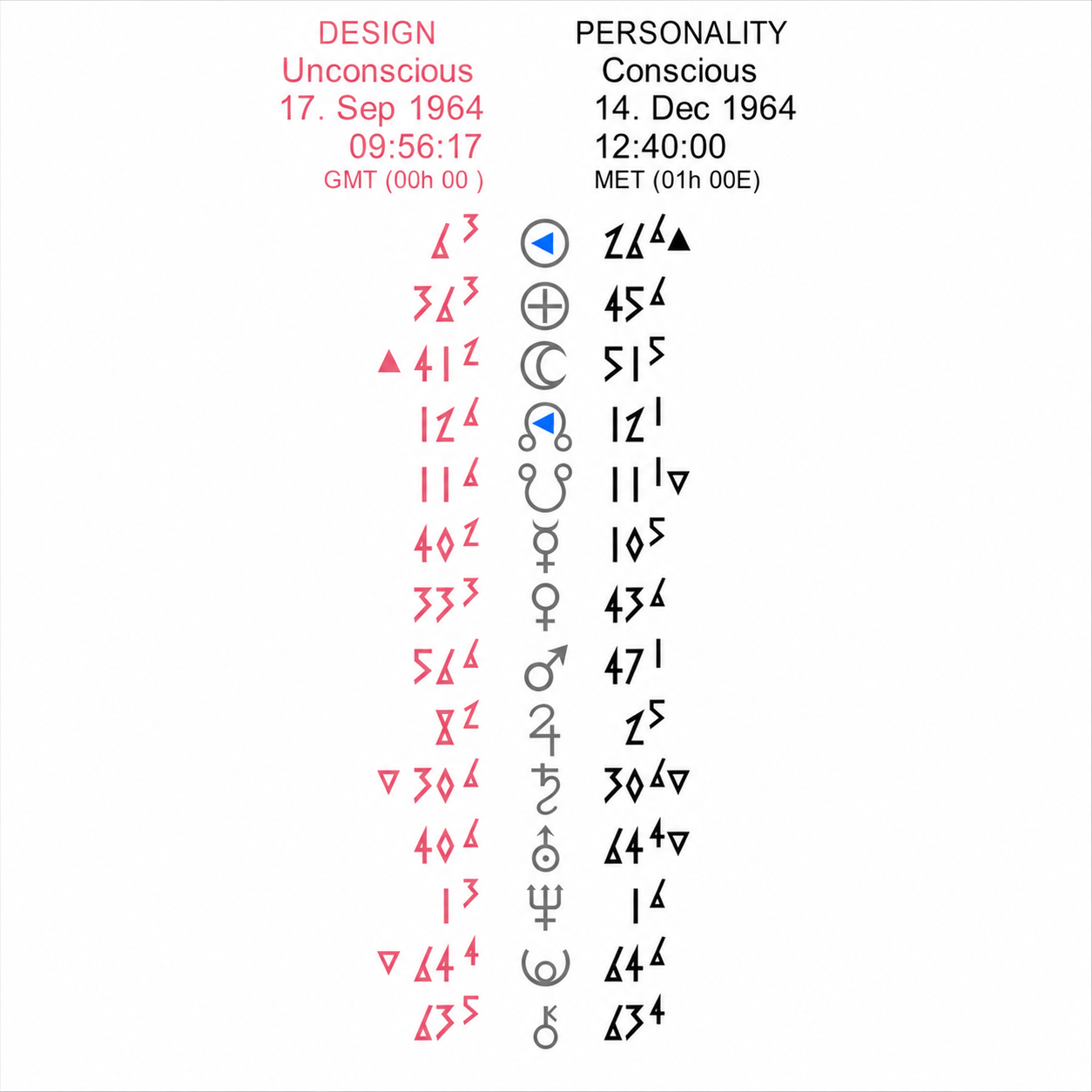 This creates a fundamental duality within the Human Design chart: the conscious and unconscious aspects of the individual, represented through two different planetary data sets. Consequently, interpreting planets within the Gates and Channels of a composite chart requires the analyst to consider not only which planets are involved, but also whether they belong to the Personality or to the Design side of the chart.
Moreover, the possible dynamics are not limited to Electromagnetic connections. As seen in previous articles, the way in which the two charts interact can also involve Dominance, Compromise, and Companionship, each producing a different relational dynamic, involving up to 4 different planets! The planetary symbolism can further nuance these dynamics, giving the same Channel a very different quality depending on which planets are activating it and whether those planets belong to the conscious or unconscious side of either person.
The Design data set, the one in pink color, is particularly important in this respect because it is traditionally associated with the body, the unconscious and the genetic dimension of the individual. Within the Human Design framework, it can also be read in relation to inherited patterns, ancestral material and karmic themes: elements that may operate beneath conscious awareness and that can therefore become particularly significant when examining the deeper dynamics of a composite chart.
The Personality data set, the one in black color, by contrast, describes the conscious identity, the way the individual experiences and expresses themselves and the psychological functions that are more obviously recognizable by the person. In this respect, the planetary symbolism of the Personality side can be interpreted in ways broadly analogous to the symbolism of the planets in contemporary classical astrology.
The skill of the Human Design practitioner with good astrology knowledge lies therefore not in assigning new meanings to Venus, Mars, Mercury, Saturn or the other planets, but in understanding how their established symbolism is expressed through the specific Gates and Channels they activate, whether on the Personality or Design side, and how those activations interact between two charts.
In this sense, the planets provide an additional layer of interpretation. The definition of the Channel describes the underlying energetic and relational mechanism, while the planets help describe the particular way in which that mechanism is expressed. The same Channel can therefore remain fundamentally the same in terms of its Human Design mechanics while taking on markedly different qualities depending on the planetary activations involved.
Many Human Design analysts do not have a background in astrology and therefore tend to overlook the interpretative value of the planets themselves. This is particularly odd because, although Human Design is not an astrological system, planetary positions are deeply embedded in its mechanics.
Gene Keys – The Planets as Keys to Transformation
Personally, I believe that the system that truly introduces very important, profound insights of great evolutionary value into the study of planets, is the Gene Keys.
Richard Rudd developed the Gene Keys as a system of contemplation based on a new kind of personal profile, the Hologenetic Profile.
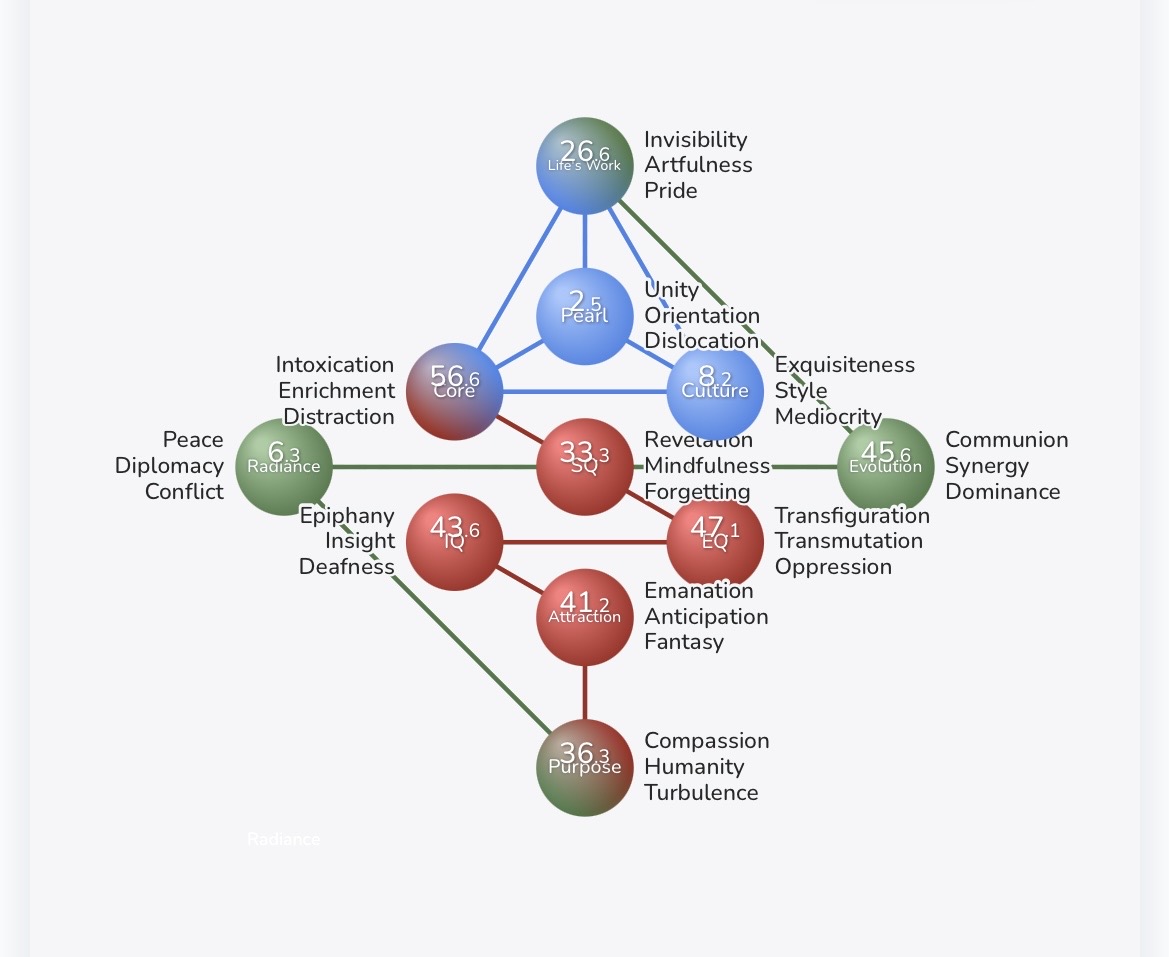 Get your free profile: genekeys.com
What makes this particularly relevant to our exploration of the planets is that the profile is generated from precise planetary positions at the time of birth and three months before, just like in Human Design. These planetary activations are then translated into specific Gene Keys (same as Human Design Gates) and organized into a series of Spheres, each representing a different dimension of human experience.
The Spheres are not isolated elements. They are connected in a specific sequence, creating what Richard Rudd calls the Golden Path. The Golden Path consists of three interconnected sequences, each leading into the next: the Activation Sequence, the Venus Sequence and the Pearl Sequence. Together, they create a progressive journey of self-discovery and transformation.
The Venus Sequence is the heart of this process and is particularly relevant to our exploration of relationships. It takes the planetary activations associated with its Spheres and uses them as points of contemplation through which we can explore our emotional patterns, our ways of relating and the deeper wounds that can influence our relationships. In this sense, the planetary positions are not simply used to describe personality traits: within the Gene Keys, they become starting points for a contemplative journey into greater awareness.
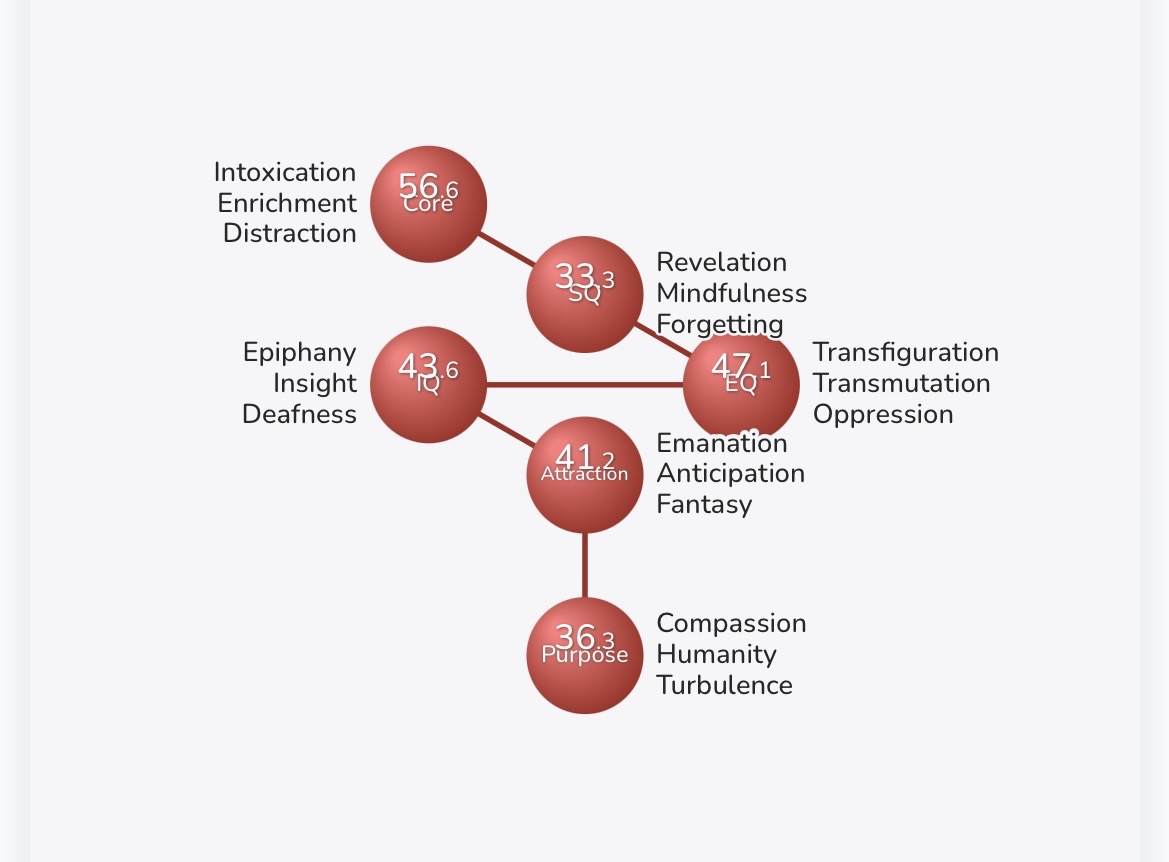 The Venus Sequence is not couples’ work. Rather, it is based on the assumption that within a couple, if even one of the two partners begins to work on themselves and increases their level of consciousness, the relationship itself can improve as a result. It proposes that by becoming more conscious of our own emotional and relational patterns, we can transform the way we participate in relationships. This is precisely what makes it particularly interesting when we are exploring the planets in relation to partnership: the same planetary positions that appear as specific activations in the profile can become gateways into a deeper understanding of our emotional and relational life.
The Venus Sequence consists of six Spheres, each generated by a specific planetary activation:
- Design Earth – Sphere of Purpose: our life purpose and the deeper direction that gives meaning to our journey.
- Design Moon – Sphere of Attraction: the field of attraction through which we draw into our lives the people and experiences that support us in fulfilling our life purpose.
- Personality Venus – IQ: our intelligence and the way we use the mind to understand, process and relate to the world around us.
- Personality Mars – EQ: our emotional intelligence and the way we experience, process and express our emotions in relationships.
- Design Venus – SQ: our spiritual intelligence and our capacity to experience connection beyond the level of the mind and emotions.
- Design Mars – Core / Vocation: our original wound and, at the same time, the vocation that can emerge from the deepest place of that wound.
These are the planetary activations used in the Venus Sequence. Exploring them one by one provides a personal journey into the way we relate to others, revealing aspects of our emotional and relational code and bringing greater awareness to the patterns through which we experience intimacy, attraction and connection.
Within the Golden Path, the Venus Sequence therefore constitutes a deeply contemplative and evolutionary journey, allowing us to explore not only self-knowledge but also our emotional and relational world.
In my own observations, many of Richard Rudd’s insights are extremely precise and reveal some beautiful surprises.
For example, when reading a composite Human Design chart, we can examine specific points by cross-referencing Gene Keys information with Human Design. We can look at where the reciprocal Attractions are located and, more generally, at where the different elements of the Venus Sequence are situated within the charts: whether they have a relationship with one another, which Gates they are in, whether there is an affinity and, very importantly, which Line they express.
This gives us very valuable information, especially when in the composite chart we do not find such obvious correspondences.
Obviously, I am talking about integrated readings of Astrology, Human Design and Gene Keys, which are not shared by everyone and which presuppose a profound knowledge of all three systems. These readings can constitute a path of great depth in one’s own journey as well as in the journey of a couple.
When these three systems are brought together with the necessary depth and precision, they offer a remarkably rich field of exploration. Astrology provides the planetary language, Human Design reveals how these planetary activations are structured within the chart, and the Gene Keys open a contemplative dimension through which these same activations can be explored as a process of awareness and transformation. In the context of a relationship, this integrated perspective can reveal nuances that may not be immediately visible through any one system alone, offering a deeper understanding of both the individual journey and the evolutionary potential of the relationship itself.
Sources
Get your Human Design chart sent for free to your inbox: humandesignapp.com
Marga offers Human Design readings:
you can contact her on whatsapp 0091 9503332918 or margajee@gmail.com
Related articles
- Marga’s whole series on Osho News: Human Design and Relationship
- Marga’s 12-article series: Three Channels a Month
- List of links to Gates and Channels
- Marga’s monthly Transits
Featured image by the author



Comments are closed.