

Amido (text) and Purushottama (photos) continue their travels in the Himalayas, visiting Tabo and the Key Monastery, the Kiber Valley and back to Manali via the Kunzum Pass
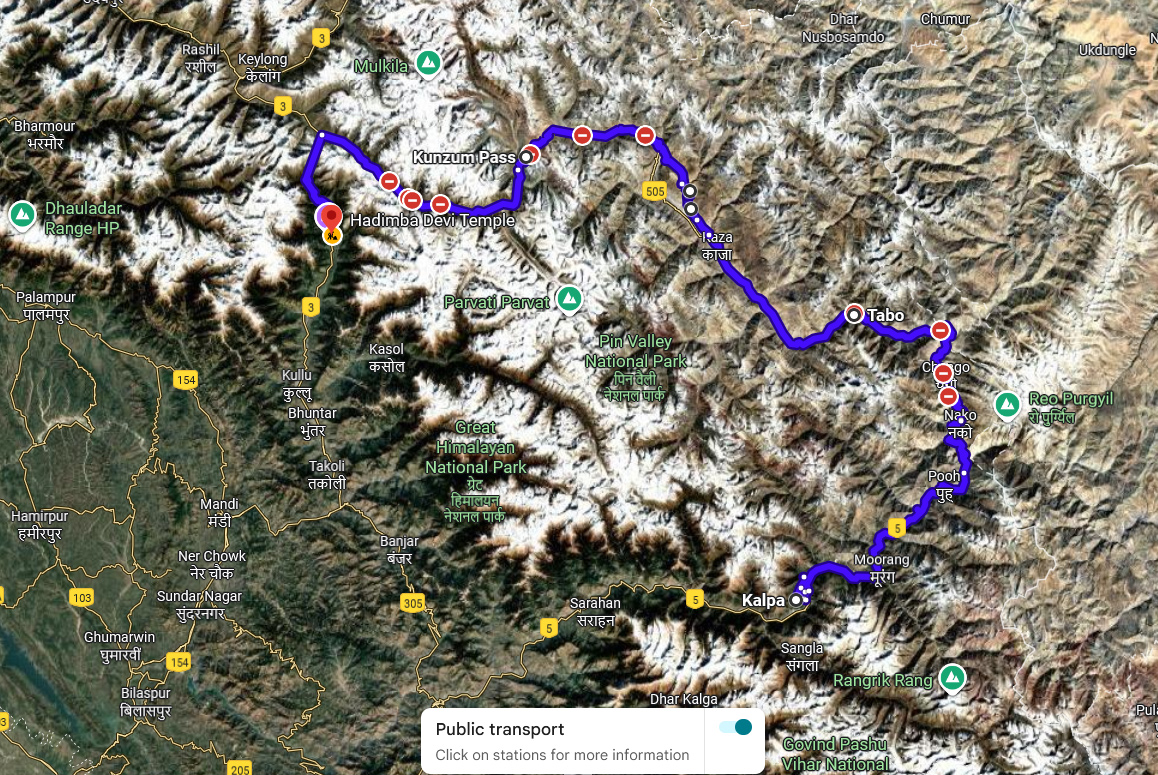
Lower Spiti Valley
After traversing the verdant beauty of the valleys of the Kinnaur District and falling in love with its mountain ranges and panoramic skies, we headed into the District of Lahaul and Spiti, also part of Himachal Pradesh (HP), and ever closer to Tibet. (Click on images to see full screen.)
The quality of the air changes as does the light; you feel as if you can see forever. The remoteness and elevation weave a magical stillness.
Our next stop, after Kalpa, was Tabo in the Lower Spiti Valley, a 100-mile (154 kilometre) bus ride away. The distance is no indication of the amount of time it takes, particularly since we had to stop for several hours due to a landslide, before we could pick our way across it to catch a bus that had come to carry us the rest of the way.
In contrast to the lush valleys of Kinnaur, the Spiti region is more desert-like. By happenstance, we are visiting at the best time of year – June and July.
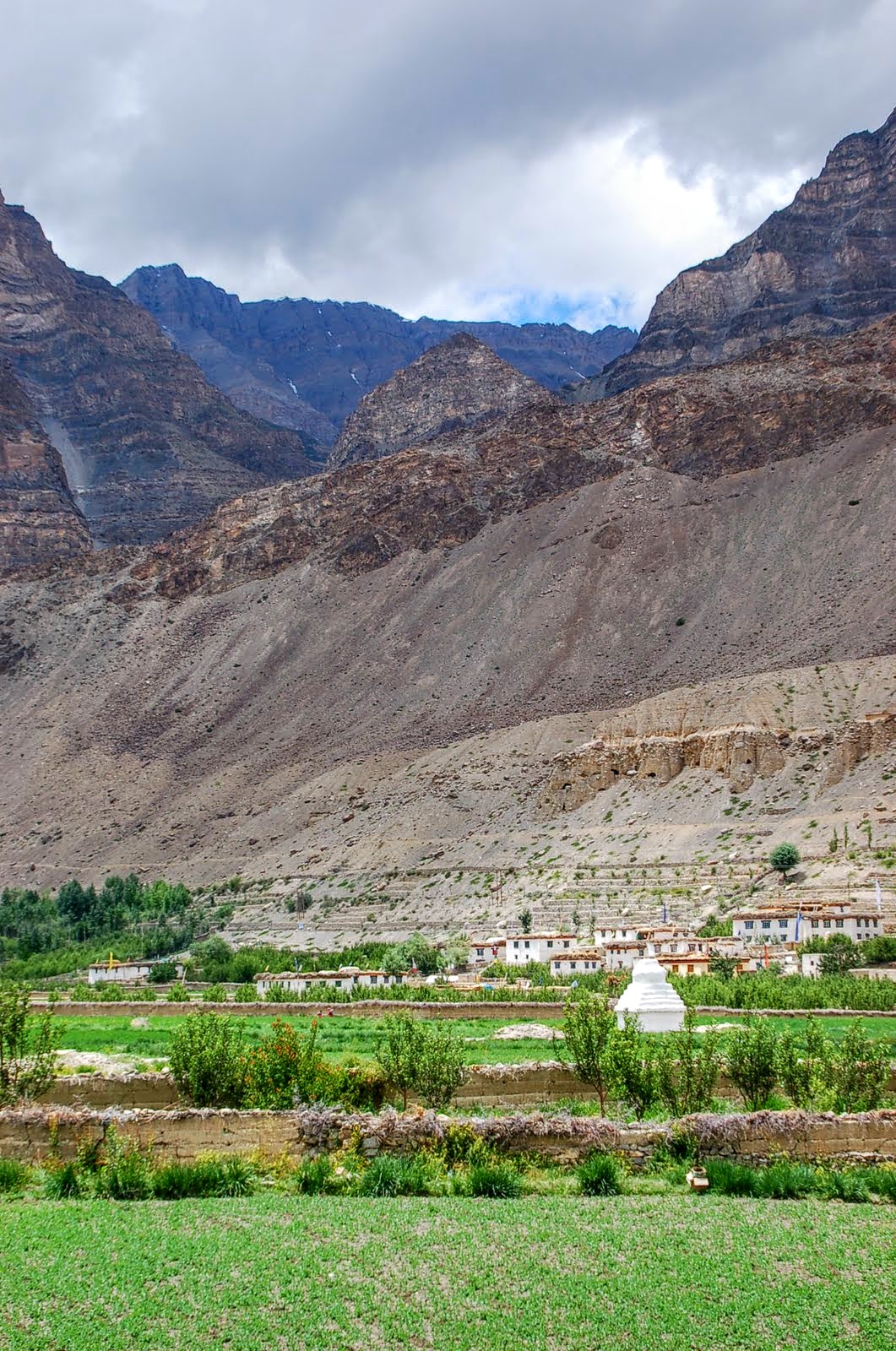 There are few people and roads to disturb the presence of the mountains. Silence… stillness… permeating the vastness of this Himalayan valley.
The River Spiti runs through this valley and feeds the irrigation canals. Barley and black peas are the traditional crops, but green peas are increasingly grown as a cash crop. The traditional crops are more ecofriendly. There is concern that growing green peas, which require more water, will upend the fragile balance of this environment. 1
The Spiti region is the least populated area in India.
Tabo
Tabo is so remote… The unpolluted night sky reveals its infinity… the sheer number of stars of varied sizes – different distances and luminosities – against the dense blackness. Sometimes the incredible density feels like it’s pressing down and, at other times, stretching out and expanding one’s sense of the universe!
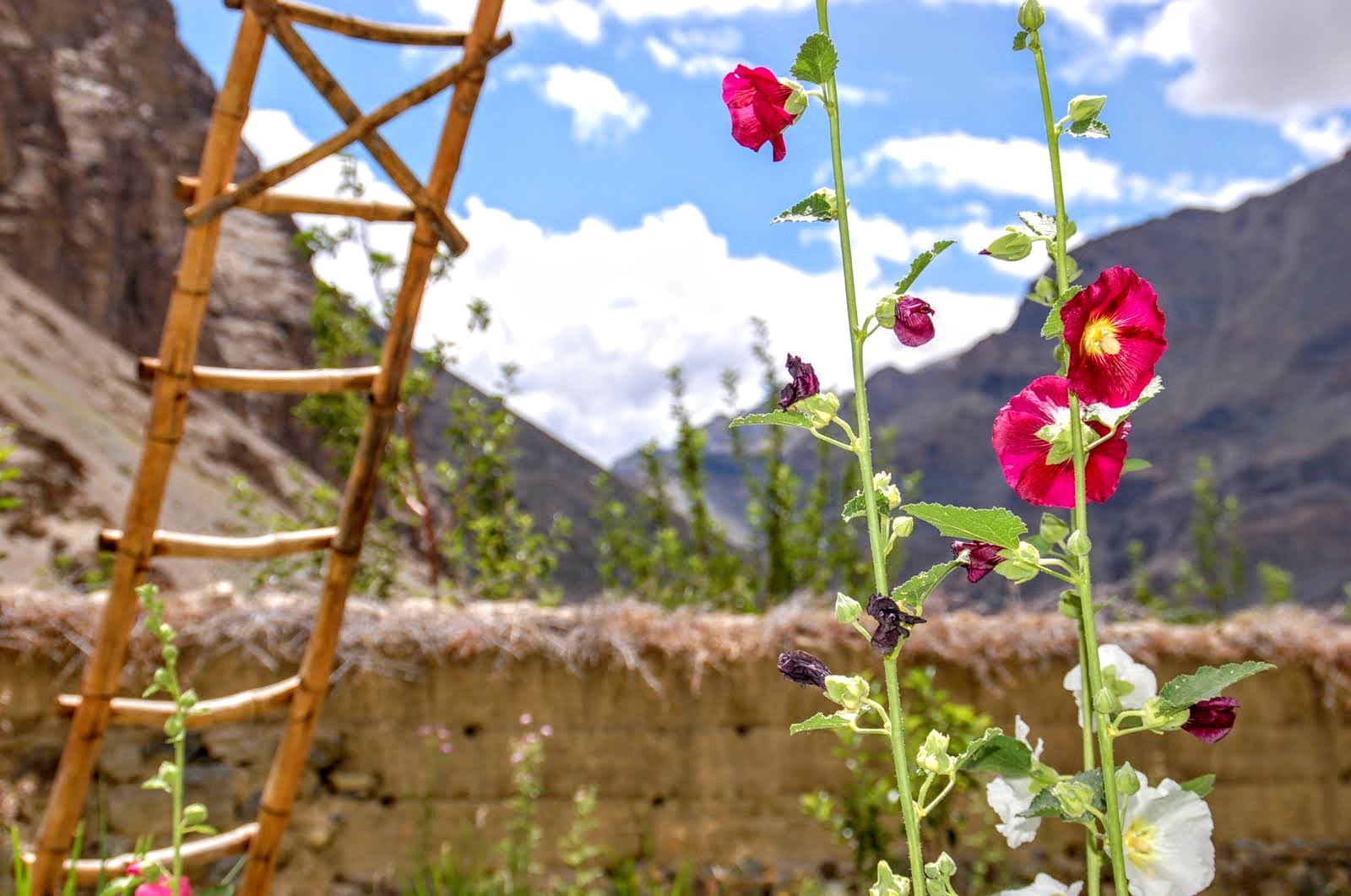
The forest of hollyhocks in the garden of our guesthouse.


Tibetan Buddhism was introduced around 950 CE to this area. Tabo’s 1,000-year-old Buddhist monastery is the heart of the town. Ancient murals decorate its walls. The young come here to study.
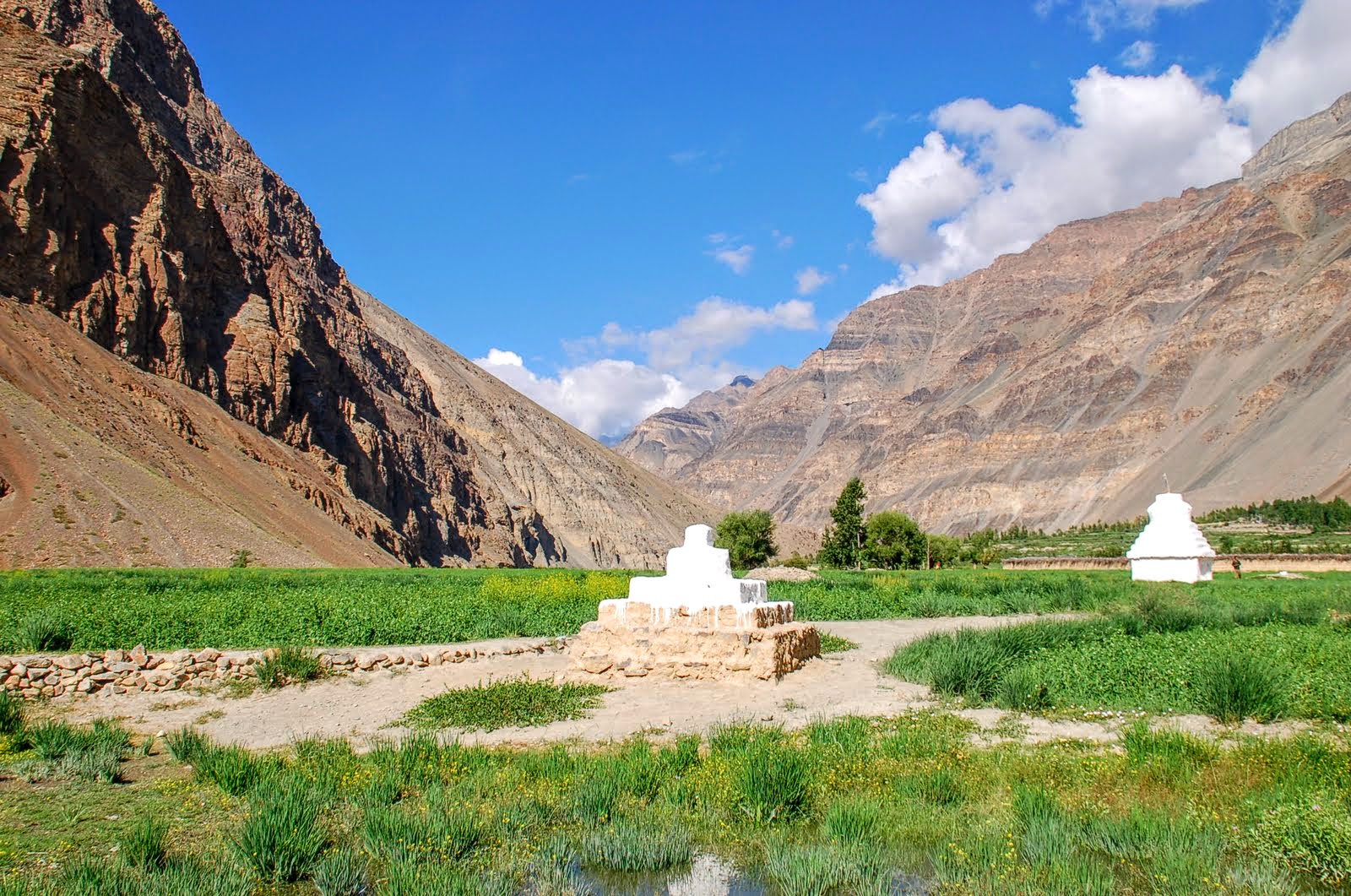
Douglas Harding talked about being one with space. You are not simply looking out but Being it. I experimented with this. The invitation is almost audible in the beauty of such places.
Key Monastery
The Key Monastery (Key or Ki Gompa) was our next destination, a mere 40 miles (62 kilometers) away – this time over slow-going terrain. Tibetan Buddhist monasteries always require a hike up a steep slope. But it is always worth it! This one is so enticing, and sited so perfectly. 2


Key Gompa, also known as the Monastery at the Center of the Mandala, perches on a Himalayan slope at an altitude of 13,668 feet (4,166 meters). It is the largest gompa in Spiti and belongs to the Yellow Hat (Gelugpa) Sect of Tibetan Buddhism (as does the Tabo Gompa). The Dalai Lama has an apartment on the upper floor. The monastery was established in the fifteenth century. Over its long history, several mural-size paintings and other precious religious items have been brought from central Tibet. The monastery is a preeminent place for learning and a refuge for Tibetan Buddhists.


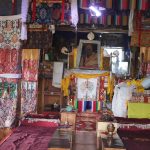
L: Monks gather to chant and intermittently blow horns, beat drums, and strike cymbals. One monk leads the chanting. The cacophony of sound produced reminds me of Pune 1 energy darshans, so loud and wild, and transformative. R: Such magnificence!
The Dharmachakra (the Wheel of Dharma) flanked by two deer appears on the roof or front entrance of every Tibetan Buddhist monastery and symbolizes the teachings of Buddha. The wheel represents the three turnings of the Wheel of Dharma by Buddha: each turning refers to a teaching Buddha gave. In the first turning, he introduces the Four Noble Truths; in the second turning he speaks on the Perfection of Wisdom; and in the third turning he explains the Nature of Mind. The spokes are said to represent the noble eight-fold path. The two deer, one male and one female, represent harmony, happiness and fidelity; their upturned gaze represents the aspiration of sentient beings for the Dharma. 3
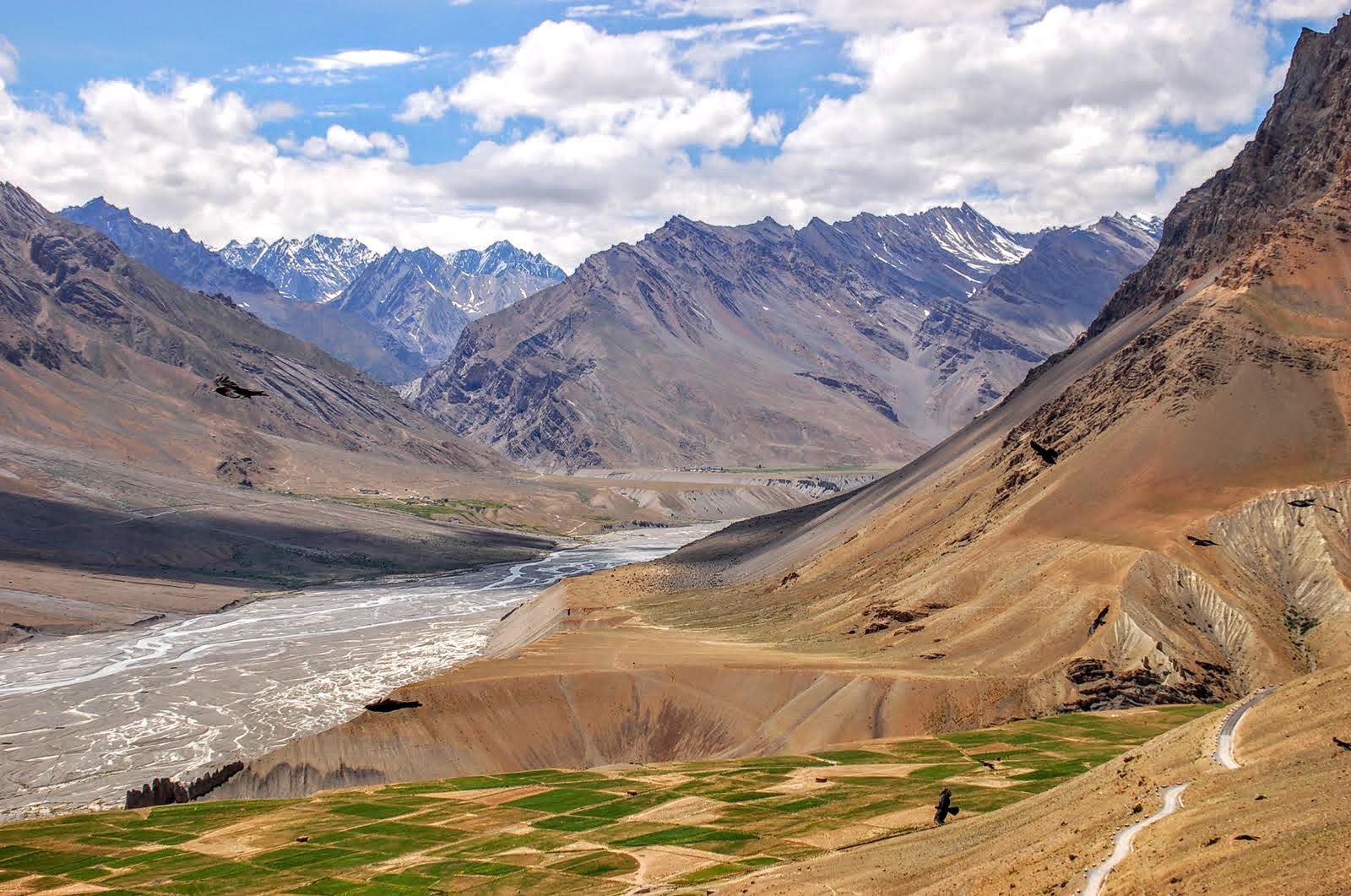
The River Spiti cruises through the valley; the Himalayas with just a trace of snow.
The views from this monastery are breathtaking. You are pulled into the vastness by the immensity of what surrounds you.


L: I’ve had a fascination with stupas from the day I was present at the dedication ceremony (which was inspired by the Sixteenth Karmapa) of one in Crestone, Colorado. Relics, small Buddha statues and other assorted items considered sacred, are gathered and then enclosed in a shapely structure that would then attract pilgrims to visit and circumambulate (as I did myself). Well, it’s fascinating! There are spots on this Earth that stop a person in their tracks, sometimes because of their beauty, but sometimes because of something less tangible. That we flawed humans can create such sacredness… R: The ornate entrance to the monastery. Again the dharma wheel and other symbology.
Kibber Valley (Spiti Valley)
From Key Gompa we shared a taxi to visit Kibber, a nearby village, for the afternoon.
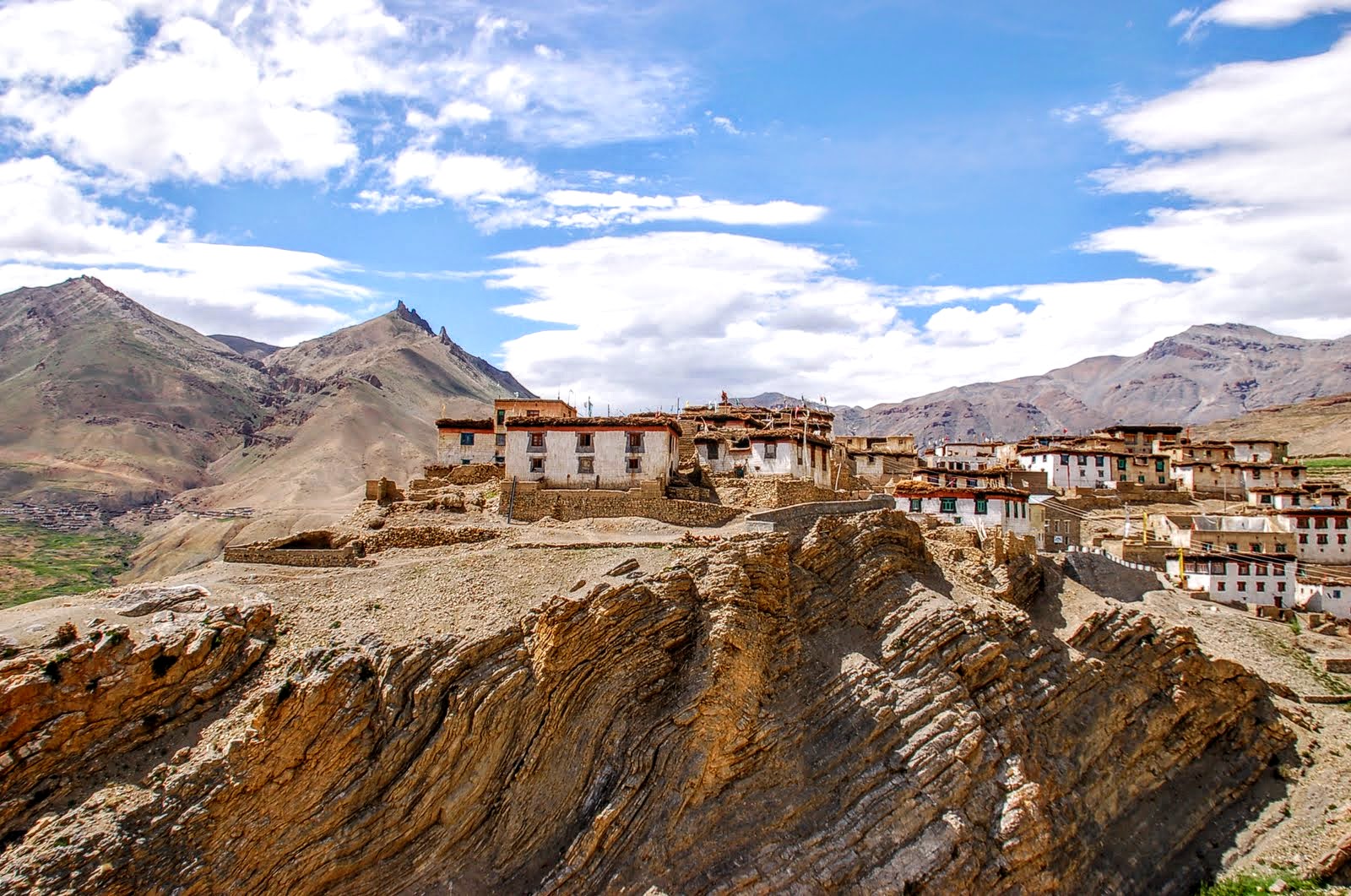
Sitting on a limestone shelf at 14,000 feet (4,270 meters) on the left bank of the Spiti river, Kibber is one of the highest villages in the world that is inhabited year-round.
Agriculture and tourism form the basis of the economy here. Barley and peas are the main crops, as well as some animal husbandry. Kibber attracts visitors to the Kibber Wildlife Sanctuary, and there’s also the fact that it is the starting point for several treks. The snow leopard roams this area, and there has been a slight increase in the population in Himachal Pradesh. It is thought that people in general are helping to protect this exquisite animal, since many were counted outside the sanctuaries. 4
I was offered a fossil by some children in Kibber; they wanted to sell it. This area was under the Tethys Sea some sixty million years ago and is consequently a source of prehistoric marine fossils!


The village gompa and stupa with its shredded prayer flags.


There is not so much color to this high mountain village except for the clothing of the women and girls and – at this time of year – the brilliant green of young barley.
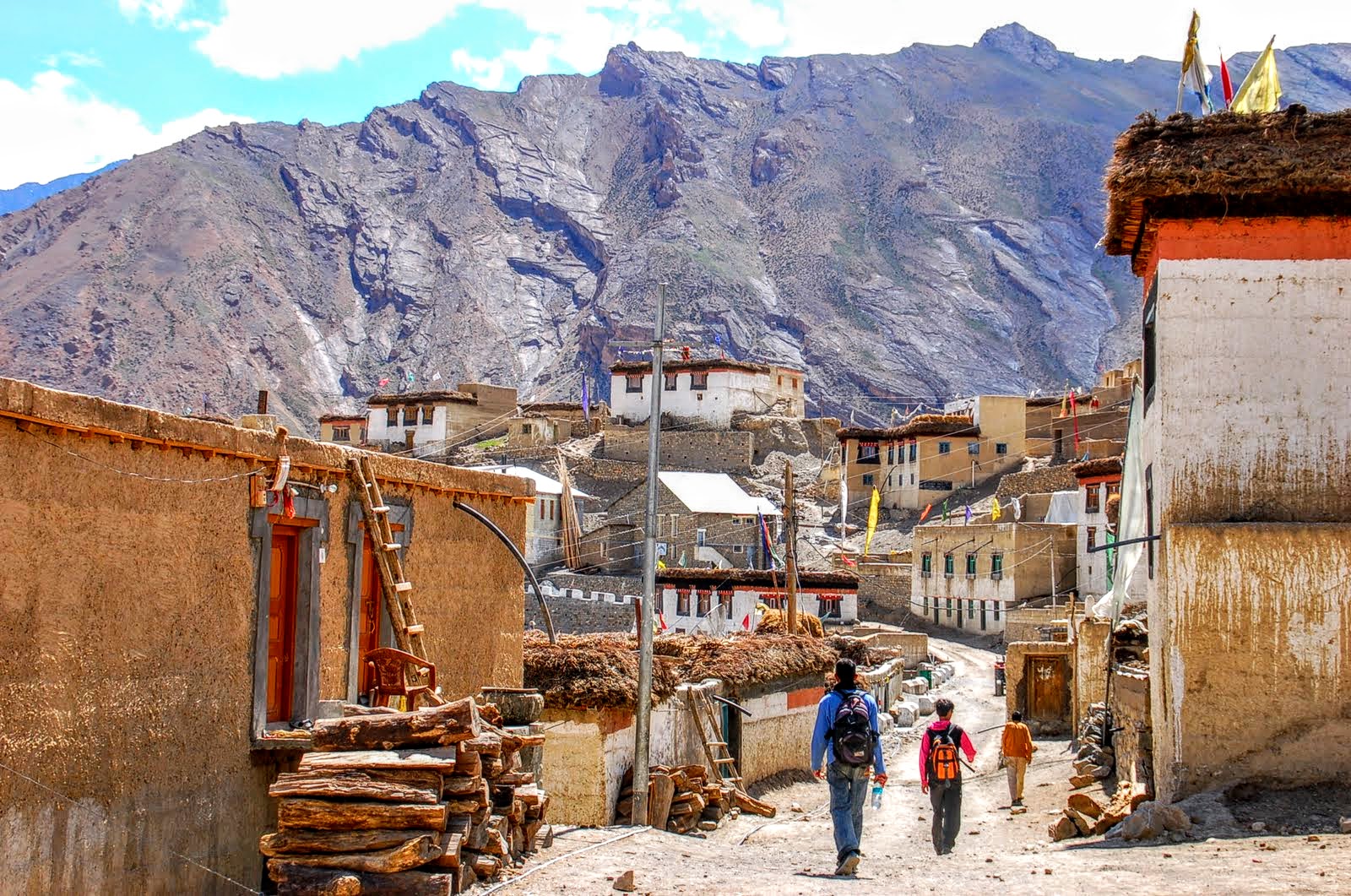
The village street lined with Tibetan-style houses, flat roofs, and decorated windows on the upper floors. Every house has a good supply of firewood. Wood and kerosene are the main fuels used for cooking and heating.
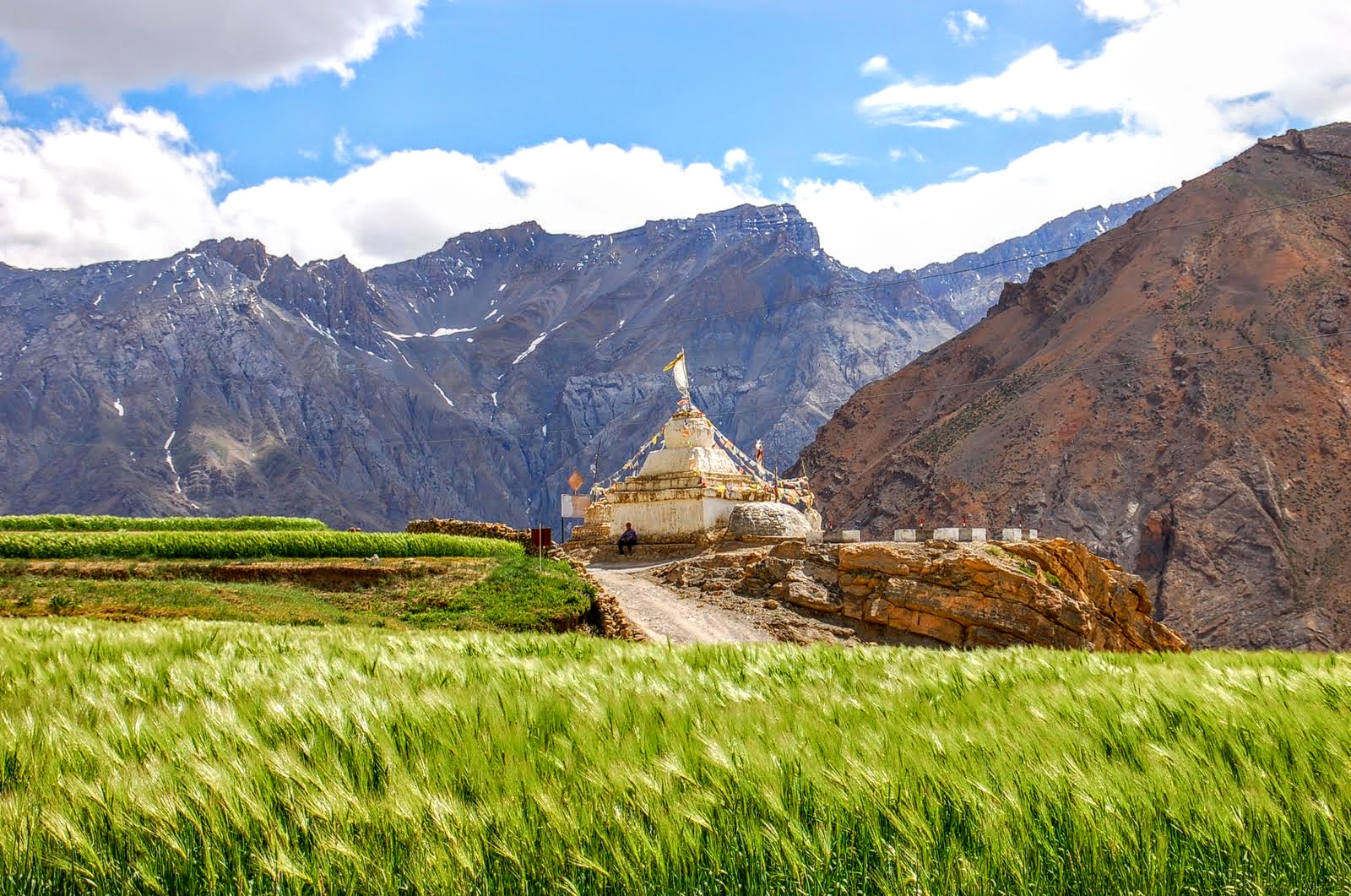
Framed by the Himalayas: brilliant green barley complements the ancient stupa.


On our last day of travel back to Manali, the bus stops for some time on Kunzum Pass for all the passengers to descend and marvel at the view (and experience the strength of the wind at this high point – 15,000 feet [4,572 meters]). This is where the Spiti region meets the Lahul region. Here you are standing within the Himalayas; no longer are they distant vistas. Here the assemblage of prayer flags flail, no gentle fluttering, and the stupas… what dedication to create them at this altitude. And then the view of the pièce de résistance, the Bara Shigli Glacier – the largest in Himachal Pradesh.
Om Mani Padme Hum
which translates as “the jewel in the lotus”, has taken up residence in my being. It is written on prayer flags strung in the windiest of places, and I imagine the threads teased free and visiting all corners of the globe.
Links
- Spiti – Wikipedia
- Key Monastery – Wikipedia
- Three Turnings – Encyclopedia of Buddhism
- Visit to Kibber Village in the Spiti Valley | Solo Backpacker
Realted articles
- At the feet of the Himalayas – Amido (text) and Purushottama (photos) visit Manali, Naggar, Sangla, Kalpa and Reckong Peo (Part 1)
- Key Gompa – An excerpt from Madhuri’s travel memoir, Reluctantly to Kunzum La: Motorbiking in the Himalayas in the Name of Love


Comments are closed.