

Amido and Purushottama (camera in hand) visit the picturesque ruins of this historic town in north-central India (Part 1)
In Chennai, in 2007, Purushottama (browsing through Lonely Planet India) found a town in Madhya Pradesh that he thought would be interesting to visit on our way to Khajuraho. We caught a train to Jhansi and then a bus to our destination, Orchha.
The train journey covered a distance of 1,125 miles (1,800 kilometers), time enough to thoroughly settle into our non-AC second-class sleeper. I love traveling by train in India. When I climb onto my mid-level bed, wrap my lungi around me and use my daypack as a pillow, then listen to the chug-chug-chug of the train along the tracks, I feel an immense sense of peace. Purushottama always takes the lower bed – so I can just peek over the edge and there he is. Food and drink are rarely an issue on Indian trains: no shortage of hawkers at the stops.
At one of the stations, a beggar, who had climbed on board to sweep the floor and ask for money, stole Purushottama’s hiking boots… or so we suspect! We didn’t notice until Purushottama needed to put them on many hours later. Fortunately, he had sandals. (Since then, our boots always go into a plastic bag and sleep next to us when we’re traveling on Indian trains.)
We arrived in Jhansi at some ungodly hour, but were able to find transport to cover the remaining seven miles or so (11 kilometers) to Orchha. An insomniac rickshaw driver took us to a guest house where they were kind enough to let us check in, despite the unreasonableness of the hour. We spent barely two days in this remote town, but it was so picturesque – a photographer’s dream.
At the time of our visit, Orchha did not receive many tourists. It had a population of 8,500, according to the 2006 census (it is now estimated to be 16,900). It’s located in the Niwari District of Madhya Pradesh. ‘Orchha’ means ‘a hidden or low place’, a name probably given due to its low-lying location on the Betwa River. An application to become a UNESCO World Heritage City is underway and its acceptance is anticipated for 2028.
Orchha was founded in 1501 by Rudra Pratap Singh, the first Raja of the Bundela dynasty. He initiated the move of his capital, in 1530, just before his death, from Garh Kundar to Orchha, as it was considered an easier place to fortify against the growing Moghul pressure. His son, Bharti Chandra, completed the project. The Bundelas controlled the area during the sixteenth and seventeenth centuries and Orchha flourished. The Bundelas were keen builders and helped develop a style of architecture that blends Indian (Rajput) and Moghul.
My memory of the place is so vivid: blue and white painted houses; the care taken to keep everything clean in such a dusty land: the stark red-orange color of the blossoming gulmohar trees and the vibrant saris; the friendliness, kindness and dignity of those whose paths we crossed; and the abundance of remarkable ruins to traipse around and photograph. (Much work has been done on the ruins since our visit.)
(Click on images to view fullscreen)
Ancient Ruins
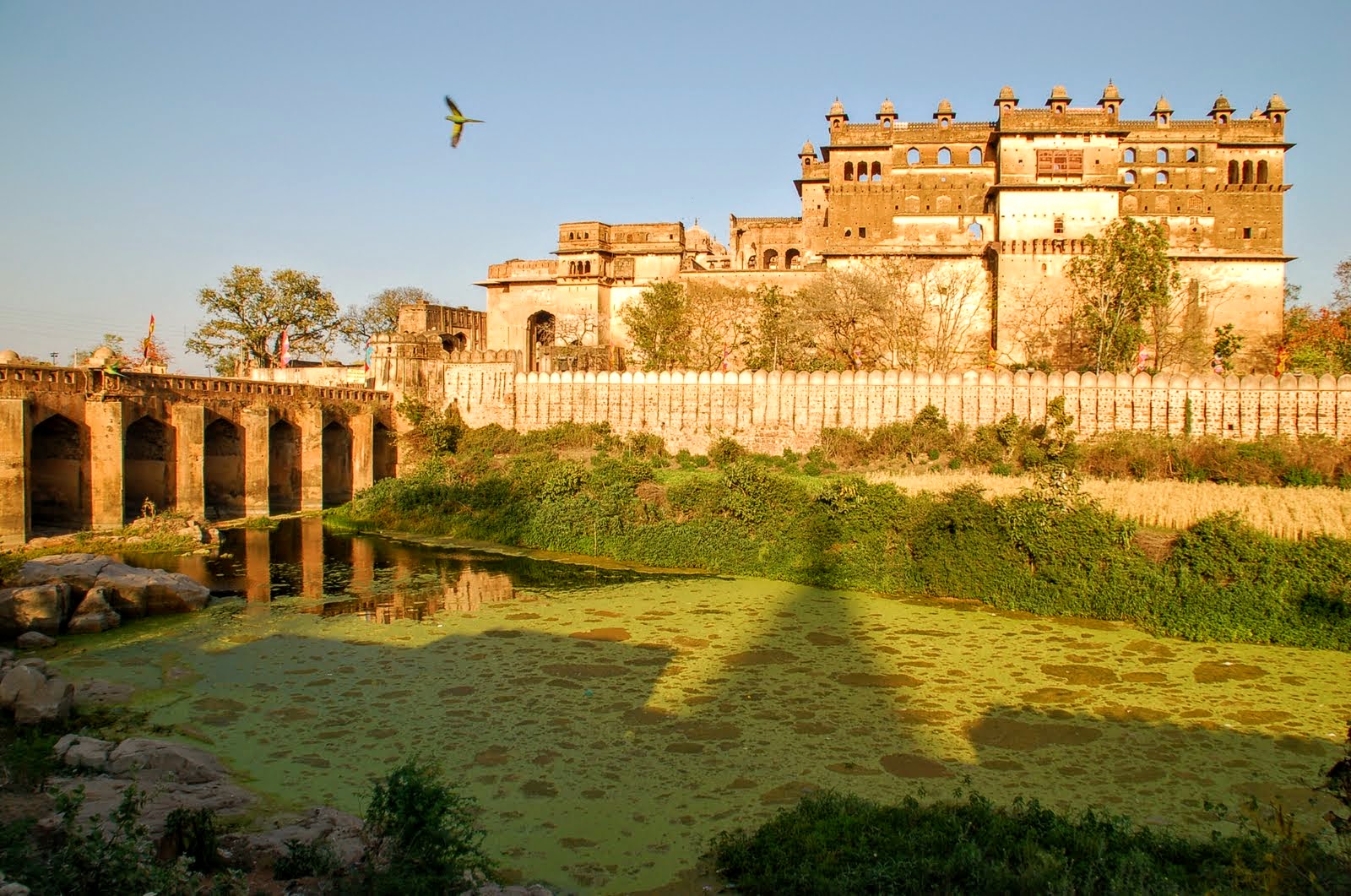
Orchha has a central Fort complex accessed by an arched bridge. The fort consists of three palaces: Raj Mahal, Sheesh Mahal (now a heritage hotel), and Jahangir Mahal. The ruins of temples and gardens are included in this complex and are all encircled by the Betwa and Jamni rivers.


Looking through these windows offers views of Orchha Fort.


The hatted rooftop structures are called chhatris. They provide a lookout point, give a whimsical silhouette to the roofline and are one of the defining features of Bandela architecture.
Three successive rajas built Raj Mahal: Rudra Pratap Singh started construction in 1531; his successor and son, Bharti Chandra, continued the work until 1539; then significant additions were made by Raj Madhukar Shah (brother to Bharti Chandra) who reigned from 1554 to 1591. Kings and queens resided here until it was abandoned in 1783.
Apart from the beauty and symmetry of the building, murals depicting social and religious themes add to its attraction.
The layout and design of its windows and passages helped to control temperature using sunlight and shadow.


L: There is something very delicate about this beautiful mural. The figures have such grace.
R: Chaturbhuj Temple viewed from Raj Mahal. This temple is dedicated to the Hindu god Vishnu. ‘Chatur’ meaning ‘four’ and ‘bhuj’ meaning ‘arms’, refers to Rama, Vishnu’s avatar with four arms.


L: An enchanting view of Chaturbhuj Temple through this hole in the wall – especially striking with the orange-red blossoms in the foreground. Our visit occurred toward the end of March. Generally, everywhere we looked was parched with straw-colored vegetation, except for the glorious blossoms of the gulmohar trees.
R: Jahangir Mahal, a fusion of Rajput and Moghul architecture, was built by Raja Vir Singh Deo in 1626 (or thereabouts) to emphasize the warmth of his welcome for the Moghul Emperor Jahangir on his first visit to Orchha. An extravagant gesture! The building surrounds a large square courtyard. The tall domed towers were a form of early air-conditioning. (We saw a similar system in Dubai.)


Mashrabiya refers to the intricately-patterned latticed windows/doors which were not only beautiful, but functional. They allowed the women of the palace to observe the street below unseen; water pitchers were placed strategically in their vicinity to cool; they managed sunlight, regulated air flow, and therefore helped to lower the temperature of incoming air.


L: Fourteen elaborate cenotaphs (or chhatris) on the Betwa river commemorate the Bandela dynasty. Each one of the cenotaphs has been constructed on the site of a ruler and his consort’s funeral pyre.
R: Laxminarayan Temple from a distance. It was built by Raja Vir Singh Deo in 1662, and is architecturally a mix of a temple and a fort. It is dedicated to the goddess Laxmi, a nourisher and preserver who provides wealth and health to her devotees. We didn’t have time to visit this temple, but according to the Madhya Pradesh Tourism website its walls and ceiling are covered with elaborate paintings and murals. It is possible to climb up onto the roof to enjoy panoramic views.


These doorways offer glimpses of the uniqueness of Orchha through their Moghul-inspired shape.


These beautiful women in their saris, chappals, ankle and wrist bracelets endlessly carry construction materials, one small ghamela at a time. The pad made of cloth used to protect the top of the head is called a chindi. This is a common way to move construction materials in rural areas.


L: The ornate doorway is possibly the entrance to a temple.
M: A small slice of this ancient ruin complex.
R: Our last hour in Orchha was spent here. The light and vistas were so spectacular – and we weren’t the only ones to think so.
Links
- The historic ensemble of Orchha – UNESCO World Heritage Centre: whc.unesco.org/en/tentativelists/6404
- Orchha – A Hidden Wonder – Laid Back Traveller: laidbacktraveller.com
- Orchha Fort complex, references: en.wikipedia.org
- Laxminarayan Temple Orchha – Madhya Pradesh Tourism: madhya-pradesh-tourism.com
Part 2 follows shortly…



Comments are closed.