

Hafiz reports from Zweibrücken in Germany, where he participated in the renaming of a fountain donated to the city by a former Jewish resident
I’ve recently come back home from a week and a half spent in Germany, in the company of my wife’s family. We’ve been researching the life and times of her great-grandfather, Fritz Gugenheim (1859-1939). My brother-in-law is making a film about him, and I have been writing a book.
If I were to describe the main theme of our projects, I’d say they are both about memory and forgetting.
Being in Germany reminded me of my first impressions of Germany, when I was a member of the Rajneesh International Communes in the 1980s. I was rather young and naïve in those days, still imprinted with the English myth of wartime victory over the despicable Hun. It didn’t take long, in the context of a caring, sharing commune, for that nonsense to be set aside. Germans, so it turned out, were rather like me: sometimes a bit fucked up, but aspiring to be considerate and kind; we could have fun together.
Nonetheless, the Second World War was still very present, in the broken fabric of the urban landscapes. My first destination had been Freiburg, which bears comparison to my own home town of Oxford: an ancient university city, rooted in medieval tradition. But, unlike Oxford, the centre of the city had been bombed to bits; only the great cathedral, the Münster, had been miraculously (some might say) spared.
After I’d been in Freiburg for just 4 months, Sheela came and closed the commune down – apart from the “Far Out!” disco, which was a popular money-spinner. Along with half a dozen others, I was despatched to Berlin. Berlin in the 1980s – the legendary City That Never Sleeps!
This was edge city, a frontier town thrust deep into enemy territory, in which the world’s unresolved geopolitical confrontation was no more than a short subway ride away.
Dörfchen commune was large and overcrowded, inhabiting most of a block of flats just off the Kurfürstendamm – Berlin’s main drag, an endless glittering shop window. Its version of Far Out! (shortly to be rebranded – sadly, in my opinion – as Zorba the Buddha Rajneesh disco) was a couple of minutes’ walk from our front door. This was where we played host to Berlin’s night-time frenzy: all the tension built up within the city’s enveloping Wall exploding across our dance floor.
Commune living was intense – intentionally so. We were a pressure cooker within the pressure cooker that was West Berlin itself. Implosion on the Ranch, at once far away yet embedded in our hearts, was enough to blow the lid off. It was as if our ground of being had been ripped away; the consequences for each of us could not fail to be profound. What had happened? We had placed our trust in leaders who, secretly, we knew to be deeply flawed. Despite everything, many of us retained our Faith, doing our best to rationalize this catastrophe as some masterly device, a zen stick to beat them all.
Our predicament did not go unnoticed in the German media; the sannyas movement had set down deep roots in German culture, far more so than in England. I recall a cartoon which appeared prominently in one of the weekly news magazines – Der Spiegel, perhaps: a father is counselling his bewildered-looking son – “We too believed that our Führer knew all the answers…” The sense is clear: a pattern engrained in German history has reasserted itself; the self-conscious rejection of the parental values which had brought such ruin on the nation had created yet another disastrous psychic dependency.
Would we remember this lesson, or would we choose to forget?
Me, I chose to stay with the commune, as it did its best to reconfigure itself in the wake of this scandal. The population slimmed down dramatically, and most of the foreigners left for their homelands. “Rajneesh English” ceased to be the lingua franca; I made an effort to learn proper German. Nonetheless, I knew I couldn’t shake off my sense of otherness. Living in an international group had made it clear that, for all our attempts to break free of the constraints of upbringing and cultural conditioning – all the effort that went into Dynamic Meditation and catharsis, our uniformity of clothing, the habitual lack of curiosity about individual backgrounds – there was no avoiding the fundamental nature of national characteristics. I was definitively English: a little bit zany, quite likely to flip from solemn to stupid on a whim, and sharing with my compatriots access to a rich fund of comedy gold. Germans, for all their lovability, were inherently serious, inescapably troubled.
Above all, as someone once said, don’t mention the war.
Eventually, common sense prevailed: I moved back to Oxford and fell in love with a local girl who appeared to have an infinite patience for my tales of strange goings on in faraway places. It didn’t escape my notice that she was also more than a bit troubled; whose favourite song was, for a long while at least, Julie London’s “Cry me a river”. She certainly had a lot of tears to shed: far more than I ever managed to squeeze out for the Mystic Rose.
We got married; decades passed; a lot happened which needn’t concern us right now. More recently, the past came calling, bearing a lot of money (thanks, you’re welcome) and an insistent question: Where did this come from? Who created this wealth?


I set to work on researching the Gugenheim family history, starting with what I had already intimated: my wife’s father had been a teenaged refugee from Nazi Germany, whose life was cut cruelly short by cancer; his father had been born into plenty, then pressed into the family business, for which he had little flair or enthusiasm; fleeced by the Nazis of all dignity and wealth, he had taken his own life. And behind this catalogue of disaster was one most intriguing person – the aforementioned Fritz Gugenheim.
The more I delved and discovered, the more I scratched my head in wonderment: how come that this extraordinarily accomplished man had more or less been forgotten by history? More surprising yet: how was it that even his descendants knew virtually nothing about him?
Yes, he fulfilled the basic requirements of a rags to riches story: born in humble circumstances, accrued substantial wealth – but his life and career were so much more fascinating than a mere tally of capitalist accumulation. He was a manufacturer and merchant of luxury silk products – that quintessential bourgeois commodity – who became a figure of consequence in German commercial and cultural life over several decades. He was an expert networker and gifted administrator. And, crucially, for our story at least, he never forgot the place where he had started: the small provincial city of Zweibrücken, and the mucky square in which he used to play as a child.
I conducted most of my research online, notably in the German newspaper archive in Berlin, but from time to time I reached out to someone I had never met to clarify some story or other. I came to appreciate that I was not alone in my quest to cast light on the more shadowy areas of Germany’s past; to restore the memory of those who had been purged from the national identity during the terrible catastrophe of the Shoah.
Just when I thought my story was more or less complete, I was contacted by someone from Zweibrücken who had been conducting his own enquiries into the life of Fritz Gugenheim. Helmut Sittinger had been writing articles for the local newspaper as part of a campaign to rename a public fountain in honour of its original donor – Fritz Gugenheim, the local boy made good. This was, I understood, not uncontroversial. Just as, back in the 1920s, this area, the Rhineland Palatinate (die Pfalz) had been a hotbed of Nazi sympathizers, so had it now become a mainstay of the AfD, the hard-line anti-immigration movement. Had people learned nothing from history?
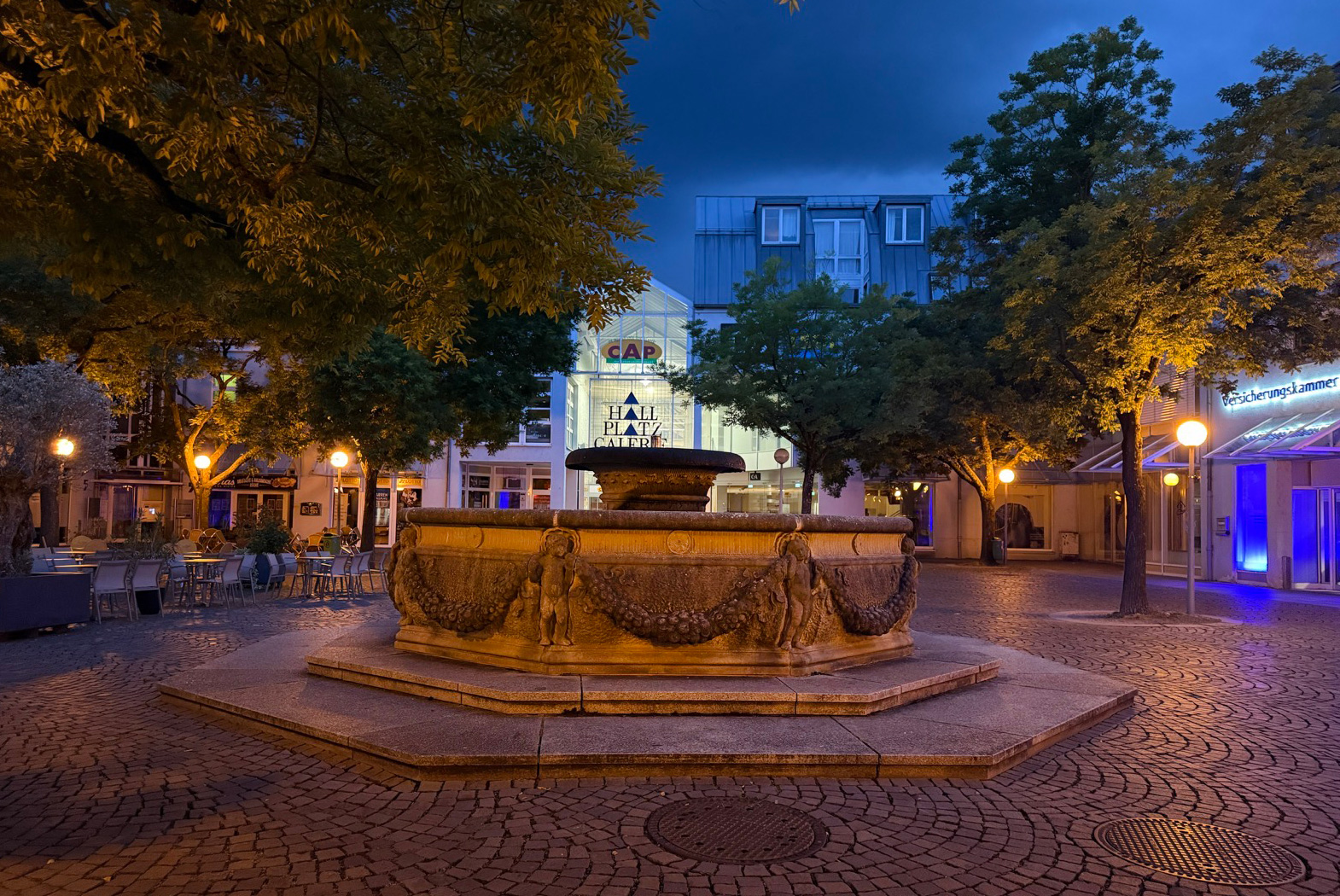
The fountain, originally installed in June 1914, had, at the donor’s insistence, been named in honour of the otherwise obscure Bavarian king, Ludwig III. Miraculously (so I would say), it had survived the bombs that fell all around, as the city was more or less turned to rubble over one night of intensive bombing shortly before the end of the war. It is a remarkable survivor from another age.


The renaming campaign had been deliberately conceived as a means to memorialize not just Fritz Gugenheim but also the local Jewish community from which he emerged: by the late 19th century, this numbered approximately 300 souls, with their own synagogue and shared access to the town cemetery. The synagogue had been burned to the ground on the night of November 10, 1938; where it used to stand is now just a car park. In the cemetery, Jewish graves had been desecrated; memorial stones scattered and only partially restored. Renaming the fountain might offer an opportunity to lament a vanished culture of tolerance, as well as to celebrate the virtues of coexistence.
This was all tremendously exciting for us. In the week before the crucial vote was taken in the civic Culture Committee, we contacted the local newspaper to announce that the present-day Gugenheims were ready to offer their full support to the renaming campaign. It was, so we understood, touch and go – but the motion was approved; funds were allocated for the necessary information board, and in due course, having consulted with us as to a suitable date, we each received a formal invitation from the Oberbürgermeister.
At last, we arrived. Exiting the railway station, we headed straight for the fountain on the Hallplatz. After journeying so long and far in forgetting, here was our touchstone of ancestral memory. It was a moment of tremendous portent.
It’s a curious thing: an octagonal structure, with naked cherubs at each corner, each hand holding up the flowered garland which embraces the fountain’s basin. Over the next few days we would spend a lot of time hanging out here, taking advantage of the delicious home-made gelatos at the neighbouring Eiscafé.
We were welcomed with such kindness, not least by Helmut and his wife Barbara. We were also treated to a personal tour of the civic museum by its recently retired curator, Dr. Charlotte Glück. Over 30 years, she had shaped this temple of memory: this small, provincial city did indeed have a remarkable story to tell… but was it still being understood? Our tour ended with a paean to the virtue of Freedom, invoking Mahatma Gandhi, Martin Luther King, Nelson Mandela, Janis Joplin – already the heroes of another age. She was worried that the modern youth would dismiss all of this as mere cliché.
The big day rolled around. Jeremy, my brother-in-law, set up his cameras in the square. The town youth band tuned up their instruments. The Mayor stepped up to the podium to welcome us all, and to clarify the purpose of this gathering: not merely to honour Fritz Gugenheim, after whom this fine fountain would henceforth be named, but to restore the memory of the former Jewish population of Zweibrücken, fellow citizens who had been treated with such callous brutality.
My wife, Camilla Gugenheim, delivered a brief but heartfelt message on behalf of the family: thank you for remembering Fritz, who so loved his Heimat.
Next up, myself. I had prepared a ten-minute speech in German, but before launching into this well-rehearsed peroration, I pulled out my camera to take a souvenir snapshot of the small crowd which had assembled around the fountain to witness this event. Almost all were of the generation who had grown up in the aftermath of the war; that is, the same age as my erstwhile colleagues in the Rajneesh communes.
“Eigentlich, geht es um die Erinnerung” – actually it’s all about remembrance – I ad-libbed. There was a small ripple of laughter; I had their attention.
I wanted to share something of what I had learned about Fritz’ accomplishments and character. There was a flurry of facts to indicate his many achievements and depth of engagement, but I wished to bring it back to the matter in hand: this fountain, which itself spoke – in watery splashing – of his kindness and generosity: playful, child-friendly, essentially non-serious; an enduring enhancement to the city’s shared space.
“My hope is that this fountain renaming will bring lasting, positive consequences. Not only should it attract visitors and tourists, but it might also help preserve the memory of Zweibrücken’s former Jewish community from oblivion.”
As the ceremony drew to a close, I found myself in a kind of communal embrace, a moment of catharsis. People were touched, moved, some of them intensely so: feelings so long suppressed had at last found release.
The Mayor came over, to request a copy of my speech for the city archive, and also to present me with a book about the city’s experience in the Nazi era. He flicked through, tracking down one particular image: a densely crowded field, the town racetrack, in which perhaps the entire population was gathered to witness Josef Goebbels spin his web of hatred. His urgent comment: this must never be allowed to happen again.
Next day, both local newspapers reported on the event. I was delighted to read in the Pfälzischer Merkur that my speech had been delivered in “perfect German”. However, while the reporter had clearly been listening closely, accurately citing my characterization of Fritz Gugenheim, her article failed to make any mention of the former Jewish community. Might this have been too controversial to print?
Old habits die hard, I suppose.


Comments are closed.