

In this Long Read, Hafiz recalls his early taste of sannyas at the English commune – extracted from his memoir, I Am Cooking Something Else, the story of Oxford’s legendary Magic Café
What was it that first attracted me to this notorious Sex Cult?
Well, I was still a terribly lonely boy, weary of carrying my burdensome, metaphorical sign – the one that read ‘Hands Off’ – through all those wasted years, even bringing it with me into the famously sociable Charles Street. Was there even a point in pursuing spiritual enquiry without first engaging with this?
Rajneesh – Bhagwan as I learned to call him – had a very attractive, insightful line on this. There was, he boldly asserted, no inherent contradiction between sex and spirituality; they were in fact entirely complementary. Moreover, he developed and encouraged a wide range of strategies to enable the truth of this to be appreciated. Here was a faith that could celebrate the full potential of being human. And there was a large community living out this vision, evidently having a wonderful time. I could do with some of that!
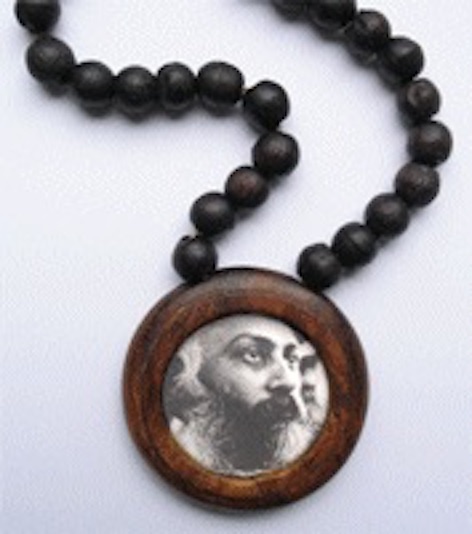 The Price of Admission? Sannyasins committed to four undertakings: to wear only ‘sunrise colours’ – red, maroon, orange, cerise; to don a set of beads carrying the master’s portrait – the mala; to meditate for one hour a day; and to adopt a new name chosen by the master. All in all, it offered the chance of a fundamental reset, a fresh beginning. Yes, I was ready for that, too.
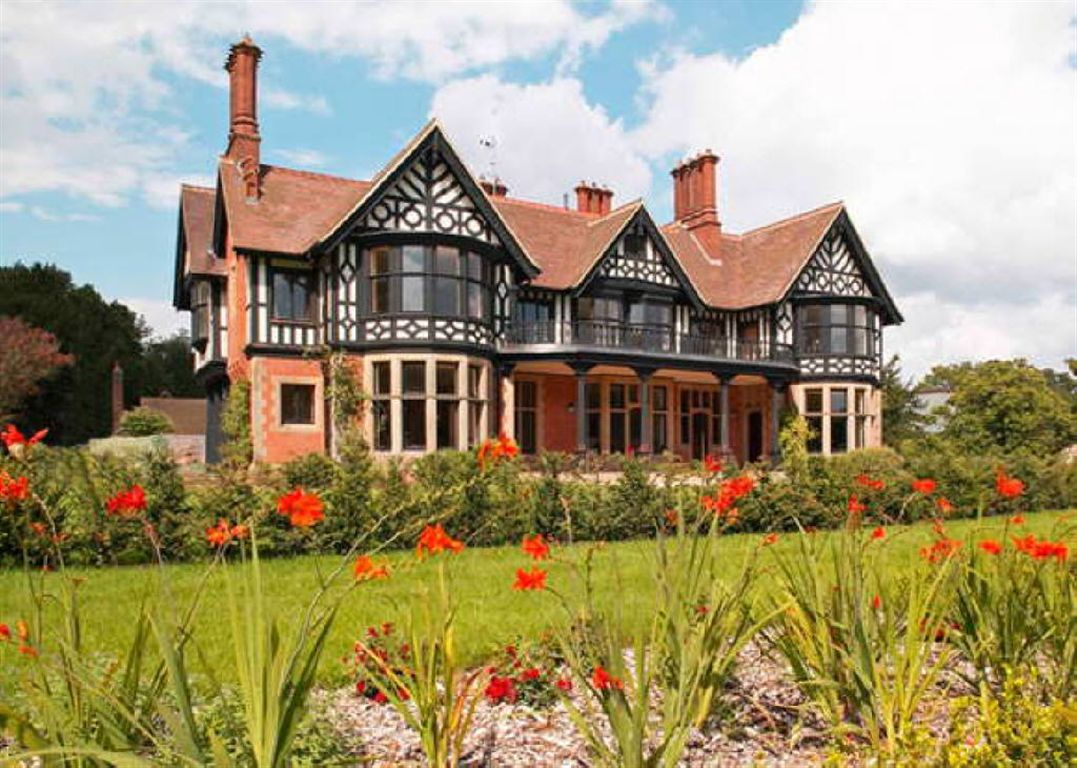
Sannyas Central in England was called Medina Rajneesh, a large property deep in the Sussex countryside, built around the turn of the twentieth century in the Tudorbethan style. Its original purpose as a preparatory school for boys remained much in evidence, though now overlaid with a playful new age wackiness, which in the couple of years of the commune’s existence had done much to instil a special charm. Had the term yet been coined, it could well be described as Hogwartian; it was a very British fantasy of communal living.
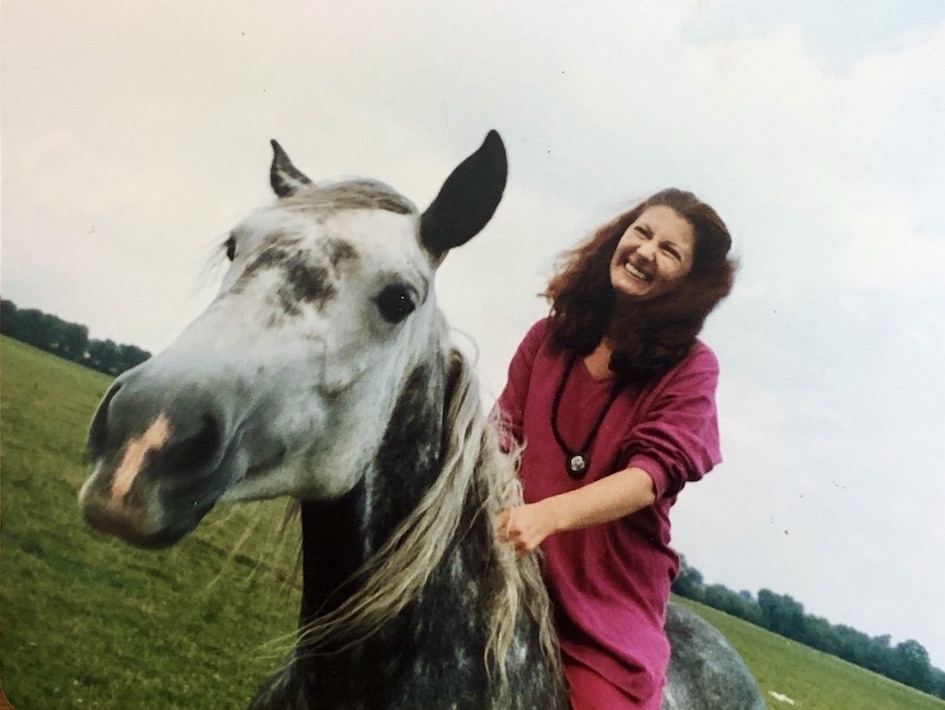
My first visit came just a few weeks after I had started to attend gatherings in Oxford, still getting to know the ten or a dozen local sannyasins. Molly, who hosted our weekly meetings, was to be initiated with her new name, Sohani, so we piled into a small van and headed across country. On arrival, I had my first taste of the visceral power of a whole community dressed in red, like plunging into a collective energy field. All was soft, warm, loving – if only I could allow it in. The evening sannyas-giving ceremony culminated in a marvellous, ego-stopping dance, for which the excellent resident band played a succession of simple devotional songs that tuned us all onto the same delicious wavelength – the way of the heart. When the music stopped, all merged into a lovely pile of bodies, hugging and being embraced. I was utterly bowled over. “This is where I want to live,” I told myself, “this is how I want to be.”
Just a few weeks later, it was my turn. “Where does your name come from?” I’ve often been asked, as the apparent mismatch between my name and national identity invites an explanation. This allows me the cheeky reply: “It came in the post.” I’d received a large envelope from Oregon, USA, addressed to Swami Antar Hafiz. This was to be my new name, printed at the bottom of an embossed certificate, together with a helpful guide as to its meaning: all male sannyasins were Swami (women were Ma), which implies being master; Antar means ‘Inner’; Hafiz is a Sufi word for God, in his aspect as preserver. This was a lot to swallow!
Many sannyasins can relate how they were personally initiated by the master’s mystic thumb, pressing into the third eye point on their brow, triggering a precious glimpse into transcendence. I would have to make do with a deputy digit, courtesy of one of the big-haired mommas at Medina. But I had made my jump: I had elected to submit to the will of a purported enlightened being, and to the community dedicated to his vision, as directed by his earthly representatives.
 Bhagwan, it’s worth noting at this point, had responded to the feminist moment by appointing a team of women as principle directors of his organisation. Chief amongst these, Big Momma herself, was Ma Anand Sheela, officially Bhagwan’s secretary. Medina was headed up by Ma Poonam, a benign dictator. This was in fact Matriarchy in action.
The day after my sannyas ceremony, I was invited to join the entire community on a trip to London. Much to my embarrassment, I was chided by Poonam for wearing a black donkey jacket: my transition to red-ness was not yet complete. We were set to parade through central London, to announce the launch of Britain’s newest newspaper, the Rajneesh Times, and to present a gift of flowers to the visiting vice president, George Bush. This was a very different demonstration to any I had previously taken part in! Despite my lack of red coat, I joined in with the collective convulsion of happiness, as we paraded our message of ‘Love, Life, Laughter’ through the streets.
I returned to Oxford with my beads, sifting out any noncompliant clothing from my meagre wardrobe, and devoted myself to cultivating my new identity. I was grateful to have the support and encouragement of the local sannyasin community: small though this was, it fostered a sense of group belonging through a regular programme of gatherings and meditations.
Bhagwan had developed a wide range of meditation techniques which differed markedly from the traditional model of silent sitting, cultivating a state of detached watchfulness (vipassana). The chaotic lifestyles of modernity required a new approach; there was simply too much going on in everyday life to expect the psyche to arrive readily at stillness. Instead, a vigorous, rhythmic soundtrack encouraged the fullest expression of thoughts and emotions, via a succession of physical exercises, before subsiding to a more quiescent state. In short, they tended to involve noisy cathartic expression, definitely not the sort of thing your neighbours might willingly tolerate.
There were techniques more suited to domestic practice, but for these hardcore methods, notably Kundalini and Dynamic, we needed to hire a local community centre. Afterwards, lying down in a sort of afterglow, we would listen to a recording of Bhagwan speaking, allowing his voice to resonate in our clarified consciousness. Then we would pack up the hall and head for supper. Meanwhile, Sohani had remained at home preparing a wonderful feast for us all.
For me, it amounted to a marvellous package, in which the shared meal, the ritual feast, was by no means the least important. After the mental and emotional clutter had been acknowledged and allowed full expression, what remained was a receptivity, an open-ness, and a sense of gratitude. These were all gifts which might be shared over a meal prepared with love. It was a proper communion.
For an extra blast of transformative Bhagwan energy, a weekend workshop at Medina was recommended. This was a big source of income for the Commune: a wide range of seminars and trainings was offered, led by a team of adept therapists and facilitators. For someone like myself, habitually unemployed, this posed a financial challenge. Making this explicit, I was instructed by Poonam herself to get myself a job.
There is a big difference between getting a job and committing to a career. For some reason this escaped me entirely. Hitching to Reading to see my family one day, a driver suggested that I should become a nurse. This was not something I had hitherto shown any interest in; nonetheless, I accepted this as Cosmic Advice, and duly applied for a three-year nursing training at the John Radcliffe hospital. Rather surprisingly, I was accepted. When, shortly afterwards, I was informed that second thoughts had been had, I made a determined effort to reinstate myself on the course. What was I thinking?
It was soon apparent that nursing, estimable profession though it be, really wasn’t what I wanted. Put most simply, I couldn’t be a servant of two masters. There was something I was most keen to do at Medina, and my demanding work schedule just wouldn’t allow the necessary time off. That was the Satori Event. “Tell me who you are?” Well, I definitely wasn’t going to be a Nurse.
The dynamism of emergent spiritual and religious movements is generally expressed through a narrative of expanding frontiers, be these internal or external. Sannyas, it soon became apparent, was not in the business of remaining in the same place. It was already two years since its centre of operations had uprooted from the legendary ashram in Poona, India, to enter a radically new phase of activity. The emphasis was now on building a new society from scratch, a model community in the middle of the Oregon badlands.
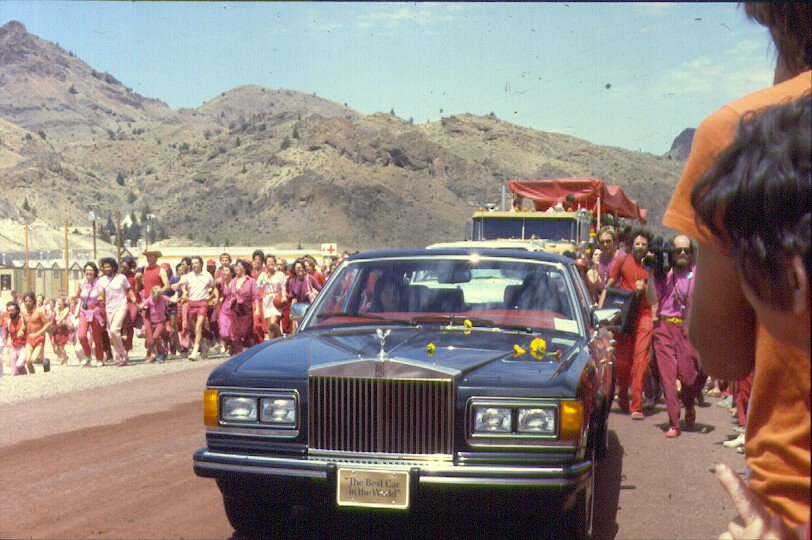
An extensive property had been purchased – the Ranch, also known as Rajneeshpuram – space enough to manifest the boldest of dreams. To meet these new circumstances, hair was to be trimmed back, flowing loose robes were exchanged for thick puffa jackets (red, of course) more suited for the fierce Oregon winters, and practical skills such as construction and roadbuilding were enthusiastically embraced by quondam pioneers of spiritual exploration. True to feminist form, women were allotted privileged status in controlling the heavy diggers and earthmoving equipment. Happy smiles remained in place; team spirit was overflowing in the thrilling videos we watched, relaxing after Sohani’s delicious dinners. See the hillside explode, to make way for the new runway for Air Rajneesh!
Bhagwan himself had gone into silence. His presence on the Ranch was restricted, apparently, to a daily drive-by in one of his growing collection of immaculate Rolls Royces, an opportunity to greet his slow but steady progress with outbreaks of frenzied joy. It was very much Sheela’s show: she called the shots, quite literally. Having provoked some confrontation with the local residents, selected commune members had been equipped and trained in firearms use, a red-clad police department to be known as the Peace Force.
Furthermore, the easy-going exploration and expression of sexuality which had been fundamental to the sannyas lifestyle had been substantially reined back, as a clear-sighted response to the AIDS pandemic. Sheela had showed up in London to share her unwelcome message: obligatory condoms and rubber gloves for all sexual contact.
 Our little centre in Oxford was under some pressure from Poonam, for not being dynamic enough. Perhaps Oxford was simply too much of a ‘head-town’. I took up an invitation to visit our Bristol equivalent, Udgatri, which had recently acquired a substantial property on the side of Brandon Hill, to see what might be possible. This was a decommissioned police station, with plenty of space for group meditations and gatherings, as well as still boasting a couple of lock-up cells. About a dozen commune members travelled in daily from their shared house, pooling their energy and skills to create a welcoming space for the flourishing local sannyasin community.
Most exciting for me was the delightful little café, with access to an outside patio area, which was evidently just waiting for the right person to take it in hand. While I was there, I took the opportunity to bake a cake, which went down well.
But perhaps there was another café opportunity in Oxford. As I’d anticipated, the intimidating regime imposed by the Uhuru Women’s Collective had driven away all but a hardcore of committed supporters and guilty men. The café had been obliged to close for want of custom, opening only for special women-only events. It seemed a terrible shame, given the amount of voluntary effort that had gone into refitting the premises. From a friend – okay, a girlfriend (!) – I learnt that a new collective had formed, men and women both, proposing to rent the premises under the name Wholemeal Café. Allowing my misgivings to be overridden by womanly wiles, I agreed to help out with cooking duties.
The Uhuru Women, learning of this outrage, stamped their Doc Martens down hard, demanding that I be purged from their premises. Wholemeal responded with admirable principle, declaring that it was their right as renters to conduct their business without interference. The upshot was, the fledgling café closed down, and the premises once again reverted to sorry desuetude.
I had managed to close down the local community café. Here, surely, was a karmic debt waiting to be redeemed.
It felt like time for me to move on. Funds I’d saved from my brief nursing career had been spent on a ticket to the Summer Celebration on the Ranch, a more-or-less obligatory token of my commitment to the faith. It was understood that I would move to Bristol, to Udgatri, on my return.
The Celebration, held under the wide, suddenly very hot skies of the Oregon semi-desert, certainly provided an expanded horizon for me. Thousands of red-clad devotees, all in one place, and I was a part of this awesome undertaking! Bhagwan appeared each day, to sit in silence with us, and we celebrated our good fortune in being in his presence. I explored the rapidly expanding township, took part in the daily meditation program, enjoyed the generous meals served up by the extremely efficient commune kitchen, and helped out with the washing-up operation afterwards.
Meanwhile, Sheela was engaging with representatives of the worldwide movement, laying down the template for the next stage of its evolution. When I arrived back in Bristol, to take up my place as a proper commune member, it was to the news that time had been called on this little centre. In just a couple of weeks all who wished to would be moving to Medina. Centralisation was the new policy.
I had barely time to get used to the strangeness of not having my own room to take refuge in, barely time to accustom myself to the responsibilities of café management. Still, this was very much a culture of ‘one day at a time’. I would get used to that. Two weeks later, I was on the bus headed for Medina, alongside my colleague, Jivan: ‘two thin cooks’.
 I was very much a new boy, and was allowed the privilege of a guided tour of the estate. Apart from the main building, which housed the kitchen and eating areas, plus two storeys of dormitories, various other structures were clustered around the entrance driveway: a smaller building dedicated to the 20 or so children, for their sleeping and teaching needs, a laundry, a small shop selling knick-knacks and sweeties, a communal clothes store, and an extensive garage caring for the disparate fleet of motor vehicles pooled by residents. Slightly removed was a complex of newer structures reserved for therapy group activities.
There was, I was informed, one person I really must meet – the resident witch, Jaya. Jaya was currently Tools Mama, supervising the communal store of useful implements around the back of the garage, making sure that each item returned to base after being used. It would have been easy to mislay things in such a large household! But she was also available for on-demand psychic readings. We introduced ourselves, and a tarot pack was produced.
The first card I pulled out was the Queen of Swords – swords, the suit for mentality, the intellect. “Ah, the Old Nag,” she observed, with a gentle Irish lilt.
 Second card: The Fool – Zero the Hero. “And that’s you,” she said.
“No more cards. Two’s quite enough.” She was, of course, absolutely right. I have been busy with this particular conjunction throughout my entire life.
I was happy to be set to work on kitchen duties. Down in the basement, to sort out a fresh delivery of provisions, I met an ebullient young Italian woman named Premo. She struck me as being very much at home. As I recklessly wrapped sticky tape round and around an unruly box, she called me to order: “You think the commune’s made of money?”
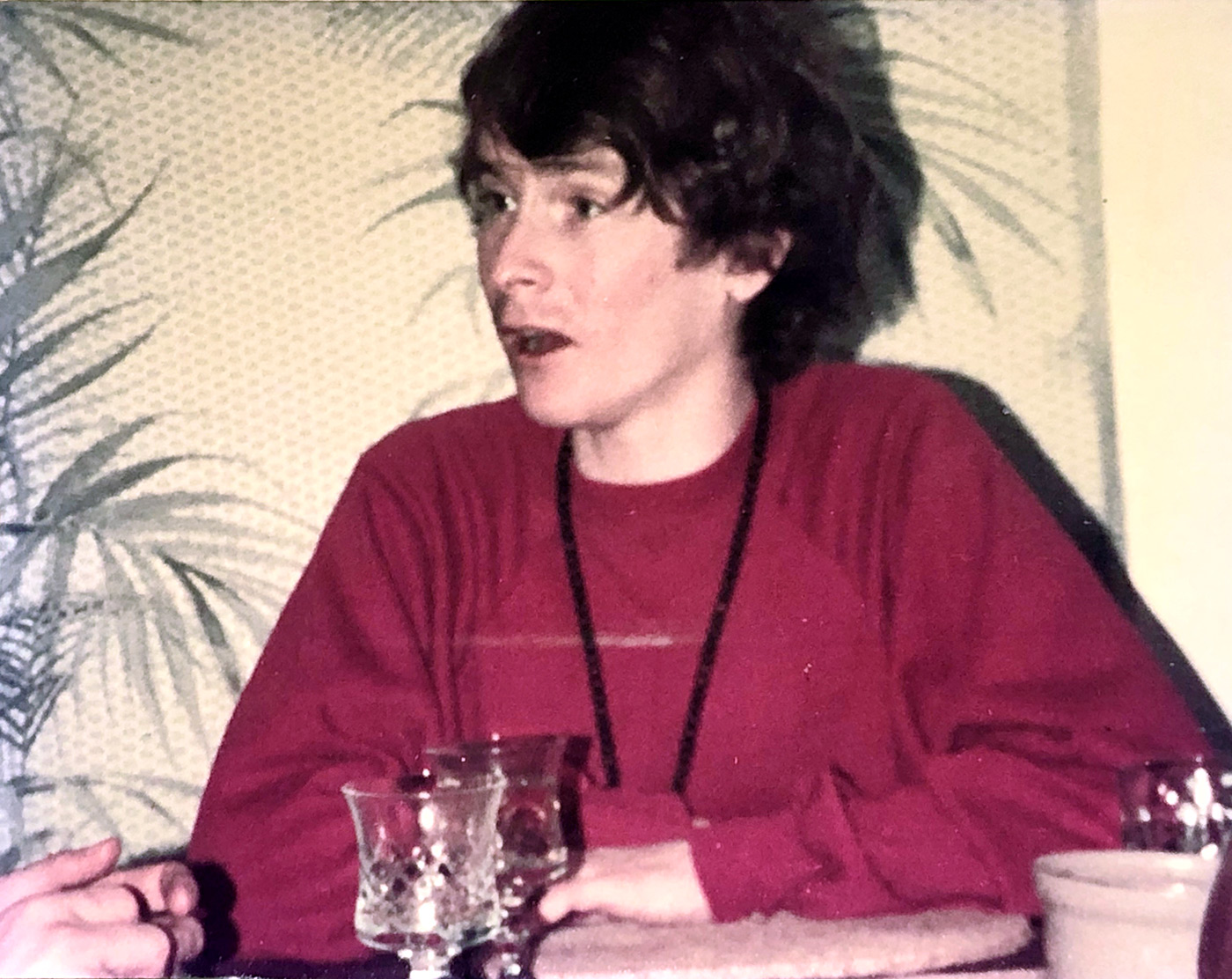
I’m glad to say that I have remained in touch with Premo, on and off, down the years. Asked to contribute to this current book, she was kind enough to provide the following impressions of her own time at Medina. She had evidently been living there for some time before I showed up, after having settled in London following taking sannyas in Poona.
Medina was a true dreamland for me (and surely for many of us) – in spite of anything that could be said about Poonam and some of her ways. I worked in the kitchen from the very beginning and for quite a long time; when I asked to join the Commune I was first told that I could do so only if I got an outside job, and for a while I worked with a catering company that had an ongoing gig making meals for construction workers at building sites.
Every day I would leave at 6am in the misty, chill Suffolk morning and spend 7 hours frying eggs and bacon and heating up baked beans from gigantic cans, making toasts, then washing dishes and starting the midday meal preparation (more gross stuff like macaroni cheese, deep-fried things, and such). During the weekend I would help in the Medina kitchen.
After a couple of weeks, Vira – the tiny, sprightly German powerhouse who ran the kitchen at the time – told Poonam, “You know, I really need Premo in the kitchen,” and Poonam replied, “Okay. Tell her to quit her job.” I had tears in my eyes that afternoon when I received the news, it was one of the greatest days in my life.
Medina kitchen was impeccably organised but I added my own contribution when I colour-coded all the cleaning supplies and sponges and cloths – in order to ensure top hygiene standards – and even made a laminated board illustrated with drawings that showed all the purposes of each colour sponge or cloth. Some people were very resistant to the colour-coding, though.
On warm days we would take our cutting boards, knives, aprons, and bins full of produce, and we would go sit outside in a vivacious and giggly circle, prepping the veggies and yakking and laughing and gossiping away (not the ‘mean’ kind of gossip, but more of a quite loving and light-hearted storytelling).
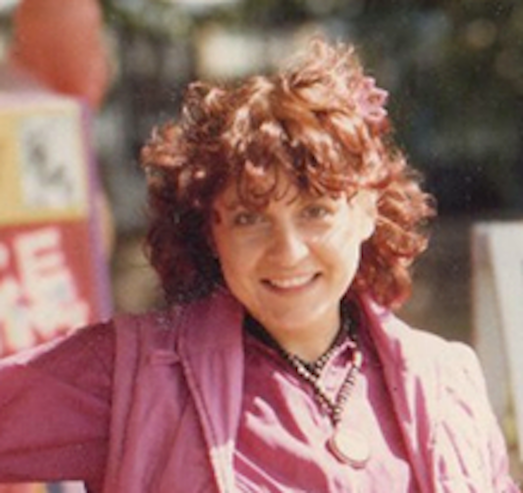 I remember one funny episode related to the cooking of spaghetti: I was horrified when I saw that the spaghetti bundles were cut in two “because they were too long to fit” and because “they would cook faster.” I took a bundle, climbed on top of the cooks’ stool (our stoves were high, and some of us cooks were tiny) and demonstrated how it’s done by circling the bundle halfway down its length with both hands, giving it a little twist in opposite directions while holding it right in the middle of the boiling pot, and then releasing it so that it would fan evenly, gently sinking into the water as it softened. Premananda looked quite impressed and said, “Wow! She’s done that before!”
Veggie shopping was my favourite: We would take a flatbed truck to the wholesalers’ farmers’ market and load gigantic amounts of fruit and veggies and fresh dairy and all sorts of things. We had the most amazing cellar below the kitchen, a real labyrinth of cool and well-aired stockrooms.
Also, it was amazing that we dined in these spectacular rooms, hand-decorated with vintage stencils of birds and vines and foliage, with giant bay-windows… I loved them!
The menus were always incredibly varied and featuring dishes from so many different traditions – from Yorkshire pudding (vegetarian version of course) to lasagna to Indian curries and Japanese delicacies… And the bread! Oh my god, the bread!!! We had amazing bakers. On visitors’ Open Days we had Cream Teas with the most incredible spread of delicious cakes, scones, homemade jams, pies and rolls… we as residents were not allowed to partake, as visitors of course had priority… but it was soo good to look at it all!
It’s a delightful evocation, in which Premo’s understanding of the central role of the kitchen in commune life shines through clearly. Mealtimes are an opportunity for coming together, to be enjoyed in a civilised and relaxing atmosphere.
It’s also evident that not everyone really knew what they were doing, that a constant process of improvisation and adaptation was in play. At the time I really didn’t appreciate this: I was simply overawed by the complexity of the operation, and lacked the self-confidence to assert my own experience.
But perhaps the strongest flavour here is one of nostalgia, for a lost paradise. Already, by the time I arrived, this was visibly slipping away. Medina, suddenly obliged to find room for commune members from all the smaller centres, now closed, was bursting at the seams. The cosy community that had grown together, the close-knit bonds of friendship built through shared endeavour, was confronted by drastic upheaval.
Poonam herself had been deposed, ordered to taxi-driving duties on the Ranch – doubtless in the interest of her spiritual growth. A colleague of Sheela’s was now in charge: she seemed genial enough, but this was an uncertain new world. I’m sure I wasn’t the only one to feel challenged by the unfamiliar situation I now found myself in. Nonetheless, the governing ethos was to Celebrate Everything – so that’s what we did. We understood that sannyas wasn’t supposed to be an easy ride. This was a daredevil adventure into the unknown, trusting in the wisdom of the Master.
It soon became apparent that there was a master plan to co-ordinate all the communes around the world in a single, tremendous transformational effort. Apart from the Ranch, there would be just one multi-campus European commune, together with similar centralised communities in Australia and Japan. The specific plan for Medina was to convert it back into a school, where all the children from the European communes could receive their education, freeing their parents to concentrate on their spiritual engagement. There was no time to lose!
The beautiful stencilled paintings, so beloved of Premo, were amongst the first things to go, covered over in a uniform wash of brilliant white. The grand piano in the parlour was manhandled up the stairs, and the immaculately polished parquet floor was hidden away under linoleum sheeting, hammered into position by barbarous nails.
It was all change in the kitchen, too. In place of the lovingly constructed menus, respective of local foibles and sensibilities, there was to be strict co-ordination with the rest of Europe, using a three-week (later expanded to four) rota of recipes derived from the Ranch. This would ensure that there was no possibility of a sannyasin, travelling between the different nodes of the European commune, ever having to eat lasagne over two consecutive days, however much they might wish to. Chefs would have to learn the new regimen, and the ordering department adapt their purchasing accordingly. It should, in theory, greatly improve efficiency – at the cost, perhaps, of spontaneity and gaiety. In fact, as Premo reminds me, the Ranch-derived portion control bore little relation to local appetites: “We always had soooooo many leftovers!”
All of this was swallowed down, more or less without demur. The only hint of rebellion came with the order to abolish toast. Surely this was an assault on the very essence of Englishness, on a fundamental bastion of individual freedom? Just so, Ma. Get over it, Swami.
I was kept busy in a variety of roles, not just in the kitchen. As Christmas – which was, to the immense disappointment of the kids, no longer to be observed – approached, I was part of the construction crew, spending the week in London renovating a large house in St John’s Wood. That was fun: easy camaraderie prevailed amongst the equal mix of men and women in the team, and I felt no pressure to pretend to a muscular physicality which I didn’t possess.
Back at Medina for the weekend, I attended a commune meeting at which it was announced that I was to be one of five people to be despatched to Freiburg, to help with the building program there, in just a couple of days’ time. Where was Freiburg? I had little idea.
I spent Christmas day learning how to dowse: selecting a couple of copper rods from the Tools Store, bending them at a right angle, and then pacing a steady course over the lawns, registering the point at which the outstretched rods would suddenly swing together. We were attempting to plot the buried, and unrecorded, plumbing lines. Whether this resulted in a coherent, usable map I never discovered.
Very early on Boxing Day my companions and I were driven down to Harwich, to take the ferry across to Hook of Holland. As we closed in on the dock, we passed a disconsolate crew of picketers gathered around their brazier, outliers in the desperate combat with the Unions that Mrs Thatcher had unleashed.
Did it cross my mind that there might be some correspondence between Margaret Thatcher and Ma Anand Sheela, both exemplars of a new feminist-derived empowerment? I feel sure that I was too bleary-eyed, too wrapped up in the astonishing adventure on which I had been consigned. For the next few years the travails of the United Kingdom under its intransigent dominatrix would be little more than a distant rumour, of riots and royal jamborees.
Excerpted from the book:
 “I Am Cooking Something Else”
The story of Oxford’s legendary Magic Café
by Hafiz Ladell
ASIN : B09JRGGLPB
Publisher: Independently published (18 Oct. 2021)
Paperback: 252 pages
ISBN-13: 979-8492328382
Dimensions : 18.9 x 1.52 x 24.61 cm
amazon.com
amazon.co.uk
amazon.de
Related article
- “I Am Cooking Something Else”: The story of Oxford’s legendary Magic Café – Hafiz Ladell’s introduction to his book
- Interview with Dharmen on the ‘rise and fall’ of the Meditation Centres in the Netherlands
Credit for images to the author; Medina Rajneesh, mala, Sheela, Poonam (sannyas.wiki); drive-by (Sudhir de Gregorio); Sohani (Sohani); Premo (Premo)

Comments are closed.