

Devarupa remembers her last days with her beloved Chandradeva
Tuesday, 13 February 2018
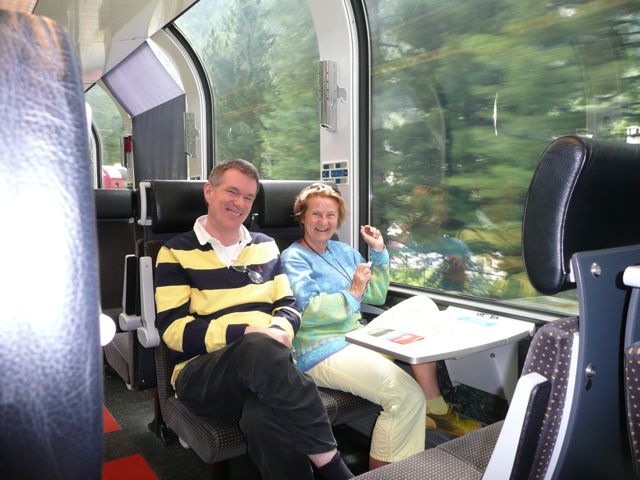
Late in the evening, Chandradeva and I arrive home in good spirits from Freiburg – back up ‘the mountain’ to Saig. It had been lovely to sit with friends at Taruno’s and plan another Osho meditation and dance evening in Freiburg.
I check the letterbox on the way in. We are expecting the results of a CT and PET scan, which are supposed to clarify the origin of the adenocarcinoma – the growth that had turned out not to be a pimple, and that was recently removed from above Chandradeva’s left ear by a dermatologist.
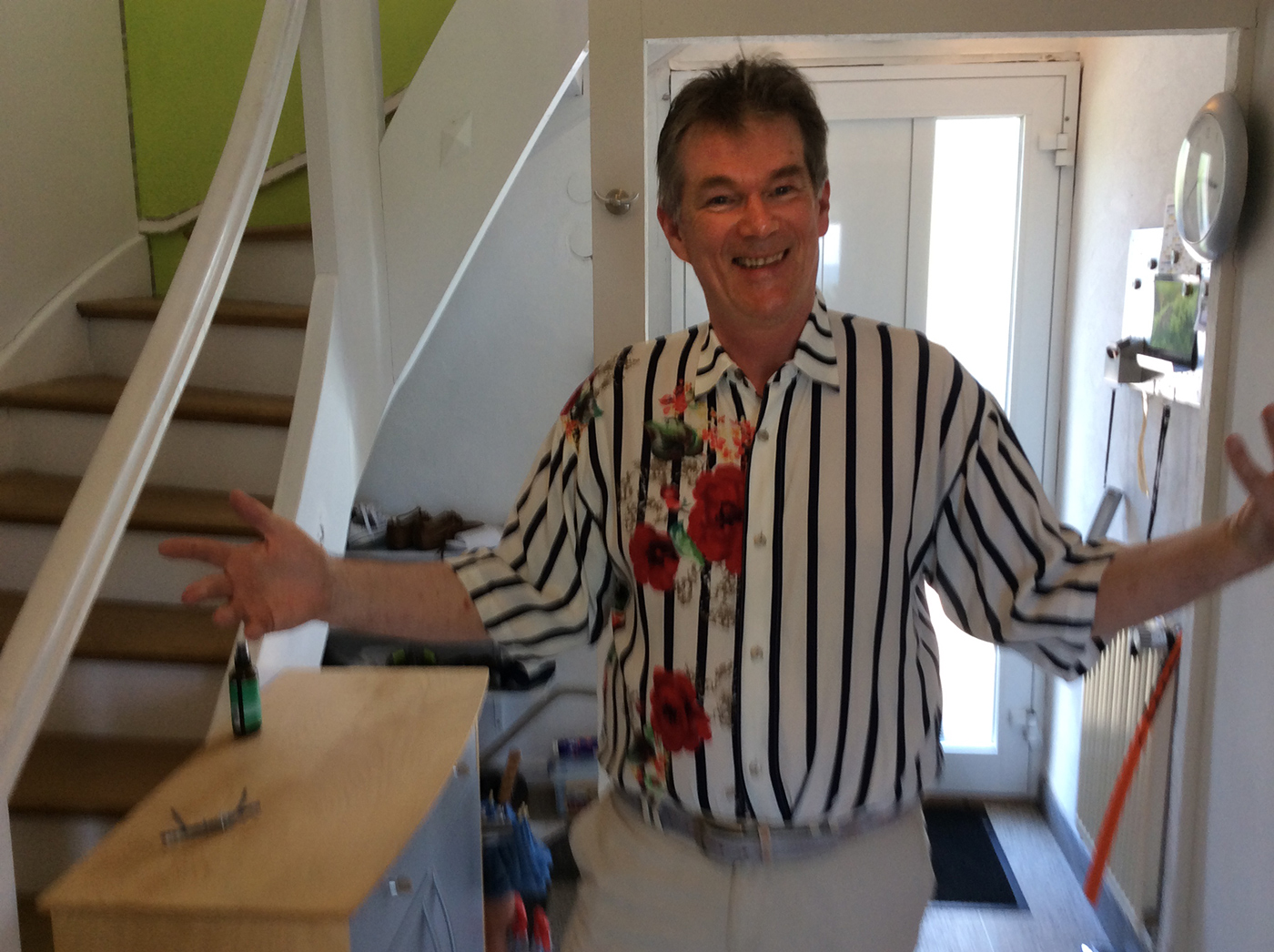
We both sit down on the oak staircase. Chandradeva begins to read, haltingly. “All these Latin words – you can’t understand any of it!” he grumbles, and sets the report aside in anger. Over his shoulder, I have already seen enough. My body is shaking, beyond my control.
“May I take the report with me and translate it?” I ask him.
He agrees, and as the night goes on, I no longer ask where the metastases are, but where they aren’t. The glandular carcinoma – whose precise point of origin would not be determined even later, thus receiving the name CUP adenocarcinoma – has spread to the lungs, adrenal glands, soft tissue, beneath the scalp, in the brain (as we will later come to hear), the lymph nodes and, above all, in the bones.
That explains the severe pain in his right hip and leg that has been plaguing him since December, and that grew worse during our holiday in Iceland in January, when he fell on the ice. All the tests and diagnoses up to that point had pointed in a different direction, while parts of the pubic bone and hip joint were already beginning to disintegrate.
This is not my role, I protest inwardly, as the following day I read the ‘translated’ report and explain it to Chandradeva as far as my medical understanding allows.
“That means I may not be alive in six months,” he says.
“Yes,” I reply. “That’s what it could mean – unless a ‘miracle’ happens.”
There is a lot to do on the practical side. The fact that the first appointment with an oncologist at the University Hospital in Freiburg cannot take place for another two and a half weeks leaves us both stunned. My calls to private oncologists in the area secure us another appointment – this time with a three-week wait.
I read aloud Osho’s insights; which method heals which of the five bodies. Chandradeva chooses allopathy for the survival of the physical body; he is willing to undergo radiotherapy and chemotherapy. Hypnosis and meditation are his chosen tools of transformation – they are to “invite the miracle.” Osho cites complete trust as a condition for the effectiveness of hypnosis, and non-identification for complete recovery through meditation.
He wants to do everything “to get well again.” I promise him that I will support him in all his decisions, even if I would make different choices.
Chandradeva and I each wait for the specialist appointment in our own way. He seems calm, carrying on with his IT work. There is not much he wants to say about his illness. I have the impression that it is enough for him that I am there – present for him.
The changes are subtle – and crucial.
In my daily cooking I pay even closer attention to living foods. Turmeric, selenium, and all the fortifying supplements that seem safe to me become part of our daily routine. Every meal a small celebration: a table runner, fitting plates, flowers, fragrances – the colours of the food. My usual chatter falls away. Sentences become brief, precise – there is a great deal of space for listening, for letting things settle.
One of the few questions I ask of him, “What do you want to live for?” He listens, remains silent, has no answer.
Not-knowing becomes a constant – an anchor for being fully, vitally present. At night I sit for long hours at the computer. An inner compass begins to work like a precision instrument – clicking through here, abandoning a thread there, sorting through a flood of information, a flash of recognition when something important for the healing process is found – like, for instance, the man who was then going to become ‘our’ hypnotherapist – and when confusion over conflicting interpretations and viewpoints is cleared.
I am also in ongoing exchange with my sister, who is a doctor. However cautious her prognosis, her concern leaves little room for illusions.
A list of questions is taking shape for the first consultation with the oncologist.
The consultation begins with his assistant: the removal of a further tumour is meant to provide more clarity about the nature of the primary tumour, she says. Surprised by my detailed questions, she calls for the senior consultant. My impression is that neither of them is truly listening. But I stand my ground, making it clear that I have questions that are arising from my research – because a human life is at stake!
While Chandradeva is waiting to get a blood test – he is now in a wheelchair as he can no longer bear weight on his right leg – I deal with paperwork and, in passing, meet the senior consultant, this time in an entirely different way. He smiles at me, without a mask. In that moment I see the shyness of a boy who does not really know, of someone who is asking for understanding. I am truly meeting him now. I tell Chandradeva about it, tears running down my face, as we hold each other’s hands.
We come home with the knowledge that all treatments from now on will be palliative. In the oncologists’ view, there is no cure for Chandradeva’s body.
Wednesday, 28 February
On this day we meet Dr Marc Betz for the first time. A former paediatrician, his primary tool today is what he calls Medical Auto-System Hypnosis. Both Chandradeva and I feel a definite “yes” towards this doctor and to this powerful tool. Chandradeva is so moved that his tears flow almost the entire evening.
During the first and only session with Dr Betz, Chandradeva connects with an inner guide in the form of a white stag. This guide will stay with him until his death. This connection also allows him to access the thoughts which, in his view, have led him to invite his own death.
Dr Betz becomes a valuable support for me as well. My focus is to be able to speak even in moments of shock, and to respond to what is happening rather than reacting or freezing up.
With the second oncologist, a few days later, there are again tears – this time of relief and gratitude. This doctor is listening. He answers our questions, and makes the first treatment proposal: the hip and pubic bone are to be treated with radiotherapy first. This should relieve the pain, halt the tumour growth, and over the coming months restore some stability to the bone. Chemotherapy would only be considered as a second step, along with further investigation of the tumours in the head.
Chandradeva finds it difficult to tell his family about his cancer. Both his parents are still alive. He is particularly concerned about his mother. We weigh up what is most loving and what is reasonable. Three weeks after his diagnosis, he shares the news with his sister, his brother and his parents.
Chandradeva has often told me how important they are to him and how grateful he is to his parents that they had taken the news of his commitment to Osho as an opportunity to assure him of their unconditional love and support. This cannot have been easy, especially for his deeply Catholic father.
With a sense of urgency, in the first weeks after the diagnosis I ask Chandradeva to give someone power of attorney, write a living will, and a testament. Despite his resistance, I insist on this way of taking responsibility. When the appointment with the notary for the testament falls through twice,
he eventually writes down his wishes in his own hand.
By now it’s already late March – Easter – and Chandradeva is home for a few days before the next round of radiotherapy. His sister is visiting for two days. It matters to me that both of us read through the testament and witness it. The greater closeness that Chandradeva’s illness has brought within the family should stand the test of time.
Easter Sunday
On Easter morning, during breakfast, he suddenly collapses with a heart rate of 250 beats per minute. A paramedics team and skilled doctors manage to keep him alive. It comes as a shock to me when the doctor in the ambulance asks whether he should be resuscitated in case his heart stops. I hand her the living will and say “No.” I feel awful, unsure whether I am doing the right thing.
Upon arrival at the clinic, Chandradeva, who can now be asked directly by the doctor taking over, answers the same question with a clear “No.” I am relieved.
We drive – always with the wheelchair in the boot – to two hospitals we are considering for his subsequent chemotherapy. Chandradeva opts for an anthroposophical hospital, which combines the compulsory chemotherapy with compassionate care. I would have chosen differently for myself, but it’s easy for me to see that this hospital will be the best to support him according to his wishes.
The radiotherapy at Freiburg University Hospital is carried out as an inpatient procedure. He has now been sleeping sitting up for weeks because, despite the morphine, he is unable to lie down. For the duration of the radiotherapy, he is given an extra dose of morphine, which allows him to lie down relatively pain-free for those 10 minutes. For the rest of the day, he ends up being quite drowsy.
As a one-off attempt, the doctors want to do the radiotherapy while giving him a painkiller in tablet form, but it fails – and the radiotherapy is called off. We are devastated. I try to lift our spirits by pushing Chandradeva in his wheelchair into the clinic’s garden. A ward doctor walks past, stops and remarks how peculiar it is that he cannot lie down for the radiotherapy, whilst here we are, relaxing as I wheel him through the garden. I am so overwhelmed, outraged and upset that I cannot reply to him straight away. All I am capable of is to cut him off before he can say anything more and to interrupt his renewed attempt to speak, with that raised eyebrow and in his arrogant tone. He and the other doctor who is with him remain perplexed. Later, a voice inside me says, “That’s where I missed an opportunity.”
Chandradeva continues to suffer from painful sores on his buttocks. He spends his nights sitting in the wheelchair and sometimes spends hours wheeling himself up and down the ward corridor because he can’t stand the smell of cigarettes from his roommate.
The private room at the Paracelsus Clinic, set in the most beautiful spring countryside, is a relief. Chandradeva sleeps with the help of cannabis at night, yet he continues to lose weight dramatically in spite of it. I’ve taken carer’s leave. During chemotherapy I can be with him for most of the time. On the remaining days his sister Ruth, his niece Linda, and his brother Udo come to visit. The doctors see that Chandradeva is tolerating the chemotherapy well, but what I see is that day by day he looks more and more exhausted.
After the first round of chemotherapy, back at the University Hospital in Freiburg, they are preparing him for the third stage of the treatment. They are trying to fit him – in vain – with a mask for a precise radiation of the brain tumours; the superficial tumours on his head have grown enormously and increased in number. There is no time or room for experimenting that such a complex fitting would require. The three men working on his head are under enormous pressure. So much pain for everyone involved!
Chandradeva is supposed to spend a week at home to gather strength for the second round of chemotherapy. But… Instead, I call the palliative care unit at Freiburg University Hospital again. They have heard my ‘distress’ before, and with their clarity and support had helped me get him admitted to the radiotherapy department, even though just a few minutes earlier it had seemed impossible. These wonderful, humane moments, triumphs of the heart.
This time I am promised a bed for Chandradeva for the following day. He asks me, “Do you think I’m going to die?”
“Yes, I do,” I say.
There is no answer why his life keeps on going, because I don’t see that same uncompromising strength he used to display every day for his work reflected in his efforts to get better and carry on living.
In the morning, before we set off for Freiburg, Chandradeva looks at me, “I have opened the space for death,” he says calmly. This sentence allows me to sink back, relaxed.
“What has helped you the most?” I ask in return.
“When you said to me, ‘We are all dying,’” he answers.
It’s ten days before his death.
Not whether Chandradeva dies, but how we live – or die – these days: that’s my anchor in these weeks. I take the liberty to help shape this atmosphere. My only wish is that our hearts be whole. For that, I’d do anything.
One day, out of exquisite stillness and ordinariness, these words come, addressed to him, “Chandradeva, everything is love.”
The words fall into him. They become his words. He becomes those words.
After our arrival, the doctor in the Palliative Care Unit sits with us for at least ninety minutes – asking, listening, explaining that Chandradeva has entered the final phase of his life, that she will do everything to support him in what he wants and how he wants it.
Alone again, we can barely take it in; we wonder, we smile – gratitude, joy. So this is how it can also be! Relaxed, timeless, everything relatable, space – so much space for everything.
In the days that follow, he says to me, “Please make a video of this. Not only the dying should be treated this way – everybody should.”
Sunday / Monday, 6–7 May
Chandradeva would like to see again some officials from the Freiburg Building Authority, his employers of the last few years. We ask the doctor whether for this gathering we could use the common room of the palliative unit.
“Of course,” she says, and immediately gives examples of what that room has already been used for. “And last week we had an emergency wedding there,” she adds with delight.
“What is an emergency wedding?” asks Chandradeva, intrigued. She tells us that, if necessary, the palliative unit can take on all the preparations and paperwork for a wedding – and that it can be held within twenty-four hours.
He is delighted, and in a playful way lets the doctor understand that he would very much like that, but that it was me who was not so willing. He fills the moment with such tenderness and lightness that my “no” starts to waver. Suddenly, I realise that a wedding doesn’t necessarily mean opening a new door, but that I could bring a turbulent relationship to a close with a loving gesture on both sides.
Tuesday / Wednesday, 8-9 May
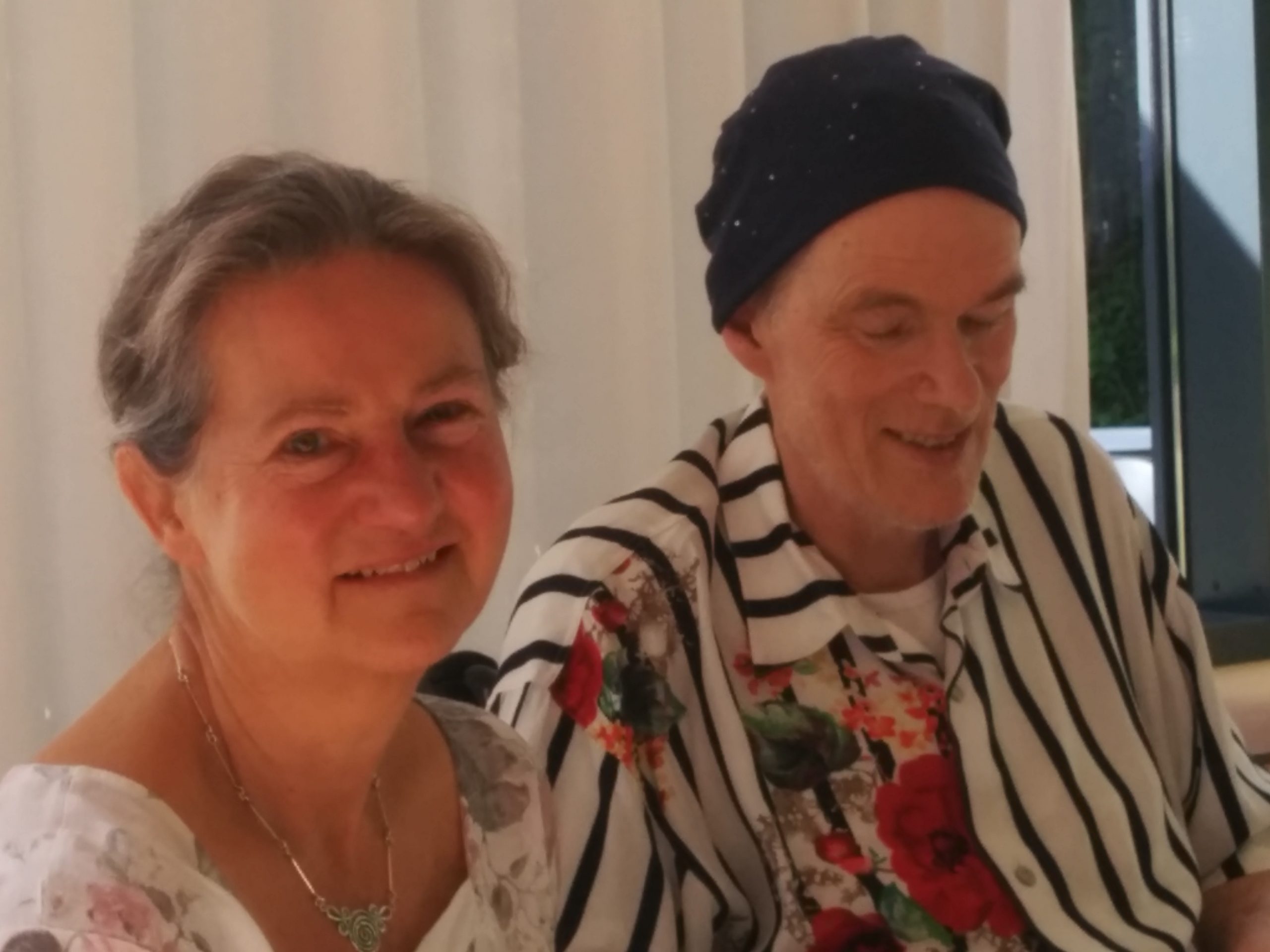
And so the next day, instead of the Building Authority, it’s Chandradeva and I as bride and groom who sit in the common room of the palliative unit – with Garimo and Abhay as witnesses, along with other friends, the loving team of doctors, nurses, and carers, and not least the registrar (who had obtained all the documents from Austria and was herself celebrating her own wedding anniversary that day) – and we say “yes” to one another.
“Everything is love” – is his message to all the friends and acquaintances in the room.
On 9 May, the doctor does not, as announced, speak of transferring Chandradeva to a hospice; instead, a folding bed stands outside his room, number 6. An invitation for me to spend the following nights in his room and to be with him in his final hours.
Meanwhile our friend Premdas arrives from Denmark. He had returned from Australia, together with Deeva, to be with her father who was dying. He passed away just a few days ago, so Chandradeva and Premdas are now able to discuss how to bring to a close the project with the Freiburg Authority on which they had both been collaborating.
Friday, 11 May
In the morning, Chandradeva receives a letter from Marga, which I read aloud to him. She describes how, as her partner in a Satori group, he had helped her find her voice. After this letter he resolves to stop eating and drinking.
Together we listen to the Bardo texts by Maneesha and Sudheer. Afterwards he looks at me, radiant, “I almost don’t dare say it, but ever since we began listening, the pain has completely receded into the background – and the light that I have known from outside is now coming from within me.”
He wants to explain this to the doctor, who shortly afterwards enters the room. He is almost too weak to get all the words out, and instead takes the doctor’s face very gently in his left hand. She had clearly not expected that – and, somewhat overwhelmed, speaks of the euphoria that can be caused by withdrawal from food and water, and that he may reconsider at any time whether he wishes to keep to his decision. I fold my hands over my heart – a protected space that needs support in order to expand, to make room for all forms of tenderness.
Over the course of the afternoon, Chandradeva explains to Premdas and me – more in the form of questions than of decisions – how he imagines his farewell. What matters to him is that the song “There is so much magnificence near the ocean” should be played and sung, that there should be no grave, and that his ashes may be carried away by the river.
He is exhausted, but still able to speak from time to time. Together we decide how I should support him during the final minutes of his life. I am to remind him that he is the witness, and I am to do so in a loud voice.
Today I am crushing all his medication and draw it up into a syringe. Chandradeva swallows carefully, taking care not to choke. This has been happening occasionally for a few days now; it is frightening and painful.
Saturday, 12 May, 7 am
Chandradeva is no longer able to swallow his medication. His breathing pattern is changing. Around thirty breaths per minute now. His ability to respond with words or gestures is diminishing. An image of him emerges in my mind, as if he were giving birth to himself through his death like in a backward somersault.
This way of being swept up by a great force, to which one can either surrender or not, was also how my son was born. I feel the need to hold him in my arms. Finally, he gives the doctor and me his consent for a cannula to be inserted into his abdomen, which will supply him with a constant flow of morphine without him losing consciousness and without prolonging his life.
Premdas supports me with his knowledge gained from his fresh experience of assisting the death of family members. He explains to me that this particular breathing rhythm heralds the final hours of life; he reassures Chandradeva that he is doing a wonderful job of surrendering to such a big ‘let go’.
My hands try to let their warmth flow into his arms, which are growing colder and colder, as are his legs. His right eye rolls upwards, whilst his left keeps a constant gaze on me. There is no strength left to close his eyelids. A gesture of his shows me that he is disturbed by the bright light. I immediately lower the blinds, dimming the room.
Saturday, 12 May, 5:15 pm
It’s time for Chandradeva and me to be on our own. Premdas leaves. At the same time I feel uncertain. I don’t know what’s important now. Whilst talking to Chandradeva, I put on Klaus Wiese’s track Seed. I watch, feel, and ask if that’s alright with him. I tell him that I don’t know how best to support him right now, that I don’t know when it’s the right time to say the sentences we’ve agreed on. I don’t want to lecture him! He has leaned on me so trustingly. Can I live up to that trust?
And then I tell him that I am strengthening my own witness and that I hope that this will strengthen his. Holding his hand, I calm down – and then his breathing changes once again.
His powerful, effortless inhalation makes me wide awake – as if all his strength had returned to him… a long exhalation, accompanied by a hint of a “Yes,” which I receive almost euphorically. Now everything is simple. Our breathing rhythms merge; with every long exhalation my “Yes” resonates with his; the words come as they should: clear, joyful, grateful, tender: “Osho,” “Yes,” “You are the witness,” “You may now leave the body behind…”
The pauses between breaths grow longer – two or three times; then one final half-breath… the gentle, final ebb of his breath escapes.
I chuckle and cry softly, calling after him once more in a whisper that he should fly with Osho, that he is free, that he can witness everything.
Then silence… peace… my overflowing heart.
It’s a few minutes past 6 pm when I finally ring the bell. The nurse and a carer I have grown fond of come into the room. Unassuming and respectful, as always. Over all these days, they have helped me to maintain a balance between the simplicity and the uniqueness of dying. Chandradeva was my first teacher in this process. And what a teacher! His devotion – impressive, enduring. No one need fear such a death!
Whilst his body is being dressed by the two of them, I reach Taruno, who is inviting our friends who live in the area to come and say their goodbyes.
Wonderful, light-hearted stories are told all round, appreciation and laughter, Garimo’s tender holding and stroking – it’s almost midnight by the time everyone has left, and I am left alone with Chandradeva.
Then a nurse knocks gently at the door and asks if she may come in. She senses the room, looks at his face closely, takes me in her arms, quite unafraid to smile and to weep.
“What an energy,” she says. “You did this beautifully.”
This night, too, is full of wonder – a magically deep sleep, an empty heart in the morning.
From laughter and scars, a wreath of fruits.
Empty hearts rejoice.
Related article
Translation by Osho News – Download German original, 88 kostbare Tage (PDF)
Comments are closed.