

In this essay, Sugit compares the ideas of the Dutch philosopher Spinoza with Osho’s understanding (Part 2)
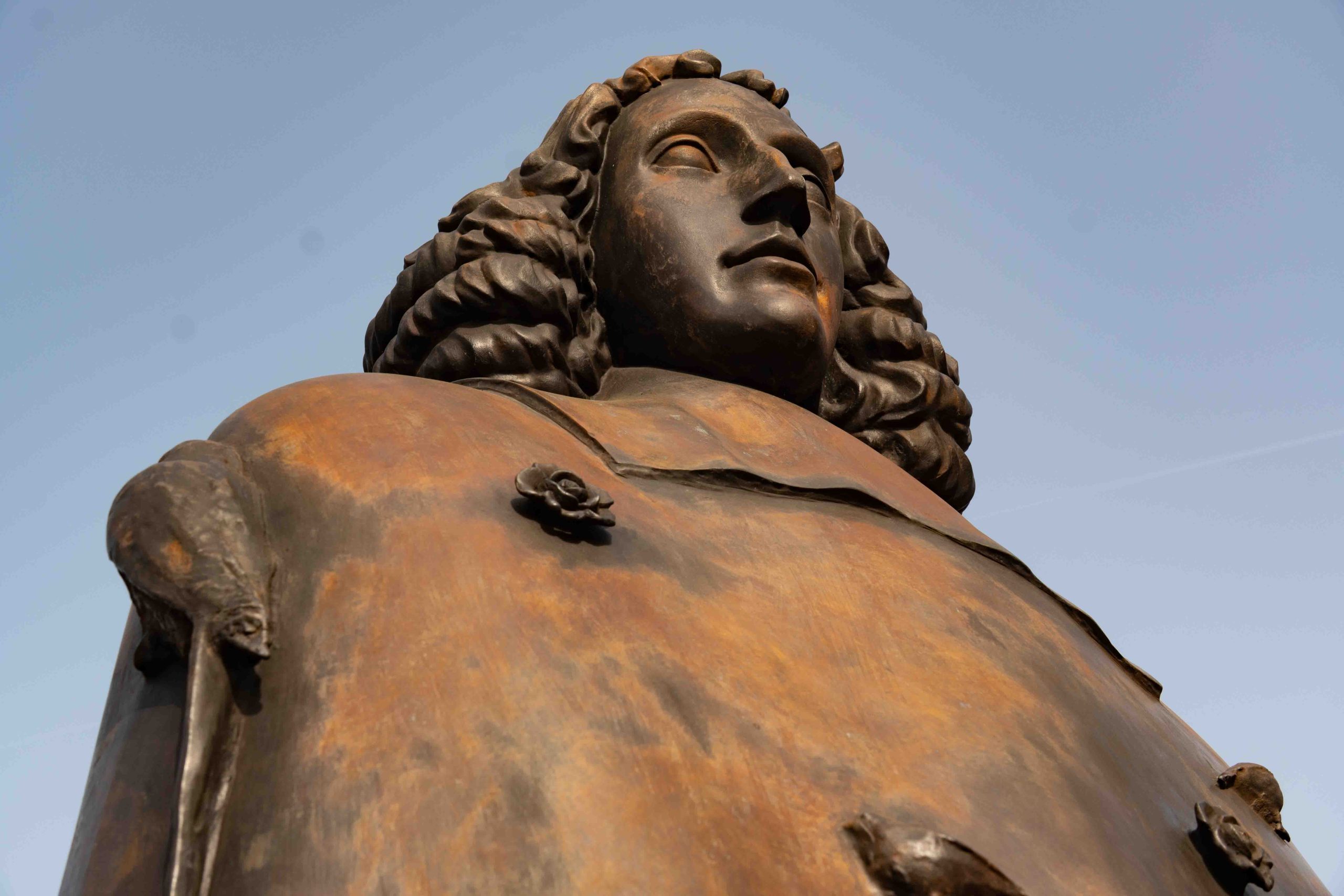
This is part two of a series about the Dutch philosopher Benedictus de Spinoza (1632-1677). The first part, Spinoza, A Rational Mystic? written by my friend and Dutch compatriot, Srajan, is a historical introduction, which is best read before this.
In this part, I will try to show the most important things that he asserts, in his own words, and why his ideas were and are the most radical of the Western Enlightenment. Ideas that have in fact not been picked up in our culture and that are eminently relevant. More or less implicitly I compare what Spinoza says with Osho’s work.
How I got into Spinoza
I became interested in (Western) philosophy during university. I had great respect for analytical philosophy, which was the mainstream in that context, and of course the European Enlightenment. All pretty square, but with some intuition of doubt: it dawned upon me that it was all a lot of words, and especially that, if it was any use, then it should guide an individual to “the good life”, which was missing in most of philosophy.
One of the towering figures was Wittgenstein and his Tractatus Logico-Philosophicus, and I was shocked when I found out that, after thinking that he had resolved philosophy once and for all and became a village school teacher, he had to come back and start over again.
Osho gave me time off from that chapter. His opinions about philosophers were generally damning and, in my mind, rightly so. Still, I always wondered if there would be some opening in Western thought for the call to ultimate freedom and response-ability from the East.
How is it possible that we, meaning my kind of people, the Westerners, are materially so almighty and spiritually so utterly poor?
- Consciousness is generally regarded as the most baffling problem in science.
- Body and mind are seen as unconnected, a complete dualism. At the same time the mind is supposedly the master of everything one does. If your body behaves badly (sins!), you are free to change that at will, if only you really wanted.
- Although in progressive circles the Bible is not the official book of law any more, our culture is still steeped in the idea of a Maker and his separate creation. A paternalism that shows up more and more in the disrespect for life and the natural world around us, or in misogyny, or in the ease with which other cultures are deemed unworthy.
How different are the ideas of the East; I feel blessed to have been exposed to Osho’s commentaries on all that. Enlightenment, whatever it is, is relevant and possible.
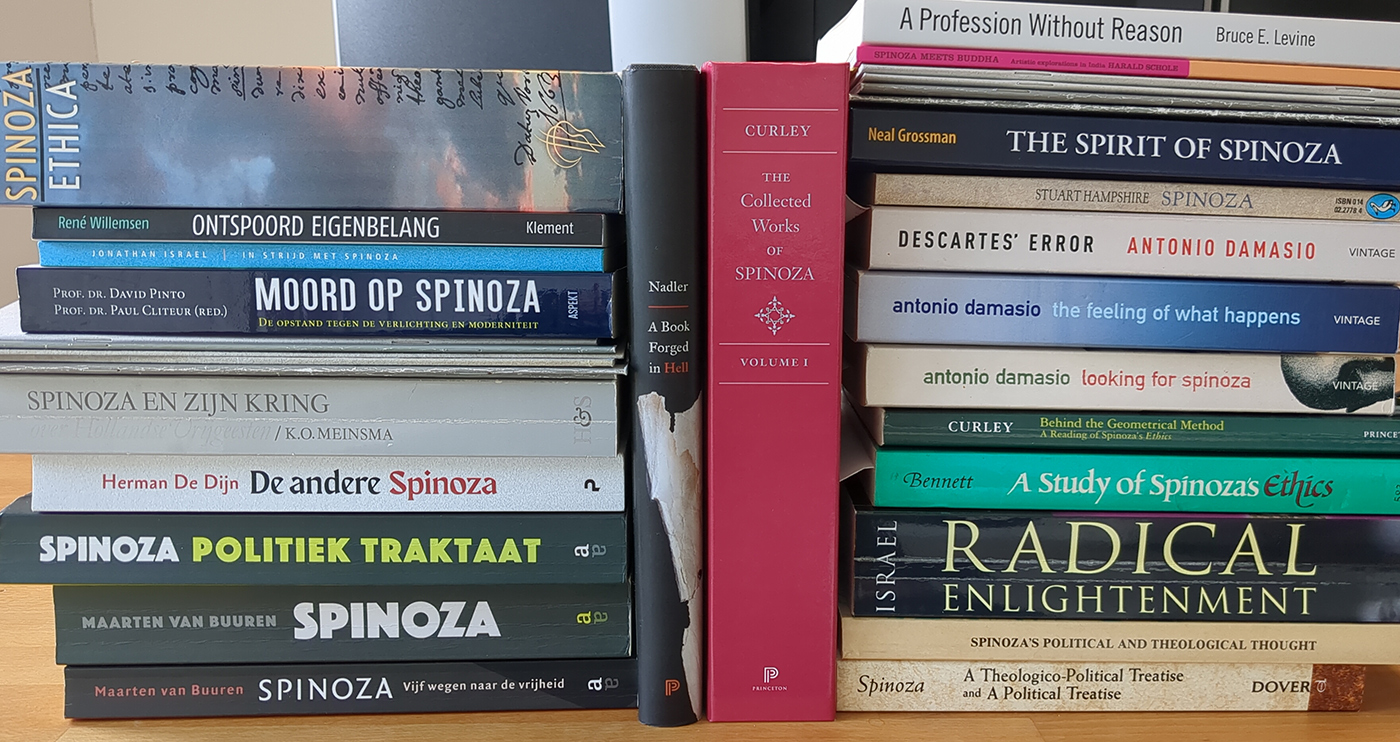
Some years after I met Osho I came across an 800-page academic book called Radical Enlightenment, a book about Spinoza, and bought it on a whim. But leafing through it, I found nothing about meditation or self-discovery, so it remained on the shelf to gather dust.
Osho never spoke about Spinoza. This is not surprising, as during his time studying philosophy at university, the curriculum was likely determined by Anglo-Saxon thought, in which Spinoza never held a prominent place.
The only link between these two men that I can see is through Nietzsche, about whom Osho talked a lot. Nietzsche recognized Spinoza as a predecessor and was – at times – enthusiastic about his ideas. But strangely, from the literature it seems that he never actually read Spinoza himself.
Then around 2010 I read in a newspaper about a Dutch translation of Spinoza’a Ethica, and bought the book. When I started leafing through it, my jaw dropped. I read sentences that are clear as day, stating things newer than what is mainstream in my culture. Statements of fact that are identical to Eastern thought. Clearly, this man has thrown the foundation of Judaism and Christianity completely out of the window, and built something better.
We are warned that the Ethics is a difficult book to read. Sure, because he tries to write systematically, from first principles. No rhetoric, no repetitions. Getting into the details in his axioms and propositions and proofs is daunting. But there is lots of text that stands out and are perfectly understandable. The quotes I use are translations from Latin by Samuel Shirley in Spinoza Complete Works, edited by Michael L. Morgan, Hackett Publishing, 2002.
To love oneself
The fundamental rule in Christianity is: love thy neighbor. And that is still how our present-day ethics works: you should do so and so because “someone says” that is good. Being good is a commandment, and behaving well is being obedient.
If there is one thing that convinced me of Osho’s radically different approach is when I heard him hammering about love again and again. When you don’t love yourself, there will be no love at all, because self-love is the very source of love for others. Here, for example, is the start of The Dhammapada, Vol 5, Ch 5:
We begin with one of the most profound sutras of Gautama the Buddha: Love yourself…
Just the opposite has been taught to you by all the traditions of the world, all the civilizations, all the cultures, all the churches. They say: Love others, don’t love yourself. And there is a certain cunning strategy behind their teaching. […]
A man who loves himself takes the first step towards real love.
And here is Spinoza, around 1670:
Again, since virtue (Def. 8, IV) (E4, Def. 8, IV) is nothing other than to act from the laws of one’s own nature, and since nobody endeavors to preserve his own being (proposition 7, III) except from the laws of his own nature, it follows firstly that the basis of virtue is the very conatus to preserve one’s own being, and that happiness consists in a man’s being able to preserve his own being. Secondly, it follows that virtue should be sought for its own sake, and that there is nothing preferable to it or more to our advantage, for the sake of which it should be sought. […]
Ethics, Part 4, Proposition 18, Scholium
What a revolution! This is a natural philosophy, without any commandments from outside of each being.
Even stronger: to be virtuous means to act from your own essence:
To act in absolute conformity with virtue is nothing else in us but to act, to live, to preserve one’s own being (these three mean the same) under the guidance of reason, on the basis of seeking one’s own advantage.
(Ethics, Part 4, Proposition 24)

Deus sive Natura
“God or Nature”, that is the foundation of Spinoza’s metaphysics: God is Nature, and Nature is God.
The concept of “substance” is used by both Descartes and Spinoza. Descartes uses it to describe the many different materials/bodies that exist in the world.
Spinoza shows this: for something, a “substance” to be really a “thing in itself”, it has to be independent of other things. Thinking this through, it is clear that there can be only one thing that deserves the name substance. Only the whole cosmos is really independent and uncaused by something else. All other “things” are not a substance in themselves, but mere parts and forms of that one substance. Every part of nature is interdependent.
Mind you, Spinoza does not see Nature as we commonly use the word, namely the area that is behind a sign “Nature reserve”. Nature is everything, the cosmos, Earth, all of life, your body, including your mind and feelings. And this of course leads to another essential idea: you are part of God.
So the whole of Nature, God, is the one Substance. Every part of Substance has a physical side (“under the attribute of extension”) and a mind (“under the attribute of thought”). Everything in the physical world has a mind and everything in the mind has a counterpart in the physical world. This way, each mind is part of the mind of God.
Spinoza’s God is impersonal. It is without will, because it is perfect already. For me it’s obvious that Spinoza’s God is the same as what we call “godliness”.
A telling detail is Spinoza’s idea about “miracles”. Divine miracles are essential in Jewish and Christian belief. The parting of the Red Sea. Virgin birth! For Spinoza, “miracles”, i. e. exceptions to the natural law instigated by God for a special purpose, are nonsensical – just human imagination. God is Nature, and everything that happens in Nature happens in God. We may not know the natural laws, our human science is always partial, but for sure, God is perfect, and how can something perfect make an exception for you? There can be no “chosen people”. Everyone is ordinary – and godly.
Similarly, the devil is just part of man’s imagination. As is the idea of hell:
Fifthly, this knowledge frees us from Sorrow, from Despair, from Envy, from Terror, and other evil passions, which, as we shall presently say, constitute the real hell itself.
Short Treatise on God, Man, and His Well-Being, Part 2, § 18
In Spinoza’s writings, “God”, and “Godly” are mentioned some 3500 times, with great reverence. Nonetheless, he was condemned as an atheist, which at the time, and for many even now, is the greatest abhorrence imaginable. Why this violent reaction?
Apparently, the idea to let go of a heavenly father and to accept instead a godliness that you are part of is very threatening. It will take away all your excuses of helplessness and victimhood.
Here is a remarkable link from Osho to Nietzsche to Godliness. In Zarathustra: The Laughing Prophet, Ch 19, Osho comments on Nietzsche’s book with these words:
I was surprised to find the word godliness used by Zarathustra, because perhaps for twenty-five centuries nobody has used that word. I have been using it, destroying God as a person and reviving a new sense, a new sensitivity about godliness, as a quality.
Osho uses “godliness” some 700 times. Here in an original Hindi talk from Kahai Vajid Pukar, Ch 8, Q 1, translated as Let Us Search for a New Way of Life:
Up to now, you have been asked to attain godliness. I tell you: remember, don’t even talk of attaining. There is nothing to be attained; it is already attained. Godliness is the name of our self. Godliness is within you; you are within godliness like a drop in the ocean. If you can understand the mystery of a single drop, you will have understood the mystery of all the oceans. Just as the sun exists in every single ray, and the secrets of all light are revealed if you can recognize a single ray. If the veil of one single ray is lifted, the veil of all the suns has been lifted. In the same way, you are a ray of that sun, and you are a drop of that ocean; everything is hidden within you. The whole is contained within you; the whole is wholly contained within you.
Now you might ask: Why God? Why Deus sive Natura, why not nature only, as our modern science attempts? Everything being just blind billiard balls bumping into each other, with – in the basement – some quantum physics (we are in big trouble trying to connect the two floors). Good question. In Spinoza’s work I have found no direct answer. Which is one of the reasons why there is still debate about him being an atheist or the most godly man philosophy has ever seen. But implicitly there are lots of reasons. I will try to come back to this at the end of Part 3 of this essay.
Good and evil
Of course, writing about “ethics” Spinoza talks extensively about good and bad. Again, a revolution. According to him, good and bad do not exist in the world. These concepts only exist in our minds:
Some things are in our understanding and not in Nature, and so they are also only our own creation, and their purpose is to understand things distinctly: among these we include all relations, which have reference to different things, and these we call Entia Rationis [things of reason]. Now the question is, whether good and evil belong to the Entia Rationis or to the Entia Realia [real things]. But since good and evil are only relations, it is beyond doubt that they must be placed among the Entia Rationis; for we never say that something is good except with reference to something else which is not so good, or is not so useful to us as some other thing. Thus we say that a man is bad, only in comparison with one who is better, or also that an apple is bad, in comparison with another which is good or better.
Short Treatise on God, Man, and His Well-Being, Chapter 10
By “good” I understand here every kind of pleasure and furthermore whatever is conducive thereto, and especially whatever satisfies a longing of any sort. By “bad” I understand every kind of pain, and especially that which frustrates a longing.
Ethics, Part 3, Proposition 39, Scholium
How do we know what is good or bad? Spinoza asserts that it is the exact opposite of what we are told: it is not that we learn what is good, and then we do it. No, we call something good because we like it.
For I have demonstrated above (Sch. Pr. 9, III) that we do not desire a thing because we judge it to be good; on the contrary, we call the object of our desire good, and consequently the object of our aversion bad. Therefore, it is according to his emotion that everyone judges or deems what is good, bad, better, worse, best, or worst. Thus the miser judges wealth the best thing, and its lack the worst thing. The ambitious man desires nothing so much as public acclaim, and dreads nothing so much as disgrace. To the envious man nothing is more pleasant than an other’s unhappiness, and nothing more obnoxious than an other’s happiness. Thus, every man judges a thing good or bad, advantageous or disadvantageous, according to his own emotion.
Ibidem
Knowledge of good and evil is nothing other than the emotion of pleasure or pain insofar as we are conscious of it.
Ethics, Part 4, Proposition 8
So good and bad are not intrinsic properties of things or people, but only exist as judgments in our mind. Still it is useful to us to retain these terms in the following sense:
-
- By good I understand that which we certainly know to be useful to us.
- By bad I understand that which we certainly know to be an obstacle to our attainment of some good.
Ethics, Part 5, Definitions
And what then, is certainly useful? It is that which brings an individual nearer to his or her essence.
The mind’s highest good is the knowledge of God, and the mind’s highest virtue is to know God.
Ethics, Part 4, Proposition 28
And he goes on to prove why this is necessarily so.
Well, at least, still for me, I now feel a slight panic coming up; is this some idea of infinite hedonism or nihilism? No, quite the contrary, that’s why I quoted earlier, “I mean his real advantage.”
[…] Therefore, nothing is more advantageous to man than man. Men, I repeat, can wish for nothing more excellent for preserving their own being than that they should all be in such harmony in all respects that their minds and bodies should compose, as it were, one mind and one body, and that all together should endeavor as best they can to preserve their own being, and that all together they should aim at the common advantage of all. From this it follows that men who are governed by reason, that is, men who aim at their own advantage under the guidance of reason, seek nothing for themselves that they would not desire for the rest of mankind; and so are just, faithful, and honorable. […]
Ethics, Part 4, Proposition 18, Scholium
The good which every man who pursues virtue aims at for himself he will also desire for the rest of mankind, and all the more as he acquires a greater knowledge of God.
Ethics, Part 4, Proposition 37
Spinoza explains exactly why, under any circumstances, hatred is not in your own interest.
Hatred can never be good.
Ethics, Part 4, Proposition 45
He who lives by the guidance of reason endeavors as far as he can to repay with love or nobility an other’s hatred, anger, contempt, etc. toward himself.
Scholium
He who wishes to avenge injuries through reciprocal hatred lives a miserable life indeed. But he who strives to overcome hatred with love is surely fighting a happy and carefree battle. He resists several opponents as easily as one, and stands in least need of fortune’s help. Those whom he conquers yield gladly, not through failure of strength but through its increase. All this follows so clearly solely from the definitions of love and intellect that there is no need of detailed proof.
Ethics, Part 4, Proposition 46
Reading this, it is quite remarkable that Nietzsche said, “I am the first immoralist” (in Ecce Homo, 1888). Sure, that is against the Christian idea. But as we see above, Spinoza had already dealt with morality by throwing all commandments out of the window altogether. In his system – very basically – the only way to virtue is to use your ratio (reason) and intuition: to look and see. Just as Osho says again and again, as during the 1964 meditation camp at Shri Muchala Mahavira, Ranakpur, transcribed in Sadhana Path, Ch 5 (translated as The Perfect Way):
My friends, we must not fight with ourselves, we must know ourselves. […] Morality is behavior; religion, the inner being. Morality is the periphery; religion, the center. Morality is personality; religion, the soul. Religion does not follow on the tail of morality but morality invariably follows religion. Morality cannot even succeed in making a man moral, so how then can it make him religious? Morality begins with suppression, with piling things on oneself, whereas religion starts with knowledge.
In the next, and final, part I will discuss Spinoza’s views on Body-Mind, Determinism and Freedom, Emotions, Meditation, Death, Religion and politics, and his legacy: Radical Enlightenment.
Many thanks to Sagar Mudra and Srajan for their critical comments.
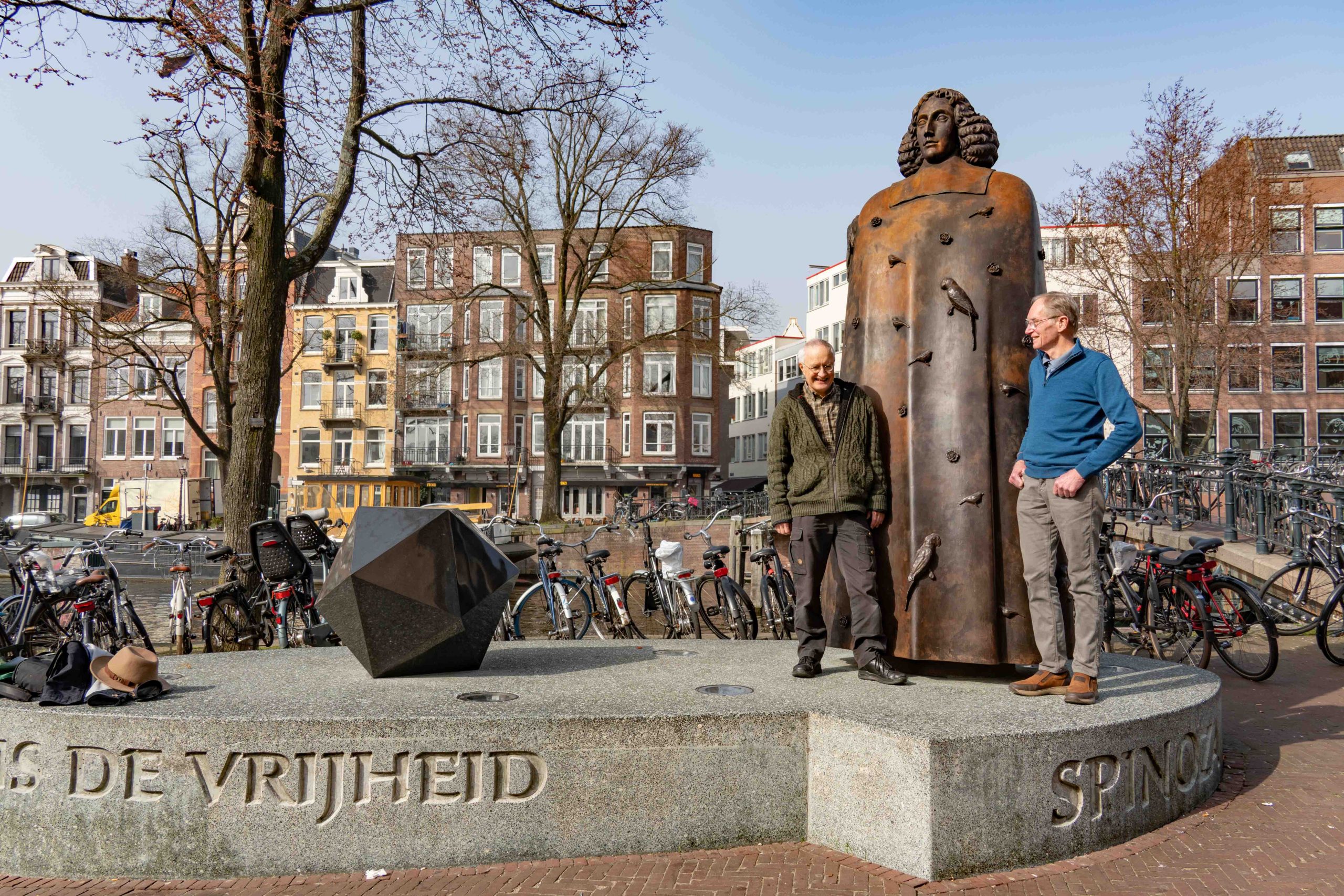
Photos credit to the author: Spinoza’s Statue in Amsterdam, Zwanenburgwal, by artist Nicolas Dings
Related articles
- Spinoza, A Rational Mystic? – Part 1: Srajan introduces Baruch Spinoza, the 17th-century philosopher
- Spinoza, A Rational Mystic! – Part 2: Sugit compares the ideas of the Dutch philosopher Spinoza with Osho’s understanding
- Spinoza, A Rational Mystic – Part 3: Sugit continues his analysis of Spinoza’s ideas
- Seekers from the Low Lands – a four-part series of essays by Srajan



Comments are closed.