

An interview with Dharmen, where he spoke primarily about the centres and communes in the Netherlands – by Punya, transcribed and edited by Srajan (Part 1)
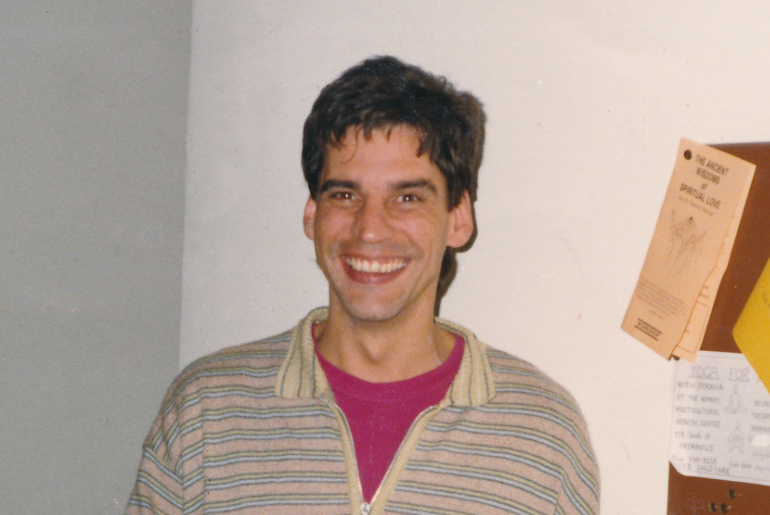
Dharmen was a Dutch sannyasin who lived in Poona 1 and 2 and in several communes in the Netherlands and Denmark, and visited Rajneeshpuram on several occasions. While in Corfu, Punya interviewed him about his experiences, but then, unexpectedly, he died while travelling in Ghana. Srajan, familiar with the Dutch communes, could check the dates and fill in some of the gaps in the story, and edited the interview as Dharmen had intended to do himself.
In the late 70s and up to the early 80s there were quite a few communes and centres all over the Netherlands: in Amsterdam, Rotterdam, The Hague, Groningen, Soest, Arnhem, Haarlem, Nijmegen, Beuningen, Opende, Egmond aan Zee, Eindhoven and Uffelte.
When Osho left Poona for Oregon, in 1981, Dharmen also left India, first landing in Amsterdam, where there were two meditation centres, Sadhana Rajneesh and Amitabh Rajneesh. The latter was on a houseboat, a beautiful meditation centre, but without accommodation. Dharmen looked further afield and chose to move to Groningen.


Satnam Rajneesh Groningen
In Groningen, the largest city in the north of the Netherlands, there was a small commune, called Satnam Rajneesh. It was a small place, and people lived all over the city. What we wanted was a real commune where we could all live together, but for that we needed money! Our idea was to open a vegetarian restaurant which was, of course, going to be called Zorba the Buddha.
One of our friends, a German businessman and former mining company director – his name was Vidhan – knew how to negotiate with banks. So off he went, in and out of many banks, but everywhere the answer was simply “No!” Until suddenly one of the bank directors said he would lend us the money. It’s an interesting story. Only years later I found out how it came about. I’ll tell you more about it…


The countryside commune, Stad Rajneesh, in Heerde
The following year, in 1982, the commune members from Groningen and Amsterdam put themselves together to find something in the countryside and found a place in Heerde. It was a perfect place for meditation and for groups. It was in the middle of the woods with little houses and two big buildings. It was in the east of the Netherlands, in the so-called Bible Belt.
It must have been a shock for the locals. Suddenly all these orange people invading their village. It was actually a very strict Catholic neighbourhood, which is quite unusual as most people in that part of the Netherlands are Protestant. The priest would proclaim from the pulpit: “The devil has come to our town. And the devil this, and the devil that…”
We had a really beautiful school for the kids. An official school. One of the sannyasins was a teacher. She specially got registered so she could start the school. All the children in that school performed above average compared to the rest of the Netherlands. Of all the schools nationwide, our school came out number one!
All these kids… They are fathers and mothers themselves now. I had a girlfriend. She had two little boys. I know one of them, he’s a man now. A father himself. He is in the theatre world in Amsterdam, organising the lights. The other has a very good job as an accountant or something similar.
I used to work at a market in Amsterdam selling clothes to make money for the Heerde commune. I would go to shops and buy clothes to sell them in the market. With the profit I made, I could support two people who could work inside the commune, taking care of the commune building, cooking, cleaning, etc. A lot of people were making money outside for their commune, as I did.
We developed the place really nicely, until Sheela came and said she needed money for the Ranch. This meant that we had to close all small centres in the country and move to Amsterdam, where we would open a disco and make the money she needed.
After Heerde closed down I went to live with some friends in Nijmegen, in the east of Holland. Heerde had lasted maybe a year and a half. It’s a pity because I have the feeling that such a place could still be there, like Osho Risk or Miasto, or the Humaniversity, if we had stayed. But okay. It’s gone now.
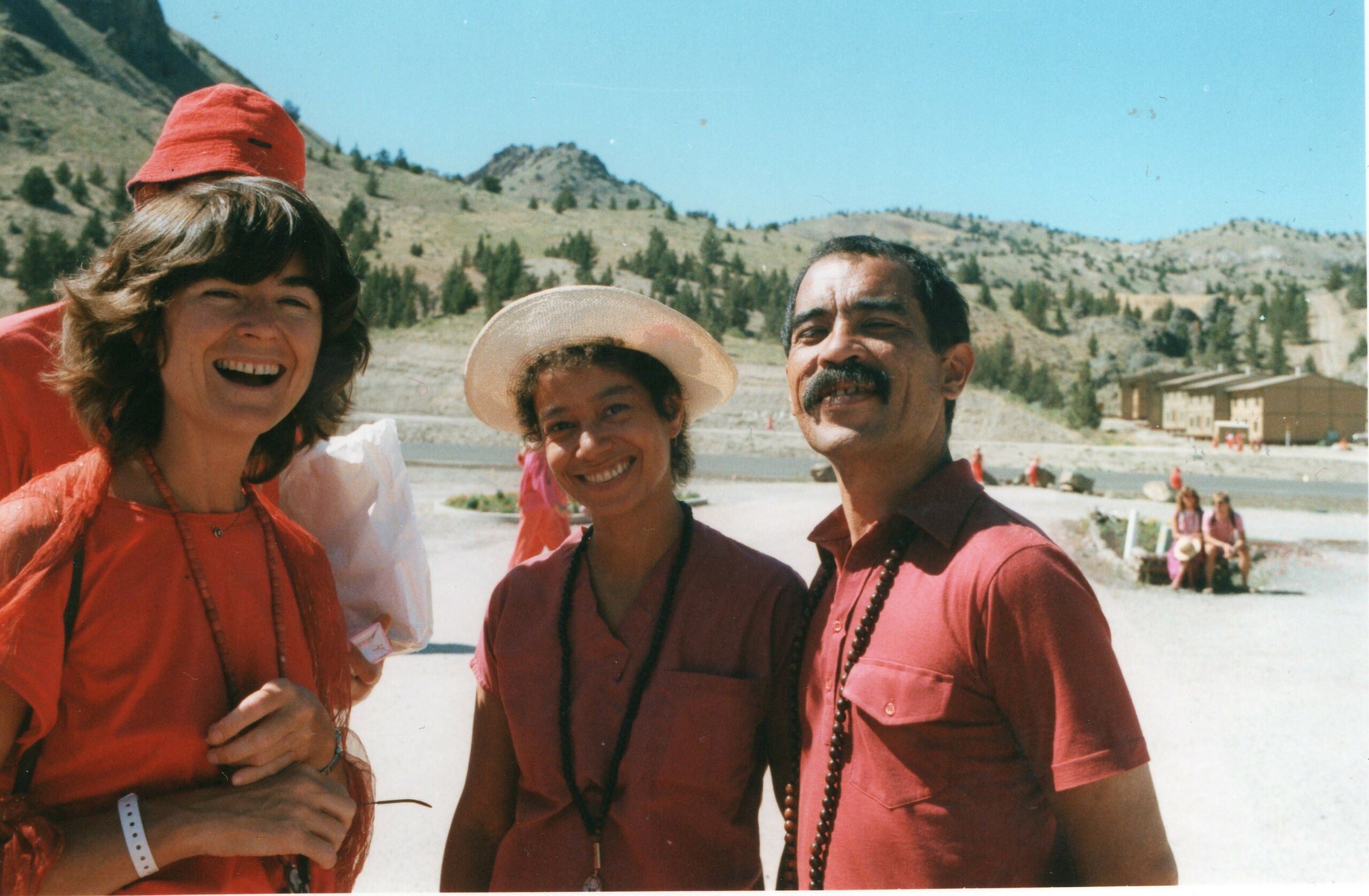
First Annual World Celebration
This was going to be the first festival of many more to come. How I came to be at that celebration was a pure miracle. On Monday I was doing my job and on Tuesday morning I was on a plane to Boston! If Osho was in America, I also wanted to be in America. But I had no money. My friend had some, but only 400 guilders.
“I want to go to the festival,” I said. “You know what – we’ll go to the casino.”
My friend and I were working on building sites but not making thousands. And in those days the exchange rate for the dollar was very high. Three and a half guilders to the dollar! One trip would cost us something like 10,000 guilders. But we really wanted to go. So we went to the casino and an hour later we had the money. Goodbye!
Sometimes it really feels as if Osho is also doing his job. It’s as if he had said, ‘Okay, I am going to come with you to the casino.’ The clever thing was that we stopped playing at the right time! A lot of people go on and on and then lose everything. That happened to some who then developed a gambling problem – they kept on playing back home after the festival. That’s when you lose, I was told.


The ‘jail’: Sadhana Rajneesh Amsterdam
It was such a pity to leave all those small communes behind in order to gather in one big commune in Amsterdam. They found an old jail in the Havenstraat and received the name Sadhana. When I heard it was in a jail, I said, “No. I am not going to live in a jail. I don’t feel like living there.”
I decided to leave the commune and started working for myself until I heard the commune was leaving the jail and moving to a former monastery in another part of Amsterdam.


The ‘monastery’: Stad Rajneesh Amsterdam
The ‘monastery’ was a corner building in Pijnackerstraat; we had the whole corner. It was quite large. (It was called the ‘monastery’ because it had previously been a school run by nuns. The classrooms were in the main part of the building, while the nuns lived in the smaller rooms above the classrooms.)
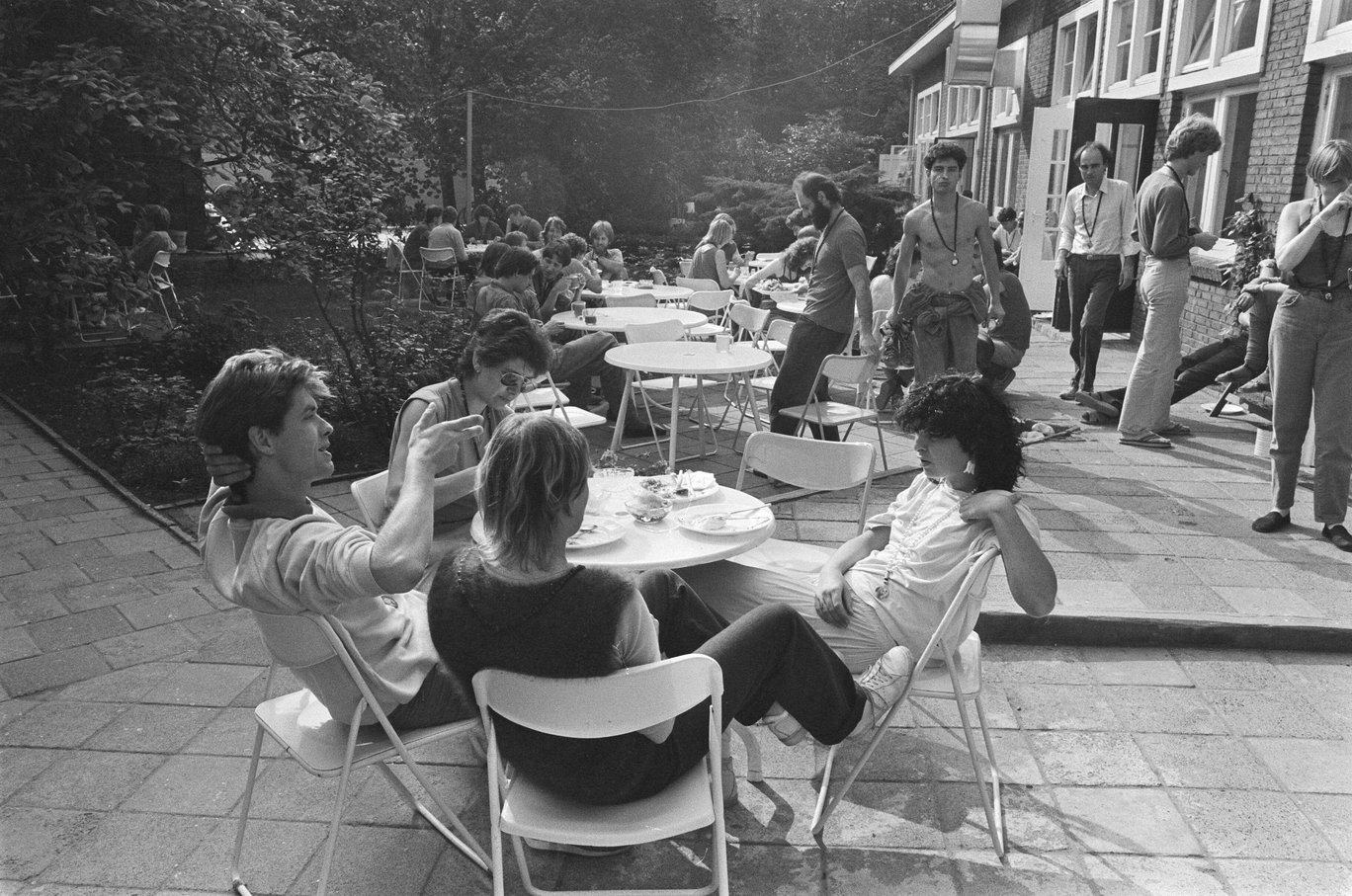
In the jail people had been living in a cell, four people to a cell. Really cramped. But in this commune everyone had a bit more space. It was a great place to live and to be. We also had a beautiful inside garden. It was in a very popular neighbourhood called De Pijp (the pipe). I guess there were about 100 or even 200 people living there.
Osho Books and Tapes
When I moved to the monastery I started to take care of Osho’s books and tapes. I worked together with the Cologne commune, who did all the publishing work. We then started translating and publishing books also in Dutch, as Dutch publishing houses had already been doing since the ’70s.
After I took over from the sannyasin who used to do it before me, it really got moving. (She was not very business-like; it wasn’t really her thing.) I started visiting bookshops and asking, “Would you be interested in these books?” Many said, “Yeah, we want to buy them, but you people don’t really have it together. When you say you will send them, you don’t send anything.”
“Well, that’s changed now. I am now in charge and I am going to send you the books.” And they would say, “Okay, let’s try.” They ordered two or three books and I immediately packed the books to send them away, so they had the books the next day.
Business started growing, I had about seven or eight customers, and from 2 or 3 books it grew to 20 or 30 books per order. It really started spreading and going well. Also meditation tapes – Dynamic, Kundalini – really started spreading around the Netherlands – together with the books. They were selling really well. It worked out fine.
Sometimes I would help out in the Disco when people needed a break for a few weeks or a month. But I was happy with the books and tapes. As I had to collect the books and tapes from Cologne, I would get a nice big car and drive there to pick them up. They’d mostly all fit in the car, or they were sent by post. We were also selling a lot of English books.
I had a great life, you know. I mean, I had a girlfriend in Amsterdam and a girlfriend in Cologne, and la-la-la. I would stay in Cologne for three days or so and go to their disco there. It was just great fun. Like the whole commune was. We had a great time.
Mountain of Osho Books at Schiphol Airport
Once a year all commune members could go to the Oregon Ranch for the Festival, where they would gather in their thousands.
We had a scheme for getting books from Rajneeshpuram to Amsterdam. Many of the German sannyasins were travelling there and back on flights with a stop-over in Amsterdam. On the Ranch they were given four or five books to take back in their hand luggage. “Dharmen will be standing in Schiphol Airport and will collect the books.”
So there I was standing at the airport collecting the books, hundreds and hundreds and hundreds of books. Somebody would then come with a van from the commune and pick them up. It saved money. That’s why we did it.
And the customs people would look at me next to this mountain of books and ask, “What are you doing? Do you have another plane coming in full of books?” At a certain moment this customs guy said, “Here, you have this pass.” They gave me a pass so that I could go anywhere in the airport, unrestricted. Nowadays this wouldn’t be possible because of security.
Of course we were all dressed in orange, mala and everything. Me and the ones coming from the plane. The whole airport was full of orange people coming from the Ranch. And people would love it. Just crazy. They thought we were crazy, which we were… But they liked us.
Same as the people down-town. Amsterdam was such an open city. It was the gay capital of the world. Gay people from all over the world would live in Amsterdam because they had freedom there. Like in San Francisco.
People in Amsterdam were used to quite a lot and were easygoing. A bunch of people in red with a mala? No problem. Just do whatever you want. Also this disco. You know, the pimps were looking on, the prostitutes. All kinds of people from the shady side of life would visit.


Nivedano and the Banker
I was in Cologne for my books, and Nivedano, the drummer, was there too. He had been sent away from the Ranch with a simple “You have to go to Cologne.” But he didn’t like Cologne. So when he heard I was driving back to Amsterdam, he sat down with me and asked, “Can I come with you to Amsterdam?”
I said, “Yeah, sure. I am leaving tomorrow. Just come along.”
The next day he gets into the car and we drive back to Amsterdam. Now, this brings me back to the bank director who gave us the loan in Groningen.
Nivedano asked me, “Do you know Piet Slavenburg?” That was the banker who gave us the loan. I looked at him, “Slavenburg?” and said, “Yes, we know him.”
“Oh, I lived with his daughter in New York. He would send us 3,000 guilders each month so that we could live there.”
The banker wanted his daughter to live in New York together with Nivedano because she had a heroin problem. And while living with Nivedano she didn’t take heroin. As a father he was really happy with that. That’s why he sent money every month.
“Nivedano, you be with my daughter. I’ll pay for everything,” he would say.
Nivedano was already a sannyasin, living in New York. That made me think, “Ah, that’s why he has given us the loan.”
Slavenburg must have thought, “Here is this other orange guy with a mala, just like Nivedano, walking into my office. I feel good about these people. He wants a loan to start a commune. I’ll give him the loan.”
After everybody had said no to giving us a loan – everybody! I think we had gone to about 100 banks. And then suddenly – ta-daa! – this banker shows up. “Ahh. That’s why!”
I told Nivedano. “You know what he did afterwards? He robbed his own bank. He left the Netherlands and they don’t know where he is.”
Nivedano had a good laugh. It’s a very strange story… It’s somehow as if Osho was taking care of things again. That’s how we got the money.
Nivedano came with me to Amsterdam and I think he stayed for a bit, but then he left, I don’t know where.
Interview to be continued…
Notes
- The ‘Slavenburg trial’ was against Ruud and Piet Slavenburg, H. Gonggrijp and M. Veltena, the entire management of the bank. Ruud Slavenburg and M. Veltena were ultimately sentenced to small fines and suspended prison terms; H. Gonggrijp and Piet Slavenburg were acquitted. Their claims for damages were awarded. The gentlemen received their compensation in part as compensation for the damage to their good name. And indeed, that name never became good again. Credit Toon Kasdorp: The Slavenburg affaire
- Ranch/Commune exchange programme was created so people could have an experience in different places. The Commune members had a silver bead on their mala, while the Ranch residents had a gold (brass) bead. The exchange lasted around 3 months maybe.
Related articles
- Seekers from the Low Lands
- Dharmen (1956-2023)
- Interview with Dharmen
Images from archives (Osho News, Nisarga, Subodhi, Srajan, Gyanam, Devabodhi, Parigyan, Alamy)



Comments are closed.