

Prem Joshua in conversation with Sufi Abheeru and Aminah Divya – on Osho, music, and meditation (video)
In this talk on zoom for the series, Histórias com Osho (Stories with Osho), composer and multi-instrumentalist Prem Joshua reflects on his early encounters with Osho, the transformative years in Pune, and how the Master’s presence continues to shape his life and music. He shares stories of inner discovery, community life, and the source of creativity. (Interview edited for length and clarity.)
When I’m on stage and feel connected – to the music, to the other musicians, to the audience – it’s the same joy. It’s like meditation. That space of no thought, of just being. Then music happens. That’s why I continue. That’s why I love it. I feel grateful to Osho, because he helped me discover that silence inside, the place from where the music comes from.
Q: Joshua, how did Osho come into your life, and what happened next?
This is like two questions in one. Maybe I give a little background to how it happened.
It was in the late seventies – around 1976 – that I first read about Osho. At that time, I already had strong plans to go to India. I was only 18 years old. In those days there was a hippie trail from Europe to India. These were wild times, very liberal. We were young and felt the whole world was ours. There was a certain openness. Our parents had experienced a terrible war, but we were the next generation, and we were ready to change everything.
So I went to India, travelling overland from Germany where I was born and living then. I hitchhiked through Greece, Turkey, Iran, Afghanistan, Pakistan, and finally reached India. The journey took about three to four weeks.
I had heard about Osho and was interested in the idea of a spiritual commune – people living together, experimenting, creating a different world. I had also heard about Auroville in the South of India, near Pondicherry, and I went there first. But the commune was quite small and it didn’t really connect for me. So I thought I should go to Pune and see what was happening around Osho.
To make a long story short…
Q: So you had heard about Osho before?
Yes, a little. I hadn’t read his books, but I had heard about this man in India who was creating a commune that combined meditation, therapy, and the arts. That sounded very cool.
I went to Pune – by that time I was already broke. I was travelling in India without money, which is something you can do when you are 18 or 19, but later it becomes difficult.
I entered the ashram. The energy was so incredibly strong that I almost freaked out. It was too much for me. I didn’t see Osho then. I only stayed one day. It was very intense. I felt it was better to go back to Europe. So I returned overland.
But that one day stayed with me. I knew I had to go back. I made some money and went straight back to Pune.
Q: What year was that?
The first time was in 1977, and then I returned in autumn 1978. That’s when the real process started for me. I took sannyas in early 1979.
Of course I saw Osho and experienced him. But I was not an easy believer. I had many doubts. I was not ready to take sannyas so easily. Something needed to happen first. It was not like, “Halleluja! This is it, heaven on earth.” Not at all.
I took my time and did many meditations. [Every month there were] ten-day meditation camps, and I joined several of them. Slowly, through meditation, something happened in me. I took sannyas and became his disciple.
Q: How was that?
The initiation itself? I was a little afraid. Everything was so new for me. To be so close to him made me nervous. I was the last one to take sannyas that evening. He let me wait…
When I sat in front of him, he said, “Just close your eyes and listen to the sounds. Just be completely relaxed.” At first I was nervous, but then I relaxed. He touched my forehead and gave me my new name. That’s how I became Prem Joshua.
And I still am.
In the Western world, the idea of having a Master is not really known. The concept of a guru doesn’t exist in the same way. Also, the idea that a person can realise himself is not so known in the West.
There have been Masters in the West, but in India this understanding is much more present – that there is something beyond the mind, something you can grow into, that you can become one with the whole.
In Christianity, it’s different. There is always something in between – a priest, a God, a figure like Jesus.
For me, it’s very important that as human beings we have the possibility to discover something vast within us. This changes the whole perspective of life – that something so immense is inside us, and that we can experience it.
I don’t know how much I have discovered, but it’s a process… Osho has helped me tremendously on this path. And there’s not only Osho – there have always been other Masters who can support us on this path.


Q: Let’s go back to the 70s. You lived in that wild community – did it scare you at first?
Yes, it did. I was very young. There were many young people, but the whole atmosphere of experimenting and allowing so many things was also intense. It was all new to me. But I was not only afraid. I was also curious, and I liked it.
I started doing therapy groups, but after some time I began working in the commune. And I would say that to work changed me more than the therapy groups. Someone had suggested I stop doing groups and start working. So I began in the kitchen.
For months I only chopped vegetables. Then I moved on and became what was called a pot wallah. There was a small washing area with a basin, and the cooks would bring me their pots. They were very big and hot. I had to wear wooden sandals, step inside the pots, and scrape them with a spatula and brushes, and lots of water. I cleaned the pots, and back they went into the kitchen to cook more food.
I was a pot wallah for, I think, six months. I was just cleaning pots every day. Maybe I was also cleaning my inner pots. But I was young, full of energy. It was an important experience for me.
Later, when I returned to Europe, wearing orange clothes and a mala, people would ask me, “Are you crazy? What did you do in India?”
I replied, “Cleaning pots.” They thought I must really be crazy, but that’s what I did. And it was fun. It was great! Just doing this simple task.
There is something I want to say about this community. At that age, most young men in Europe had to go to the army and do one and a half years of military service. But I was cleaning pots and chopping vegetables. That was my way of serving. I feel it is very important in life to do something for a community – whether small or large, even for the State. It doesn’t have to be the army. You don’t have to become a soldier. But to do something for others, some kind of social service, changes your whole perspective.
I think there’s too much focus on the ego. How much money can I make? What is the State doing for me? The real question is: What can I do for my society? In this process, also in Osho’s community, I learned to ask: What can I give? What can I contribute? I began to discover what I have inside me, and how I can share my treasures with people.
Before I came to Osho, I was a painter. I also played music, but through Osho I became a musician. I worked at improving as a musician, and at the same time I contributed to the commune through playing music – and I’m still playing today.
Now I am older, but I am still playing music. I still share my music as much as I can. I love it!
Q: We do too! We also love your music. Before we get into that I would like to know: After Pune, did you go to the Ranch, did you live on your own, or were you in one of the big communes in Germany?
I was in the European communes, in different places. It was an incredible process, very beautiful. I loved it! I also went to the Ranch. There were four big festivals, each lasting about ten days. I went to all of them together with the whole commune I was living in.
That’s when I saw the Ranch. But I have to say, I never really liked it. I tried, but it was not my place. The United States was not my place. And the atmosphere in the community – something didn’t feel right to me. There were power dynamics among the leadership. Something was strange. I didn’t like it so much. So I never had the feeling that I should live there.
When Osho returned to India, I was one of the first to go back. What can I say – I love India. I was happy he was back.
In the beginning, Osho was in Mumbai, and I went to all his discourses there. I stayed in Mumbai. Then, when he moved back to Pune, I arrived three days before him. We were preparing his room. I remember putting a mosquito net on the window. It was so exciting – “Oh, he’s coming back.”
It’s funny – I haven’t thought about these things for a long time. But now, when you ask, suddenly I remember them again.


Q: Was Pune Two less wild than Pune One?
It was different. But one thing I want to say about the Pune One commune in India – we were wearing orange, we had malas, and from the outside it looked like a sect. Maybe it was a sect. But one thing is certain – we were happy. That’s the important point. There was real happiness. It was exciting to be alive. We were dancing, creating a beautiful place, working with art and aesthetics. We were thriving. And you know – who cares if that’s called a sect? Happiness is what’s important.
Q: Osho said that music comes after silence. You also said that Osho taught you silence. Tell us about Osho’s influence on your music.
I remember very clearly when he said, “The deepest music is silence.” For me, that was like “Wow!” – incredible. Until then I thought music was about notes, about playing, and having fun. But to say that silence is the deepest form of music – and that music comes out of silence – that changed my whole perspective about music.
Through meditation, I had experienced moments of silence. So I tried to bring that into my music. There is nothing special or mystical about it. It’s simply a process. We can talk about inspiration and creativity – and I have also learned something about that through Osho.
When somebody creates art or music or dance, it’s not that “I create” – “Me, I create something, I’m a wonderful artist,” or something like that. It’s more like… things come to you. It’s more about being ready – that the music comes, or the dance comes.
Sometimes with music, it’s like this – I sit somewhere and suddenly I hear a melody, or I play an instrument and some melody comes. I don’t know from where it comes – but it comes. I receive it, but it’s already there. That’s the funny thing; it’s already there. I just have to open my antennae and catch it. Then I record it on my phone. And then, like this, a song is slowly evolving. I go back, I listen to it, I play it again – something else comes – and that’s how, slowly slowly, music develops.
What I want to say is – it comes, it’s a gift. I just need to be open. That’s the process – it comes from silence.
Q: Empty pots?
Yes, from empty pots. Let me say one more thing about music and silence.
Listen to the birds! Do you have nightingales in Brazil? They create such beautiful melodies. Where do these melodies come from? They are already there, in existence. A small bird can create melodies with a virtuosity that you would only expect from a great Jazz musician. And they do it naturally, day and night.
Q: How did music come into your life? Was it already there in your childhood? You mentioned that painting came first.
My parents thought it would be good for me to learn an instrument, to have some connection to music. We were not a rich family, so they didn’t buy a piano or anything big. They bought me a small flute and found a teacher. I was about five or six years old.
I started to play this flute. I started learning songs, and read music. I had a fantastic flute teacher. He was Italian. I was very impressed by him, mainly because he owned a red Italian sports car! As a kid, you like sports cars…
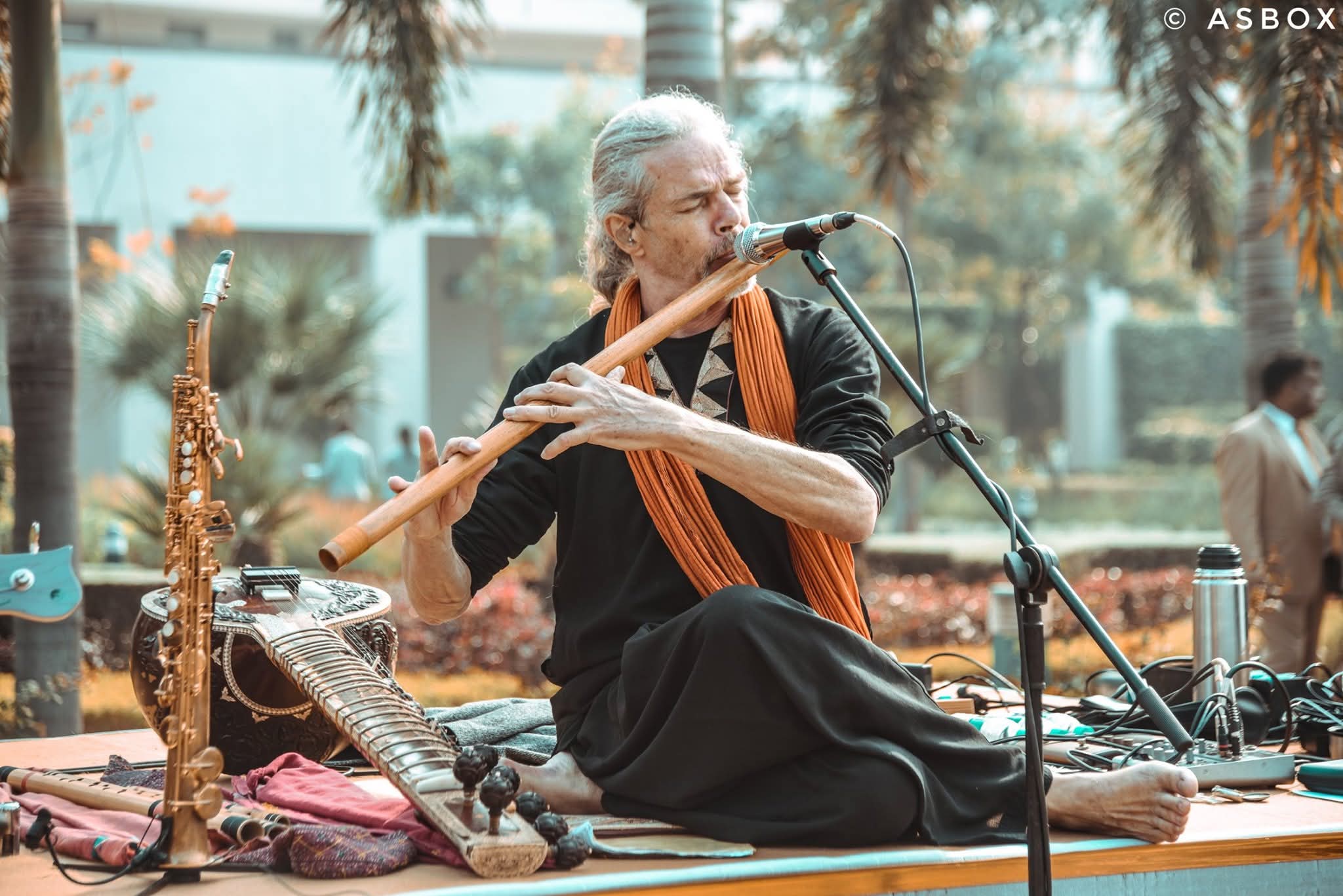
So I started with the flute – and I never stopped. I still play it today, together with other instruments. Many children learn an instrument and then stop. I continued. Later I learned the guitar and the saxophone.
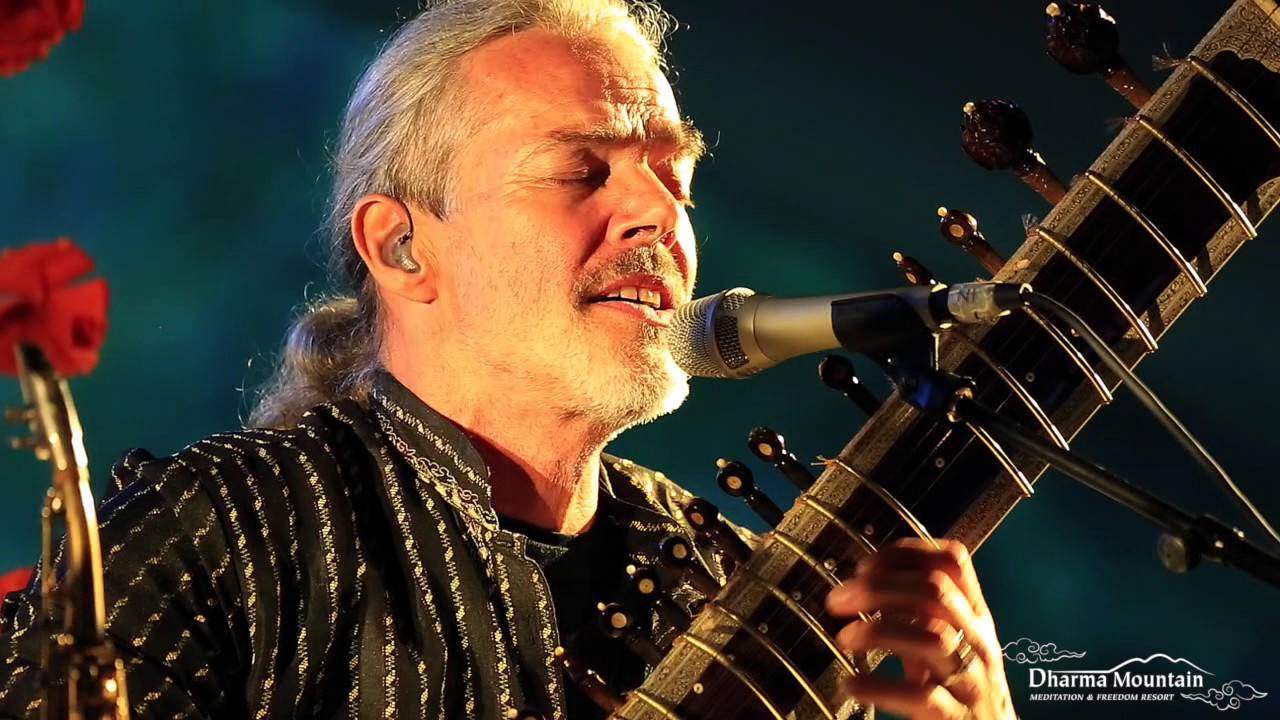
When I came to India, I studied Indian music. I learned sitar with Maestro Ustad Usman Khan in Pune. That was a very strong experience. The teaching was very traditional. I would sit in front of him for hours. He would play, and I would repeat. There was no written music, no notes. Only listening and repeating, again and again. Slowly, you absorb what the teacher gives you. It was demanding, but I loved it.
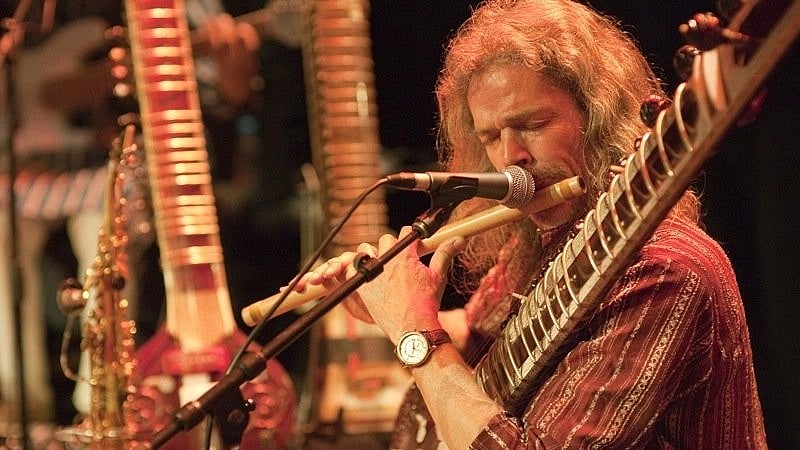
Later I also learned the Indian bamboo flute, the bansuri. Step by step, I went deeper into Indian music. I never became a fully-trained Indian classical musician – that takes a whole life and total dedication. But I learned the basics, and this music influenced me deeply. Then, slowly, I began to combine what I had learned in the West – Jazz, Fusion, Folk – with Indian music. It happened naturally. I didn’t plan it. It just came.


Joshua in Hampi and Goa cr Petia Chtarkowa
Q: When did you start composing your own music? Was it in the ashram?
In the beginning, yes. I was playing in the ashram and there were always opportunities to play.
One day, I was asked to play in Buddha Hall for a celebration – I think it was Osho’s birthday. There were thousands of people. So I composed some music and played it. The response was very beautiful, and it encouraged me. From that moment on, I started composing more and more.
Later, I formed a small group, just two or three people, and we played in the commune. It was not commercial – it was for meditation, for sharing.
Q: What was the name of your first band?
I think the first was Terra Incognita. Later, I had another group called Hamsafar. That was already outside the commune. We also played concerts in Europe.
And then later on, I started the project Prem Joshua & Band – which is still going today.

Q: How was it to start playig for an audience outside the sannyas world? Was it scary?
A little, yes. Inside the sannyas world, people were very open and receptive [to this kind of music]. Outside, people would ask, “What is this? Is it Indian? Is it Jazz? Is it World Music?” But slowly things developed. We played many concerts, often very small ones. The audience grew. We recorded CDs. People began to invite us. It all evolved step by step. It wasn’t easy, but it was real. You play from your heart, and people feel it. That’s enough.
Q: You’ve been playing for decades now. Has the experience of sharing music changed for you?
Yes and no. Yes, because life changes. We change, and the music also changes. But the basic joy of creating and sharing from the heart is still the same.
When I’m on stage and feel connected – to the music, to the other musicians, to the audience – it’s the same joy. It’s like meditation. That space of no thought, of just being. Then music happens. That’s why I continue. That’s why I love it.
I feel grateful to Osho, because he helped me discover that silence inside, the place from where the music comes from.
Q: Do you still meditate regularly?
Yes, but not in the same way as I did before. In the early years, I did all the Osho meditations – Dynamic, Kundalini, Nadabrahma – every day. Now it’s more that music itself is my meditation. Playing, composing, even just listening deeply – this is where I find that same space. I still sometimes sit quietly, just to be, just to reconnect.
In the end, the method is not so important. What matters is the space.
premjoshua.com – en.wikipedia.org/Prem_Joshua
Related articles on Osho News
- My Inner India – Joshua talks to Ishu about music and his beloved India (July 2016)
- More on: Prem Joshua
- Histórias com Osho – Histories with Osho – Two Brazilian sannyasins create an oral history of life with Osho – by Subhuti
- More on: Histórias com Osho
Link to English HcO playlist

Comments are closed.