

An unusual nickname for Osho triggers conflict in the press room – by Subhuti
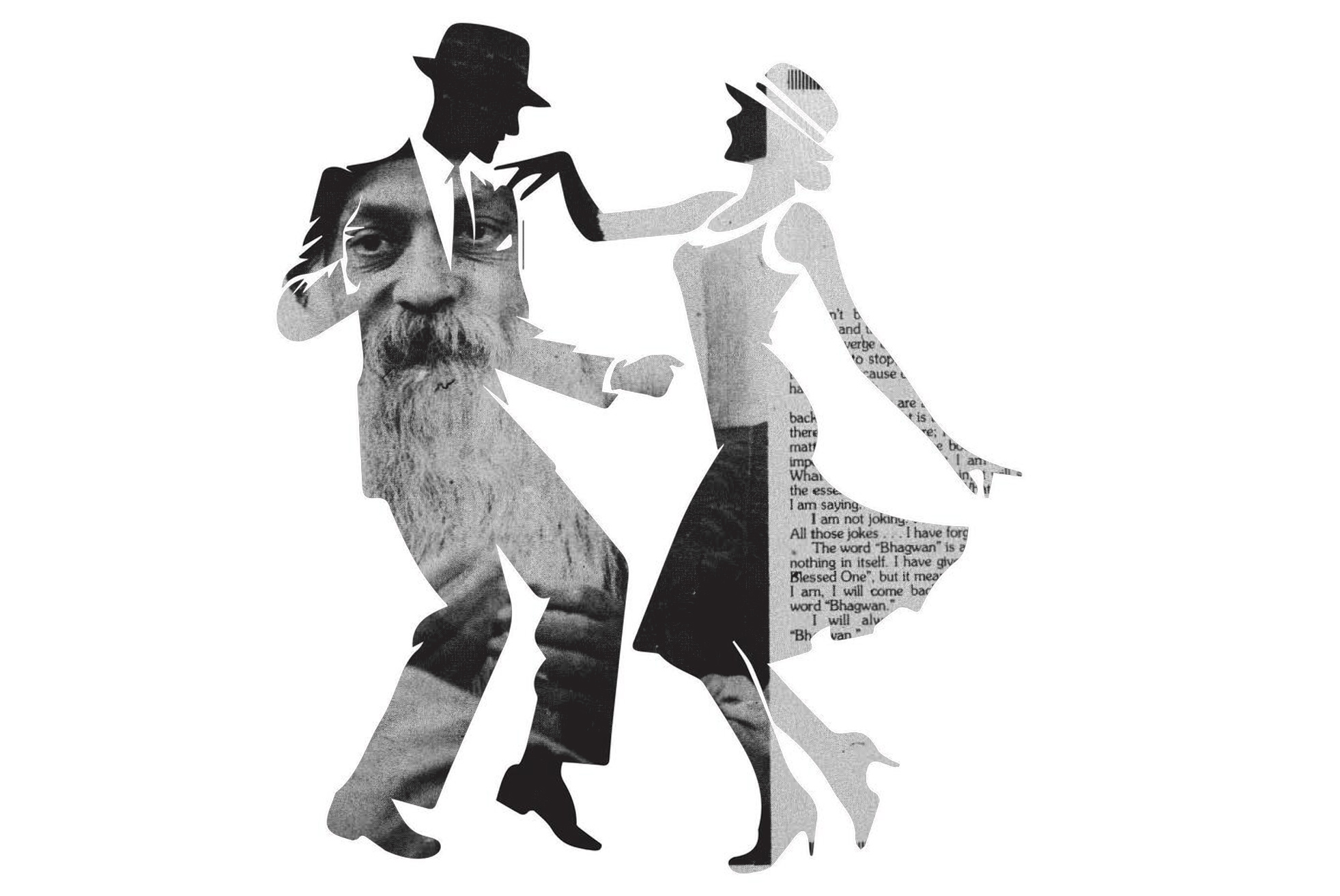
I did not need to be a modern-day prophet to figure out that something bad was going to happen. I could see it coming. It was visible for all to see, on the man’s baseball cap.
Almost everyone wore baseball caps in Central Oregon. When I first went there, I expected to see lots of cowboy hats, worn by tall, silent, gum-chewing strangers who had only very recently traded in their horses for Ford pickups. But a visiting reporter set me straight. When he came to the Ranch from Portland to write an article, he looked around the yard and said, “I’ve never seen so many cowboy hats in one place.”
He was talking about us, the so-called ‘Rajneeshees’. It turns out that, having read too many Louis L’Amour novels about the Old West, we were more addicted to cowboy hats than the locals, almost all of whom wore baseball caps.
True, most of them carried rifles, stacked neatly on racks on the rear windows of their pickup trucks. But cowboy hats? Nowhere in sight. This was a new era of the American West, symbolized by baseball caps.
And every baseball cap had a logo. Some were predictable, like ‘USA’, or ‘NYC’. Some were commercial, like ‘Texaco’, for the petrol company, or ‘Mac’, for the big dump trucks. We even had a few of our own on the Ranch, such as: ‘Warning: Delicate Ego’. I refused to wear that one, because I feared it was true and didn’t wish to advertise the fragile nature of my inner reality.
This must have been around 1983-84, when the Ranch was a couple of years old. By that time, I had been blessed with a Green Card, so it was considered safe for me to take The Rajneesh Times artwork into Bend, some 90 miles from the Ranch, to get it printed at the offices of a local newspaper called The Bulletin.
I got on well with The Bulletin’s editor, Bob Chandler, and also with his right-hand man, whose name I forget, so we’ll call him Les. They also liked me because, being newspaper men, they knew how challenging it was to bring out a weekly paper and they both thought I was doing a fair job.
Les was the production manager and supervised the magical part of printing a newspaper, which consisted of converting a flat piece of artwork, stuck to white cardboard, into a metal half-cylinder that clipped onto the circular drums of the printing press. When all the metal cylinders were clipped onto the drums, the press would start to roll, slowly at first, so we could check the quality.
When it was okay, we’d give the thumbs up, and the press would speed up. A huge roll of white paper would spin at one end, feeding a continuous, unbroken sheet through the machine and somehow transforming it into a complete, neatly folded newspaper that slid off the ramp at the other end.
Presto! Within minutes, several hundred copies of The Rajneesh Times would be printed, stacked, bound and ready to ship back to the Ranch.
All well and good. But one day, Les was not there. I guess he must have been on holiday, and I already knew that his second-in-command was not what you might call a Rajneeshee-friendly native. Not exactly an enthusiastic admirer of Bhagwan Shree Rajneesh. I knew because of the logo on his baseball cap. It was a Rolls Royce caught in the cross hairs of a rifle scope.
Not wishing to disturb the printing process, I studiously ignored the guy’s cap, and stayed mainly in the design room, thinking to myself, “Turn a blind eye, get the job done, and get back to the Ranch.”
But life had other plans for me. I was busy trying to mind my own business when I heard the man’s voice.
“Hey, look at all these photos of Boogie Woogie in their newspaper! They just love printing photos of Boogie Woogie!” shouted the guy with the baseball cap, loud enough for the other operatives in the press room to hear.
I don’t think he intended for me to hear it. But hear it, I most certainly did.
Now, as a matter of fact, what he was saying was true. After all, our newspaper was called The Rajneesh Times, dedicated to the vision of Bhagwan Shree Rajneesh, and so, in most editions, we had a fair number of photos of our beloved Master.
But he said it in such a nasty, sneering way that it triggered a small explosion in me. Without thinking, I stormed into the press room and shouted, “You keep your comments about Boogie Woogie to yourself when I’m in the press room!”
I was so angry, I referred to Bhagwan as ‘Boogie Woogie’ myself!
Without waiting for a reply, I went to see the editor, Bob Chandler, sat down, and told him what had happened.
“I don’t care whether people like Bhagwan or not,” I explained. “That’s not my business. But I want to be treated with respect when I’m in the press room.”
To his credit, Bob immediately fired the guy, which shocked him, and certainly astonished me. I wasn’t even sure that Bob would take my side. In fact, I was surprised at my own reaction. If I’d thought about it, even for a moment, I would probably have pretended that I’d been out of earshot and let the whole thing slide.
But there was no time to think. It just happened. ‘Boogie Woogie’ got me going.
One year later, when the Ranch was almost over, I drove to Bend for the last time, to print the final edition of The Rajneesh Times, and I noticed that Bob had rehired the guy.
Fair enough. I didn’t hold a grudge. We looked at each other, like two soldiers on either side of a battlefield, when the war was over and both men had run out of bullets.
Neither of us said anything, but I did notice he wasn’t wearing the offending baseball cap. In any case, Bhagwan was in India by then, staying in Kullu-Manali, and I was halfway out the door myself.
Now, as most people know, in the world of music, ‘Boogie Woogie’ is an upbeat, fast-paced way of playing the piano, coming out of the blues genre created by African American musicians.
It’s a delight to hear it. But, whenever I do, I can’t help smiling and thinking of that day in The Bulletin press room, back in Oregon, when Boogie Woogie took on an entirely different meaning.
By the way, when the Ranch collapsed, Bob Chandler handed me another surprise: he took me out to lunch and offered me a job as a reporter on The Bulletin.
I was flattered, and felt grateful to him, but I declined as graciously as I could manage. By that time, I didn’t want to stay in Oregon a moment longer than necessary.
Sure enough, one fine day, I drove out of the Ranch in an old yellow school bus, part of our community’s elaborate transit system. I’d agreed to drive the bus to Mill Valley, just north of San Francisco, for a guy who was planning to sell it.
When I reached the top of the Ranch, I pulled over and got out. From this vantage point, you could see the entire property, but no buildings, which were all hidden in the valleys. It was a vast, empty landscape, timeless and endless, seemingly untouched by the intense dramas that had unfolded there.
A classic line from one of Arnold Schwarzenegger’s future movies would have fitted the occasion so well, I’m sure I would have said it: “Hasta la vista, baby!”
But not Schwarzenegger’s other famous line, “I’ll be back.”
Oh no, good people of Oregon. Not me. I won’t be back.
Previously published as a Facebook post, reprinted here with the author’s permission. Vector image credit vecteezy.com
Links
- The Rajneesh Times – sannyas.wiki


Comments are closed.