

Madhuri reviews books by Andrew Terrill, Cathy Glass, Amy Baker, Richard Frere, Stanley Tucci, Kate Furnivall, Laurie Graham, Mary Morris and Larry O’Connor, Barbara Kingsolver, Kate Morton, Satoshi Yagisawa, Patricia Bosworth, Cliff Goodwin, Leslie Thomas
 On Sacred Ground
by Andrew Terrill
Enchanted Rock Press, Colorado, 2022, 397 pages
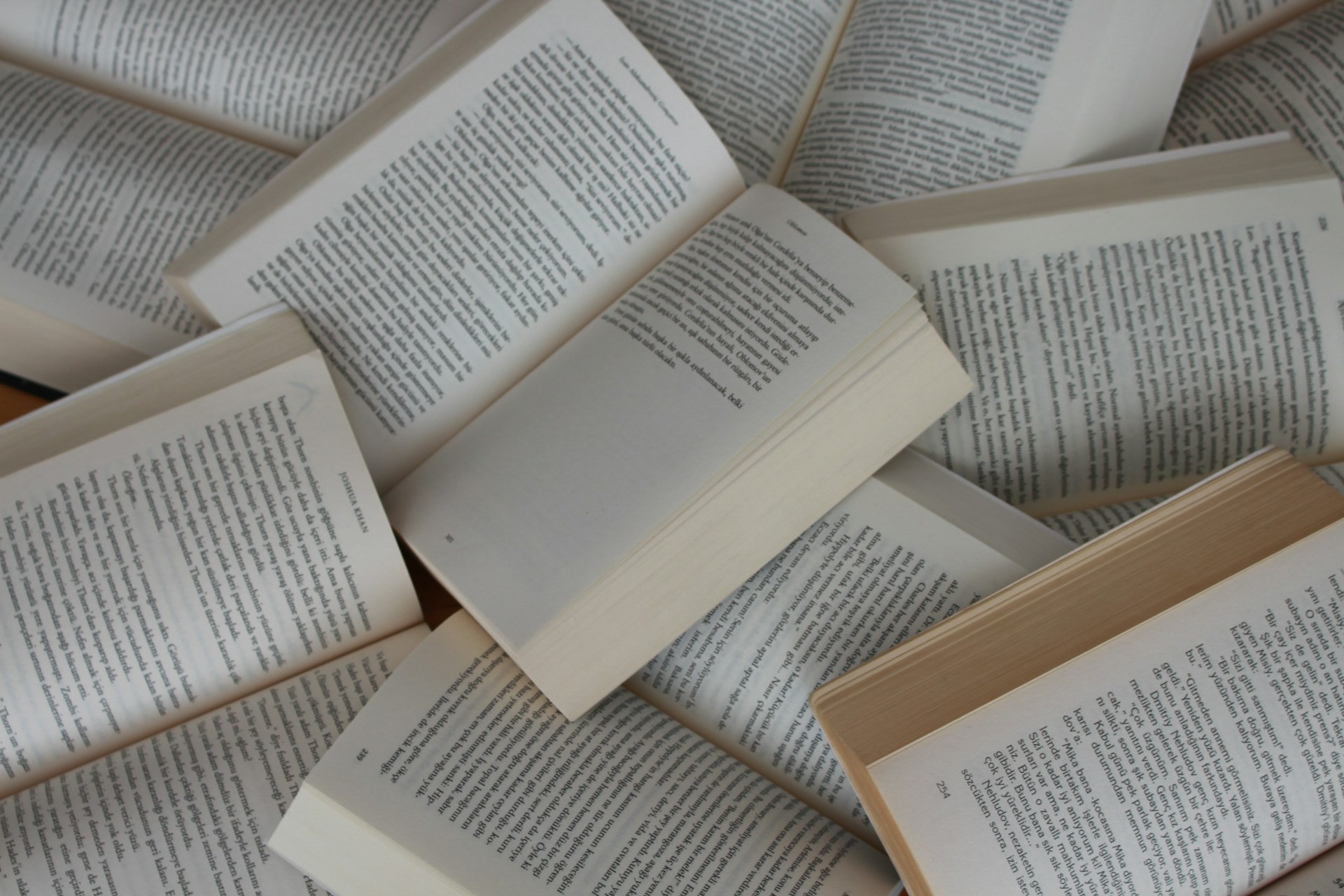
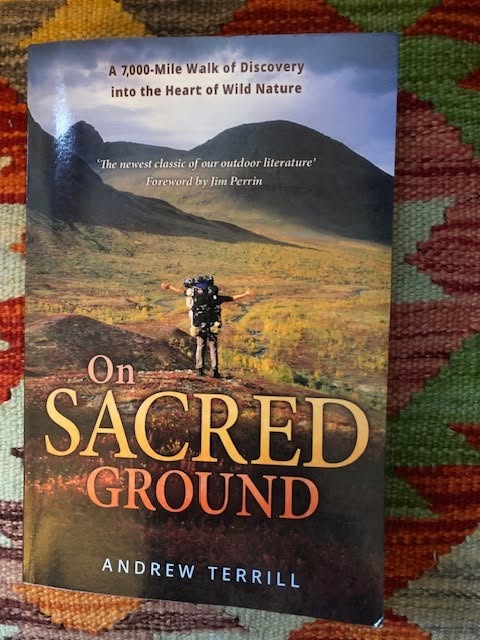
Together with the author’s previous book, The Earth Under My Feet, this book describes a young man’s journey on foot – and heavily laden with a backpack he named Ten Ton – from the southern tip of Italy, 7,000 miles to the northern tip of Norway. A socially-awkward youth with a stammer, who grew up in a stable, loving family in a London suburb, Andrew had conceived a great longing to go to the Arctic – but he wanted to earn it by experiencing every step of the way ‘in the rough.’
This volume begins in mid-November 1997 in the Austrian Alps, and we go with him through snow and storm and on road and mountain, with his tent, ‘Auld Leakie’, and every mood he has and every human being he meets along the way. (Most of these people are incredibly kind, but there is the occasional grump who won’t give him water or a camping place or whatever he needs right then.)
He learns to embrace the elements and revel in storms and cold and sun and ice… and, at times, he finds a cabin to shelter in, and celebrates that too. He then crosses into Germany, with an interesting foray into Czech, then up to Denmark, which he absolutely loves – particularly a certain island I can’t spell here because I don’t have Danish crossed-out O’s on my keyboard!
Then it’s up to Norway, with a foray into Sweden and back; and the extreme distance up to the Arctic Circle and beyond. And this is where the book becomes immensely beautiful and touching… we see this awkward young person on what really amounts to a Vision Quest, though he has no spiritual vocabulary for such a thing. The man he leaves home as, and the man who returns, are incredibly different in one regard, though the ineffable uniqueness is the same: he has bloomed.
His instinct that he needed to do that particular walk, despite economic difficulties and the opposition of his father (who however supports him in a practical way) is, it turns out, exactly right. The North is every bit as soul-nurturing for him as he had felt it would be, and much more.
A passage or two, from Norway:
“As I lay quietly, a powerful feeling of needing absolutely nothing, of utter completeness, flooded my body and mind. It was profoundly peaceful – a total removal of all cares. The surrounding land played a huge part in it. I felt embraced by it, accepted, comforted, connected. You are home, it seemed to communicate, although not in words. Everything is okay. And I knew, deep down, that it was, and always would be, even when future situations might have me feeling otherwise.
“I lay in a state of fulfilment for several hours, not even needing sleep.”
Then, quite a bit later, in a camp in a place called the Trollheimen:
“At first I sat and relaxed, attempting to read, but reading was impossible – I couldn’t take my eyes off the landscape. A fair amount of snow still lay in drifts, but open ground balanced it. It was a landscape of contrasts: grass and snow, earth and rock, rushing stream and motionless pool. The temperature felt comfortable and the air smelled heavenly with its scents of plant growth and sunwarmed soil. The sound of running water accompanied the songs from numerous birds. Soon, even sitting was impossible. I stood up and began wandering – but without real purpose. I took step by slow step, stopping repeatedly to take it all in.
“With each breath exhilaration grew, along with a profound sense of peace and well-being. Slowly, the feelings strengthened. Soon, they filled me to my core, then expanded beyond my own borders. A sensation of extraordinary completion overcame me, as though every aspect of life was exactly the way it was meant to be. It was like being connected to something incomprehensibly immense that was utterly without limits, but not only connected – also welcomed, accepted, merged. There were no doubts left now, no anxieties, no fears. I was still fully aware that I was alone in a remote Norwegian wilderness, but being here suddenly felt like the most comfortable and natural thing in the world.”
And later still:
“I’d begun The Walk hoping it would become a way of life, and it had. But then it had become so much more. It was now an act of worship; no other definition fit. I worshipped the wilderness, the universe and my existence within it. I worshipped the very ground I walked upon. It wasn’t soil and rock any longer but a home to tread with absolute respect. The earth beneath my feet had become sacred – I was walking on sacred ground.”
I have read many books where people take long walks, but none have touched the mystical so directly and innocently. This human being is an innocent one, and we feel this all the way through, and see it in his photos – there are a lot in the book. There are beautiful nature shots, and then the ones with himself in them – and towards the end he always has a huge joyous grin splitting his face open.
He later did more walks, and married a woman he seems also to worship, and went to live in the Rockies of Colorado, and writes for outdoor magazines.
I also have a great affinity for the summer Arctic… I spent 6 weeks there working and hiking, and in my inner world the land there figures prominently – precisely, it seems, for that same untouched quality. It is a rhapsodic relationship, me and that inner place. I felt too that this book could be immensely empowering for anyone who wanted to meet themselves and our Nature – there is still so much wildness left, and people are often kind to wanderers, and it is a thing a person can do at any time, with even slender resources: strike out and start walking.
Not long ago I read in a book by a biologist that human bodies are designed for long, long walking. Perhaps it is one way to explore our natures and what we are here for. This young man, by the way, was also doing the walk for two charities which try to make life better for homeless people. He raised altogether £25,000 for this… and his parents did all the work on the English end, so he refers to them both together as Base Camp.
Even the two pages at the end of his Thanks yous reads like gratefulness incarnate. I highly recommend this book.
 Damaged
by Cathy Glass
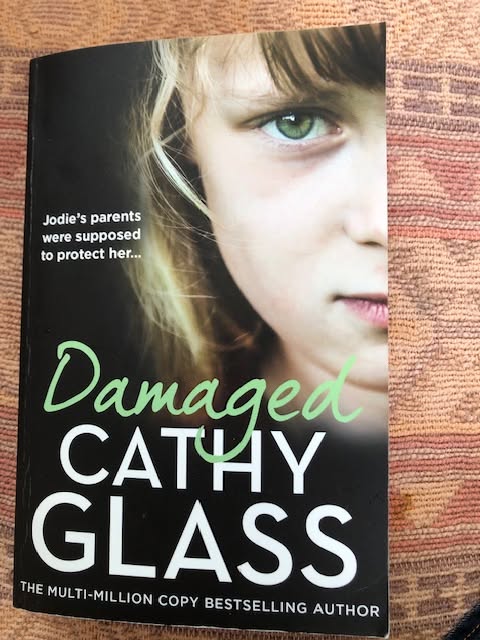
The author, a long-time foster carer, spent one harrowing, exhausting, devastating year sheltering, and trying to support and encourage, an 8-year-old girl whose behaviour was so destructive that five foster carers in quick succession had admitted defeat. The child had since birth been on an ‘at-risk’ register, meaning social workers were supposed to visit the home regularly and assess conditions – yet nobody had noticed that she had been not only beaten, burnt, and had bones broken, etc, but had been used since infancy in a paedophile ring. She’d been to the A&E 50 times in her short life, and nobody noticed… plus, as an infant she’d been hit on the head enough that she was brain damaged and would never be able to read or write or even walk across the kitchen holding a spoon without dropping it. She finally set her dad’s dog on fire, and this got her taken ‘into care’, as they say.
What is also harrowing about the whole story: because the overworked, constantly-changing social workers missed all that, and because the author (on £250 per week) could not bring enough healing (she was out of her depth and really suffered, on call all night every night for the nightmares and freakouts and hallucinations the child experienced – I think the author was absolutely saintly in her efforts) the child was eventually sent to a very lush children’s home in the country costing Social Services £4,000 per week, for years… where she never recovered, and could not be described as happy, but settled in with some enthusiasm and had a lot of therapy and outings.
The perps were prosecuted finally for abusing their next-door neighbour’s child – there wasn’t enough direct evidence to get them on what they’d done to their daughter.
This book echoed in me disturbingly: I’ve never read such a precise description of the damage a child can accrue from abuse. She even has multiple personalities, to try to cope… and, as her disclosures continue, she suffers a nervous breakdown.
A great many people I know, of both sexes, suffered sexual and/or emotional/physical abuse as children. I hate to say this, but it seems almost as if it’s the rule rather than the exception. What are we all carrying? I think the whole society – all societies – need therapy, regarding this one crime, so that each and everybody can face what the results are, the human cost, the soul cost, the damage. Education needs to include this subject, along with empathy… so that there isn’t the slightest bit of pushing-abuse-under-the-rug left.
 Miss South America
A Tale of Ignoring Life Advice While Backpacking Around
by Amy Baker
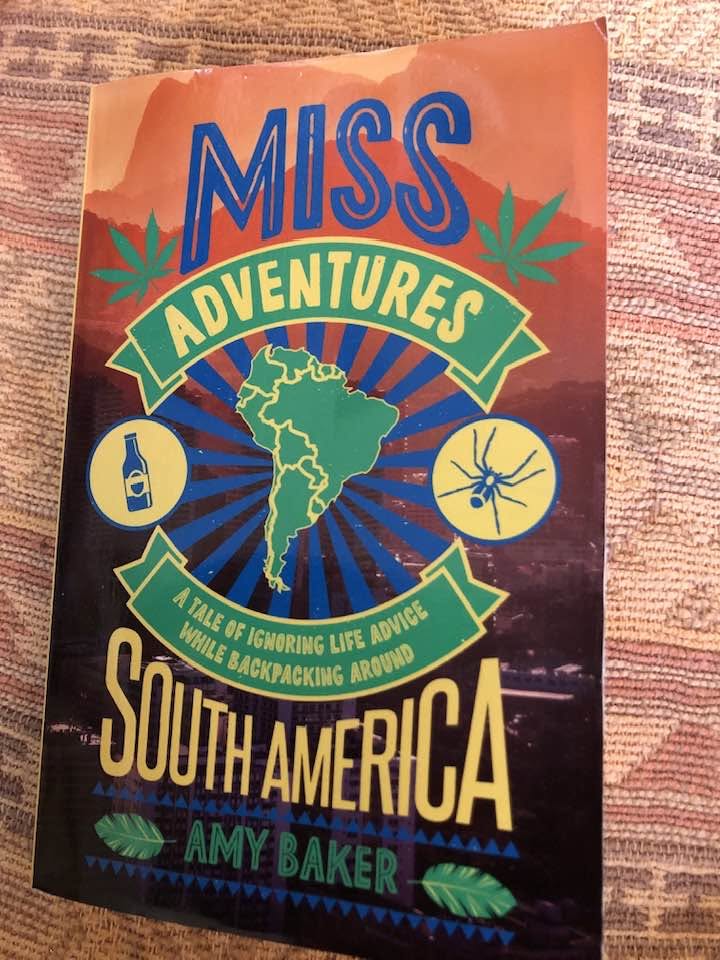
A young woman with a good job in London decides to quit and take off for South America to become a travel humour writer. She is given much unsolicited advice, all of which she writes down and almost all of which she then ignores.
She embarks on all sorts of adventures: climbing a mountain (very reluctantly, and complaining nonstop all the way), spending three days in the rain forest (mostly interested in the handsome guide, and traumatised by the mere sight of vast spiders), being terrified by faux gangsters, drinking way too much alcohol with her buddies, and, maybe most of all, indulging a deep interest in handsome young men. Oh yes, there’s the sharting incident…
It’s very funny in places. Each chapter ends with a little discourse about what she learned and how it relates to the advice she’d been given at the start. There is a particularly gorgeous scene towards the end where she’s up in a hippie retreat place doing some soul-searching. By gorgeous I mean, we like the scenery! And the place sounds good too.
Very much a young-person-starting-out sort of book. Nice to see a young woman being so empowered for adventure and not coming to any serious grief. By the way, she liked Colombia best.
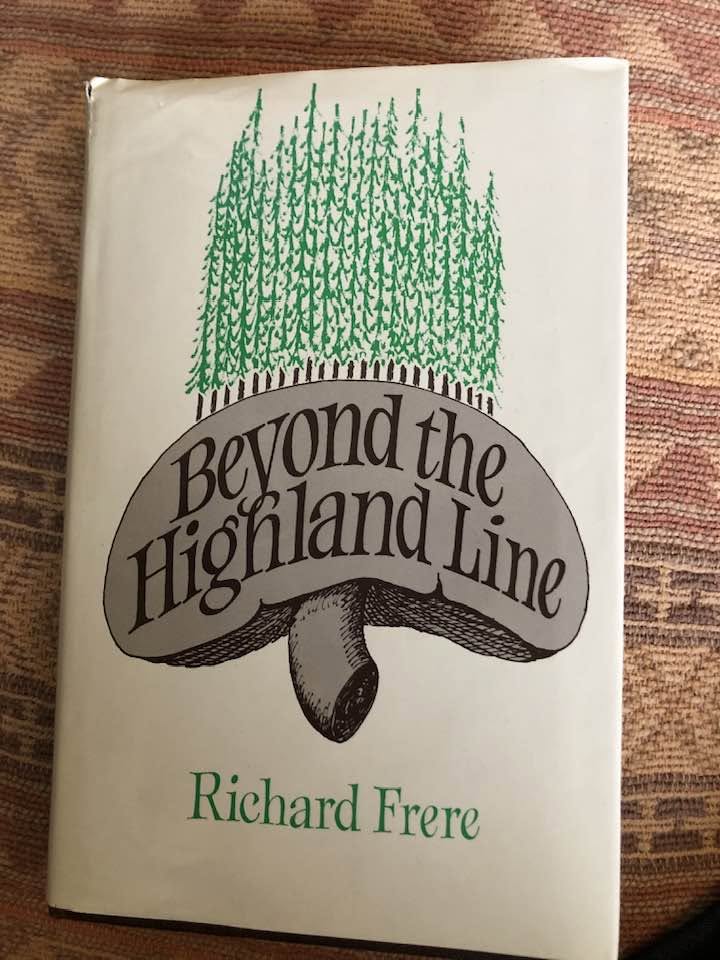 Beyond the Highland Line
by Richard Frere
This unlikely-looking book is actually really good. The writing is beautiful – erudite, different, honest, a bit old-fashioned in a good way.
A young upper-class man in the late 40’s moves his reluctant wife into a strange icy-cold house cobbled together from three railway carriages, near the tracks in a tiny village in Scotland. He has yet to make his fortune and relies uneasily on his mother, who pretends the wife does not exist. The strange house cost £500.
The couple then try mushroom farming and poultry farming, wherein disasters intervene; and the man eventually tries timber cutting, thinning, transporting (hard to read about: the buying and felling of entire hardwood forests).
The book is a chronicle of a young man trying, and mostly failing, to get on in business; while what he really loves is climbing mountains. It’s often funny – there is a horse in it called Dobbin who is the most endearing horse I’ve ever read about, and a long chapter is devoted to him. Made me laugh!
The author does not spare himself, and his love and respect for his wife shine through, even as he’s making disastrous decisions that will affect her. The cover is not equal to the interior at all – it’s anaemic, in my opinion. The book is a testament to human folly, and has a few notable characters in it, well-drawn.
The author pic in the back shows a tall handsome older man greeting a big friendly dog which stands on its back legs to greet him. There is something touching about somebody so distinguished-looking being so bumbling. And we remember then that actually there is something he does really well: write about it all.
Later he wrote Maxwell’s Ghost, about a friendship with Gavin Maxwell, who famously wrote Ring of Bright Water, and had his own troubles too.
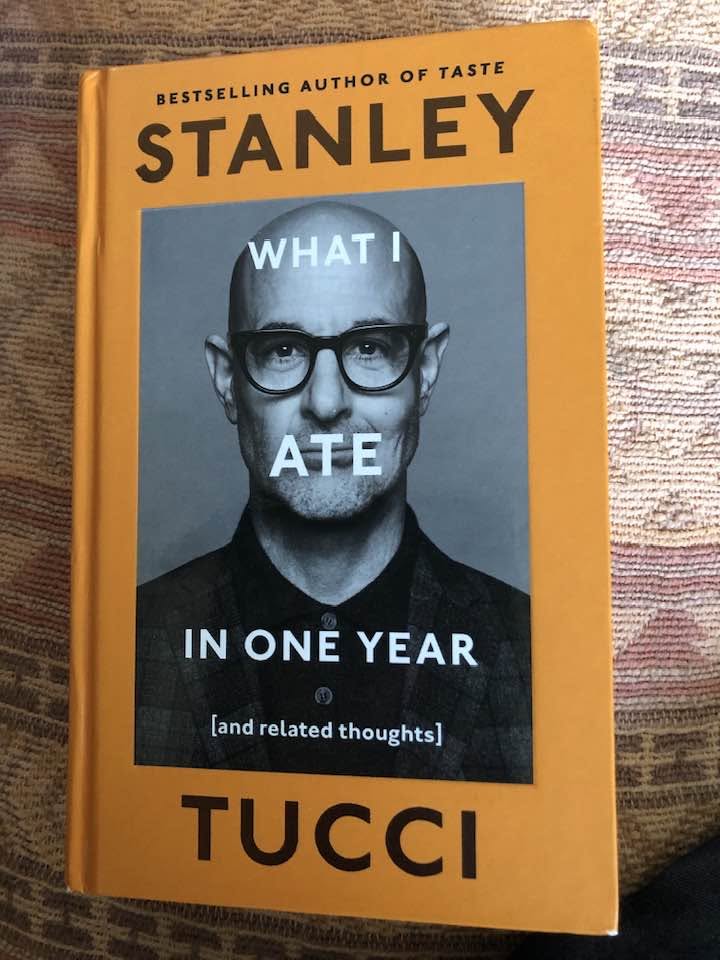 What I Ate in One Year
[and related thoughts]
by Stanley Tucci
As foodie memoirs go, this one was fairly non-juicy – probably because I had no idea who this guy is and also who most of the many many celebrities he cooks and eats and makes movies with are. He describes great numbers of meals cooked and/or eaten in many countries, mostly pasta; plus what he cooks for his kids and what his wife cooks and eats. Some of it sounds good and some I want nothing to do with (e.g. snails).
There were two really funny passages, both in airports: in one, a security agent makes him drink up old fetid water out of one of his kids’ water bottles, after which she goes all star-struck and starts gushing about his movies.
350 pages. I guess if you see lots of movies and really like pasta, it would be a fun read. He’s as humble as a greatly name-dropping soul can be. He admits when his food doesn’t turn out well. I don’t think I ever saw the word ‘pasta’ so many times in one book. He is Italian-American after all. He also loves his extended family a lot in a very natural way so there is an air of emotional health throughout.
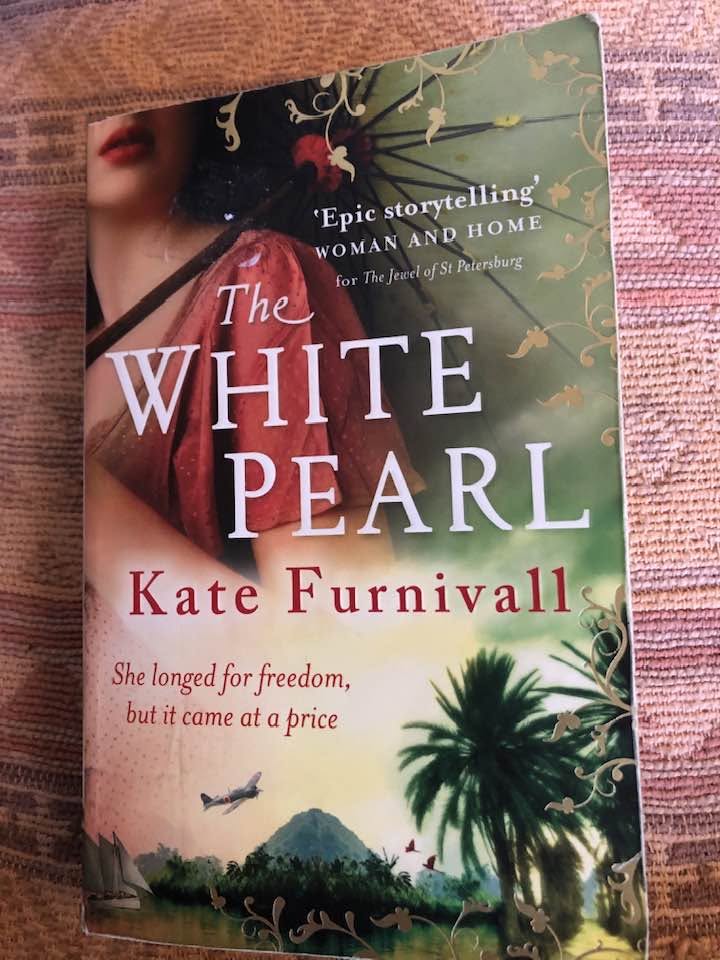 The White Pearl
by Kate Furnivall
This one is a doozy! In the back of the book is an interview with the author where she describes her creative process. The characters, she says, have a life of their own and do whatever they like, pulling her along. I get the feeling of a great deal of freedom, of pulling out all the stops and cutting loose. I thoroughly enjoyed the book, even as I was often scared!
The cover does not show the story really very much! It’s a swashbuckling tropical hotchpotch of characters and action, set in 1941 in Malaya, particularly in a small town north of Kuala Lumpur. A rubber planter’s pearl-wearing, sedate, but secretly passionate and frustrated wife, with a young son, accidentally kills a native woman during a car crash that’s not her fault. She tries to rescue the woman’s two teenage children, who have vowed revenge on her.
Meanwhile the Japanese bomb Pearl Harbour, and very soon all hell breaks loose in Malaya. There are scary scenes with bombing and carnage. The woman flees with her husband, child, and some friends on her beautiful sailing boat. The second half of the book is all about the relationships and tensions within this group, and others who attach themselves to it with the permission of its kindly owner.
I was amazed when we then land on a pirates’ island full of treehouses… and the extreme adventure continues… not without casualties! There is one unlikely plot twist near the end which bothered me, but in wartime, who knows? And I was inclined to feel lenient. The book is begging to be a movie!
I would definitely read more by this author. She is courageous in the sheer scope and vitality of her storytelling! I’ve been to Kuala Lumpur, and the descriptions of tropical airs and jungles were great.
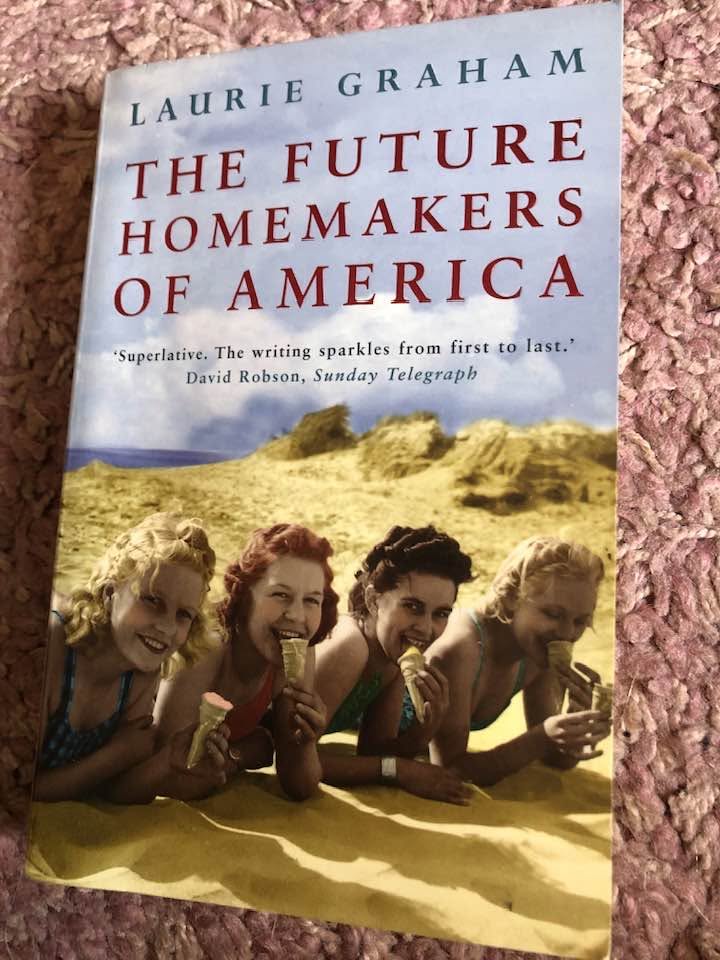 The Future Homemakers of America
by Laurie Graham
This is quite a strange book. The author, who’s written many, is English; but she’s confidently taken on a whole team of five US Airforce wives stationed in Norfolk during WWII, plus a local Englishwoman – and she gives them all a more-or-less interchangeable sassy dialect, where you don’t know if you’re in Texas or the Fens.
Plus, there are anachronisms, at least according to my AI (and my memory). She’s got a husband retired from the air force becoming a salesman for leaf blowers, before there were leaf blowers for sale. She’s got a bride registering at Walmart in Texas, when there were just a few Walmarts, in Arkansas.
It was a good story, compassionate and funny and various, about the six women maintaining a friendship all the rest of their lives, though divorces and affairs and kids and jobs etc. There’s a sub-plot about a hereditary neurological disease, Huntington’s Chorea.
There’s a kindly heroine with a gift for friendship.
The ending is nice. The writing is clever and brisk and yet relaxed. But I also didn’t believe the frankness with which the women discussed intimate details and their marriages: my mother told me that when she was young wives simply did not discuss their marriages that way. I don’t think they did until the ’60s, when people suddenly started thinking honesty was a good thing. Before that it was all about appearances.
This is supposed to be in the ’40s, a slovenly wife talking about her Dutch cap: “I can’t stand those things. By the time you’ve remembered where you left it. Then it has life of its own. Springs outta your fingers, goes flying across the bathroom and it always lands in that skronk behind the WC. I’d sooner take my chances.”
Of course, the frankness makes for a better story. But I don’t think people talked like that. (If you know different, let me know!) Plus, Americans here use some Brit phraseology. Like ‘row’ for argument. This always happens when Brits write dialogue for Americans or vice versa – errors are made. Editors don’t seem to catch them as they should. (They should ask me!) It’s very irritating; makes you not trust the book.
392 pages, published in 2002.
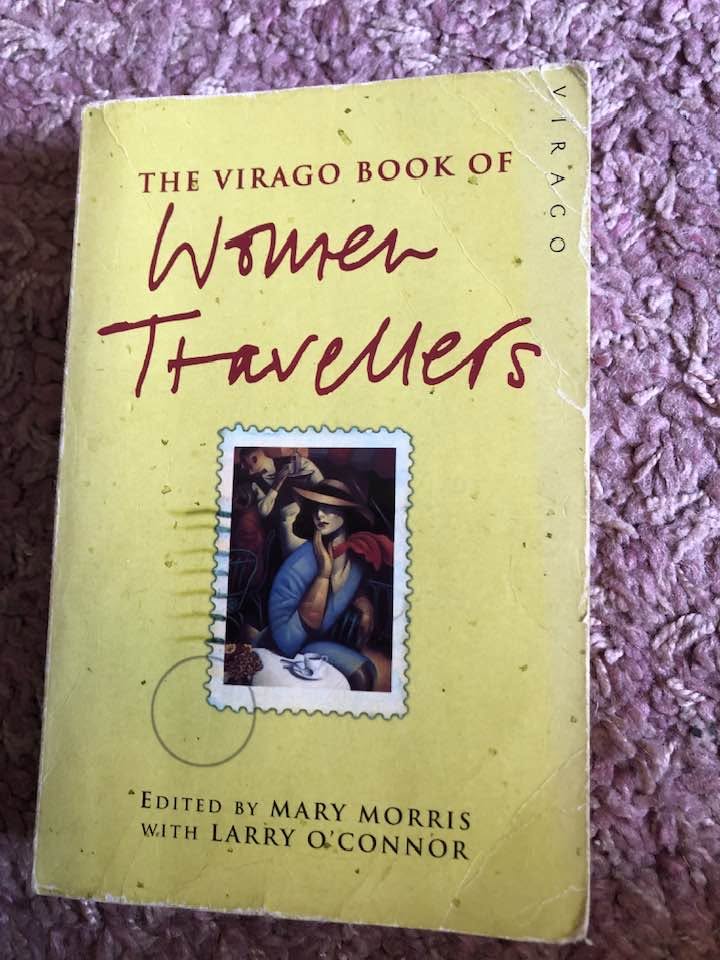 The Virago Book of
Women Travellers
edited by Mary Morris and Larry O’Connor
Whatever stereotypical notions we might have of how women are supposed to regard high adventure, this book blows them away with the wild winds.
From the 17th century to the present day, these excerpts from books by 51 different lady travellers are lively, colourful, and educational. Many of the writers are well-known: MFK Fisher, Frances Trollope, Edith Wharton, Alexandra David-Neel, Isak Dinesen, Beryl Markham, Dervla Murphy, Joan Didion – but many I’d never heard of. It seemed to me there was a general tone of honesty and practicality, rather than self-glorification.
The adventures are amazingly diverse – scaling a peak in the Rockies, flirting with and escaping from men in Italy, being thirsty in the Gobi desert, being a nanny in the household of a cruel sultan, drawing totem poles among hostile natives in BC, dancing in Alaska during the gold rush, flying in Africa looking for elephants (and having an affair), etc etc. By far my favourite was The Big Smoke by Emily Hahn, a mining engineer/journalist, about her time in Shanghai during WWII: she’d always had a hankering to become an opium addict, and she managed it easily; then kicked the habit later with the help of a German doctor who gave her hypnosis and let her detox in his clinic for free. The insouciance of this story is wonderful.
There is a short bio of each author. Impressive how much wandering some people managed even before airplanes and cheap flights.
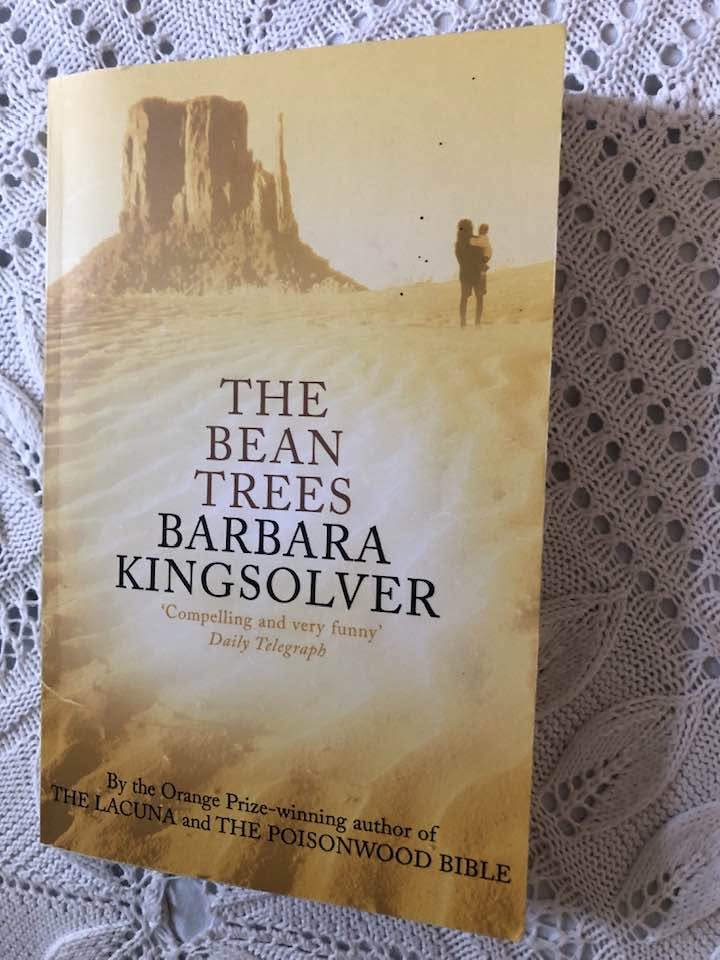 The Bean Trees
by Barbara Kingsolver
This delightful novel, from 1988, is even more timely now than it was then. Kingsolver must be an exceptionally loving, intelligent, and wonderful human being. In fact, I was thinking about her name… kings should go to her to be solved, and it would only do them good. They would come out compassionate and humane and funny, and stop stealing from and annoying the rest of us so much.
A young woman from Kentucky raised by a kindly single mom takes off west to find her destiny. In Oklahoma she is handed a little Cherokee baby girl, so that the child will escape further harm. She takes the baby to Arizona and ends up in Tucson, accumulating a little community. There she becomes party to attempts to save refugees from Guatemala and El Salvador.
At 233 pages, it’s not a big book, but every page is whimsical, captivating, touching, funny, deeply yet lightly felt… as if human life is so utterly poignant and difficult and apt to go wrong that we might as well not go at it all too heavily, as that would just be too much.
Themes I found running through it: immigration, sexual abuse, and, very much so, the practicality and desirability of young mothers teaming up with other young mothers and living together, sharing child care and rent and confidences.
A very special book. 10 stars.
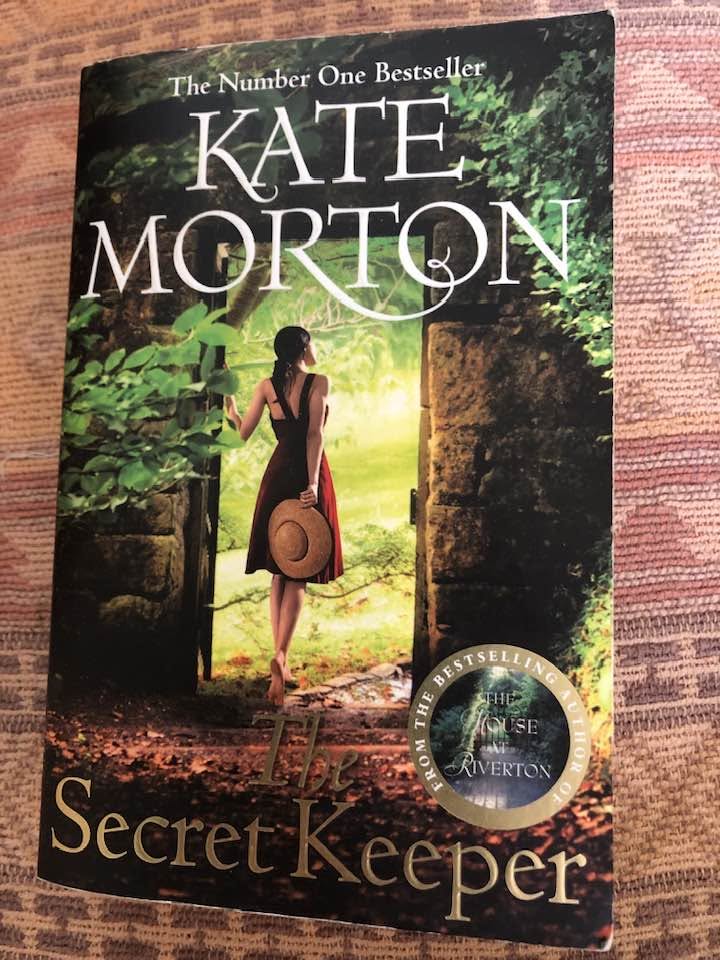 The Secret Keeper
by Kate Morton
A ravishingly good Anglo-Aussie saga by a ravishingly radiant young Anglo-Aussie writer. I’d read one of her novels before and been impressed. 590 pages of often-yummy description of Queensland long ago, alternating with scenes from the London Blitz and later bucolic summer farmhouse happenings. There’s a twist at the end but we believe it.
A child in the Queensland country is told to stay home because she’s misbehaved, while the rest of the family goes to the seashore for a day… but never comes home alive. The shocked child is sent to England to relatives. Later, as a teenage beauty she is married off to a famous writer who is not a nice man.
A young girl leaves home in Yorkshire to join her boyfriend in London. She’s longing for higher society and gets a crush on the beautiful young matron across the street. The war comes and they both serve in the WVS canteen. The boyfriend, a really likeable guy, ends up torn between the two…
The paths of the characters cross and re-cross, and a daughter in 2012 tries to find out what really happened during the Blitz.
I was happily engrossed for several evenings, and felt the ending was really good. This is not a simplistic writer – she’ll surprise you with the sudden beauty or intrigue of something she says.
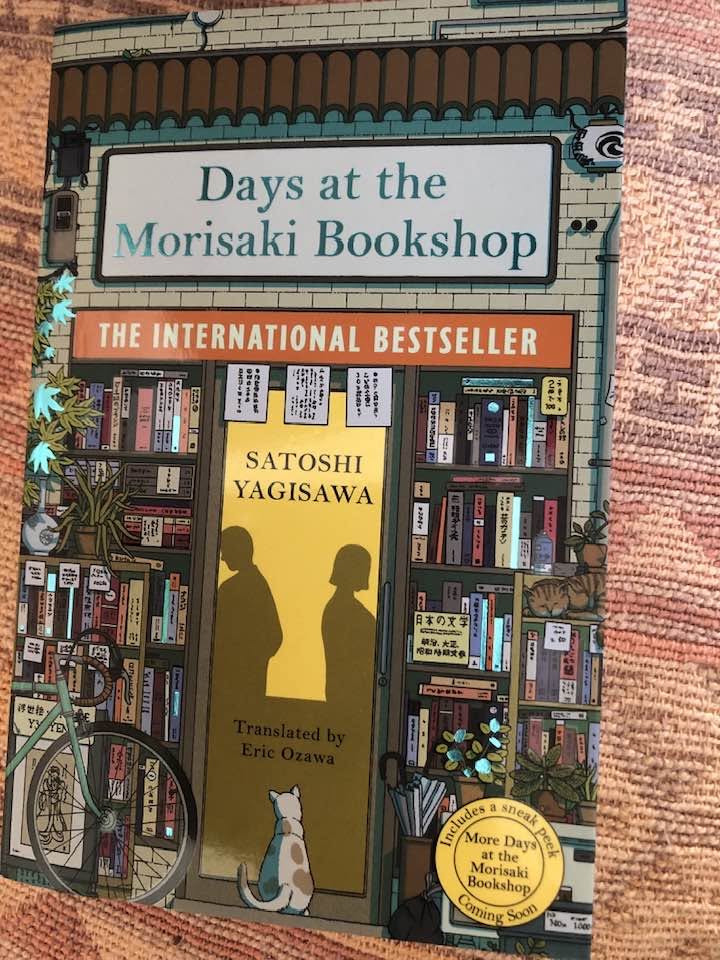 Days at the Morisaki Shop
by Satoshi Yagisawa
A sweet, nifty little debut novel, 147 pages, about a young woman who is jilted by a young man and ends up taking refuge upstairs in her uncle’s bookshop in a district of Tokyo filled with secondhand bookshops. She begins to read books for the first time in her life, and is drawn into mediating in an old love-drama in her uncle’s life.
The book was made into a film. I liked the photo of the author – serious, handsome, bookish. The atmosphere is good – coffee shops, Autumn, mountain shrine, old Japanese buildings…
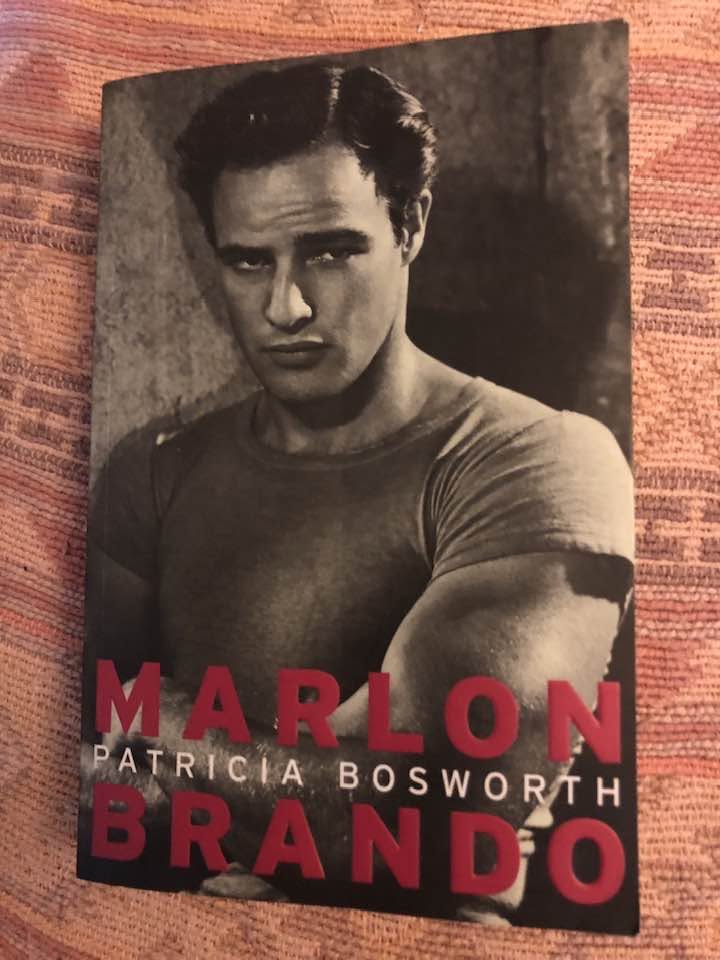 Marlon Brando
by Patricia Bosworth
The author met Brando (together with Marilyn Monroe!) once whilst manning the door at an industry Do. He put his hand on her shoulder, as she opened an inner door to help the pair escape paparazzi. She says his eyes were “incredibly piercing”, and she retained the feeling of that warm hand for decades…
I only remember seeing one film of Brando’s: Last Tango in Paris, which at the time was considered very shocking and avant-garde. I didn’t like it… but that had less to do with the actors than the (to me meaningless) premise of the thing. It was just kind of revolting. (At the end of Poona One somebody came up with a t-shirt saying Last Mango in Poona. That was much better, as a piece of art, I thought.)
And the stereotype of the young, sullen, wordless male is not one I feel attracted to. I guess having four older brothers cured me early. James Dean and Brando epitomised the type, very ’50s rebellion against the status quo. (The ’60s rebellion was I think much more goofy and celebrative, and included females, more or less.)
So I didn’t approach this book with great enthusiasm. (Once though in Poona we had a production of A Streetcar Named Desire, with the inimitable Dwabha as Blanche Dubois. She was so memorable that I forget the Stanley Kowalski actor completely!) Nevertheless, I was mildly interested in what the author had to say about Brando’s role in the play and film.
Basically: tortured genius, his entire career. Early fame, blazing talent, terrible childhood with alky parents – the dad violent. (Why did Marlon later give him all his money to handle??) Loved his mother. He was in psychoanalysis his entire adult life, in NY daily leaving the set at 4:00 so he could go to his psychiatrist.
Total womaniser! 9 kids with different women. Passionate social activist. Owner of a Polynesian atoll plagued by hurricanes. Over-eater who became hugely obese.
It’s a good book – particularly focussed on his career. Well-researched, we’ll-written, calm and non-sensational. 226 pages. Other bios have been much longer, apparently. This is a good one if you don’t have that much time.
There are some photos included, but not nearly enough.
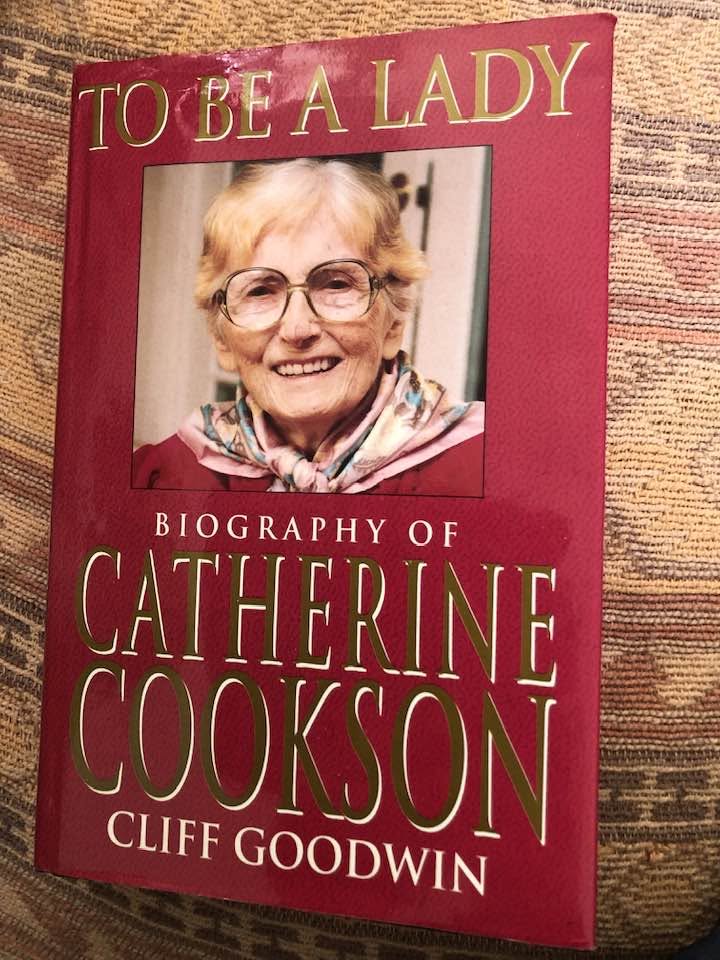 To Be a Lady
Biography of Catherine Cookson
by Cliff Goodwin
I was just in the mood for a good biography, and was not disappointed. This prodigiously productive writer didn’t start publishing until she was 40 – and the last years of her life were spent in bed for 6 months of each year, due to ill health; dictating stories, editing, proofreading, dictating some more. She’d often publish two books in a year. This bio is from 1994, and she was still alive then.
Her life was dramatic and difficult, since she was illegitimate in a working class Catholic household, with its share of drinkers and verbal abusers. Her real father, whom she never knew, gave her hereditary hemophilia. This brought lots of pain and bloody suffering.
Her marriage to a teacher proved immensely happy and supportive; Tom Cookson ended up serving his wife’s gift above all else… though he’d had a dream of sailing round the world alone. Catherine eventually became so wealthy from her writing that the couple donated huge amounts to hospitals and universities researching different diseases, including blood ones.
She was annoyed by people characterising her books as romances or bodice-rippers; “Catherine has always defended them as unromantic, unsentimental social histories of the north. A view supported by the growing number of sociology students advised to study her autobiography and early works.”
I liked this quote from Catherine: “I am capable of doing everything that I make my characters do: good, bad, or indifferent. I am quite capable of doing the worst things possible.”
I had to wonder what this talent and determination might have accomplished in a softer milieu… I tried to look at her Design, and it seems likely she was a Manifestor, which seems to make sense.
I found the book very well written and researched.
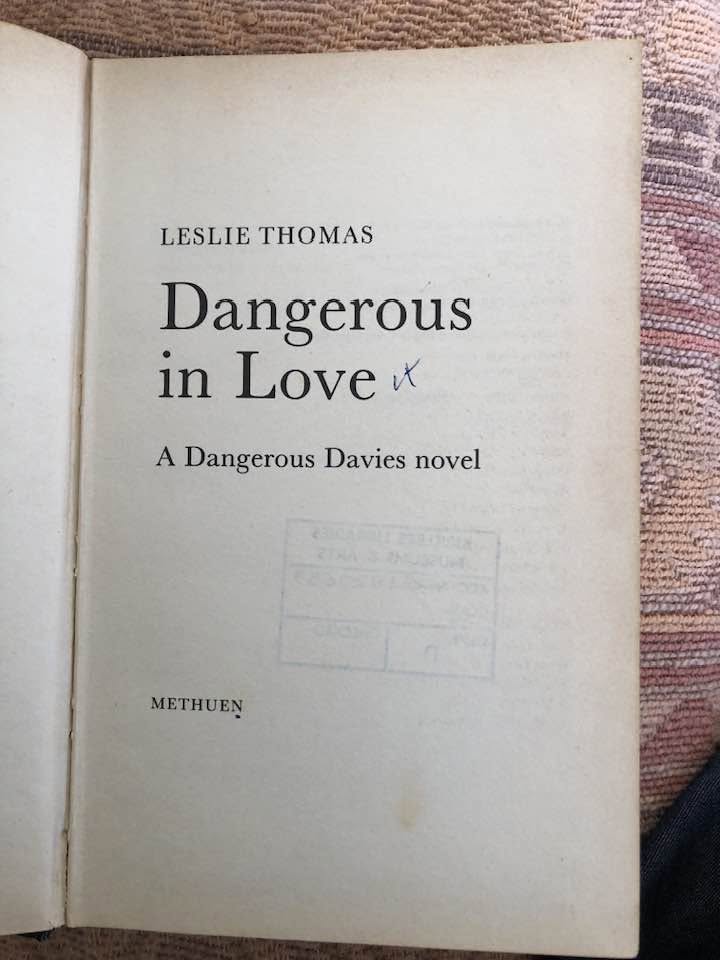 Dangerous in Love
A Dangerous Davis novel
by Leslie Thomas
I found this hardback without its dust jacket, so it just looks black and blank on the outside. I picked it up because I’d read a superb memoir by this writer: This Time Next Week, about growing up in an orphanage. It made me see how important a cover is to enjoying a book; I felt slightly disoriented throughout not having one to refer to!
This book is an amusing detective novel about Dangerous Dan, who has a way of ending up on his head in a hedge instead of besting the bad guys. He has a huge shaggy male dog called Kitty, who looks like a yak some friendly local hairdressers have created dreadlocks on. In this book he falls in love with a social worker from Martinique, and she with him. There are evil pharmaceutical workers who smuggle drugs, and a very gritty London backdrop. It’s from 1987, and, as detective novels go, it’s very sweet.
These reviews were previously posted on Facebook by the author, reproduced here with permission.
Featured image by Gülfer ERGİN on Unsplash
Related articles
- Madhuri’s collection of short reviews: Late Evening Reading
Comments are closed.