

In this essay, Sarjo shares the strategies he has found for maintaining a meditation practice in the midst of everyday life
One of Osho’s teachings that strikes me most is: “Meditate in the marketplace.” Or: “Be in the world, but not of the world.” “Don’t go locking yourself away in a monastery.”
I lived for five years in an Osho commune in Italy. I’ve been a sannyasin for over twenty years. And even now, I struggle to meditate with any real regularity.
It seems the problem isn’t mine alone. Observing some of the Osho centres in Europe, and speaking with people who live or have lived in them, I find that this difficulty – which I experienced firsthand during my five years in the commune – is widely shared.
Recently I’ve had the good fortune of attending workshops and work-as-meditation sessions regularly at Osho Risk in Denmark, where I currently live. My home is more than forty minutes by car from Risk, so my partner and I stay there for a few days at a time, once every month or two.
This particular combination led us – independently of each other – to notice something I would dare to call “collective unconscious” at work. My partner noticed that when she’s at Osho Risk, she has no thoughts or worries about her health, whereas at home she’s almost obsessed with them (our neighbours, I should add, are mostly elderly).
I, on the other hand, noticed that at Osho Risk I have no difficulty going to sleep at 10 pm – something that at home feels nearly impossible. There, I have comics to read, and I keep reading them even when I’m not particularly enjoying them; I do everything I can to avoid going to bed, which I find quite irritating about myself.
Having Osho Risk as a kind of litmus test, we’ve noticed this difference clearly. It can probably be attributed to the collective unconscious of the place: at home, that unconscious is oriented towards health anxieties and the satisfaction of everyday needs; at Risk, towards inner search and meditation.
Having experienced this so plainly on my own skin, I also came to understand why, in the past, people used to shut themselves away in monasteries to meditate. It makes sense.
And yet…
And yet, as I said at the beginning, it’s not as though the people who actually live in the centre have some incredible, unbroken consistency in their meditation practice. A rare individual, perhaps – but not the community as a whole. So living in a centre does not automatically guarantee support for meditation.
And then there is the beloved Master Osho, telling us to meditate in the marketplace.
I live in the marketplace. I have always worked in the marketplace – even when I lived in the commune. And over the years I’ve noticed that there are periods when I meditate a lot and with ease, and periods when it simply doesn’t happen.
It feels like a puzzle I can’t solve.
I have tried various approaches. One is Gurdjieffian. In Ouspensky’s In Search of the Miraculous, I read that Gurdjieff suggested this method when you want to accomplish a task you’ve set yourself but can’t seem to follow through on: “Renounce the thing you hold most dear right now.”
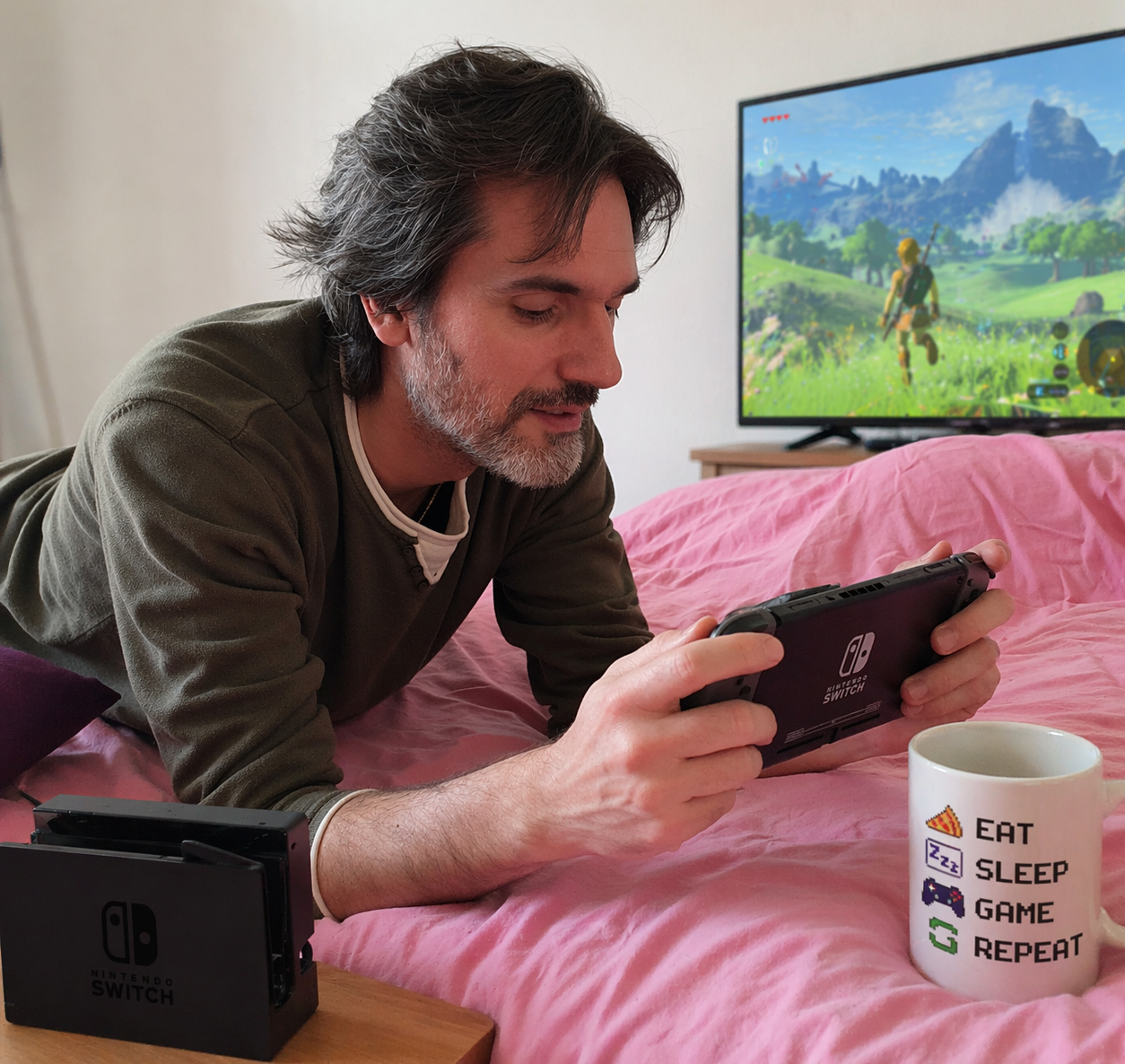
I tried it. I wanted to build myself a wooden bed – joinery only, no screws or metal parts. The project had been sitting untouched for a year and a half. So I decided to give up comics and video games – my two addictions – until the bed was finished. I completed it in three months.
Then I decided to continue the renunciation (feeding my ego as a great meditator, I’ll admit). After a couple of years, it no longer felt meaningful, and I went back to reading and playing.
The other teaching comes from Osho. If I’m not mistaken, in the series of talks And Now and Here – transcribed from a meditation camp where Osho speaks about out-of-body experiences – he says that one of the steps for activating that technique is having complete control over one’s body.
To develop this, he suggests small exercises: keeping one eye closed for an hour, for example. The essential thing, he says, is to honour the commitment absolutely, because breaking it causes damage to one’s self-esteem. (This is my paraphrase – read the book for the full picture.)
These two teachings somehow blended together, and this morning I had an insight.
The key is not to meditate endlessly. It’s not about sitting for an hour every single day, forever. It’s about making a commitment that is – and here I borrow a term from management – SMART: Specific, Measurable, Achievable, Realistic, and Time-bound (or Specific, Measurable, Agreed, Relevant, and Time-Bound).
For example: For seven days, I will wake at 6 am and do one hour of Vipassana.
Is it specific? Yes. Measurable? Certainly. Achievable? Absolutely. Realistic? Time-bound? Yes, and yes. Perfect.
At that point, you simply remember Osho’s teachings – and add Gurdjieff’s, if you need a reinforcement of will – and the thing becomes doable.
One important addition: after the seven days, it is essential to take a pause, adjusted to your own daily life and commitments. Some people might manage twenty-one days of meditation in a month with only one week off.
For others it will be the reverse. Some will manage only three days a month. All of it is fine.
There is also the aspect of creativity. There is no need to repeat the same meditation forever. Older Osho sannyasins – or so it seems to me – place great emphasis on Dynamic Meditation, Kundalini, and the Evening Meeting. And yet I have also read Osho saying that if, after a certain period, a particular meditation no longer has any effect, we should drop it and try something else.
So it’s not only the classic Osho meditations. There are many others – No Dimension, Whirling, Nataraj, Mandala, Gourishankar, and more. There are the 112 techniques of the Vigyan Bhairava Tantra, those in the Orange Book, and many others scattered throughout his talks.
Until – and this is my wish for all of us – meditation enters into all twenty-four hours of the day.
In the meantime, I need strategies that work for me. I share these reflections with you in the hope that they may be of some use.
Featured image of the author modified using ChatGPT



Comments are closed.