

Reviews by Madhuri of books by Rowan Coleman, Araminta Hall, George Mahood, Robert Goddard, Michael Palin, Nick Pettigrew, Robert Bateman and Rick Archbold, Mary Stewart

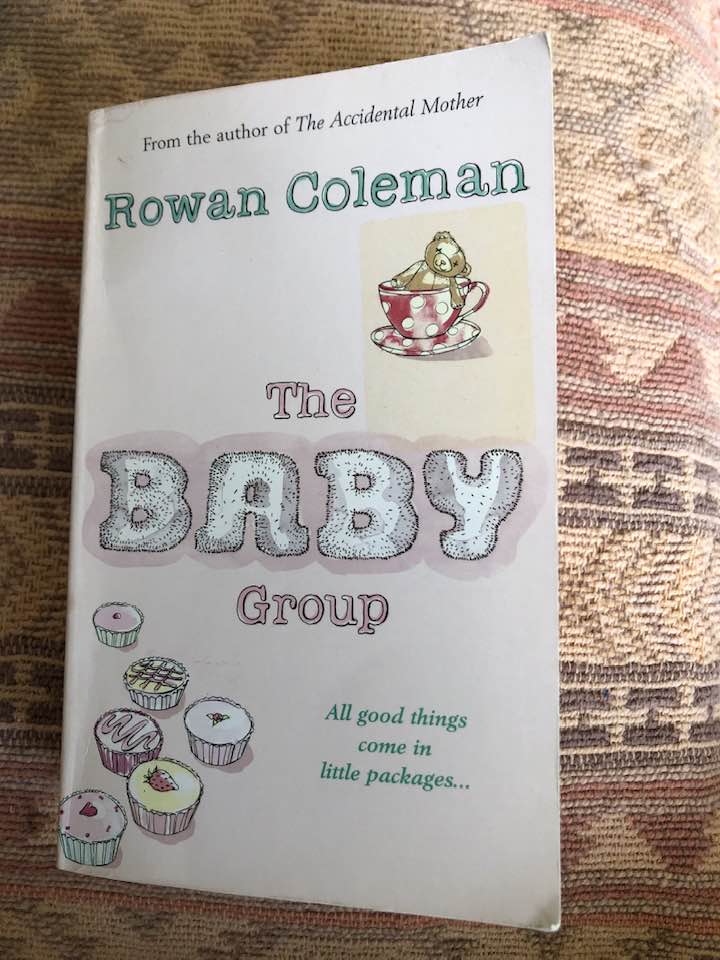 The Baby Group
by Rowan Coleman
The local book trading booths offer too many spy novels, Dan Browns, and chick lit books for my taste. The lesser of these three obnoxiousnesses is chick lit, so sometimes I take one home. And sometimes I’m pleasantly surprised.
A reckless and often unwise and not very truth-telling (though successful) young woman has a wild fling in Venice with a young man she met on the Tube. He vanishes, she’s pregnant, and when the baby comes along she ends up in an unlikely group of people – including a man and a teenager – with new infants. We find out the stories of each of them, our heroine’s terrible drinky mum appears, the electrician the heroine hires is dishy, the mum goes for him… etc. The ending made me laugh, and I found the whole thing quite intelligent, and contemporary in a good way.
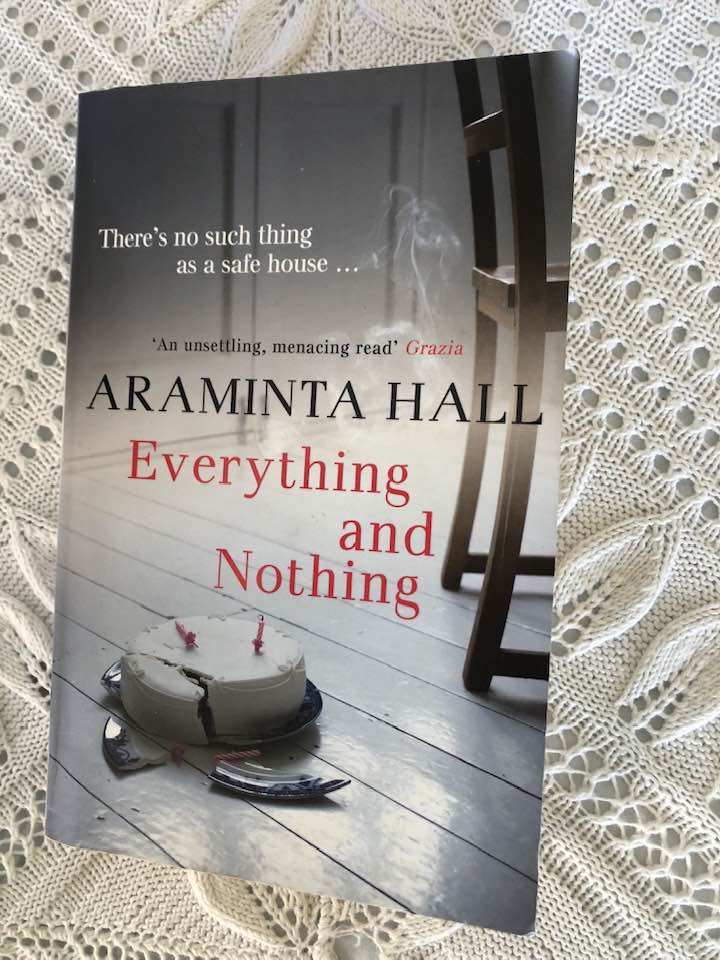 Everything and Nothing
by Araminta Hall
Another book booth find – and this one is excellent. Ever since Girl on a Train there’s been a genre of psychological thriller I’d call London Domestic. Some are unreadable (my opinion) but this one is great. The title is not catchy at all and I’m not sure why they decided on it; but it does express something of the existential dread – and breakthrough – experienced by the couple in the story.
A successful career-oriented couple with two young children are trying unsuccessfully to balance work and parenting – and relating to each other. (The husband had had an affair and the wife took him back. The Other Woman is not going quietly though.) They hire a young nanny, who turns out to be amazing – she cleans, cooks, the kids love her. (The children are finely drawn and characterful. Each is an oddball in their own way.) We are party to the inner life of the nanny, and it’s scary and heartbreaking. Everything comes to a peak when the little boy is having a birthday party. I won’t give any more away, but the ending is surprising and believable.
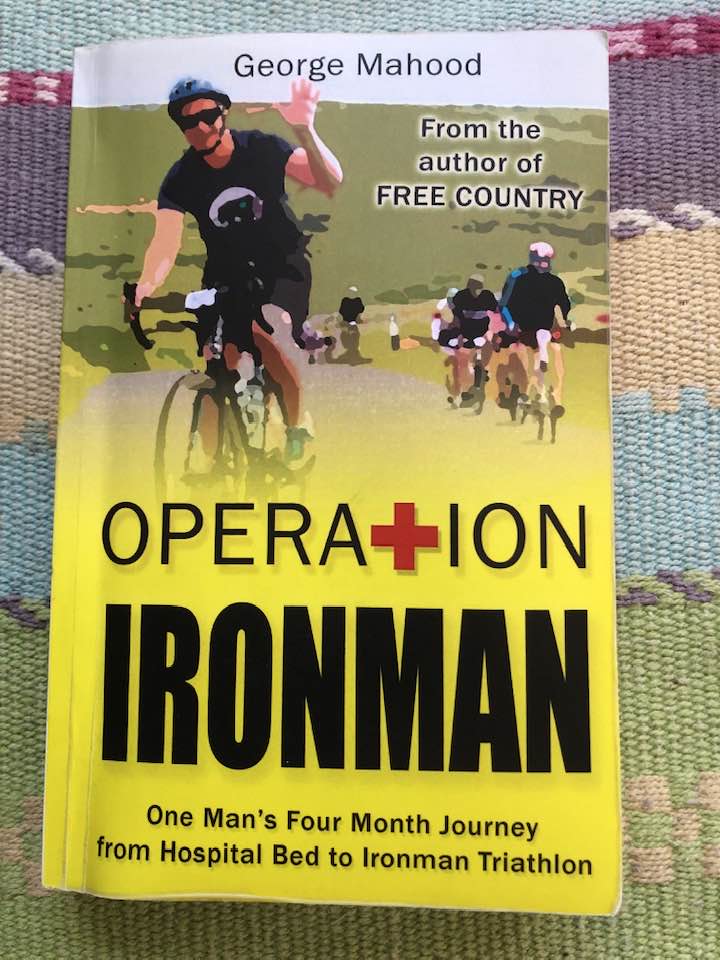 Operation Iron Man
by George Mahood
I’d read this indie-publishing author’s book Free Country, where he and a friend manage to cycle from one end of Britain to another after setting out wearing only Union Jack boxers, with no money, no other clothes, no tents, and no bikes. It was really funny, as you might imagine! So I am friendly-disposed towards him. The next one I read was about being a wedding photographer, which I found a bit preachy on a subject I don’t know anything about; but sometimes funny. In this one he manages to get up from a hospital bed after spinal surgery and 4 months later complete the Ironman triathlon. We get a minute-by-minute account of all of this; self-deprecating, often funny, with his young family as supporting characters. If you’re interested in extreme sport it might be even more gripping!
I found the story quite fun, if something less than continuously hilarious – and was of course impressed that anybody could do a triathlon. And kind of glad I’m too old to worry about stuff like that. It’s enough to go for a reasonable walk or bike ride, or both, every day. I liked it that marathons and triathlons are apparently not races, so you’re not trying to beat everybody else, but just manage to complete the thing within the given time at all. So you can get the medal and the T-shirt. People often help each other, and volunteers help everybody by feeding them and spraying them with hoses if it’s really hot.
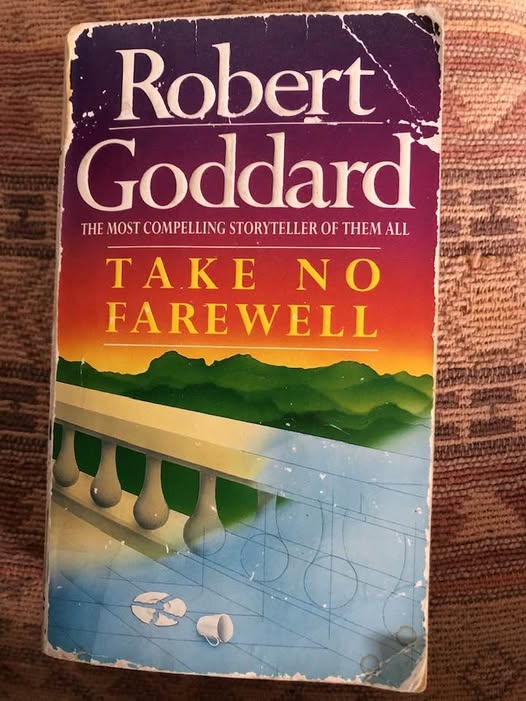 Take no Farewell
by Robert Goddard
A lavish whodunnit set in the early part of the 20th century. A young architect creates a superb mansion for a wealthy shitweasel who has made a fortune in rubber in Brazil. The architect and the beautiful Brazilian wife of the nasty man fall in love. He then chooses fame and money over her, despite his passion, and leaves her to the mercy of her husband.
13 years later somebody visiting the mansion dies of arsenic poisoning and the Brazilian wife is blamed. What follows is a seemingly inexhaustible caper between England the south of France, featuring all sorts of characters. I was held by it – the writing is very good – and the ending was not grimacingly gimmicky, though it was surprising. Somehow it felt right. The author is sophisticated and adept, the scenery descriptions evocative, and the story takes you with it effortlessly. 572 pages!
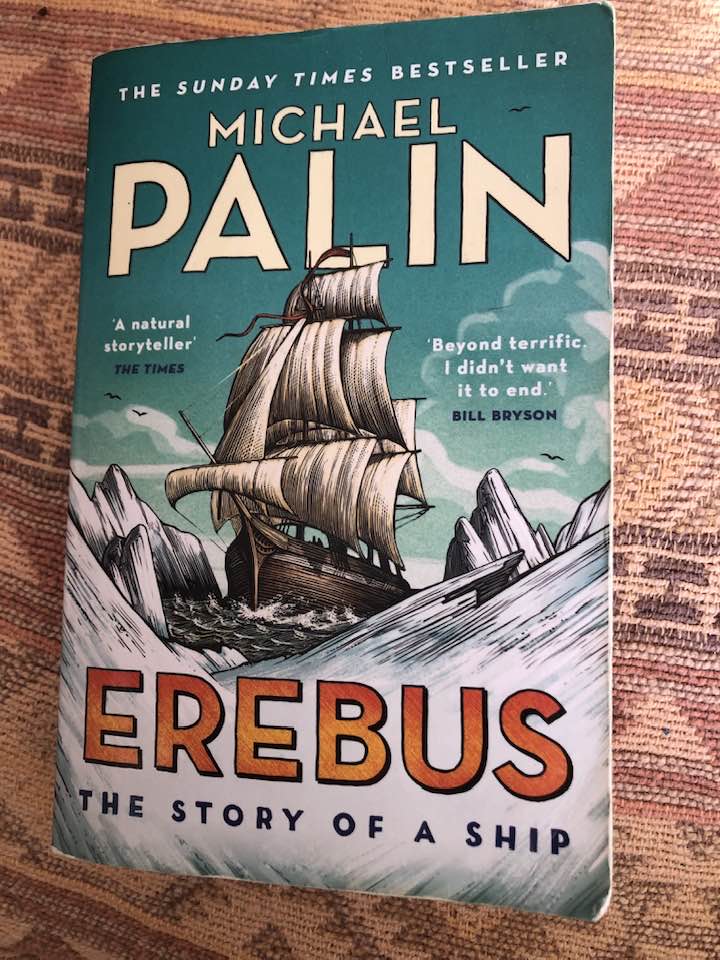 Erebus
The Story of a Ship
by Michael Palin
This is the bio of a ship, born and sent adventuring during the early years of the reign of Queen Victoria. We follow its fortunes – and those of its captains and officers and crew – into the Mediterranean, and then down to the Antarctic, further south than any other ship had gone before (as far as people knew). Later she was sent to find the Northwest Passage over the top of Canada; and that’s where she came to grief. 160 years later, she was found at the bottom of a shallow sea…
I particularly enjoyed the way that the author’s journey, following in the wave-steps of the ship (well, he flew, he didn’t sail) cuts in and out of the narrative. And I found fascinating the depictions of Tasmania and certain Antarctic islands, plus the Falklands – places with the lure of the faraway. The writing is straightforward and clear, the research behind it vast, and the sense of adventuring very agreeable to someone lying safely in a nice clean bed with a window looking out onto a quiet, horse-graced pasture!
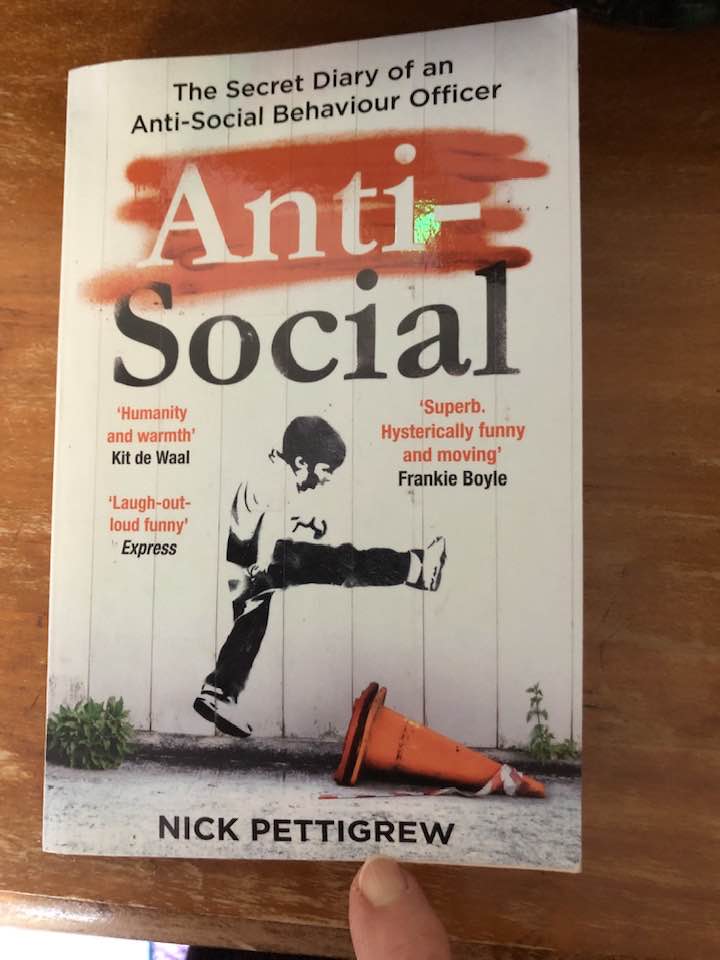 Anti-Social
A Secret Diary of an Anti-Social Bahaviour Officer
by Nick Pettigrew
This author’s job was to investigate claims of anti-social behaviour lodged by tenants of properties managed by a social housing organisation. Since I live in social housing I was quite interested. (I’m very lucky because the estate I live on is peaceful and remote, and I’ve seldom felt bothered by anyone – except workers for the landlord! Spraying guy, insulation guys… and I did lodge complaints about them.)
The author’s estates were the high-rise tower block sort where drug dealers collect in stairwells. Most if not all of the complaints he deals with are drug-, alcohol-, or mental-illness-based in some way. So we get some grungy stories. He himself suffers a lot and takes antidepressants and drinks; the stresses of the job really get to him. We are also treated to descriptions of how exactly the cases are investigated and treated; all legal protocols.
He’s also funny. One boss he has “looks like a waterbed full of evil porridge.”
At the end he quits – it’s just too heartbreaking trying to deal with an impossible caseload with constant budget cuts – and he is diagnosed with ADHD, takes the meds, and feels much better. He ends the book with many pages of a polemic on how governments should take care of vulnerable citizens, citing Finland as an example. I wholeheartedly agreed with every line of this dissertation. So I was left feeling very warm towards the poor guy.


Robert Bateman
An Artist in Nature
Text by Rick Archbold
I had never heard of this Canadian artist and conservationist. The book is quietly and spectacularly beautiful. 176 pages of gorgeous paintings that make you want to look, and look again. There is also text, a bio and a lot about the conservation work. I can only contemplate such painting in awe.
The artist and his wife live on Saltspring Island, in BC, where my oldest brother used to live and where I’ve visited. But many of the paintings are from Africa, where the artist has lived and taught. He grew up outside Toronto, so there are also paintings from the wild places of his youth.
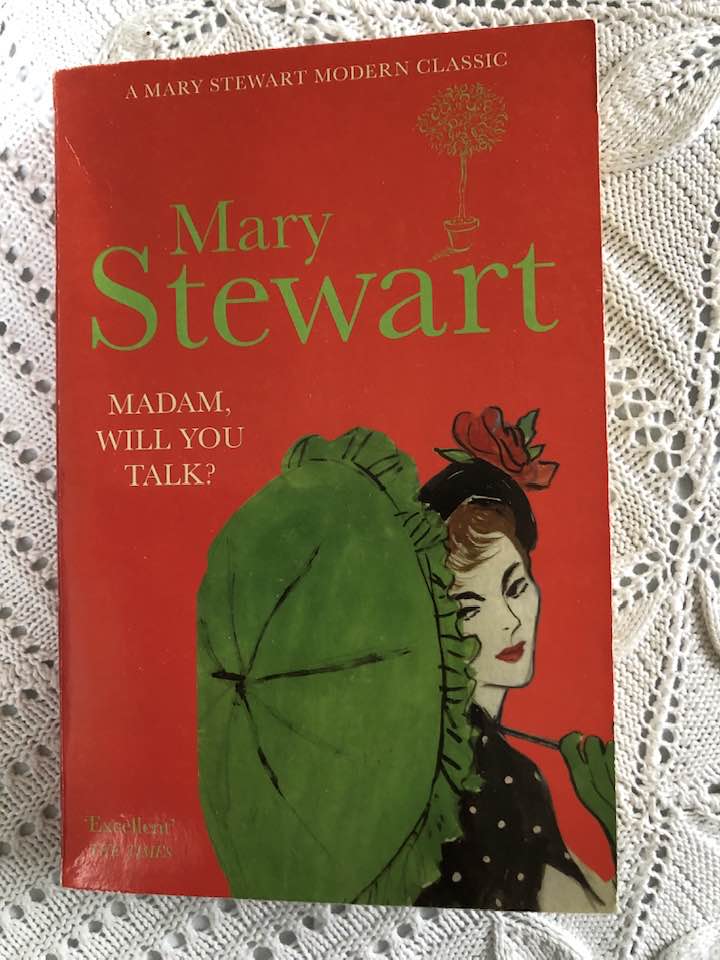 Madam, Will You Talk?
by Mary Stewart
This was published in 1955, when publishers took seriously the quality of the writing they might bring out. It is very, very good. I am delighted to discover this author!
First, going back to 1955 was very restful (even though it’s a suspenseful book). The highest tech we encounter is very fast cars and landline telephones. The heroine praises her synthetic dress because it doesn’t wrinkle despite her considerable adventures. She mentions that her nightie is nylon. This in itself is not restful of course, but it’s the spaciousness and simplicity of things… I grew up in the 50’s, in want and dim squalor in Southern California, and it always fascinates me that elsewhere, in so many places, some people were living in plenty and elegance.
A wealthy young war widow, whose pilot husband had raced cars and taught her how to drive, goes to Provence with her laconic best friend for a holiday. There she quickly gets embroiled in trying to rescue a 12-year-old boy from a mysterious situation involving various shady characters. A lot of the action happens in fast expensive convertibles blasting down country roads. Some of the writing then is just exquisite. This is about a Mercedes: “on a rising snarl she swept through the last of the thinning streets, and roared down the tunnel of her own undimmed lights, racing like a homing tiger for the forests of the night.”
And this Zen bit, where she’s reminiscing about her lost and much-loved husband: “No first-rate driver – I could hear Johnny telling me again – is ever excited at speed.”
It was nice to escape 2026 for a few evenings. And the descriptions of the food… when I first went to France, when I was 18, the food was a revelation. I don’t think it’s that way anymore. In this book we feel the lushness of the sea in all its fish, before we ate them to sorry depletion, and the gorgeousness of veggies recently in the rich ground.
The characters are sophisticated – the hero and heroine quote classics to each other – and there is a Bad Skulking Hiding Nazi to be rooted out. Very satisfying.
Featured images by the author
Related articles
- Madhuri’s collection of short reviews: Late Evening Reading



Comments are closed.