

A story by Sudas
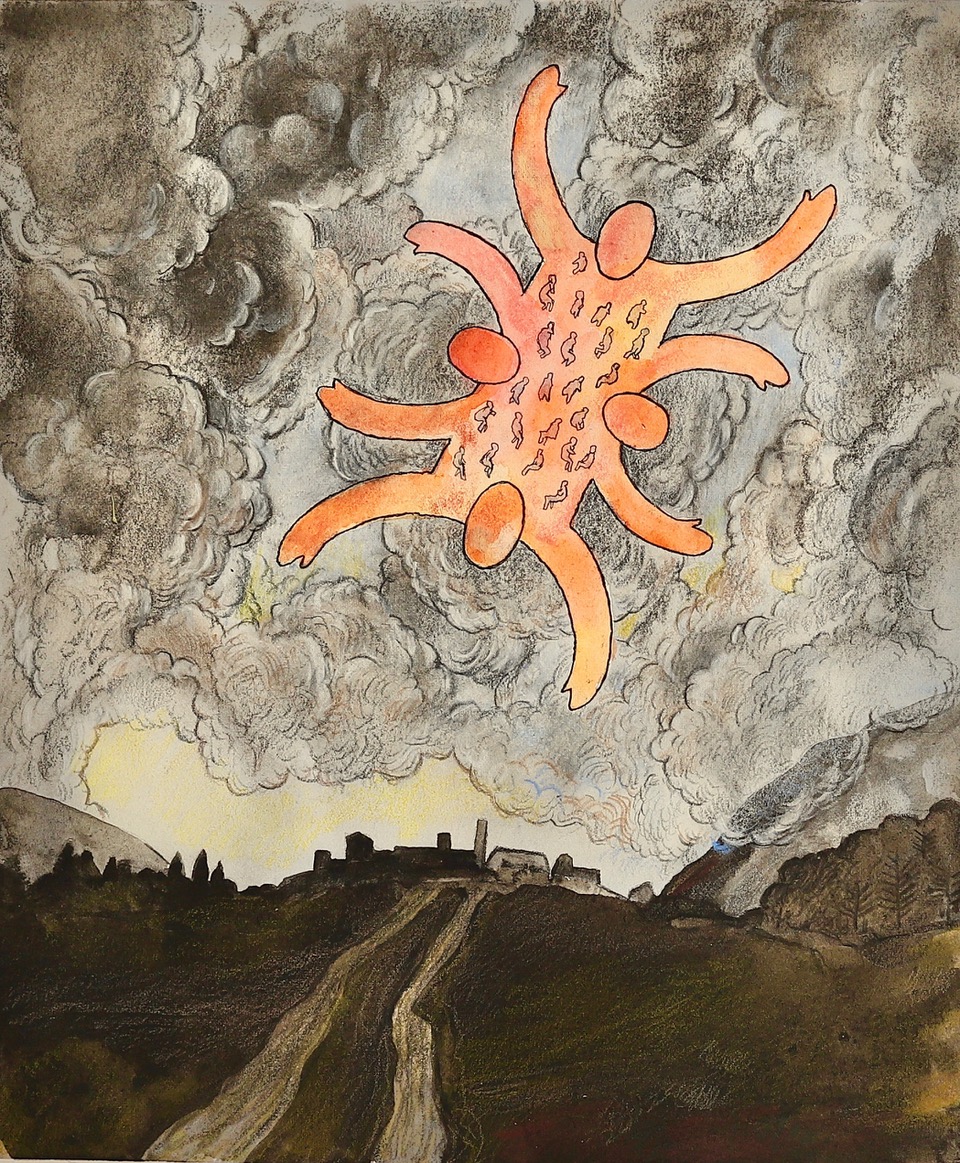
“Hey Dad, there’s a spaceship in the garden.”
“Ask if they want some coffee.”
The garden was the realm of hydrangeas and zinnias, and certain plants of oriental origin. Hydrangeas are small colonies of delicate flowers that draw strength from numbers; zinnias are simpler, rustic, with warm colours and an elementary shape.
It was not an Italian-style garden, quite the contrary, and the prevailing disorder was due in part to the laziness of the owners and in part to a choice of spontaneity.
The ground was covered with a thick carpet of leaves that had abandoned the trees during a particularly windy storm. L. liked the sound they made when he walked on them.
L.: “No, they don’t like coffee; they’d rather want to get hold of some Wellington boots.”
Dad: “What are they going to do with them?”
L.: “The spaceship is flooded. Apparently.”
They saw a figure cross the path: it had pronounced coral-red protuberances. Quick – and it vanished.
Dad: “Did you see that? What could those red protuberances be?”
L.: “I really don’t know. I’ll call after them. Hey sir, or madam, hey!”
In its haste, the figure had bumped into a Japanese tree with deep purple-red leaves. And it seems it had dropped something.
Dad: “Look, they’ve lost their fountain pen.”
L.: “It’s not a fountain pen; it looks more like a sprig of coral.”
Dad: “What are you talking about? Coral?”
L. to the Alien who’s coming back: “Good morning.”
Alien: “Good morning. I can see your astonishment: your jerky eye movements speak louder than words.”
L.: “Actually, we haven’t spoken yet.”
Alien: “Oh yes, very much so – we perceive the unsaid better than the said.”
Despite his bizarre appearance, the Alien carried himself with a certain elegance, as if it were completely normal to have coral branches almost everywhere on one’s body. However, his eyes were clearly visible.
L.: “We heard that the spaceship has flooded. I imagine that’s why you are looking for Wellington boots?”
Alien: “Not at all – it’s simply that we prefer them to loafers. Ideally we’d wear hiking boots, but their weight slows us down. Wellington boots, on the other hand, make us feel grounded, yet agile, and you can put them on and take them off in a flash. And where can I find some wood varnish? You see, these days our spaceship looks rather like a mountain refuge, and the walls are panelled.”
L.: “A mountain refuge?”
Alien: “Yes. Some of us were awarded a holiday in your Valtellina, and when they returned they brought back the thought-form of a mountain refuge, which gave the spaceship that shape. You know, the ship is very sensitive: if we think of it as a spaceship, it becomes and remains one – but a strong, shared thought from a close-knit group can completely change its appearance.”
L.: “But… does it still fly?”
Alien: “Of course it flies, otherwise what kind of spaceship would it be?”
L.: “Where do you come from?”
Alien: “From Mars, of course, otherwise we wouldn’t be Martians. Those little machines you sent, the rovers, are unable to sense our presence. But we can sense theirs. We are fed up with the noise they make; it makes us dozy. Many of us have collapsed asleep close to one of those rovers.”
L.: “Your colours start fading.”
The coral man pulls out a kind of marker pen and quickly touches up a faded branch.
L.: “You’re a good restorer.”
Alien: “It helps that I’m a painter. I can see you’re sceptical – you don’t believe I’m a painter? But we’re not very different from you aliens – sorry, Earthlings. We too have the desire to create, to express ourselves. I, for example, spend the long stretches of interstellar travel painting. Corals are extremely useful for holding brushes, pencils, markers – I tuck them between my branches and they don’t move. We have to be careful with erasers: they slip in and don’t come out again. But I must say, for astrosketching, corals are ideal.”
L.: “Don’t you think you’re a bit old-fashioned? Brushes, erasers…”
Alien: “I wouldn’t say so. Of course, we can talk about ancient traditions. Are you familiar with Lascaux, Altamira, the Chauvet Cave? We always have a great laugh when we read your hypotheses about the origins of these paintings. When we arrived, you were rather poorly equipped – but you should have seen their admiration, the vitality, the emotional engagement with our painters’ activity in those caves! Of course we no longer use the tools of that time, but we find it’s absolutely irresistible to get our hands dirty.”
L.: “But didn’t prehistoric people get frightened, seeing you so different?”
Alien: “Different? Why different? As I said, we are biologically mimetic: we were no different from a Cro-Magnon or a Neanderthal – they painted too – and above all, out of an innate philological instinct, we used local materials without adding any of our own products. On that note, I’ve heard it said that our artists were very struck by the absence of… green. Have you ever seen green in prehistoric cave paintings?”
L.: “If you’re so mimetic, why don’t you resemble us now?”
Alien: “A good question – but have you seen yourselves? Let’s just say that the reversal in your evolutionary trajectory hasn’t done you any favours. We laugh about it and quote you when we need to scold our children. As in: If you don’t stop, you’ll end up like an Earthling.”
L. and Dad looked at each other, puzzled; they didn’t really think they looked so terrible – quite the contrary – in fact they considered themselves rather good-looking. However, being very intelligent, they were willing to acknowledge the relativity of judgement: anyone can make a mistake.
Dad remembered the day when, among friends, he’d been asked to imitate a cat; well, it was very painful to see himself in a video afterwards. Far from being cat-like, he was rigid as a post. And L. thought back to when, much younger, he’d been dumbfounded to discover he wasn’t likeable to a great many people.
They looked at one another, trying to work out whether they had missed something.
Dad inspected his carapace with his back scratcher with the little silver hand, searching for the irritating itch that had been tormenting him for days. And L. rubbed his claws together, gripped by a whirl of questions he would have liked to ask.
Translated from Italian by Osho News – Artwork by Sudas (Sandro Beltramo)

Comments are closed.