

Another memory from Poona by Apurva. This one is from 2001
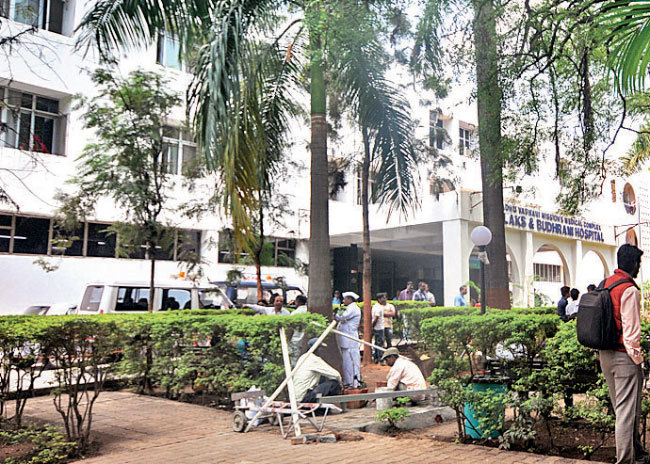
Here I am heading to my little room near the ashram in Poona. I’ve just bought a beautiful watermelon from the market. I had also gone to the Kashmiri shop to buy something for my family as I am heading home soon. I find a lovely mauve shawl with intricate silver decoration for my mum. The brother of the shop owner, Ali, offers me a lift home on the back of his scooter. I’m thankful because the watermelon is heavy.
We weave through the streets, avoiding wandering cows, a family of four all on one bicycle, rickshaws honking loudly, vendors pushing cartfuls of mangoes, vegetables and bananas, as well as other scooters haring along beside us. The perfume of incense wafts through the air as we avoid the cowpats. I’m hanging on for dear life, one hand clutching the watermelon and the other arm wrapped around Ali.
As I’m dismounting from the scooter my watermelon tips me off balance and drags me down a slope. I thrash out to save myself and smash my wrist against a rock. Ali has disappeared. I know that I’ve damaged my wrist because it’s very painful.
I’m in luck because my ayah is there to do the washing. She hears my scream, helps me get up, puts my wrist in a sling and gets me in a rickshaw to take me to the ashram. The ashram doctor sends me straight to the hospital where I will see the best doctor available.
As I sit waiting to see the doctor I notice a man leaving with his family. He has what looks like a concrete plaster on his leg. My ayah, who has accompanied me, explains that he couldn’t afford the lighter plaster. I feel guilty and berate myself for not offering to pay for the better plaster, I realise this might have meant being approached by at least fifty others.
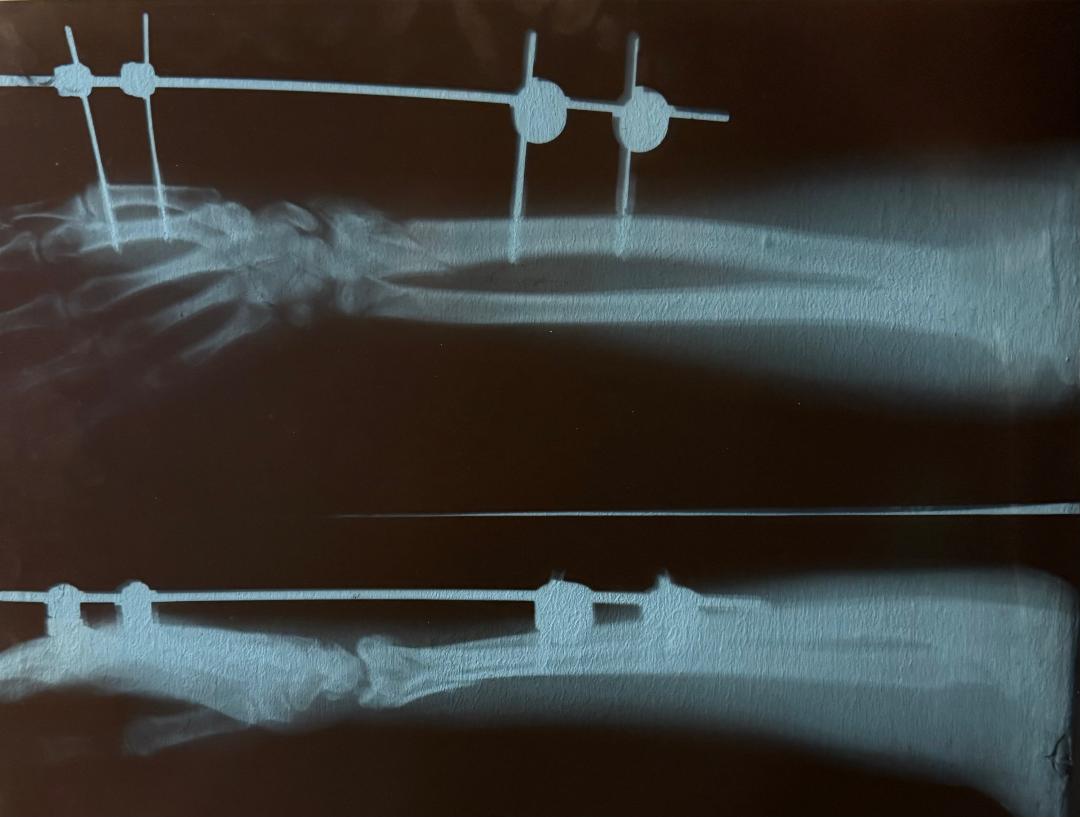
From the X-ray it’s quite clear that my wrist is in pieces. The doctor decides it would be best to put some scaffolding on my arm to pull the pieces together. He explains that this can be done in two ways: I can have a general or a local anaesthetic. There is a chance the local anaesthetic won’t work, and I could end up with a lengthy recovery, like his wife who is upstairs in the hospital. I’ve been studying in a course of Cranial Sacral Therapy, which warns about general anaesthetic and the hidden memories it can leave, so I decide to go with the local option.
Arriving at Inlaks & Budhrani Hospital for the operation, I am very nervous. I lie on the operating table where the anaesthetist has put up a little curtain so that I can’t see what’s happening. But before they start I get a glimpse of the Black & Decker drill they are going to use. I feel the vibration as they drill in, but no pain. The anaesthetist is peeping around the curtain ready to put me out if needed.
Some time is spent recovering in the hospital – enough for me to read Harry Potter cover to cover. My room is very clean and comfortable and the food is great. The nurses are attentive despite the noise and chaos. It’s another couple of weeks before the doctor allows me to leave India, and I am ready. I’ve had enough of sleeping with my scaffolded arm suspended from the ceiling.
It’s time to head back to the UK.
At the airport in Bombay the sight of the scaffolding on my arm alarms the ground staff who rush to offer me a wheelchair. I am pleased to get the help.
I am struck by the contrast between Sahar Airport in Bombay, and Heathrow. At Sahar there is the chaos of crowds waiting excitedly with loud cries of delight to greet and garland relatives with bright orange marigolds, the smell of deliciously spicy snacks and the coolies shouting as they jostle for a chance to carry luggage. Then to Heathrow, where greeting is quiet and orderly and there is only the humming of conversation in the grey décor.
Back in North Wales it’s time to go and see the doctor and tell her, or at least show her, what’s happened to me in India. I get the bus to the local surgery. Visibly shocked by my arm, she suggests that I go to the hospital. I expect her to make an appointment for me, but in a very high-pitched voice she says, “Could you go right now please? Get on the bus straight away and I’ll tell them that you’re coming.”
At the hospital they are ready for me. The doctor says he wants to remove the scaffolding and put wire inside my wrist. I refuse because I trust the doctor in Poona and am confident that this scaffolding will bring my wrist together. I don’t want another operation. I agree to come back in about three weeks, which is the time advised in Poona for the removal of the metal structure.
I’m called back in four weeks. In the consulting room are three doctors discussing how they’re going to remove the scaffolding. I’m shocked to hear the main consultant say, “We may need to look at the tools in our cars to make sure that we’ve got the right ones.”
On the day for the removal of the scaffolding, I arrive at Ysbyty Gwynedd (the local hospital) early in the morning for the anaesthetic. The anaesthetist comes to see me and tells me that actually I don’t really need an anaesthetic. I’m a bit surprised but he’s the expert, and dressed in a hospital gown I’m wheeled into the operating theatre, my arm laid carefully on a supporting pillow. The consultant looks at me and announces, “My sister lives in Poona.” Then in a commanding voice: “Now, just meditate!”
I disappear either in a meditative state or in shock, and when I open my eyes, my companion scaffolding has gone and I start on the journey to regain the full movement of my wrist.
(Editor’s note: In the meantime the spellings of Poona and Bombay have both changed, as well as the name of the airport. And instead of the colonial word coolie, a porter is now referred to as a sahoyak.)


Comments are closed.