

From Marga’s new series: Human Design and Relationship (Part 2)
In the previous article we introduced the Composite Chart as a Relational Energy Field: a third structure that comes alive when two people enter each other’s aura. What emerged is that from the point of view of Human Design, a relationship marks the birth of a new energetic configuration, with its own features and its own internal architecture, which is much more than just the sum of the individual traits of each person. We have what we call the Couple Channels, that are not present in the individual charts and come alive only when two people get together. They obviously reflect in the Composite Chart as well, and constitute a big part of it!
Before entering into the specific details of the functioning and behavior of the Couple Channels, we give a look at the general structure where they occur.
In Human Design there are 36 channels. Each channel connects two of the 9 Centers and establishes a specific energetic link between them. A channel is not just a “line” in the BodyGraph, it is a stable pathway through which energy, information and function move between two centers, shaping how certain themes are processed, expressed and lived.
Each channel is made of two gates, and when both gates are activated, the channel becomes defined and consistent. It creates an enduring inner circuitry and a reliable way of operating that does not need external stimulation.
Channels also belong to circuits that further clarify the purpose of that energetic connection. Some channels belong to the circuitry dedicated to relating, support and emotional continuity. Others belong to the circuitry oriented to survival, instinct and the protection of the organism. Others carry the logic of individual empowerment and mutation. Others organize collective patterns, sharing and influence. Others are exquisitely romantic and/or sexual in nature.
Every circuit relates to the 9 centers in its own peculiar way, exactly like each center gives each channel its own specific flavor.
When a channel involves the Emotional Center, the relational climate and the timing of emotional waves become part of the equation. When a channel involves the Sacral Center, life-force and response become central. When a channel involves the Willpower Center, themes of will, value, self-worth and commitment enter. When a channel involves the Throat, creativity, expression and manifestation become pivotal. When a channel involves the Center of Self, direction, love, identity and self-transformation become part of the shared axis.
If you want to know more about the 36 channels you can refer to a series of articles that I wrote last year, called Three Channels a Month.
When we speak about Couple Channels, we are referring to the same 36 channels, but with a huge difference: we consider their appearance in the Composite Chart of two individuals. For example, a gate in one chart meets its harmonic gate in the chart of the other, and suddenly a channel comes into being that neither person carries alone.
Of course, this doesn’t happen only on paper or pixel, but it is a strong energetic phenomenon happening in their lives. That channel becomes part of their relational field, meaning it is not simply “in one person” or “in the other”, it is in what is created between them, and it starts operating as a shared energetic fact.
The planetary factor
There is another layer.
Each gate inside a channel is activated by a planet, conscious or unconscious. The planetary body activating a gate influences the quality of its energy. A gate activated through Venus carries a different atmosphere than a gate defined through Uranus. A gate activated by the Moon behaves differently than one activated through Saturn, or the Sun.
This will affect the nature of every channel and becomes even more significant in Couple Channels.
For example a Couple Channel activated through the Moon and Venus naturally emphasizes emotional connection with a certain fluctuation. A channel supported by Venus and Jupiter amplifies attraction and relational magnetism. A channel activated through Mars and Venus introduces strong desire, urgency and volatility. A channel built through Jupiter and Mercury expands shared projects and connect intelligence to long-term vision. A channel emphasized by Neptune and Venus spiritualizes or idealizes the relationship, while Uranus would disrupt and awaken, Saturn stabilize, test and consolidate. And so on and so forth…
And now we move into the different forms that Couple Channels can take.
Electromagnetics occur when each person carries one side of a channel. One person has one gate, the other person has the harmonic gate, and the full channel comes alive only in the relational field. This is why electromagnetics feel like electricity: they generate charge and magnetism because something switches on when the two people are together.
This is often felt as an immediate pull into interaction. The sensations can be attraction, curiosity, fascination, intensity, momentum, or a simple inability to remain neutral in each other’s presence.
How an electromagnetic unfolds is not fixed. It depends on many factors: the nature of the channel itself, the planetary activations involved, the lines of the two gates, and the overall awareness of the two people. An electromagnetic changes with time and circumstances, including transits and the way the couple learns, or does not learn, to regulate the intensity.
What begins as strong attraction can mature into a steady rhythm if the couple finds ways to integrate the charge. But if the intensity keeps firing without digestion, it can become overwhelming. In that case the same pull that brought the two people together can flip into irritation, distance, and sometimes even repulsion. Otherwise love stories would last forever on chemistry alone, and they don’t.
Some electromagnetics are especially sensitive, particularly when they connect two centers that are undefined in both charts. In that case the couple is repeatedly exposed to a tension and intensity that do not belong to either person’s individual design. The energy exists in the relationship, but neither person can reliably sustain it for long. This becomes even more sensitive when the electromagnetic links pressure and drive dynamics, for example Sacral with Root, or Sacral with the Emotional Center, where the charge can easily become “too much”.
The same basic logic applies to the other forms.
Compromises occur when one person carries the full channel and the other carries only one of its two gates. The theme of the channel is present, but it is lived asymmetrically. For the person with the full channel, that circuitry is consistent and the energy of the other person’s gate can be perceived as interference. For the person with the single gate, the experience of the channel depends on the other and on what is happening in the relationship. This creates an ongoing process of adjustment: learning when the theme the channel brings is active, when it drops away, and how to participate without losing oneself.
If there are many compromises in a relationship, the person with less definition may eventually feel saturated by “too much coming in”.
On the other hand, if both individuals are aware of the mechanics, a compromise can become a beautiful collaboration…
Dominances occur when one person carries the full channel and the other carries neither gate. The channel is not created between them. It enters the relationship through one individual and tends to set the pace in that domain. For the partner who does not have the channel, it can feel like a strong energy coming into an undefined area, not always easy to sustain. For the defined partner, it can feel natural to operate consistently there, and they may also feel irritated when the other person experiences that consistency as pressure or interference. If there are many dominance dynamics, the atmosphere can become heavy for the person receiving the energy and tense for the person who feels slowed down or resisted. Or they can both be enriched by it. Again, all it goes to awareness.
Companionships occur when both people carry the same channel, and it can also occur at the level of single gates. Here the energy is manageable because there is familiarity on both sides. The theme does not depend on the relationship: each person already knows that circuitry from the inside. This often creates steadiness, reliability, and a sense of recognition in that area. Especially at the level of channels, companionship can function as a home base in the Composite, a stable ground that helps the couple hold other dynamics that bring movement, instability and change. And this is why companionship can be such strong cement in a relationship.
With 36 channels and 64 gates that can meet, clash, and combine between two people as electromagnetics, compromises, dominances, and companionships, it becomes clear that the possible configurations inside a Composite Chart are extremely diverse. This is where the real complexity begins…
A Composite Chart that carries multiple Couple Channels can express more than one nuance. A relationship may hold different frequencies at once, depending on which channels are present, how they interweave, which centers they connect and which planetary activations shape their tone.
There are channels that are naturally more prone to connect two people romantically than others. Some channels are in fact more likely to behave as Couple Channels and some dynamics tend to create attraction more easily, but nothing is automatic and nothing is guaranteed. The same channel can show up in a romantic partnership or between close friends, and the lived outcome depends on the whole configuration and on the two people. Similarly, there are channels that usually tend to connect two people in different kinds of partnerships and yet, we find them in a Composite of a strong couple! Sometimes the role of the planets involved is so strong that they can overturn the logic, shifting the orientation of a channel and changing how it is lived inside the relationship.
Categories help us orient, but they do not tell us what the relationship will be. They describe the basic structure of how a channel is activated in the relational field, and then the meaning comes from how that structure is interwoven to what else is present in the Composite.
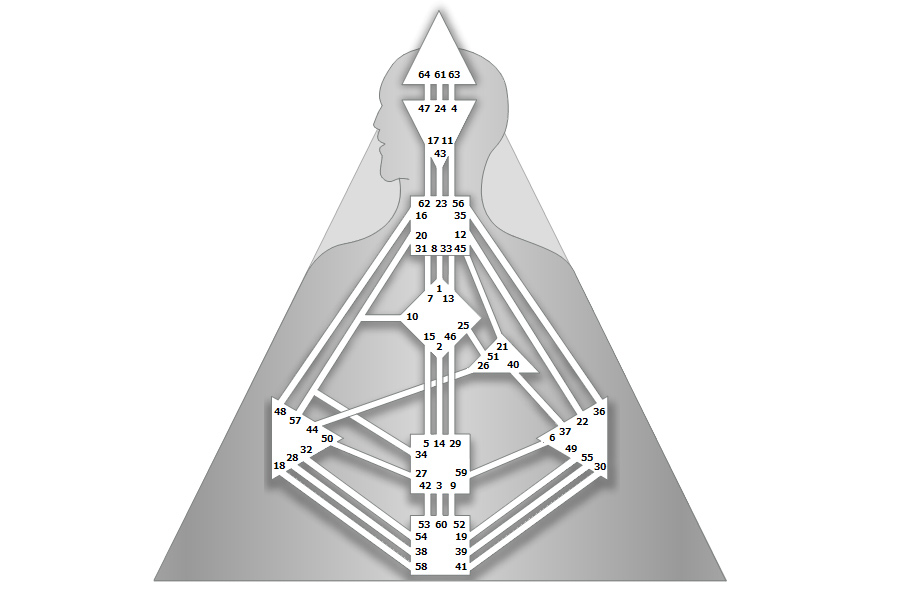
For example, take the Channel of Openness, also called the Channel of Romance, 12–22. It links the Throat to the Emotional Center and carries emotional refinement, poetic expression and aesthetic sensitivity. When it appears as an electromagnetic between two people, it can deeply characterize a romantic partnership. And yes, it is the Romantic Couple Channel par excellence, because it can express so much of what can exist in a couple, across the whole romantic spectrum, from Romeo and Juliet to Francis and Clare, and all the most beautiful love stories on this Earth. Yet the same Channel of Romance can also appear between two close friends. In that case, even without a sexual component or a couple structure, the relationship will still carry its own epic, a shared emotional language, a depth of feeling and expression that makes the relationship greater than its visible form. And this can happen between friends, between siblings, between parent and child and even between colleagues, without it turning into a “relationship” in the conventional sense. The channel describes a quality of connection, not the label of the relationship.
Similarly, the Channel 44–26, the Channel of Enterprise, linking the Spleen to the Willpower, often expresses strategic intelligence, persuasion, tangible creativity and surely it has a flair for entrepreneurship. Yet there are romantic relationships structured around this channel. In those cases, the partnership may naturally express organizational strength, intelligence and a shared material orientation, very different from a relationship structured by 12–22, but in no way less intimate in its own language of devotion, loyalty and results.
Other examples come from channels rooted in the Sacral and Root Centers, called the Format Channels. These channels can carry strong physical and sexual charge, potentially, because Root to Sacral is a powerful axis of pressure and vitality. And yet, they rarely function as Couple Channels in the sense of automatically generating chemistry and attraction.
When they are present in a Composite Chart, nevertheless, their influence is still major, because they set its rhythm and pacing. They shape how the relationship moves through time, how experience renews itself, how pressure builds and releases and how the couple metabolizes change.
The Channel of Cycles, 53–42, can give the relationship a cyclical character. Even when two people stay together for a lifetime, the relationship can feel as if it is constantly recycling its experience through duration: opening phases, closing phases, completion phases, renewed beginnings. The rhythm of this recycling can be strongly shaped by the planetary activations involved, because different planets carry different timing, different atmospheres and different kinds of “weight” inside the cycle.
Similarly the Channel of Mutation, 3–60, can mark the relationship with moments of major transformation, dramatic and unexpected, exactly in the way the channel itself operates. The couple may experience sudden turning points, thresholds, breaks in the previous narrative, phases where the relationship becomes something else, not through gradual negotiation but through a sharp shift in the field.
A relationship marked by the Channel of Concentration, 9–52, can have a different quality again: focus, goal-setting, planning, precision, the capacity to hold attention over time. It can make the relationship future-oriented, structured around objectives, projects, long-term commitments, or simply around the capacity to stay with something until it is mastered. This focus can also influence the emotional climate, because it gives the relationship a direction of attention and a clear way of using energy rather than dispersing it.
So, with Format Channels the question is not romantic attraction, but it is more a matter of rhythm, tempo, timing and how they shape the evolution of the relationship.
Among Couple Channels, a special place belongs to the Tantric Channels that link the Sacral Center to the Center of Self: the Channel of Rhythm, 5–15, the Channel of the Alchemist, 14–2 and the Channel of Discovery, 29–46.
They link the life-force to the inner axis of direction, love, identity and self-transformation. The Sacral brings vitality, sensual embodiment, creative stamina, and the capacity to engage life sustainably. The Center of Self brings orientation and consistency: the place where experience becomes meaningful, where identity crystallizes and where transformation becomes a lived inner shift.
Because of this combination, Tantric Channels carry a spiritual potential. They offer a way for physical intensity, desire and the sheer weight of life-force to be metabolized through the Self, so that energy becomes evolution rather than just physical discharge.
In the individual, this often shows up as a capacity to grow through experience: the person changes because their life-force keeps meeting identity, keeps meeting direction, keeps meeting the question of a loving alignment with oneself and others. In a couple, the same dynamic becomes shared: the relationship itself becomes a field where intensity meets meaning and purpose, and where two people are invited into a deeper ripening.
When these Tantric Couple Channels are present, especially as electromagnetics, the relationship can carry a strong intensity and a sense of immense reciprocity, the one soulmates share. With awareness and a genuine orientation toward development, that intensity becomes inner growth. It supports a maturation that is psychological, emotional and spiritual: the couple becomes capable of more truth, more presence, more integration, more depth. They ripe together, and the relationship becomes one of the places where true intimacy is made real.
This is only a first taste of the complexity contained in Couple Channels and in the Composite Chart as a whole, a way to begin sensing how vast the relational landscape becomes when channels, gates, planetary activations and line dynamics start interweaving inside the same field.
In the next articles we will go deeper into these families of Couple Channels, exploring them in a more systematic way: those most commonly associated with emotional and romantic bonding and those that structure collaboration, cycles, mutation, direction and shared purpose inside the relational field, and we will clarify how each group operates in the Composite Chart and how it shapes lived experience.
Marga offers Human Design readings:
you can contact her on whatsapp 0091 9503332918 or margajee@gmail.com
Channels discussed by Marga in detail
- Channel of Openness / Romance, 12-22
- Channel of Enterprise, 44-26
- Channel of Cycles, 53–42
- Channel of Mutation, 3–60
- Channel of Concentration, 52–9
- Channel of Rhythm, 5–15
- Channel of the Alchemist, 14–2
- Channel of Discovery, 29–46
Related articles
- Marga’s whole series on Osho News: Human Design and Relationship
Featured image: AI generated by ChatGPT with prompts by the author and using one of her photos



Comments are closed.