

Phoebe comments on the last two chapters of the discourse series, Roots and Wings. Protagonists are Mahakashyapa and the Zen monk Ziguin
The Cosmic Joke – The Tenth Talk
Osho tells this important tale by putting it into his own words:
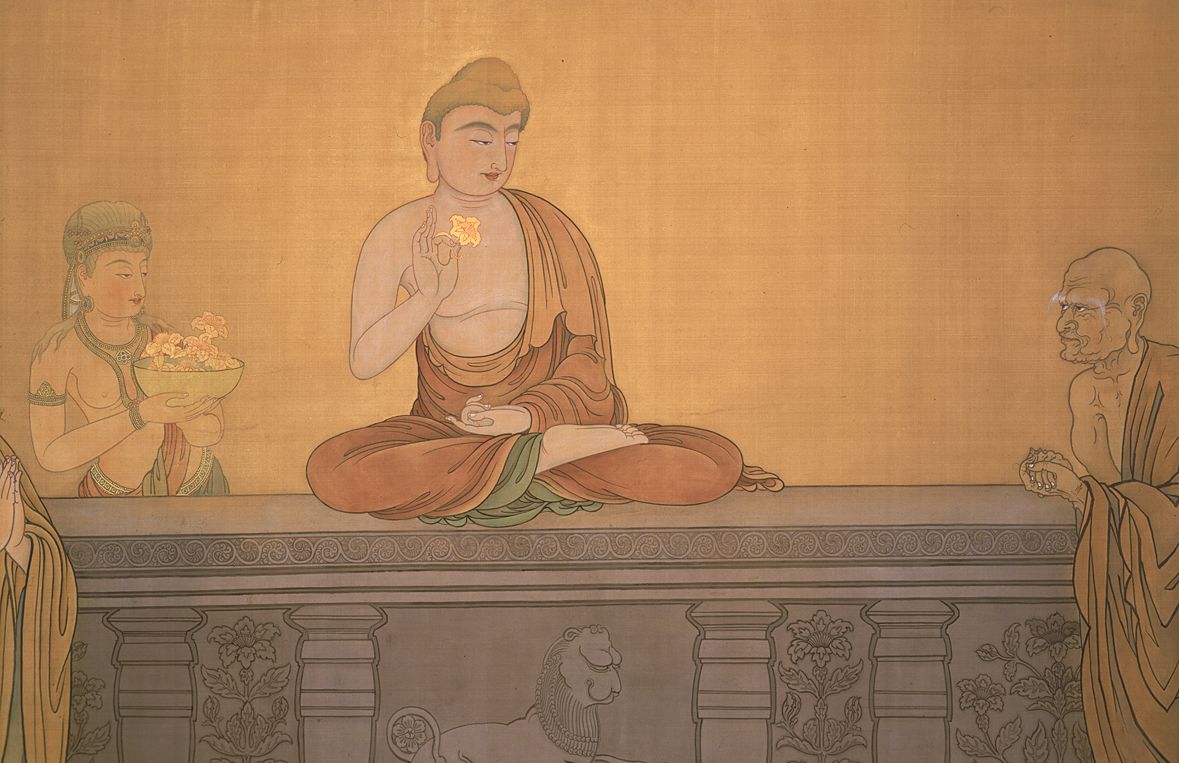
“This story is one of the most significant ones because from this was passed the tradition of Zen. Buddha was the source, Mahakashyapa was the first original Zen master, and this story is the source from where the whole tradition – one of the most beautiful and alive that exists on earth – the tradition of Zen – started.
“Try to understand this story. Buddha came one morning and as usual a crowd had gathered. Many people were waiting to listen to him. But one thing was unusual – he was carrying a flower in his hand. Never before had he carried anything in his hand. People thought that someone must have presented it. Buddha came, he sat under the tree. The crowd waited and waited and he would not speak. He wouldn’t even look at them. He just went on looking at the flower.
“Minutes passed, then hours and the people became very much restless. It is said that Mahakashyapa couldn’t contain himself. He laughed loudly. Buddha called him, gave him the flower, and said to the gathered crowd: whatsoever can be said in words I have said to you, and that which cannot be said through words I give to Mahakashyapa. The key cannot be communicated verbally. I hand over the key to Mahakashyapa.” 1
Osho explains that they’d witnessed what Zen masters call a transference of the key without scripture, meaning the key was beyond words. None of the other monks present had understood what was happening, but, by giving the flower to Mahakashyapa, Buddha was choosing him to be the first holder of the key, and the first in the line of Zen Masters that were to follow. Ever since that long-ago event, Buddhists have been asking each other what exactly was it that Buddha gave to Mahakashyapa. It became a veritable Zen koan!
Osho tells us that should all the other Buddhist scriptures disappear, nothing would be lost if this one anecdote were saved. Mahakashyapa, by breaking the silence with his loud laugh, had started a new trend in Buddhism. So we ask ourselves why then did he laugh? The answer is that he laughed at the whole situation which had suddenly appeared absurd to him.
And he laughed at himself when he realised that what Buddha was saying through presenting the flower was something that couldn’t be put into words – either you get it or you don’t. For Mahakashyapa now there was no need to go on searching because he’d realised the truth that laughter is always here and now, and that the key he’d received was the most valuable one for his meditation – the experience of silence within and laughter without.
“The key is still alive, still opens the door. These two are the parts – the inner silence, the silence so deep that there is no vibration in your being. You are, but there are no waves. You are just a pool without waves, not a single wave arises, the whole being silent, still. Inside at the centre silence and on the periphery celebration and laughter. And only silence can laugh, because only silence can understand the cosmic joke!” 1
Later, during the years in Pune, Osho designed a structure for meditation that used the device of a phase of uncontrollable laughter followed by a phase of total silence. We were enabled to make the discovery that the more total our laughter was in the first phase, the deeper would be the inner silence that followed it. It happened also that, at the end of his evening discourses, Osho started reading out some jokes that had been sent in to set everyone laughing. This phase of laughter was then followed by a loud drum beat that announced the final phase of silent sitting.
Among the different ways of meditating offered today by the various spiritual paths, I believe that the device of beyond-control laughter in the context of Osho meditation is unique. We have to thank the first Zen master, Mahakashyapa, for demonstrating how laughter can so effectively deepen the silence that follows.
Compassion Is the Flowering of Meditation – The Eleventh Talk
In this discourse, we meet the Zen monk Ziguin who, while he performed his daily tasks about the monastery, would periodically stop and call out, ‘Master, are you there? Better sober up. Look out. Don’t let them fool you. No, I won’t!’ Osho tells us that Ziguin gives us an example of a peak effort to stay alert and suggests that we practise it too.
“Meditation cannot be a fragmented thing. It should be a continuous effort. Every moment one has to be alert, aware and meditative, but the mind has played a trick. You meditate in the morning and then you put it aside, or you pray in the temple and then forget it. Then you come back to the world completely unmeditative, unconscious, as if walking in a hypnotic sleep… Consciousness is a continuum. It is like a river, flowing constantly. If you are meditative the whole day, every moment of it, and only when you are meditative the whole day, the flowering will come to you.” 2
“Life is not just to pass. It is to reach somewhere deep within you. Life is not on the surface, it is not the circumference, it is the centre. And you have not reached the centre yet. Sober up! Enough time is already wasted. Be alert and see what you are doing!… Don’t play games. Enough! You have played enough. Don’t be foolish any more. Use life for anchoring. Use life to gain roots, use life as an opportunity to reach the Divine!” 2
He continues by explaining that meditation is not something that is done by the mind. Rather it needs an absence of mind, a state of alertness beyond the mind in order to come into being. And there are no shortcuts. Meditation cannot be purchased and no other person can give it to you. You have to achieve it by yourself through patient practice. At this point within the context of the discourse, Osho tells the following cautionary tale:
A young man came to a Zen master and asked to be shown the way to know himself. He said he had already tried many things but had always given up before long. The master then asked whether he’d ever found anything that could absorb him completely, and the young man admitted that he’d had that experience while playing chess.
The master ordered a chess board to be brought and invited one of the monks from the monastery, who knew how to play it, to have a game with the young man. However, he warned this monk that it would be a dangerous game for him. He had his sword at the ready and would cut off his head if the young man defeated him because it would never do for a monk from his monastery, who’d been meditating for twelve years, to be defeated!
Then he turned to the young man and said, ‘You say that chess can absorb, well you’ll have to get totally absorbed now because this time it’s a matter of life and death. If you’re defeated, I will cut off your head.’ The first reaction of the young man was to look how he could escape, but he was a samurai warrior and his pride prevented him from running away – so he agreed.
The game started, the young man was trembling like a leaf in the wind and sweating from his head down to the soles of his feet. But now, because it was a question of life and death, his thinking stopped. In an emergency when our lives are at risk we automatically follow our instincts and not our mind.
He became so totally immersed in the game that only the present moment existed for him. He’d dropped his fearful mind, and as his perception widened and deepened, he started winning. But looking deeper allowed him to see his opponent’s being more clearly and he began to marvel at the young monk – how beautiful he’d become after his twelve years of meditation in the monastery. What clarity was in his eyes! He started feeling compassion for the other and began to make wrong moves intentionally. And that was when the Zen master, roaring with laughter, upturned the table and told them that nobody was going to be defeated. They had both won!
Osho points out that two basic things happened to the young man in this tale – he had experienced meditation and he had experienced compassion. Meditation had happened to him spontaneously – in moments when our lives are in danger, there’s no time for thought. But that was not all, because in meditation our empathy is enhanced and then compassion for the other will arise. Compassion is the flowering of meditation, Osho tells us, and when the other becomes more valuable to you than yourself, that is love.
Conclusion
At the end of Talk 11, when Osho is answering questions from the camp participants, he refers again to the new phase of his work now starting. He echoes the announcement he made at the end of Talk 1, which we understand more clearly now we’ve read the book. He is saying that from now on, like the Zen masters in their monasteries, he will be concentrating on a smaller group of seekers committed to deepening their meditation. He also indicates that he will act like the Zen masters we’ve met in the different chapters and be cruel in order to be kind, if that’s what’s needed to wake us up.
Osho tells us our egos are always to blame when, while sitting in meditation, we suddenly become aware that we’ve lost contact with the present moment, and our thoughts have carried us away into the future or the past. An example could be that we find ourselves making plans to achieve something we believe will give us more prestige, or return to the painful memory of an embarrassing mistake we’ve made. It’s therefore important to recognise the ego compulsions that continually divert our attention while we try to relax and meditate.
Then how to go forward? What can we do to deepen our meditation to the point where we manage to let go of our thoughts altogether, and are able to relax into the eternal present? Osho answered this question in the tale of Zuigan and recommends us to try out the monk’s method. While we perform our daily tasks, we could keep bringing our wandering minds back to the present moment with an amusing internal monologue.
I’ve found that we should also try to stay aware of our bodies while we carry out our daily routines to increase our physical awareness. Then, as we move about, we feel the ground under our feet and keep our senses tuned to the sights, smells and sounds around us – enjoying them but not thinking about them. This here-and-now meditation brings us more physically into the present and helps our grounding.
And what about our wings you may ask? Well, roots definitely come first because, like a tree, the deeper and wider our roots have grown the higher our branches will reach up into the sky. As Osho expresses it, he would like to give us roots into this finite earth, into all that is earthly, and wings into the sky and all that is infinite.
“Rooted in meditation you will have wings of compassion. That’s why I say that I would like to give you two things: roots into this earth and wings into that heaven. Meditation is this earth; it is here and now. The very moment you can spread your roots do it. And once roots are there your wings will reach to the highest sky possible. Compassion is the sky, meditation is the earth, and when meditation and compassion meet, a Buddha is born. Go deeper and deeper into meditation so you can go higher and higher in compassion. The deeper the roots of a tree reach the higher the peak. You can see the tree, you cannot see the roots, but they are always in proportion!” 2
Featured image: Mahākāśyapa smiling at the lotus flower, by Hishida Shunso, 1897, Nihonga style (commons.wikimedia.org)
Sources
- Osho, Roots and Wings, Tenth Talk (more excerpts)
- Osho, Roots and Wings, Eleventh Talk
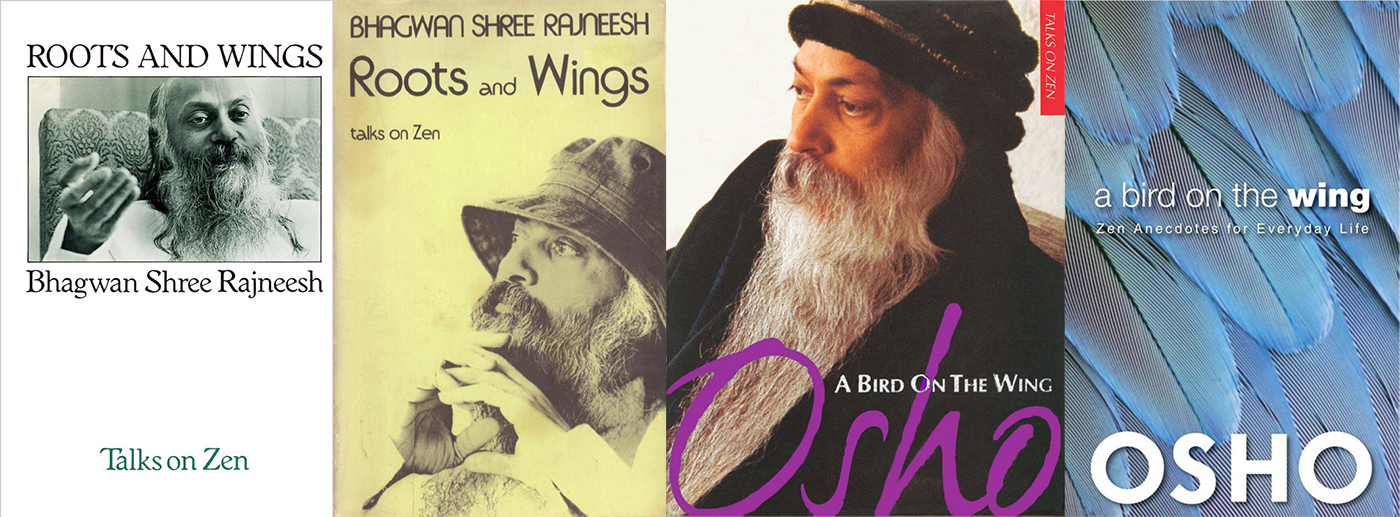
A Bird on the Wing
(Roots and Wings)
Osho Media International
Hardcover, 258 pages
ISBN-13: 978-0880502078
Kindle, 746 KB
ASIN: B00BVTW4EY
Related articles
- All articles in this series: Nuggets


Comments are closed.