

Sarjo wonders what a web novel about humans becoming gods has to do with two hundred enlightened people and a sutra of the Buddha
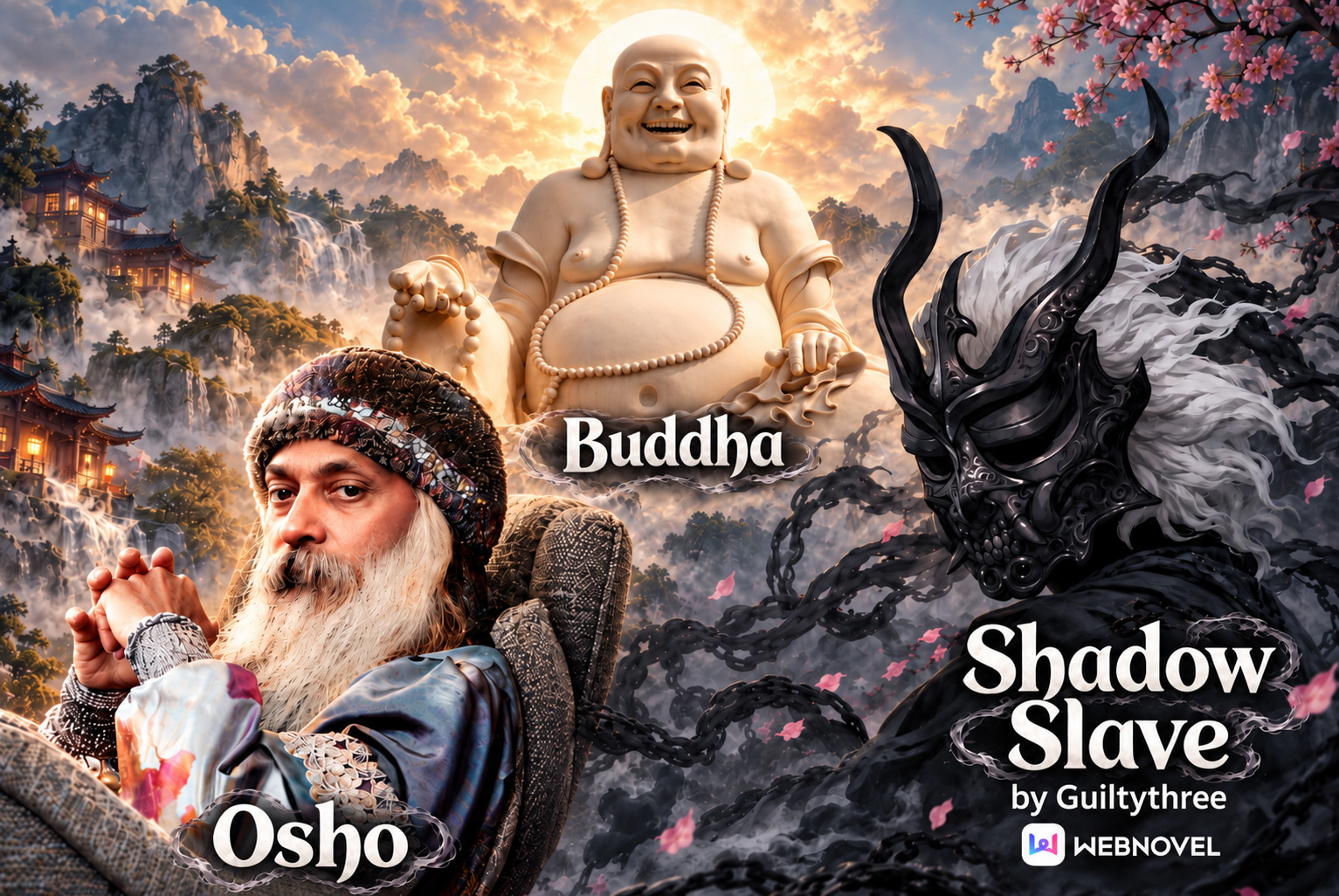
Over the past couple of months, I’ve become hooked in a web novel called Shadow Slave. For those unfamiliar with the term, web novels are – according to AI’s definition – “novels originally published online, usually in instalments, with new chapters released progressively on a website or reading platform.”
One feature of some of these stories is the protagonist’s progression: through increasingly difficult trials and by facing ever more powerful and dangerous enemies, an ordinary human being becomes a deity.
I read somewhere that we cannot imagine something that does not exist. I’m not sure that’s entirely true. But it does bring to mind a meditation technique from the Vigyan Bhairav Tantra: “Imagine the unimaginable.” [1] A paradoxical invitation that makes the question even more interesting.
So where does this theme, so common in these novels, come from – the human being’s evolution towards divinity?
Yesterday I happened to read one of the most recent Italian Osho Times newsletters, written by Akarmo. It included a passage from Osho that stayed with me:
My approach is not of helping anybody, but just for you to raise your own consciousness to the highest peak possible… of which you are perfectly capable. If we can create only two hundred enlightened people in the world, the world can be saved. […]
So you forget about the world; otherwise it will create unnecessary anxiety and will destroy your own awakening, which is the only possibility to save the world. […]
The masses as they are don’t matter; existence will not care about them. […]
But if there are a few enlightened people, they are far weightier than billions and billions of people on the earth. [2]
I had already read about the two hundred enlightened people before. This time, though, what stood out most was the final paragraph: the idea that a few enlightened people carry far more weight than billions and billions of people.
It struck me so deeply that, while I was meditating this morning, my mind decided to connect it to a sutra of the Buddha that I read many years ago in the first volume of The Discipline of Transcendence by Osho. It also appears in other discourses of his. Here it is:
The buddha said:
It is better to feed one good man than to feed one hundred bad men.
It is better to feed one who observes the five precepts of buddha than to feed one thousand good men.
It is better to feed one srotapanna than to feed ten thousand of those who observe the five precepts of buddha.
It is better to feed one skridagamin than to feed one million of srotapannas.
It is better to feed one anagamin than to feed ten millions of skridagamins. It is better to feed one arhat than to feed one hundred millions of anagamins.
It is better to feed one pratyak buddha than to feed one billion of arhats.
It is better to feed one of the buddhas either of the present or of the past or of the future than to feed ten billions of pratyak buddhas.
It is better to feed one who is above knowledge, onesidedness, discipline, and enlightenment than to feed one hundred billions of buddhas of past, present or future. [3]
If we take these ratios literally and multiply them together, the result is staggering: it is better to feed just one of those who are “beyond knowledge, discipline, and enlightenment” than to feed 1058 good men, meaning a 1 followed by 58 zeros, or 1060 bad men, meaning a 1 followed by 60 zeros.
I find myself associating that last figure in the sutra with the tenth of the Zen ox-herding pictures. That is my own interpretation, but it is how I try to make sense of the phrase, “beyond enlightenment.”
The differences are immense, almost bottomless – unimaginable, in a way. Seen from this perspective, I can better understand Osho’s statement: the presence of two hundred enlightened people on our beloved Earth would carry enormous weight.
At this point, though, a few questions come to mind. How many enlightened people are there right now? Are we destined to fail in this search? And what about those who leave the body as soon as they become enlightened – I seem to remember Osho saying they are the majority – do they count towards the two hundred?
Of course, these are questions I can’t answer and which I would have liked to ask Osho. So I’m asking you, the readers, instead. Perhaps someone knows something?
P.S. Replying that questions are an obstacle to meditation doesn’t count… I know that already! They popped into my head while I was meditating this morning, completely disrupting the technique I was experimenting with… 😀
P.P.S. But what do web novels have to do with all this? Maybe they are one of the ways our minds have found to express, unconsciously, a fundamental truth: the desire, the longing for transformation that dwells within each of us and that I find so clearly described in the Buddha’s sutra. After all, don’t we all long to realise that divinity the enlightened ones speak of?
P.P.P.S. I looked for the source of the Osho quote that Akarmo mentioned, and I found it. It’s in The Rebellious Spirit, chapter 14 (page 7 online). Luckily, Osho says in that discourse that “even two enlightened people are enough” to save the Earth… 😉
Sources
- In English the sutra was however translated as: Suppose you contemplate something / beyond perception / beyond grasping / beyond not being, as in chapter 59 of The Book of Secrets (Vigyan Bhairav Tantra, Vol 2, Ch 19)
- Osho, The Rebellious Spirit, Ch 14, Q 3
- Osho, The Discipline of Transcendence, Vol 1, Ch 9
Featured image: composite created by the author using ChatGPT


Comments are closed.