

A useful tool for daily life, or to practise in a group – a technique by Madhuri
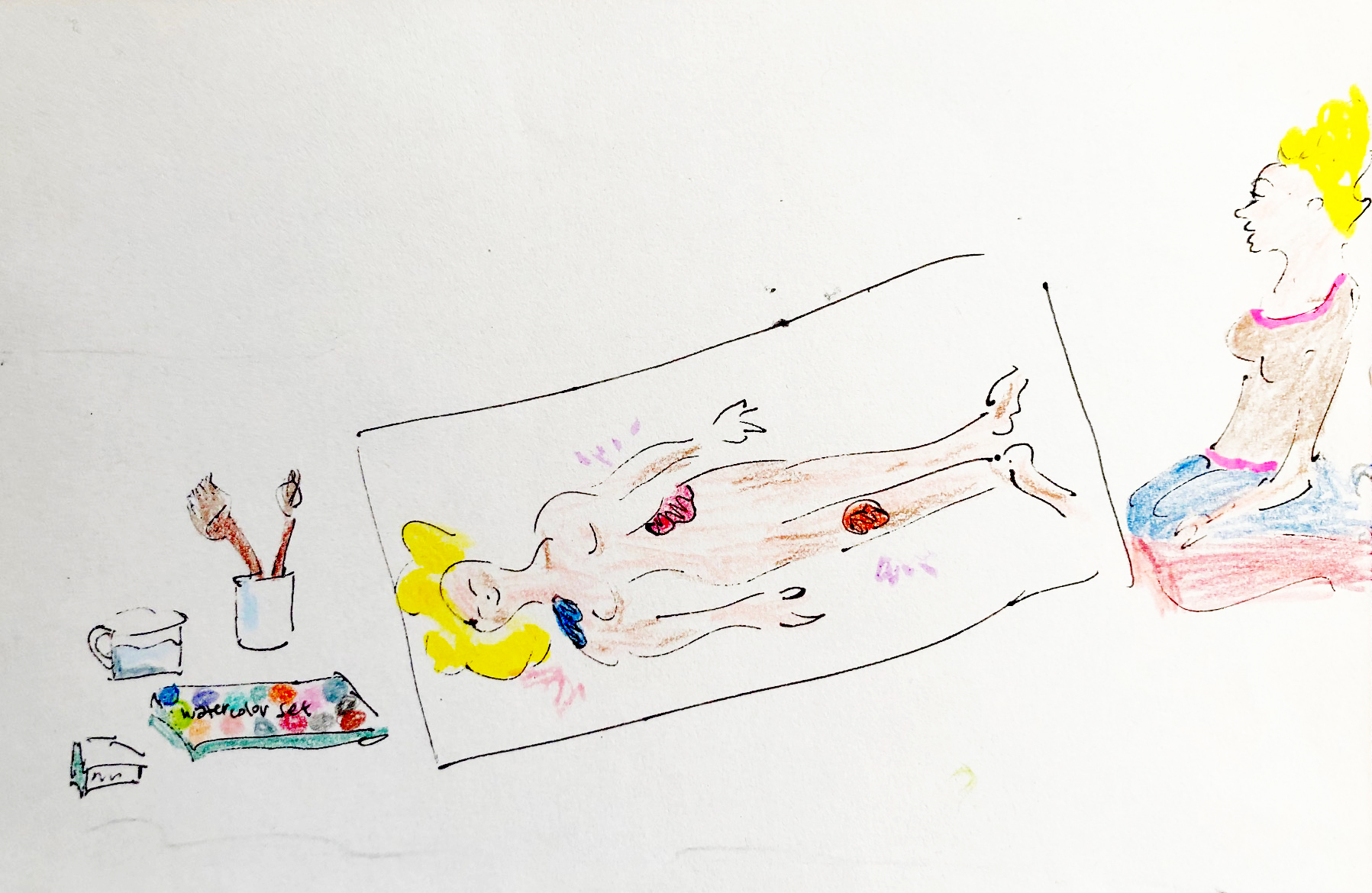
I often use this if I have some ailment, minor or otherwise. When I do dialoguing alone I don’t do the whole painting thing, but simply, lying in bed or out on a walk, I ‘become’ the symptom and dialogue with it, letting it tell me what is going on with it. But painting the symptom first can be immensely helpful, especially if you’re new to dialoguing and want to really get down deep into it.
The dialoguing questions are from Voice Dialogue which I studied with Vasumati during Poona 2. I’ve found that it works either if someone else is asking the questions or if I ask them of a part of myself.
The theory
Every part just wants to be heard! We listen non-judgmentally and impartially. We never know what might be hiding in plain sight, right here in our bodies; and since many illnesses have an emotional component, it behoves us to find out! And, of course, when a symptom has been heard, it often heaves a great sigh of relief and feels better. And we might learn something now about how to care for it and ourselves.
You will need, per person:
- a plastic tablecloth or tarp
- a watercolour set
- magic markers
- a jar of water
- brushes
- a sponge
- a piece of painting paper, about A-3 size
- a printed-out list of the dialoguing questions (below)
Also: music to paint by. I like Morning Breeze by Anugama.
The method
Put plastic tablecloths on the floor, one per person. Arrange painting supplies: watercolours, water in cups, brushes, paper, magic markers, sponges.
Ding! You’ll have 20 minutes to paint a picture of your body and its symptoms – any aches, pains, chronic or current dis-eases. Gentle but sprightly music is playing. This is not ‘art’ or ‘great’ or ‘bad’ – it is impossible to do a wrong painting in this sort of context. Just trust what emerges.
Ding! Time for a bathroom break while painting supplies are removed and paintings are left to dry.
Ding! Time to come back in.
Find a partner. Decide who’s A and who’s B.
A explains her painting to B.
A then steps out of herself and steps into a particular symptom and ’becomes’ it. Her body assumes whatever position feels right; moves as feels right. This requires no ‘doing’. Just let go into it.
B then asks questions as per Questions for Dialoguing list.
Go to next symptom (step out of 1st symptom and into 2nd one). If there is time! You could also just do one symptom if it feels okay to do that. But 3 symptoms is probably the limit for one session.
Change over. Now it’s B’s turn to ‘become’ a symptom while A asks the questions.
Ding!
Share with each other how this was for you.
Thank your partner.
Share with group.
Questions for Dialoguing
- Hello! Is it okay with you to be here with us today?
- What is your name? What shall we call you?
- How are you feeling today?
- How long have you been with —— ?
- What is your job in her life?
- How does —— treat you?
- How would you like her to treat you?
- Do you think she can do that?
- How do you see the way —— lives her life?
- If you were in charge of her life, what changes would you make?
- Do you think she can do that?
- Is there anything you need from —— that she’s not giving you?
- Are there any practical things she can do in daily life to help you out?
- Is there anything you’d like to say to her before we leave you?
- Does she hear you?
- What would it take to get her to hear you? (If the answer was no.)
- Thank you, —— (symptom’s name)! You’ve been very helpful. Is it okay if we leave you now?
This technique will also be part of Madhuri’s upcoming book, titled Techniques I Have Loved. For funding you can write to author: madhuritourmaline@gmail.com
Featured image: drawing by the author
Related articles


Comments are closed.