

An excerpt from Madhuri’s travel memoir, Reluctantly to Kunzum La: Motorbiking in the Himalayas in the Name of Love
13720ft/4116 meters
This is a high monastery with surrounding walls and a courtyard. We have been kindly invited here by two lamas to whom we gave a ride. The walls are very thick; and you need to stoop to come through the doors. There is a feeling of months of enclosure per year against harsh weather.
They use wonderful pine-smelling incense which comes in little blackish pyramid shapes, which they throw right onto the fire. We spoke to a monk – Vimal translated. (He is such a placid and happy translator.) The monk said he was thirty-four years old – since age nine in the monastery. We asked how they go about their days. From seven to nine am they all do pooja – this means worship; for them it means to read scriptures – then they go out into the villages around and preach to people; telling them not to lie, cheat, steal (scriptures?) etc. They also do austerities, of the sort Buddha did in the six years before he became enlightened. I wondered what these were, but did not ask.
They’ve heard Osho on cassettes! There’s a nice vibe – active, happy, bustling, friendly. Not greedy. Everything very ancient-grimy! There’s a dried-mud floor – grain is kept in a big sort of well in this floor. I liked the huge beams in the ceiling of the main room we saw, the fragrant one. The windows are small and must look out through those thick walls.
The lamas get three days off per month to wear ordinary clothes and go to the bazaar. That’s how we met the ones we gave rides to yesterday. One is the kitchen coordinator. (If he saw a German kitchen he’d probably fall down.)
There’s even an ancient radio with some filmi (Bollywood) music coming very badly out. Sweet tea and glucose biscuits were had. Tsampa and curds were offered. Vimal accepted, Anando and I not. Anando had had this dish in Ladakh; and I feel a bit yucked-out by the smell of milk products in India in general (though this no longer feels like India, and I don’t know if the milk is still buffalo, or yak) – it is such a strong stinky buffalo-y rich smell – and we’d had a large parantha breakfast.
Though this building is grimy with the grime of the ages, still there’s some grace in the architectural plan, in the woodwork, the utensils, the stove; the Tibetan look of any metal or woodwork. One can feel that this building has a different purpose than a farmhouse or a tourist hotel – and one is uplifted, though, as Anando said when we were outside, “I think a lot of nonsense is going on here.”
It rained a bit then; Anando dashed from the courtyard up onto the roof and took a photo, perhaps hoping for a rainbow. Taking photos is expressly forbidden. (As is, I’m sure, stealing little scriptural tootsie-rolls.) Then we had a bit of a nasty encounter with the stupid-Indian-merchant-minded lama who ran the filthy little store full of exercise books, rubber chappals, snurfling other lamas with colds, and a dank bundle of ancient filthy rags of rug and dress, for each of which incredible sums were asked. I told him the temple-cloth I wanted was damaged (it was – sewn crudely on one side with big orange thread – I’d have had to fix it) and he said flatly that it was not, and wouldn’t come down on the price. I told him officiously that in a monastery you shouldn’t try to cheat people. He was fixed and adamant.
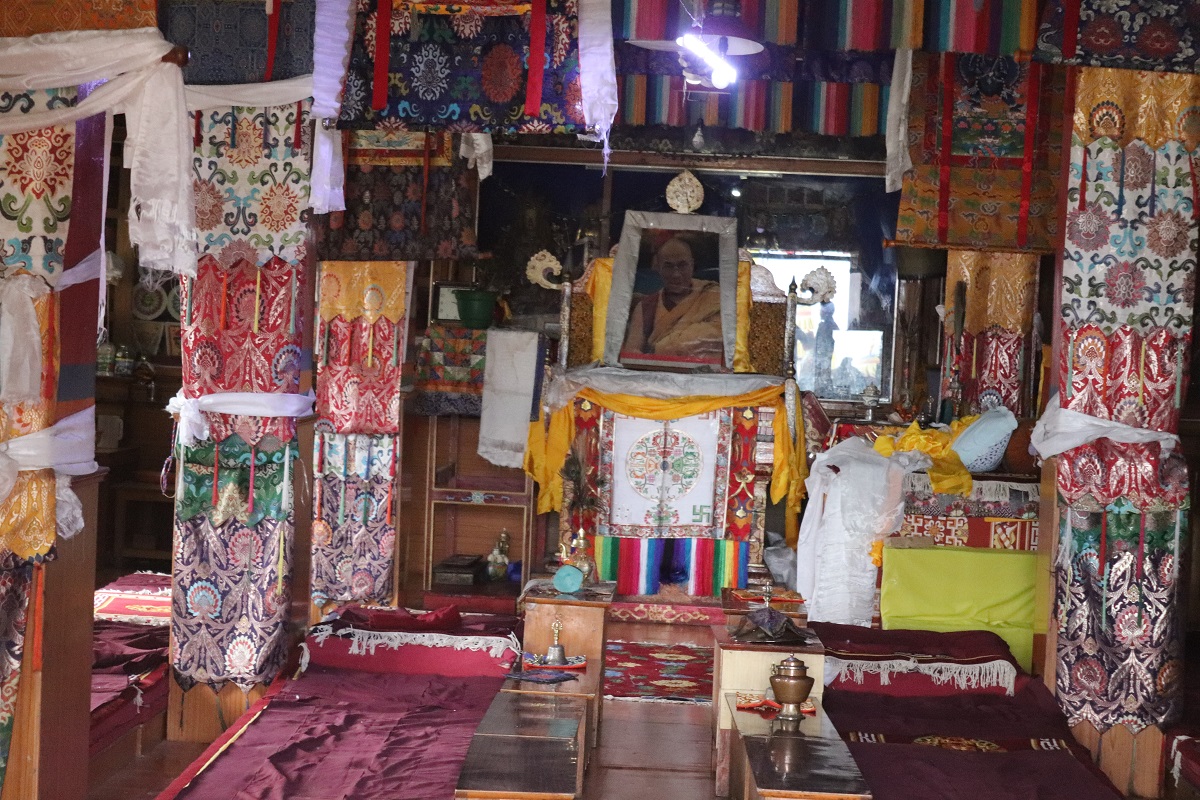
Their meditation room, reached through a dirty hanging over a low door, just behind the kitchen, was shown us after they’d been told we were meditators and lived in an ashram. It too was grimed with the grime of the ages. Long low benches faced each other, approaching a closed glass case full of dusty Buddha statues of many sorts, and some ancient framed mandalas, some rupees (?!!!), and other objects. A large gilt Buddha stood to the left, an ornate metal stupa behind. The meditation benches are covered with long rugs separated within the design into individual sitting-spaces. The small square windows, and one larger, look out on the broad prospect of wide river, valley, and peaks with their snow watch-caps on. This was lovely, though the current construction going on, with rebar and lots of stones, just outside rather detracted from my idealized romance of the effect.
The design of this room is quite nice. The ceiling is covered in some aged printed fabric – little roses or something – the walls painted, peeling, faded. But as the monks sit on those meditation rugs they simply read the one hundred and eight scriptures (kept in boxes with silk pulls in the wall) again and again. And nobody ever does the meditation of getting down on his knees and scrubbing the floor with some good honest soap and water. I was going to say, what else could you expect from a bunch of bachelors; but I’m afraid in India women are often no cleaner. (This morning, when Anando and I had hot showers – meaning bucket-baths – at the Electricity Board Rest House we both thought the same – my God, it’s so utterly filthy, there must be no women here – but then, were there women would it really change? No. Just, some kids would come along to make it worse.)
In the meditation room was a long whip (“the hunter,” it’s called) which we were informed was for people not sitting right. We told them about our Zen stick, for when a meditator was daydreaming; it has nothing to do with posture, but the meditation leader has to be so tuned in she can feel when someone’s ‘off’. Then just a tap on the top of the head or on the shoulder brings the energy right back up. The lama confessed that the “hunter” is used almost exclusively for little boys of eight or nine years old who thrash about and make mischief; Vimal said to the lama that then the whole thing is just stupid because children have to make mischief, they are children and you’re trying to turn them into soldiers.
“What then is the difference between you and a soldier?” asked Vimal.
The lama laughed and said, “Now you talk like Rajneesh.”
The lama said, too, that he was not qualified to answer Vimal’s questions because he has not read enough; a great abbot can answer them better because he has read more.
We were shown some upper rooms, including the one with a gay linoleum floor (patterned with yellow flowers) where the Dalai Lama stayed the three times he’s visited since 1977. This was no more impressive, though it had a row of old thankas hung about the walls. The roof-terrace has a skull or two on the ramparts, plaster I think.
I felt that place longing for Buddha Hall, our clean, clean, utterly clean sheet of white marble all mosquito-netted round where we meditate in the evenings. Our completely contemporary place, not some mouldy decayed dirty so-called monastery… more than contemporary really, I will not say more here…
Featured image credit to travelandtrekking.com
 Reluctantly to Kunzum La
Motorbiking in the Himalayas in the Name of Love
by Madhuri Z K Akin
Paperback and colour hardback
Independently published, 3 July 2024, 347 pages
ISBN: 9781446110393
Links to buy: madhurijewel.com/KunzumLa
Review and another excerpt from the book
- Reluctantly to Kunzum La – Surahbhi’s review
- Celebrating Shree Enfield Bullet


Comments are closed.