

In this first part of an interview with the Hindi Rajneesh Times in 1987, Sukhraj Bharti remembers his childhood with Osho, the games they played, the mischief they made, and the early signs that something unusual was already present in his friend
First Day at School
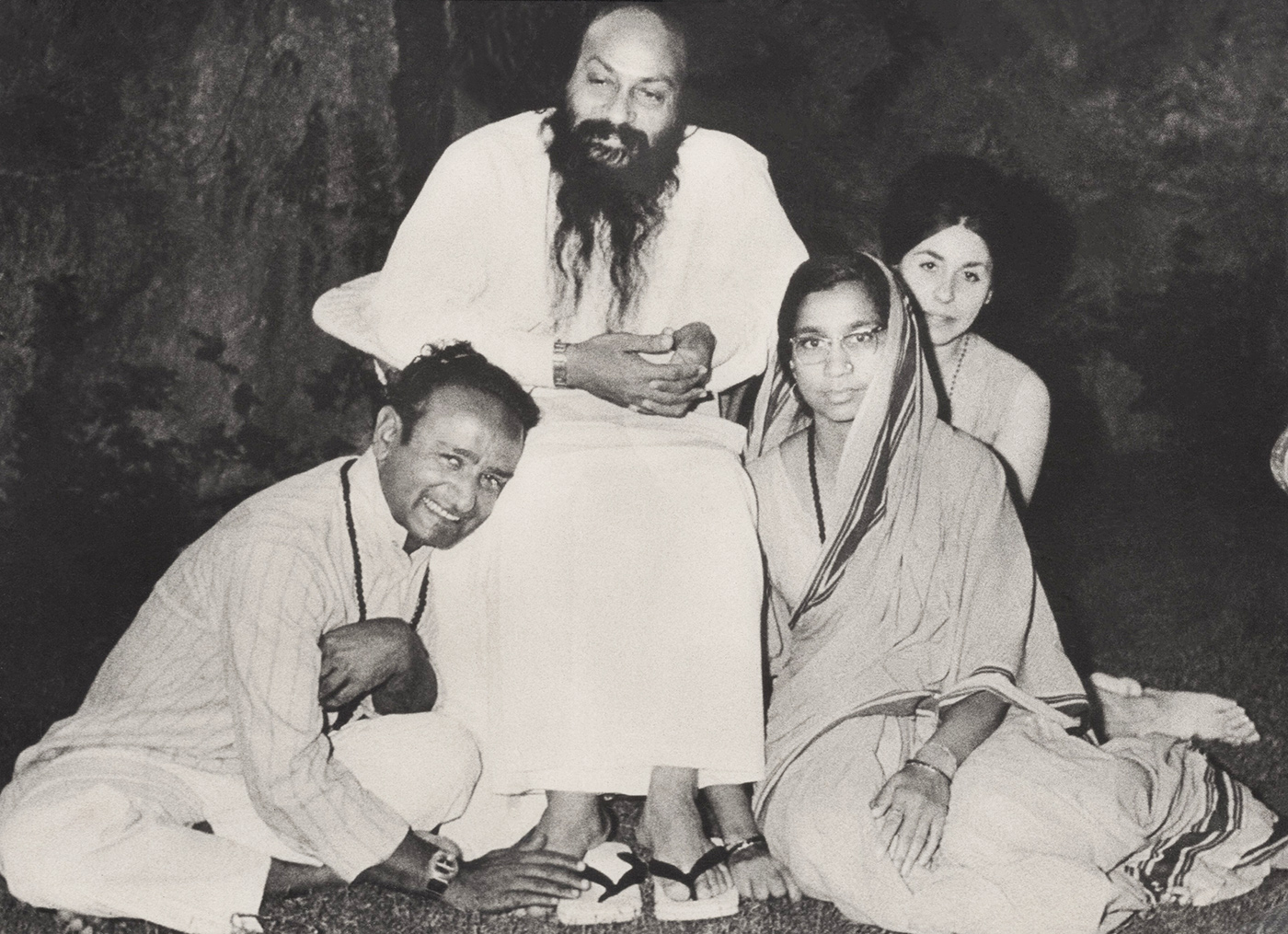
In September 1987, when Sukhraj Bharti was interviewed by the Hindi Rajneesh Times, he was a fifty-four-year-old farmer and businessman, still living in Osho’s hometown of Gadarwara, Madhya Pradesh.
His entire family – his wife, son and daughters – had taken sannyas. Later, his daughter Ma Anand Divya joined the ashram in Pune, working in Hindi Publications and at the reception of the main office.
During that visit to Pune, Sukhraj was sitting in discourse when Osho publicly acknowledged their friendship for the first time – a friendship spanning nearly fifty years. Osho said:
“He loved me when we were so young that now even the memories of those days are difficult to catch hold of. He is the only one left. I had many other friends; they came and they are gone, but he has remained with me unwavering, because it was not a question of any ideological agreement. It was a question of love. It does not matter what I say, what I do, what he says, what he does. That is absolutely irrelevant.” ¹
Sukhraj vividly remembers his first meeting with him.
It was in a noisy second-grade classroom in Gadarwara. The children sat on jute mats spread across the floor. In the middle of a lesson, the door opened and a fair-skinned boy of about nine and a half, with thick curly hair, large eyes and an innocent expression, stood there with his uncle, glancing around the room.
“As soon as I saw him,” Sukhraj says, “I felt I should be friends with this boy. And surprisingly, he chose me. As soon as he came over, I made space for him.”
“What’s your name?”
“Rajneesh. And yours?”
Sukhraj was seven years old. Rajneesh – as Osho was then called – was nine. He had been admitted directly into second grade.
Osho produced a beautiful black slate.
“I was filled with jealousy when I saw it,” Sukhraj recalls.
Osho asked, “What have you learned?”
“Nothing.”
“Can you draw?”
“No. Can you?”
In the blink of an eye, he drew a horse, then a cow.
“What else do you want me to draw?” he asked.
Sukhraj thought he should give him something difficult. Anyone could draw a cow or a horse. So he said, “Draw me a bullock cart with a driver sitting in it and a roof over it.”
Even as he was speaking, Osho was already sketching the cart.
“Wow, you are so smart!” Sukhraj exclaimed.
“I was greatly impressed by his intelligence and felt proud to have such a friend.”
They sealed their friendship in a way common among children in that district: pressing their right thumbs together, making a grand circling gesture, and then each boy kissing his own thumb.
That evening, when school was over, they showed each other their homes and decided that from then on they would walk to school together, return together and play together after classes.
During lunch breaks, they went home to eat and then came back. On his way, Sukhraj would stop at Osho’s house and bring him along.
“One scene that has always remained in my memory,” Sukhraj says, “is that I never saw Osho eating with his own hands. Until the age of ten or twelve, his mother or grandmother fed him. In the afternoons he always had milk and bread. I would go to his house and see him sitting comfortably, being fed with a spoon.”
Origins of Dynamic and Discourse
The boy who had stood in the classroom doorway had just returned to his parents’ home after living for several years with his grandparents in Kuchwada. That was why he knew no one in Gadarwara.
This did not prevent him from quickly becoming the leader of a band of troublemakers – with Sukhraj as his loyal “secretary”.
They played hide-and-seek in a grove of tamarind trees – not on the ground, but high up in the branches. Like monkeys they jumped from one tree to another.
“When I remember those games, I am shaken to my roots,” Sukhraj says. “But at the time, with Osho nearby, everything felt natural. There was courage enough to jump around, and no one ever fell.”
Another game involved jumping from a hundred-foot cliff into the local river.
“Osho would gather us and jump first. I could not do it more than three times – and that too only for his sake.”
There was also an unbreakable rule: they had to eat before sunset. Afterwards, ten or fifteen boys would gather at Sukhraj’s house to play.
After an hour and a half of rough games, when they were exhausted, they would head to the family warehouse for what they called “discourse”.
The boys sat on sacks of grain. Osho sat on one across from them. First he would say, “Sukhraj, fetch a glass of water.”
Sukhraj would run home to get it.
“I don’t know why,” he says, “but I felt immense joy in bringing the water. And then he would begin – and when I say begin, I mean it. No one could interrupt him for a full hour.”
Pointing towards Buddha Hall many years later, Sukhraj says, “This gathering is not just happening today. It is quite old. It began when we were nine or ten.”
“I do not remember the details of what he said, but I remember how we listened – wonder-struck and enamoured, just as sannyasins listen today. It has been a continuous process since the great age of nine.”
At the end of each evening’s “discourse”, Osho would ask Sukhraj to remember the main points. The next evening he would say, “Where did we stop, Sukhraj?”
Sukhraj also remembers how exceptionally fluent Osho was in reading Hindi, while he himself would stutter. Osho also had a knack for producing fascinating books seemingly out of nowhere.
Whenever he found a good story, he would say, “Sukhraj, see what a beautiful story this is. Come, I’ll read it to you.”
They would sit under the guava tree behind the school.
“Many times,” Sukhraj says, “I would lie down, rest my head in his lap and listen while he read.”
In ninth grade, drawing was offered as an optional subject. Osho, who was talented at drawing, enrolled. Sukhraj, who was not, chose it anyway – simply to be with him.
“Damn it!” he laughs.
Their drawing teacher, Rampal Singh, loved children and also coached sports. Instead of teaching how to draw mangoes and tamarinds, he would say, “I’ll teach you everything in the last month. Rajneesh, come here and tell a story.”
So what was officially a drawing class turned into storytelling. He read Chandrakanta, Santati and Bhootnath. When those were finished, he made up his own stories.
“That class was pure joy,” Sukhraj says.
In the Dead of Night
Whenever someone died in town, Osho would gather his gang.
“Let’s go and see what is happening at the burning ghats.”
Sukhraj and the other boys were terrified – but there was no escaping these nocturnal adventures.
Osho would march ahead and call back, “Are you there, Sukhraj?”
“Of course I am following you,” he would reply, though his bones were trembling.
“At that time of night, the banyan and pepper trees – always present at Indian cremation grounds – looked like monsters waiting to pounce on us,” Sukhraj says.
Once, as they entered, Osho suddenly shouted, “Hey! Look who’s coming!”
The boys shrieked and screamed.
After they had calmed down, he said, “What are you afraid of? There is no one there.”
Returning home after such late-night excursions, Sukhraj was often punished by his father or elder brother.
“They gave me an ultimatum: either you stay with Rajneesh or with us. He is a notorious boy. You will be spoiled in his company.”
“I always got a good beating because of Osho,” Sukhraj says today with a belly laugh.
Osho once told him, “Why don’t you stop them? Just catch hold of your father’s hand and tell him he has no right to beat you.”
For Osho, because of his courage – because of who he was – things seemed simple.
When he needed money, he would walk to the counter of the family cloth store and take some. His father or uncle would simply move aside.
Sukhraj, who had to beg even for a small amount, envied him.
A Journey into Outer Space
One day Osho said, “I am fed up with living here. Let’s go somewhere else.”
“But where?” Sukhraj asked.
Pointing to the sky, Osho said, “Up there. Everything is so wonderful. Down here we are stuck feeding the body every day, doing this and that. I can’t stand it anymore.”
“What are you talking about? Where can we go?”
“I have arranged everything,” Osho replied confidently. “It is a beautiful world with many palaces and all possible pleasures. We don’t have to do anything – we can just laze around.”
Totally enthralled, Sukhraj asked, “What about our families? Won’t they be worried if they can’t find us?”
“I have taken care of that too. We will leave a duplicate Sukhraj and a duplicate Rajneesh behind. They won’t know the difference.”
A plane would be picking them up the following night at eight o’clock.
But there was one condition: Sukhraj was not to tell anyone.
I promised him. It was such a stupendous thing! But I could not contain the secret. The next morning, while brushing my teeth, I told my mother, “I am going tonight.”
“Where are you going?” she asked.
“That I don’t know. But I am going. And I am going for good.”
When he arrived at the designated spot that night, Osho asked, “Is everything okay? You didn’t tell anyone, did you?”
When Sukhraj admitted the truth, Osho said, “Oh no. You’ve made a mighty mess of it.”
In the next part of the interview, Sukhraj speaks about the time when his childhood friend began to be known as Bhagwan, and about how their friendship continued as Osho’s public life expanded.
Source
- Osho, The Great Pilgrimage: From Here to Here, Ch 11, Q 1 (excerpt) – 11 September 1987
Link
- Sukhraj Bharti (1 June 1934 – 2 January 2021)
Text based on an interview from September 1987, first published in the Hindi Rajneesh Times (25 May–10 June 1988) and in the Rajneesh Times International (1 June and 29 July 1988), as well as on an extended article published in the Hindi Osho Times International (1 December 1998).
Thanks to Anuragi from Osho Resources Centre (oshoresourcecenter.com – facebook.com)


Comments are closed.