

In the second instalment of this interview Sukhraj Bharti reflects on the dawning recognition of his childhood friend as Bhagwan – and on the strange intimacy, pride and playfulness that continued between them
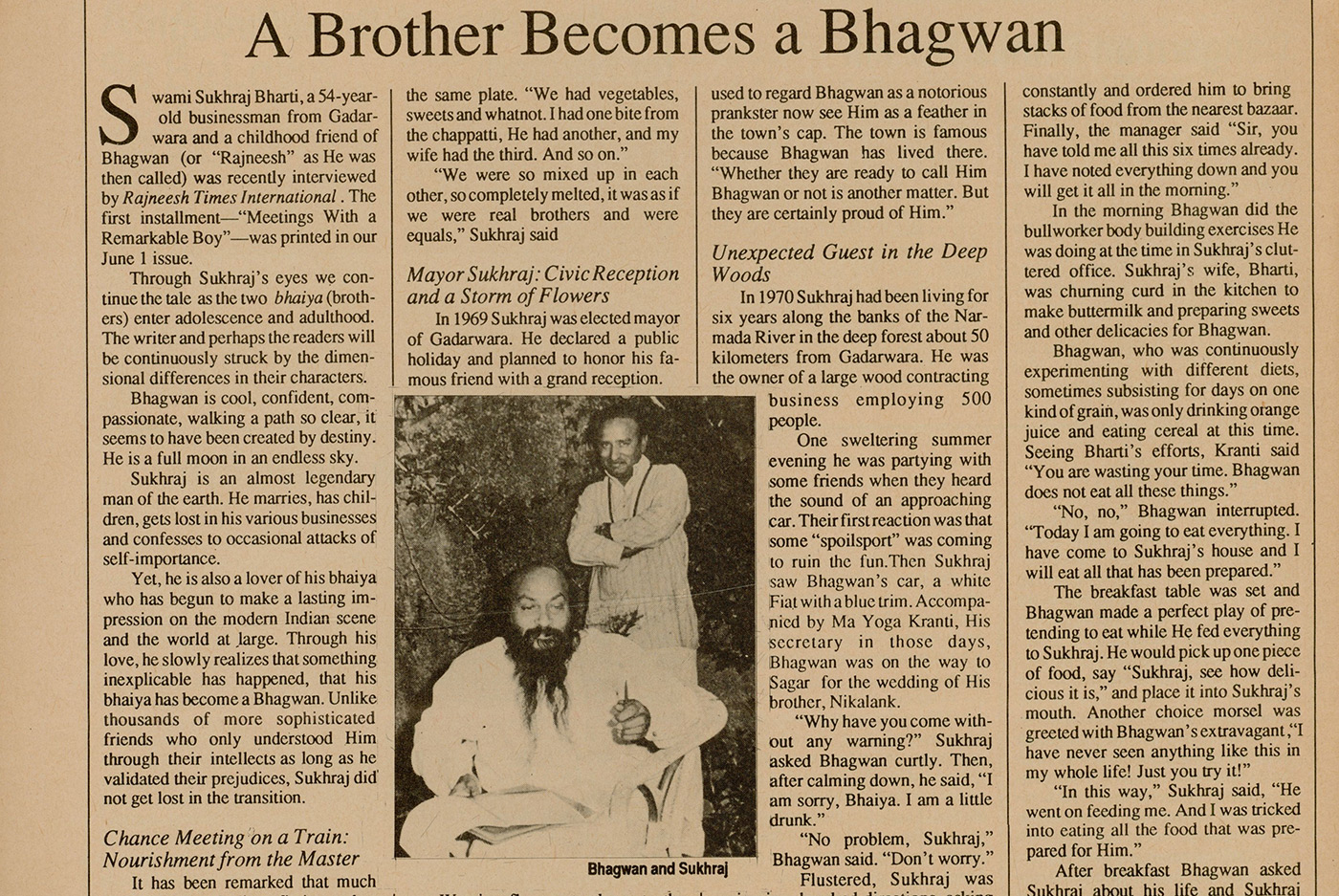
Link to Part 1: Meetings with a remarkable boy
Recognition
Fortunately, Sukhraj still cannot keep secrets. When asked whether Osho was practising meditation in those early years, he smiles.
“Bhaiya had his spiritual life, but we had no access to it. Our relationship was limited to playing and making trouble. Still, it was clear to me that something mysterious was going on. He would suddenly disappear and return late at night. His mother would ask, ‘Where have you been, dear?’ and he would simply say, ‘Don’t worry. I’m fine.’
“He never directly recommended meditation, but what he made us do was itself a kind of meditation – a kind of spiritual growth. Life with him was dangerous.”
Asked whether he had recognised the Awakened One in the boy, Sukhraj pauses.
“There have been many enlightened people whose friends must have played with them and fought with them like normal children. But there is no way to say whether they were enlightened, whether they were Bhagwans. What is within them is beyond the reach of the common man.
“I think it was out of compassion that at some point he declared himself ‘Bhagwan’. Otherwise, how would we have known? We have never encountered a Bhagwan. We would have respected him for his knowledge, his genius. But who knows what a Bhagwan looks like?
“After his enlightenment on 21 March 1953, he did not show any outward change. He was the same as always. At that time he wore a khadi dhoti and kurta – a loose dhoti draped from the back, often trailing behind him on the ground. Looking back, I remember a strange intensity within him. I know nothing of his inner transformation – but let me tell you about my own.
“I began bowing down to him. Although I still called him bhaiya – he was still my friend – I would touch his feet. Then I would sit next to him, smoke cigarettes, even drink alcohol. Still, I say, there is no way to recognise when a person has become a Buddha.”
Osho’s public life then began its ascent. He travelled across India, delivering intense lectures, awakening people and conducting meditation camps. These activities gathered momentum.
When he became a professor in Jabalpur, Sukhraj would visit him and receive the same laughter-filled welcome: “Come, Sukhraj,” followed by the same embrace. When Osho was travelling, they could not meet, but once he began frequently visiting Mumbai – with the train passing through Gadarwara – Sukhraj would rush to the station as soon as he heard. Sometimes he travelled along in the same compartment. Though they did not meet often, there was never any distance between them.
“Whether the world was welcomed or not, Sukhraj was certainly welcomed by Osho!”
Chance Meeting on a Train: Nourishment from the Master
It has often been remarked that much contemporary Indian fiction unfolds on trains and in railway stations. Many of Sukhraj’s stories about Osho take place in similar settings.
One summer in the mid-1960s, Sukhraj and his wife, Ma Yoga Bharti, were returning from a family wedding in Indore when they discovered they would be travelling in the same first-class compartment as Osho.
Sukhraj instructed the train staff to clean the compartment thoroughly and ensured that no one else was assigned the remaining berth.
“And there he came,” Sukhraj recalls, “with garlands around his neck and chest, followed by a crowd of admirers. As soon as he saw me, he asked, ‘And what are you doing here, Sukhraj?’”
“I am travelling with you,” Sukhraj replied.
Osho handed the garlands to Sukhraj and Bharti, who decorated the compartment with them.
As a gesture of intimacy, Osho rested his elbow on Sukhraj’s shoulder and leaned against him.
“My heart was throbbing with love and pride,” Sukhraj says. “Then he introduced me to the admirers as his ‘childhood friend’.”
Sukhraj and Bharti had brought nothing to eat or drink. Osho, however, always travelled well prepared – with a tiffin, water jug, plates, utensils, everything.
One after the other, the three drank from the same glass. Later, they ate from the same plate.
“We had vegetables, sweets and all sorts of things. I took a bite of the chapatti, then he took one, and my wife the next. We were so mixed up with one another, so completely melted together – it was as if we were real brothers and equals.”
Mayor Sukhraj: Civic Reception and a Storm of Flowers
In 1969, Sukhraj was elected mayor of Gadarwara. When Osho came to visit the town, he declared a public holiday and organised a grand civic reception in his honour.
Determined to decorate the roads and shower flowers from the rooftops, Sukhraj reserved flowers from gardens within a hundred-mile radius. For a week, mostly marigolds were picked and delivered.
On the day of Osho’s arrival, the town was in a festive mood. Four thousand people gathered at the station to greet him. Sukhraj removed the top of his jeep and they drove three kilometres through streets lined with flowers and bunting.
Too late, Sukhraj realised his mistake. For their durability and availability he had chosen marigolds – but they were hard when thrown enthusiastically from rooftops. Everyone in the jeep, including the film music director Kalyani and the poet Indivar, could shield their heads. Osho, who wasn’t wearing anything on his head – and was balding – simply smiled and namasted the crowd, showing no discomfort.
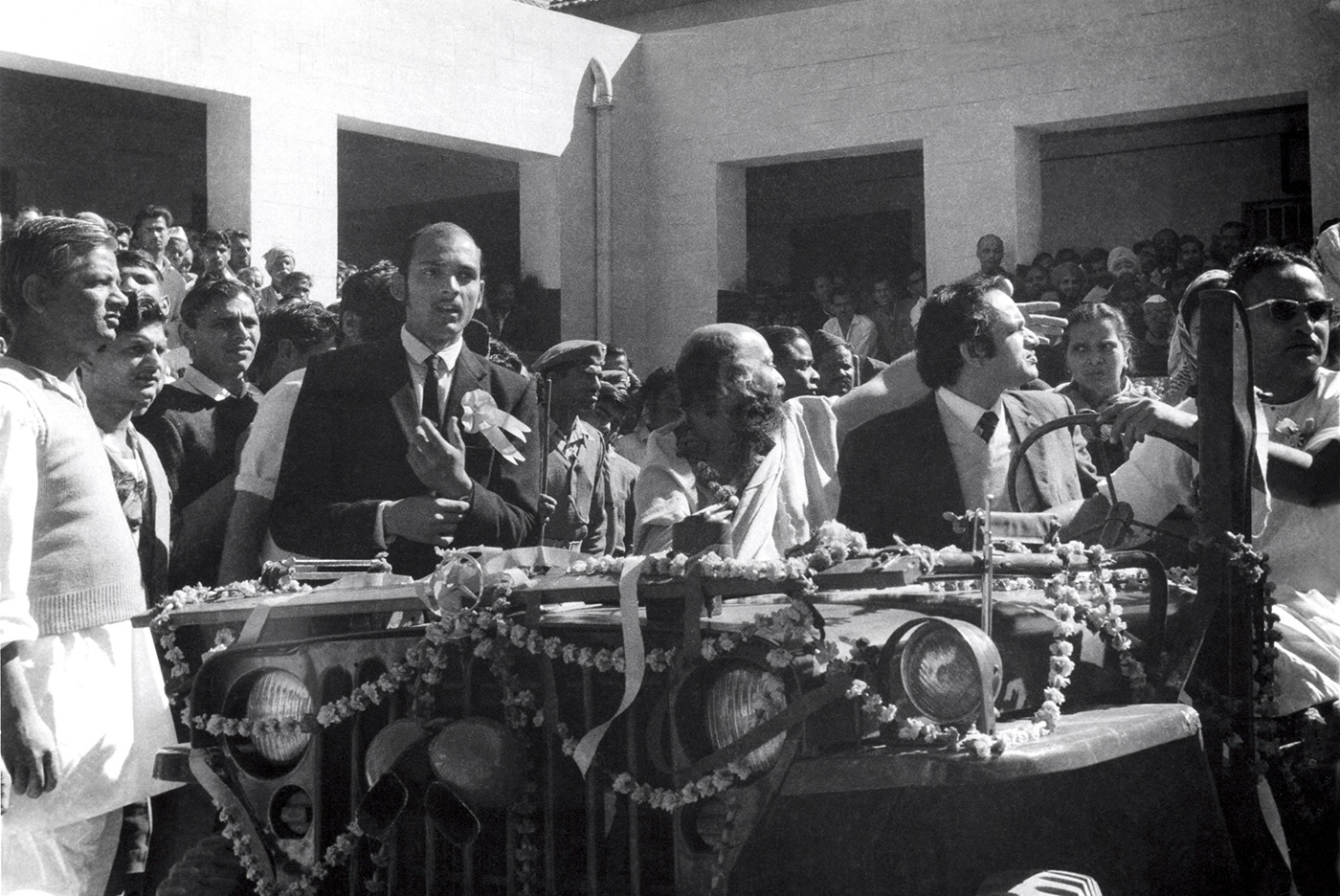
Embarrassed, Sukhraj told the driver to speed up.
That evening, just before a concert by Osho’s musician friends from Bombay, Osho praised the arrangements.
“The idea of showering flowers was wonderful,” he added lightly. “But if you had broken them into smaller pieces, it would have saved my poor skull.”
During the interview, Sukhraj observed that many in Gadarwara who once regarded Osho as a notorious prankster now saw him as a feather in the town’s cap.
“Whether they are ready to call him Bhagwan or not is another matter,” he said. “But they are certainly proud of him.”
In the final instalment of this conversation to be published next month, public honour gives way to private upheaval – and a single sentence will begin to change everything.
Links
- Meetings with a remarkable boy – In this first part, Sukhraj Bharti remembers his childhood with Osho, the games they played, the mischief they made, and the early signs that something unusual was already present in his friend
- Sukhraj Bharti (1 June 1934 – 2 January 2021)
Text based on an interview from September 1987, first published in the Hindi Rajneesh Times (25 May–10 June 1988) and in the Rajneesh Times International (1 June and 29 July 1988), as well as on an extended article published in the Hindi Osho Times International (1 December 1998).
Thanks to Anuragi from Osho Resources Centre (oshoresourcecenter.com – facebook.com)

Comments are closed.