

Purushottama and Amido write about their 2006 travels, when they visited Kerala and Karnataka – and two holy men, Ajja and U.G. (Part 2)
“…and it goes on and on and on
this sweet, sweet song,
and it goes on and on and on…”
This second section of exploring India’s unique offerings begins on the southwest coast – the Malabar Coast. Somehow to me, the words Malabar Coast have an exotic ring, perhaps from reading W. Somerset Maugham. I loved stories where people were sweating under mosquito nets!
Madhurai, where our tale left off in Part 1 , to Varkala, Kerala, our first stop on the west coast, is a journey of 160 miles (260 kilometers), and the bus took about seven hours.
(Click on images to see fullscreen.)
Kerala
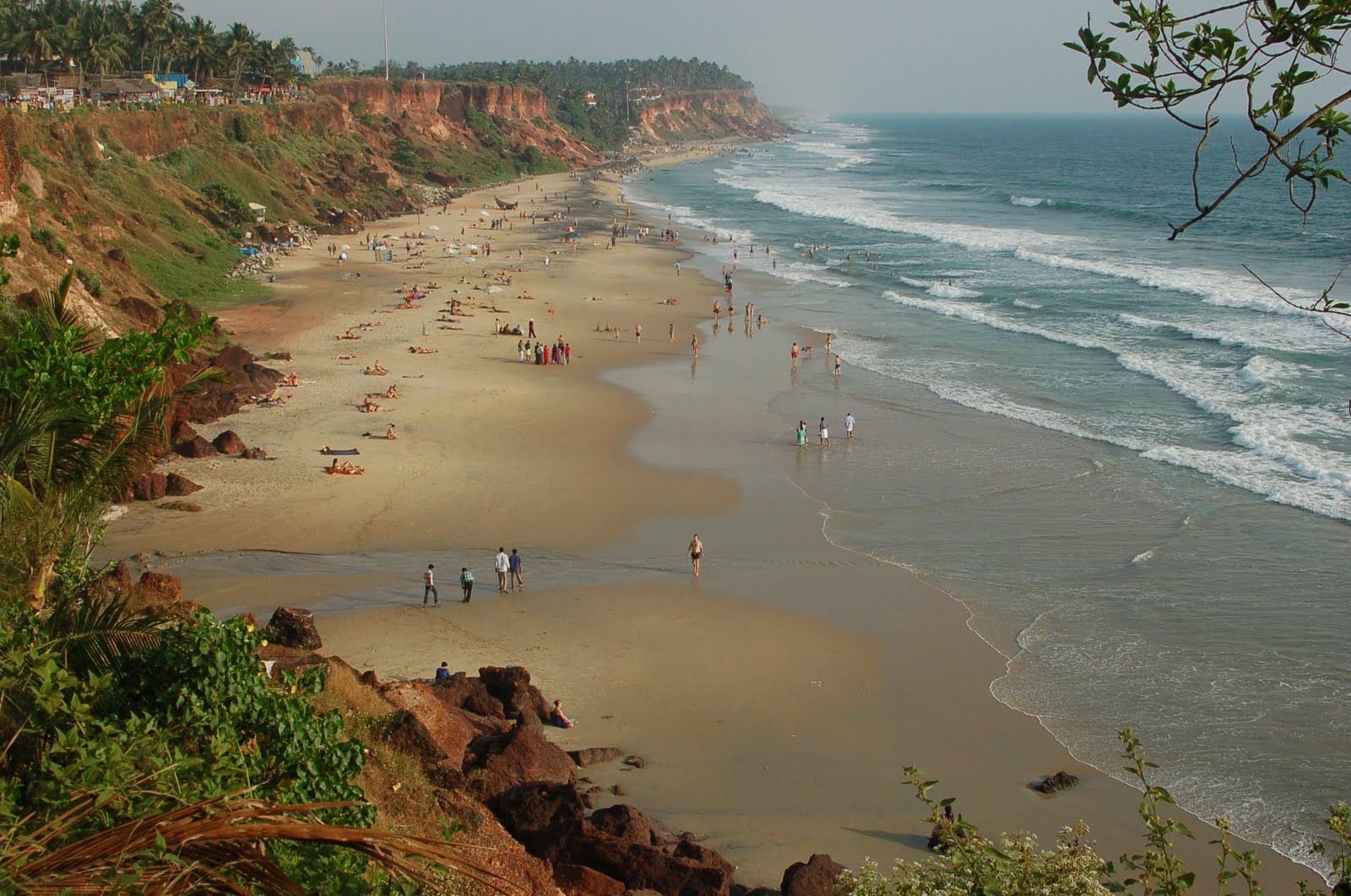
Tall cliffs provide an excellent vantage point from which to appreciate the beach below. The water is rough but could be enjoyed by not venturing in too far, and jumping the waves. We watched a fishing net being hauled ashore by a team of people pulling in unison. It felt so ancient.
What planted the seed for the next stop was a television program I’d seen about the backwaters of Kerala.
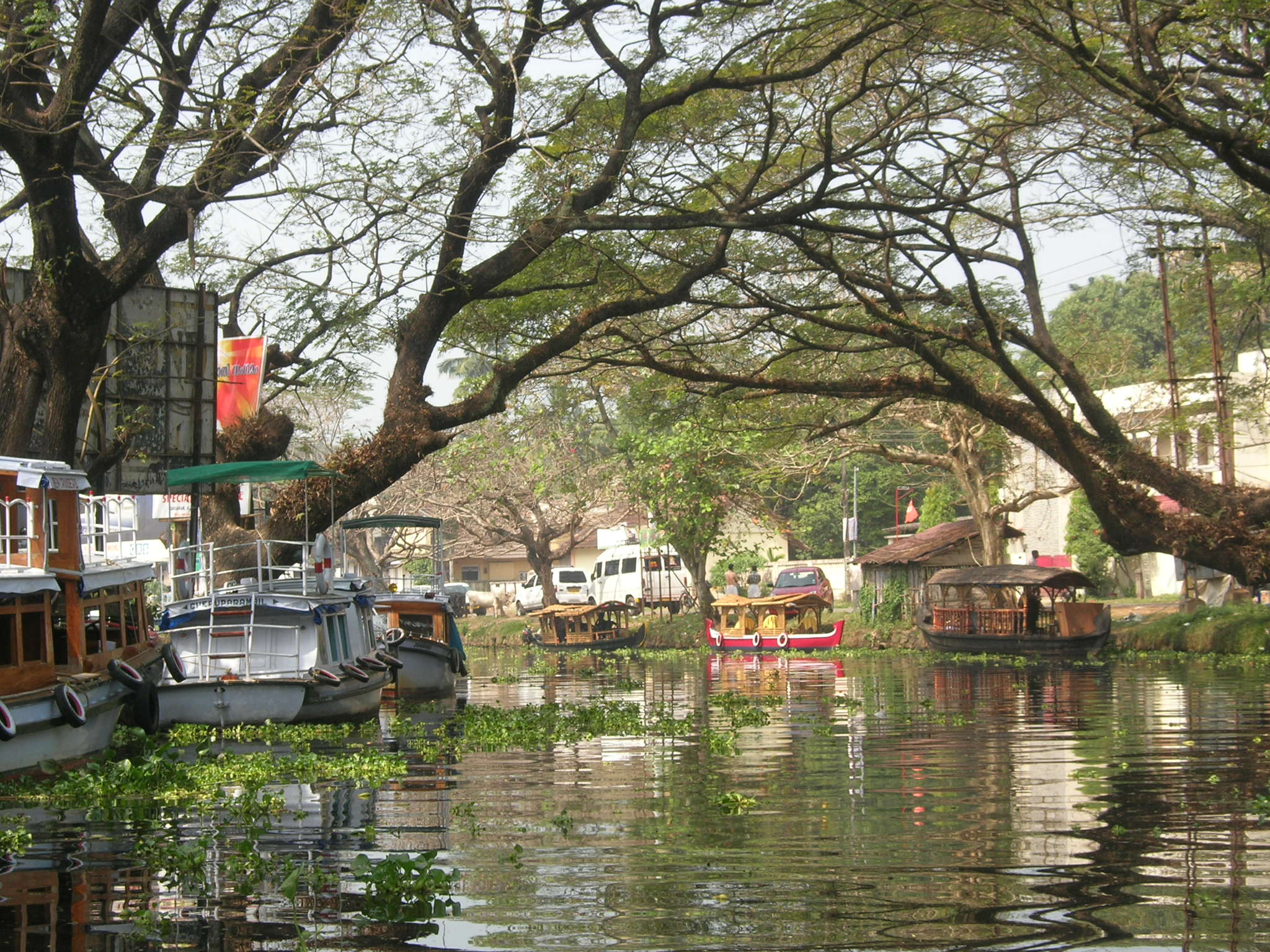
Alappuzha (formerly Alleppey) is a popular tourist destination, and the place from which to start your backwater exploration.
The backwaters are a network of rivers, lagoons, lakes, and canals covering an area of 560 miles (900 kilometers), separated from the Arabian Sea by a narrow strip of land. This creates a unique ecosystem and a rich habitat for aquatic life. A barrage (a dam-like barrier) in the Alappuzha district prevents sea water mingling with fresh water, preserving the fresh for irrigation, and helping to control water levels.
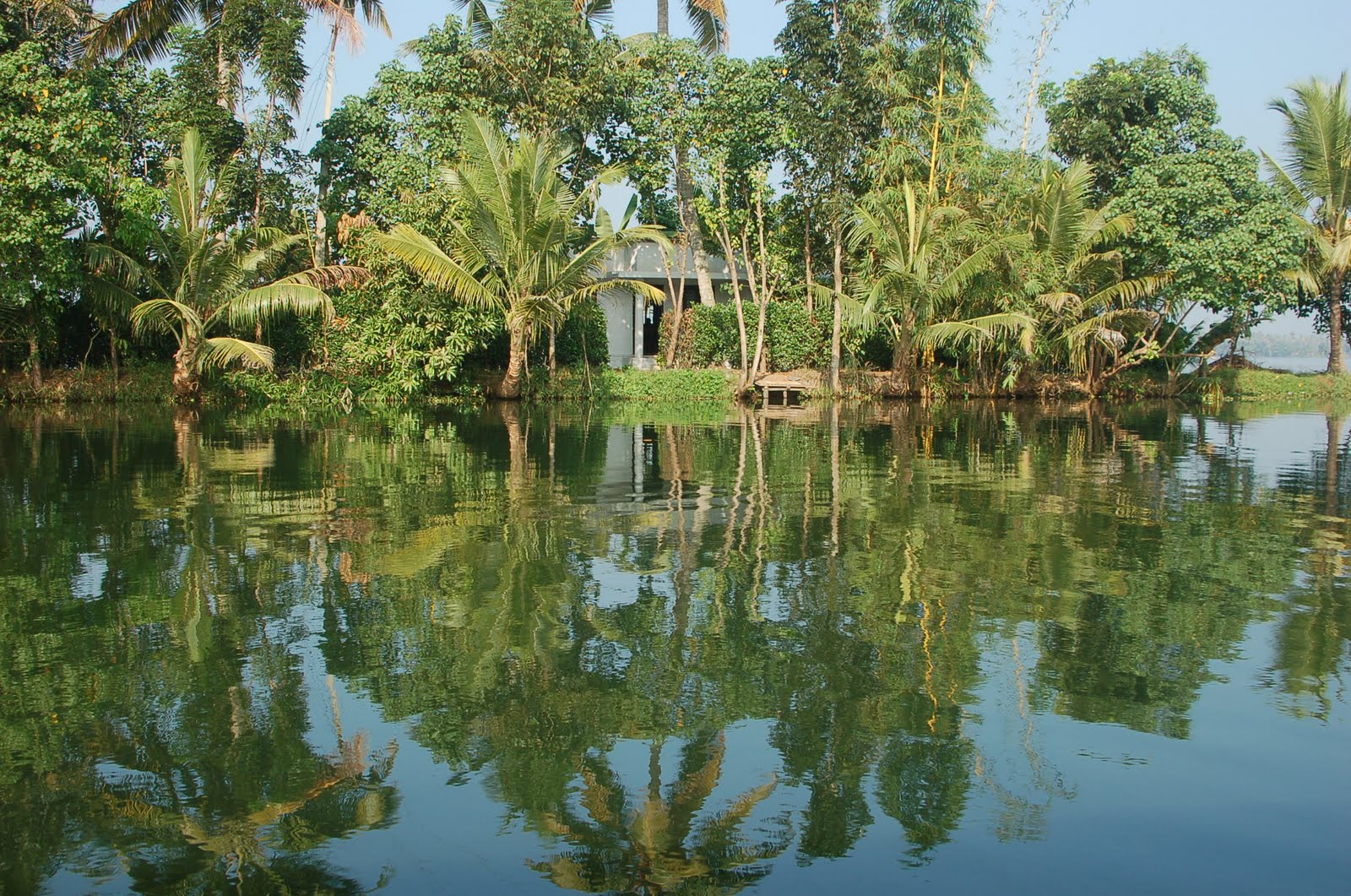
The first impression of Kerala is an exuberance of plant life. Densely packed trees line the waterways. Coconut palms tower above the canopy. In fact, Keralam – the Malayalam word for Kerala – means land (alam) of the coconut (kera). (You can see the tops of the coconut palms reflected in the water.)
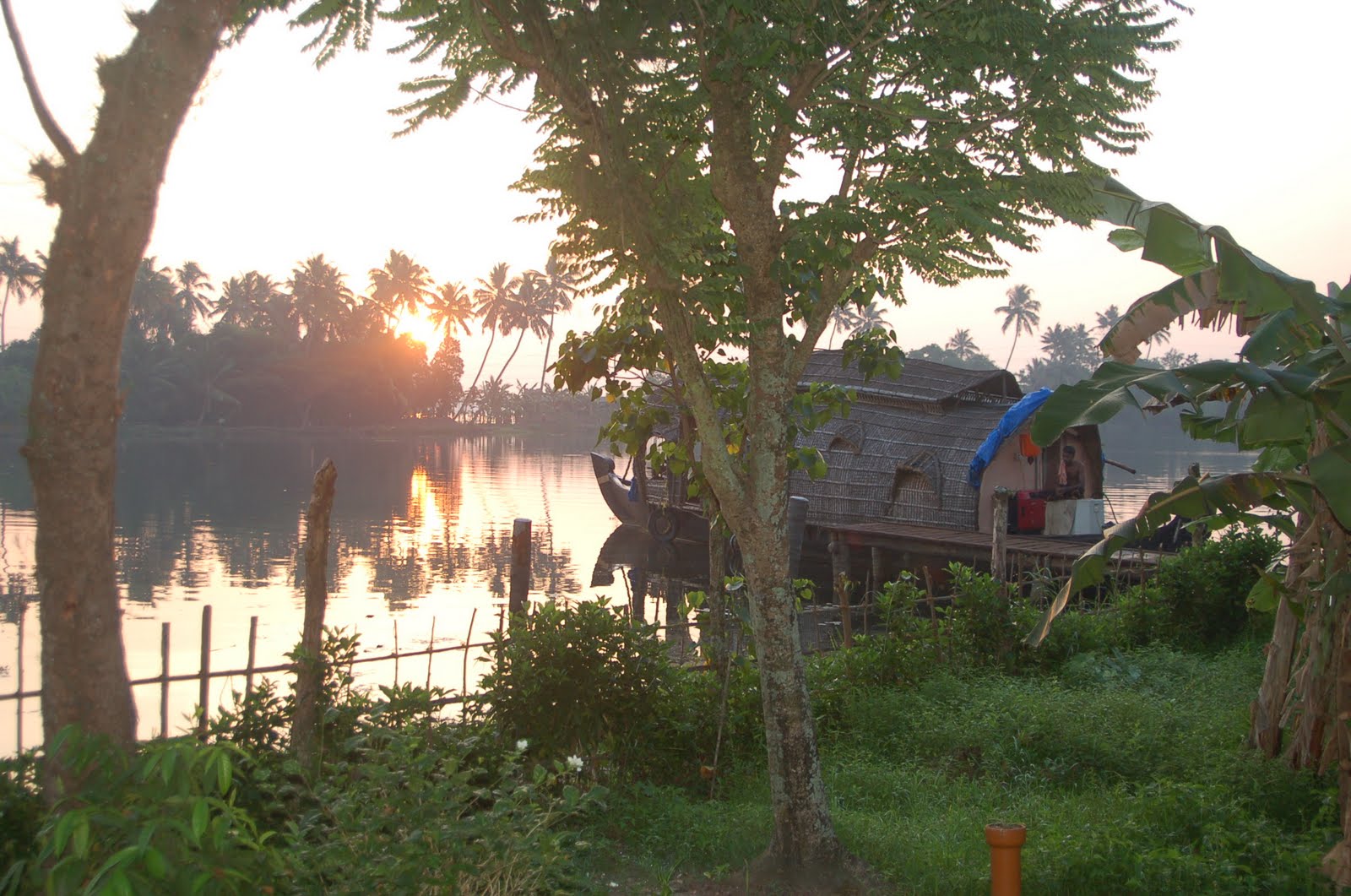
A ferry took us to Rose Cottage, our home for two nights. We swam off the jetty nearby. Rice boats taking tourists around the backwaters docked there from time to time.
There is significant concern that the proliferation of rice boats for tourism, with their use of diesel engines and discharge of untreated sewage, is having an adverse effect on this fragile environment.
Our last day was spent on a (small) boat cruising the waterways, observing the beauty of the land and the great variety of manners in which the waterways are used. The boat also returned us to Alappuzha for the next leg of our journey.


Everyone must have a boat to transport goods, visit friends and neighbors, go shopping, and to trade. The waterways are used for irrigation: rice is grown and in some areas yams. Coconuts and bananas are also important crops. And more personally, the waterways are used for bathing, swimming, fishing, doing laundry, and most importantly, playing.
We had a brief stop in Kochi (formerly Cochin), a mere 34 miles (54 kilometers) north of Alappuzha, where remnants of an ancient Jewish community live. Jewish spice traders first settled on the Malabar Coast at Kodungallur (formerly Cranganore) sometime between 970 and 931 BCE, and it is here that St. Thomas the Apostle landed in 52 CE. The 1341 CE floods that destroyed the Cranganore port forced the population to migrate to Kochi, where it was possible for business to prosper using its port instead. (The Jewish community in Kochi is now almost non-existent, because the majority emigrated to Israel after its creation in 1948.)
From Kochi to Hampi it’s 460 miles (730 kilometers). In 2006 there was no direct bus. We took a bus to Bengaluru (formerly Bangalore) and then a train to Hospet Junction (Hosapete), which is a short ride from Hampi.
Hampi
The small village of Hampi was just beginning to sprawl across the Tungabhadra River when we visited, but ruins of its former glory were visible everywhere. We needed bicycles to explore; the distances were too great to be done on foot alone. And it was hot – although it was January!
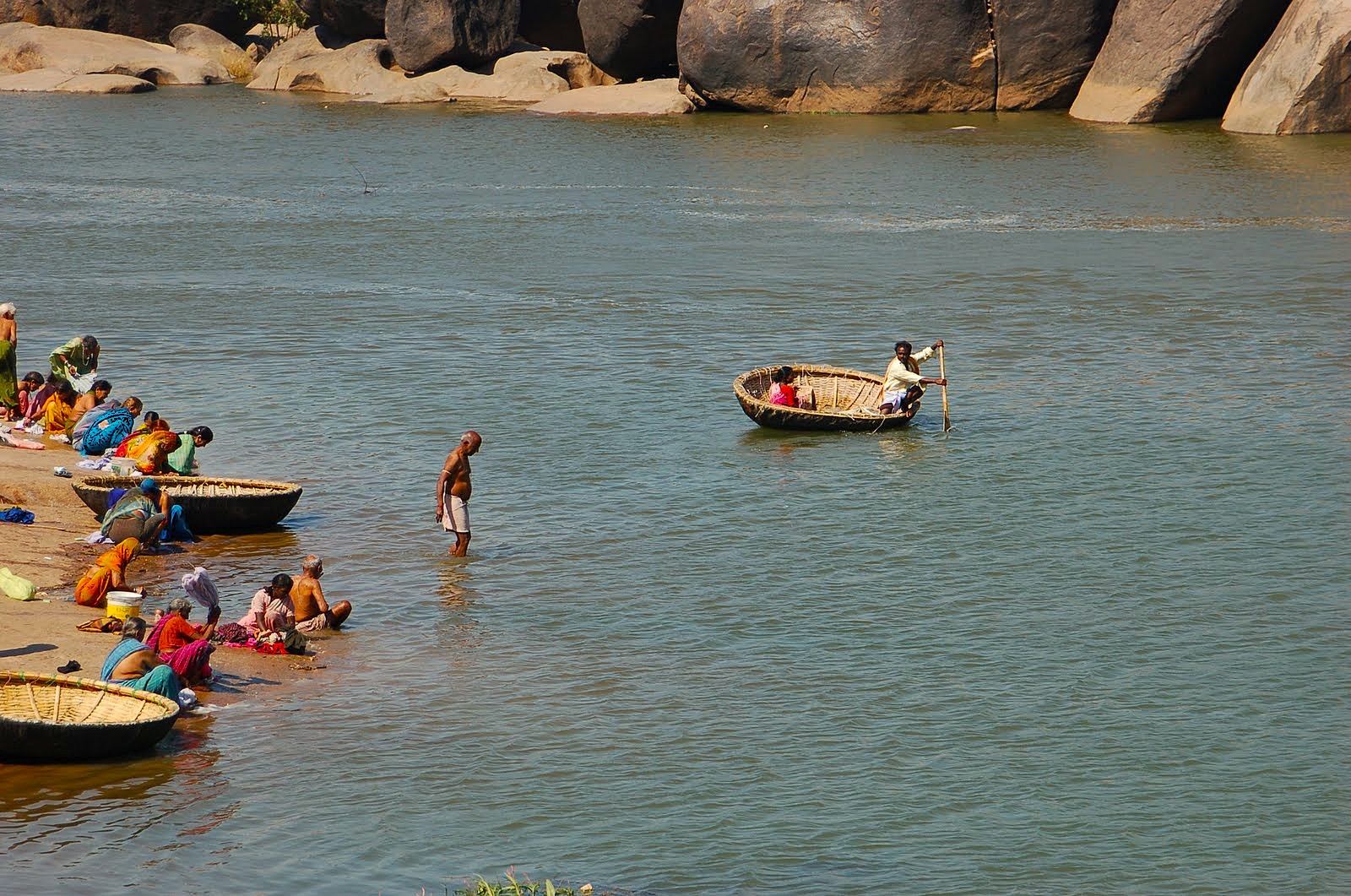
A dongi (coracle) – a lightweight boat, made of bamboo, coated with plastic or tar for waterproofing – ferried people across the Tungabhadra River. I suspect the same means of transportation (minus the plastic) was used in the heady days of the Vijayanagara Empire which ruled over the major part of the southern Indian subcontinent from the 14th to the 16th century.
Hampi (formerly Vijayanagara) was the capital of the Vijayanagara Empire. In the early 15th century it was one of the largest cities in the world, second only to Beijing. It traded in spices and cotton, exporting to Europe, Persia, Arabia, and Burma. Merchants from around the world settled here to do business, giving rise to a multicultural, cosmopolitan society as early as the mid-14th century.
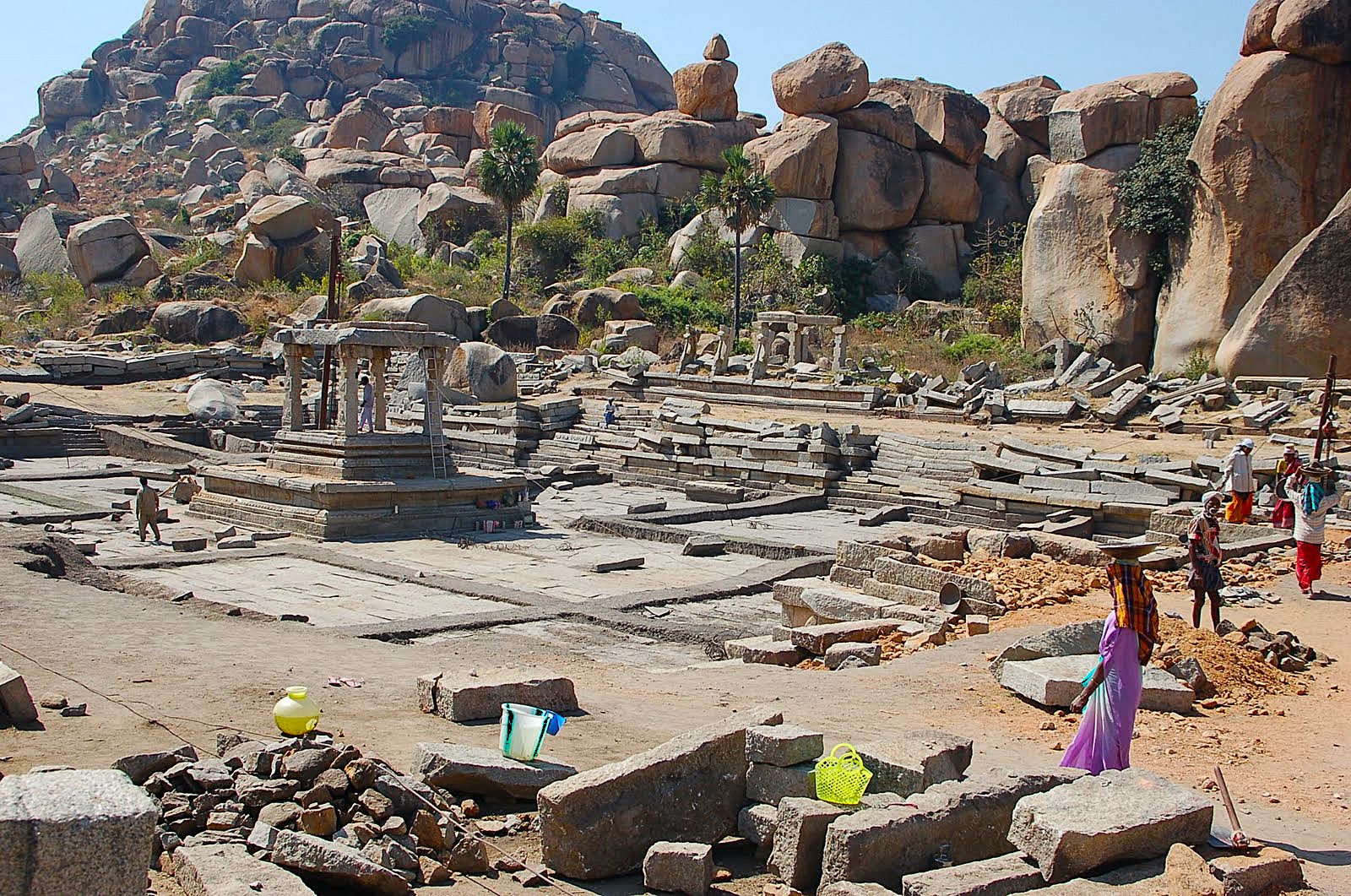
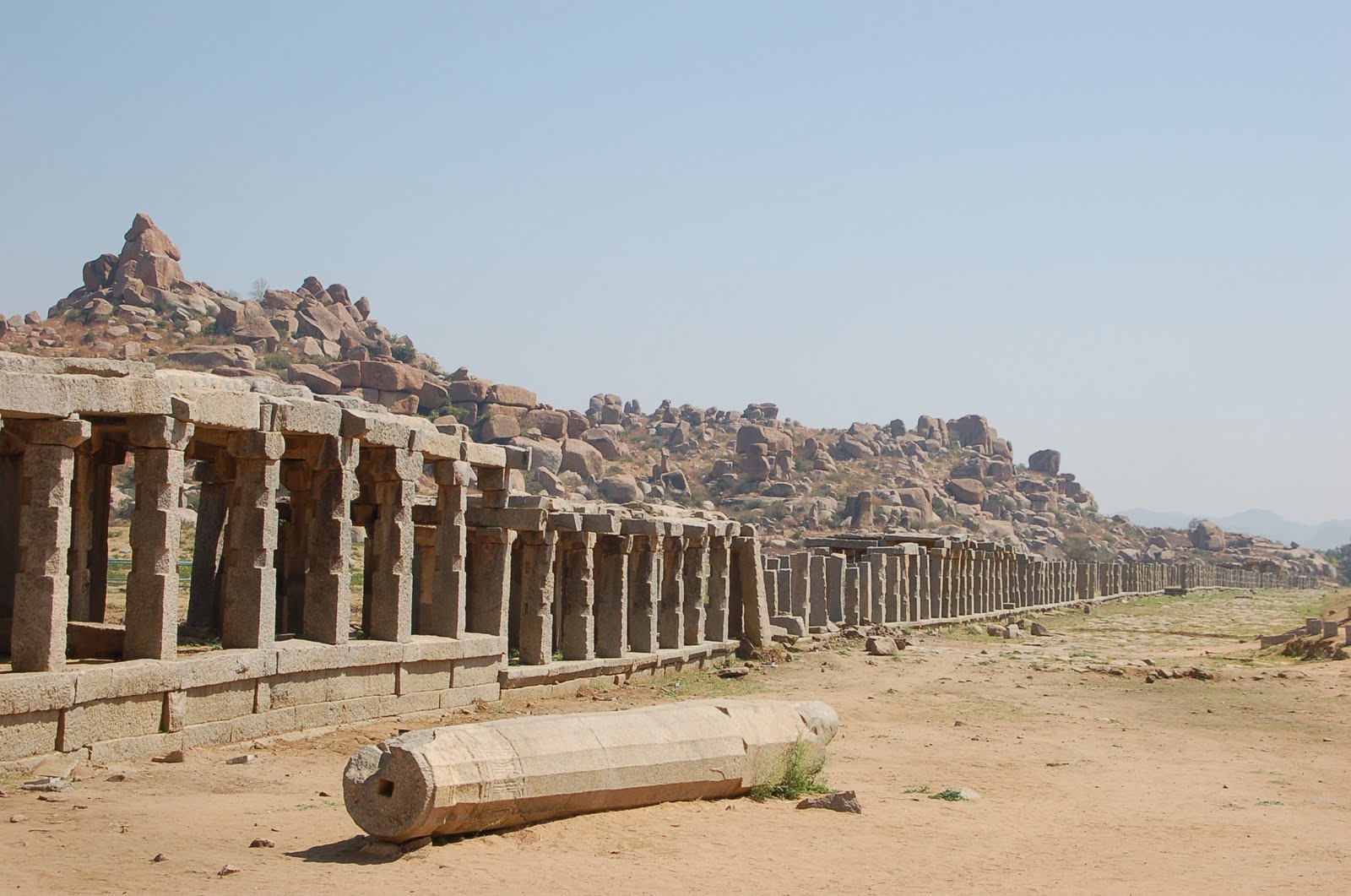
Records from those visiting merchants describe “opulent palaces, magnificent temples, imposing fortifications, and riverside pavilions.” And then, in 1565, an alliance – formed by a coalition of Muslim sultanates – laid siege to the capital. It was conquered, plundered, and left in ruins.
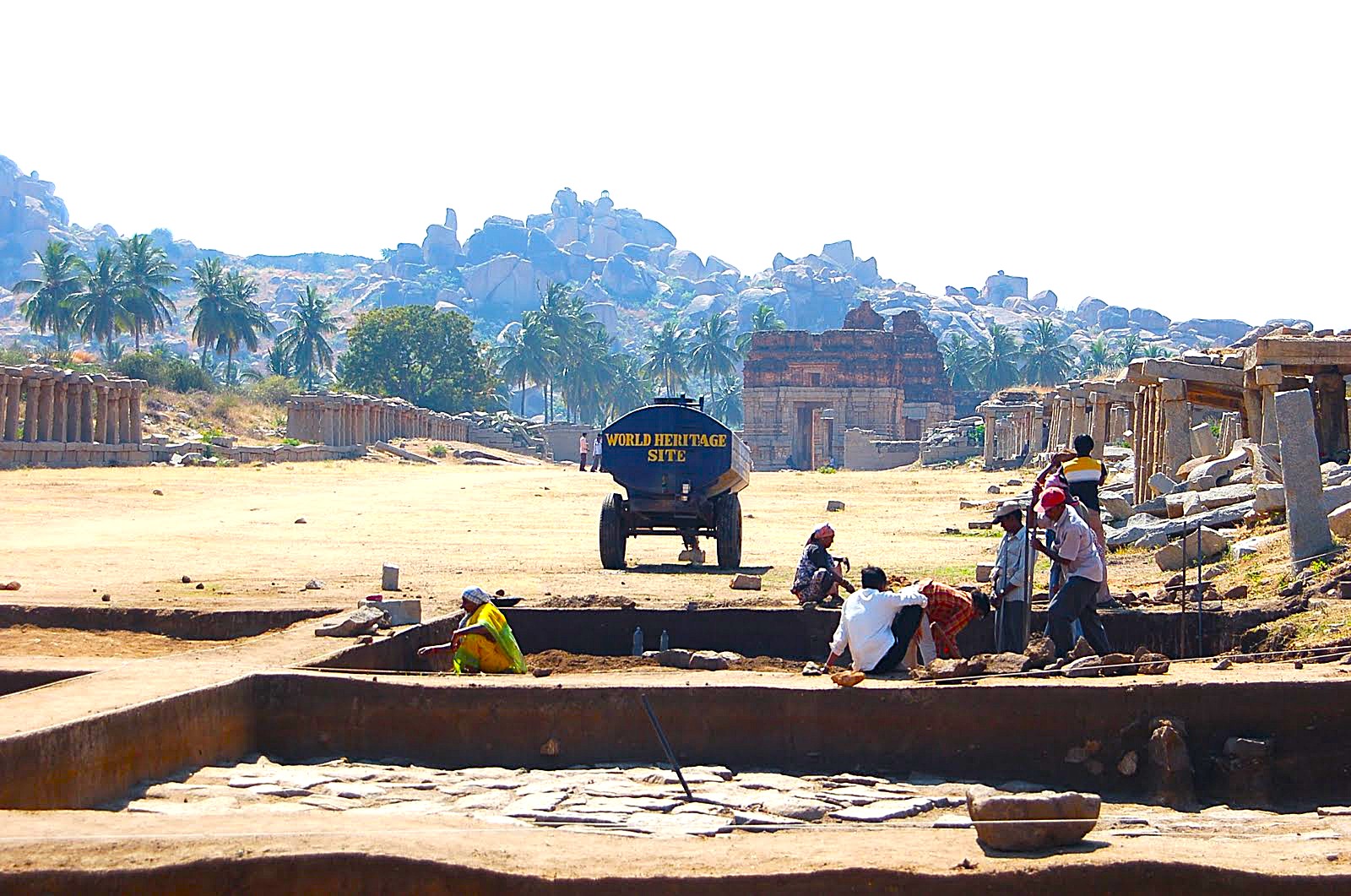
The Group of Monuments at Hampi was declared a UNESCO World Heritage site in 1986.
There has been some friction between those wanting to preserve the site as it was historically and those who want to find a way to incorporate the local population and create something more living. The local people suffered from a heavy-handed approach in 2012 when some of their houses were demolished and when they were relocated outside the perimeter of the site. I have read more recently that associations are being formed to better integrate local communities with the restoration and preservation of historical sites.
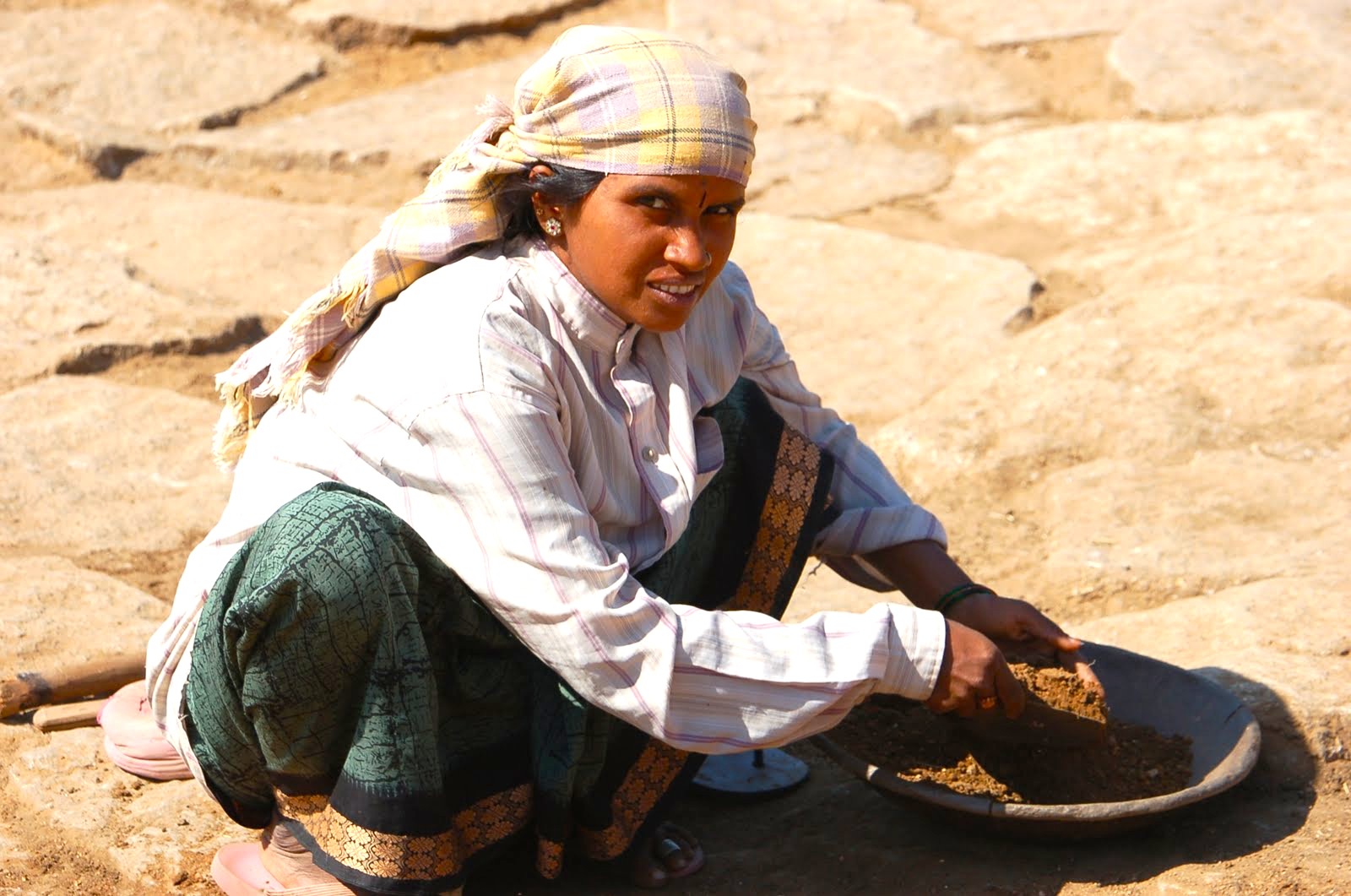
A young women sifting through some marl (crumbly earth deposit).


L: The Shri Vijaya Vithala Temple has 56 pillars. Tap them gently and they each produce a different musical note – incredible ingenuity and craftsmanship. R: The seated man offers a sense of the scale of this doorway.


L: Living among the ruins. R: We are both fascinated by doorways, especially when they repeat and repeat. And at the very end, a little girl’s head.
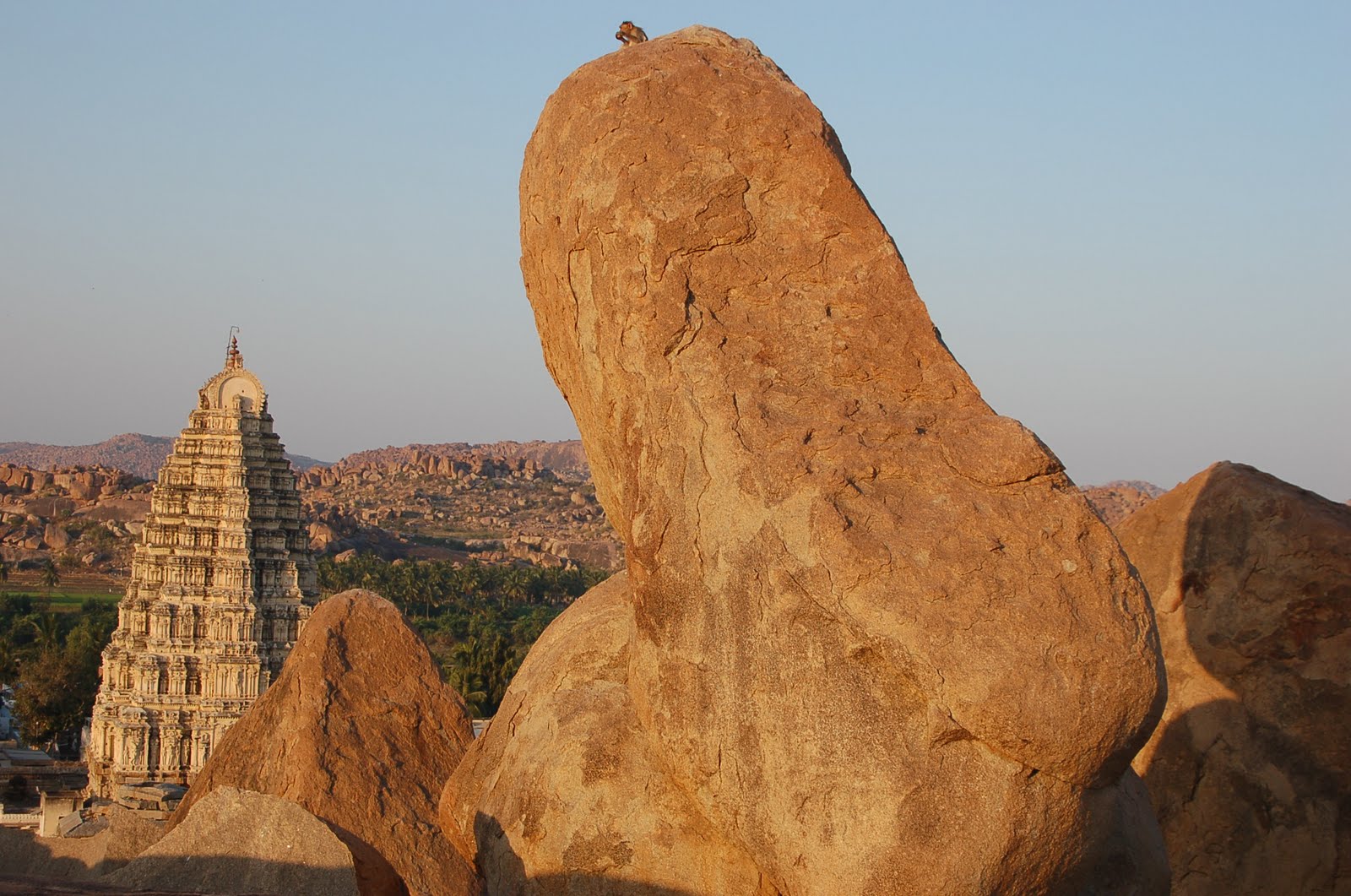
The Virupaksha Temple located in the village of Hampi and still operational.
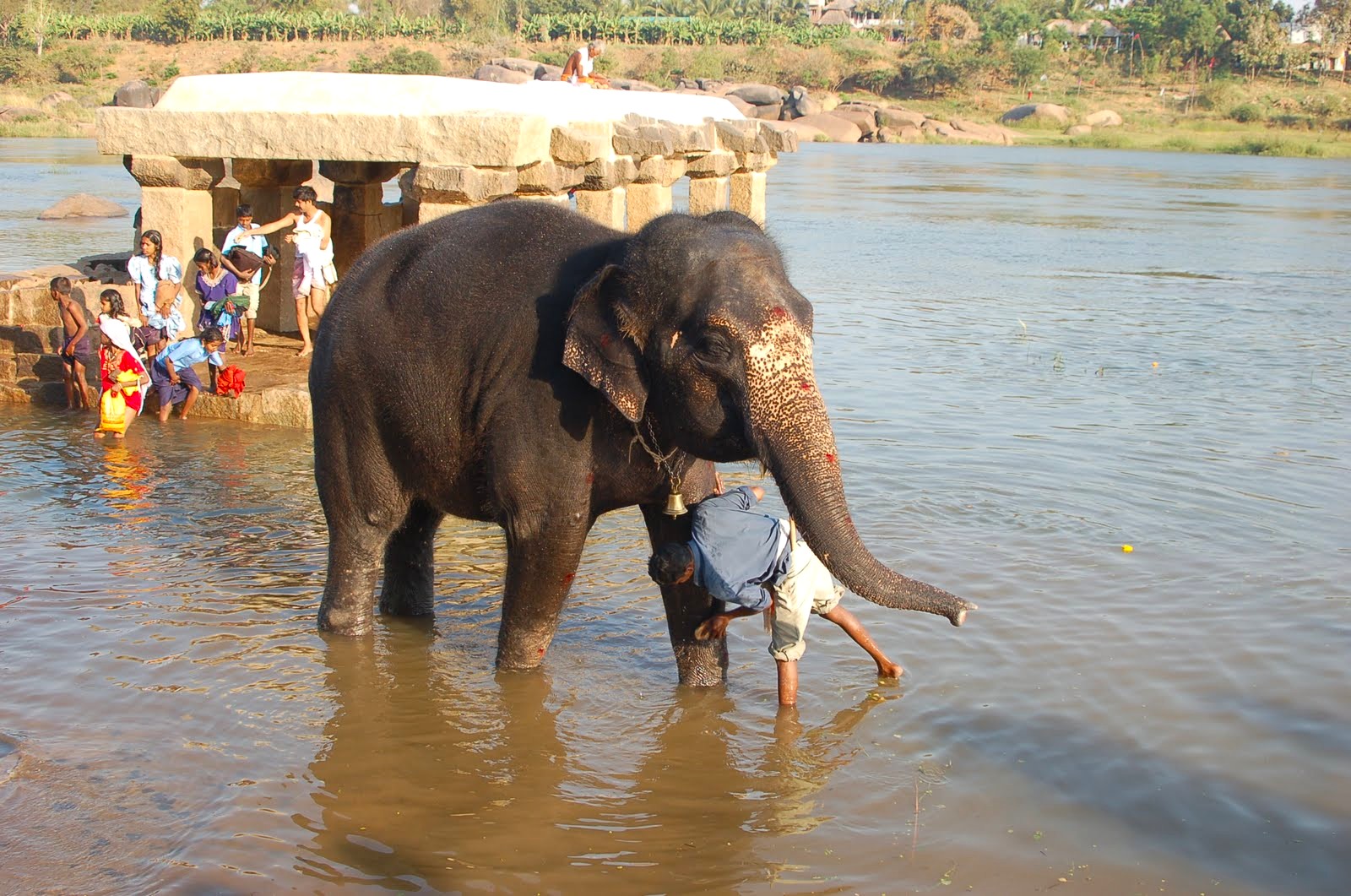
Meet Lakshmi, the Virupaksha Temple’s resident elephant, and her mahout who takes such good care of her. She exudes joy.
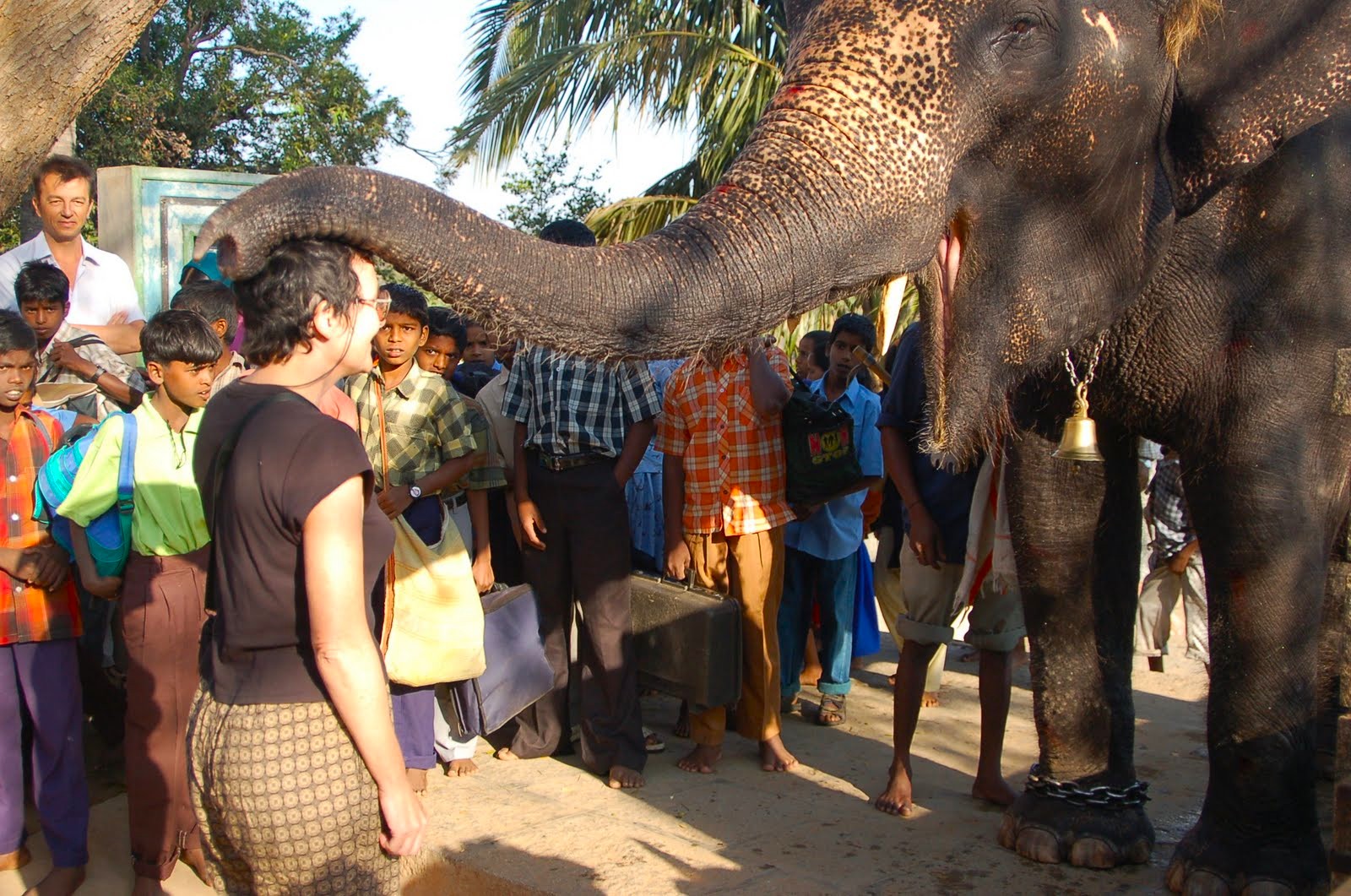
One of the highlights of this trip to Hampi was receiving a blessing from Lakshmi on my 52nd birthday. We are smiling at each other!
…and then on to Arambol, Goa.
Goa
First I wish to introduce you to two friends from New Zealand, Karen and Russ. We met the couple in Koh Phayam, on December 26, 2004, when an earthquake in the Indian Ocean created an immense tsunami which killed 230,000 people and displaced 1.7 million. We were staying in a hut just off the beach when the wave arrived. Its power was much diminished by the time it reached Koh Phayam, one of Thailand’s more northerly islands. Everyone was advised to retreat to the high point in the center of the island, where food was prepared and space in the school provided for us all to sleep. Cell phones were not so widespread at that time. Everyone shared information as well as they could. It was definitely a time of bonding, of community, of gratitude. (I couldn’t sleep that night; there was such a strong current of love.)
We met up with Karen and Russ in Arambol, at the entrance to the village. We spent a lot of time together, sharing our explorations of the inner journey. They told us of a young English fellow who had created a notebook filled with the names and addresses of saints and sages he had visited in India. He mentioned that out of everyone he had met the highlights were; Bhagavan Arabbi Nithyanandam – Ajja (meaning uncle) as he was lovingly referred to – in Puttur, Karnataka, and U.G. Krishnamurti in Bengaluru (formerly Bangalore), Karnataka. We decided to see for ourselves.
Ajja’s Ashram
We reversed our northward trajectory and traveled south to Mangaluru (formerly Mangalore), Karnataka, where we spent the night. The next day we called Ajja’s ashram to enquire about visiting and were invited for lunch. We scrambled to gather our belongings, check out of our hotel, and find a bus to Puttur – a distance of 32 miles (52 kilometers) from Mangaluru.
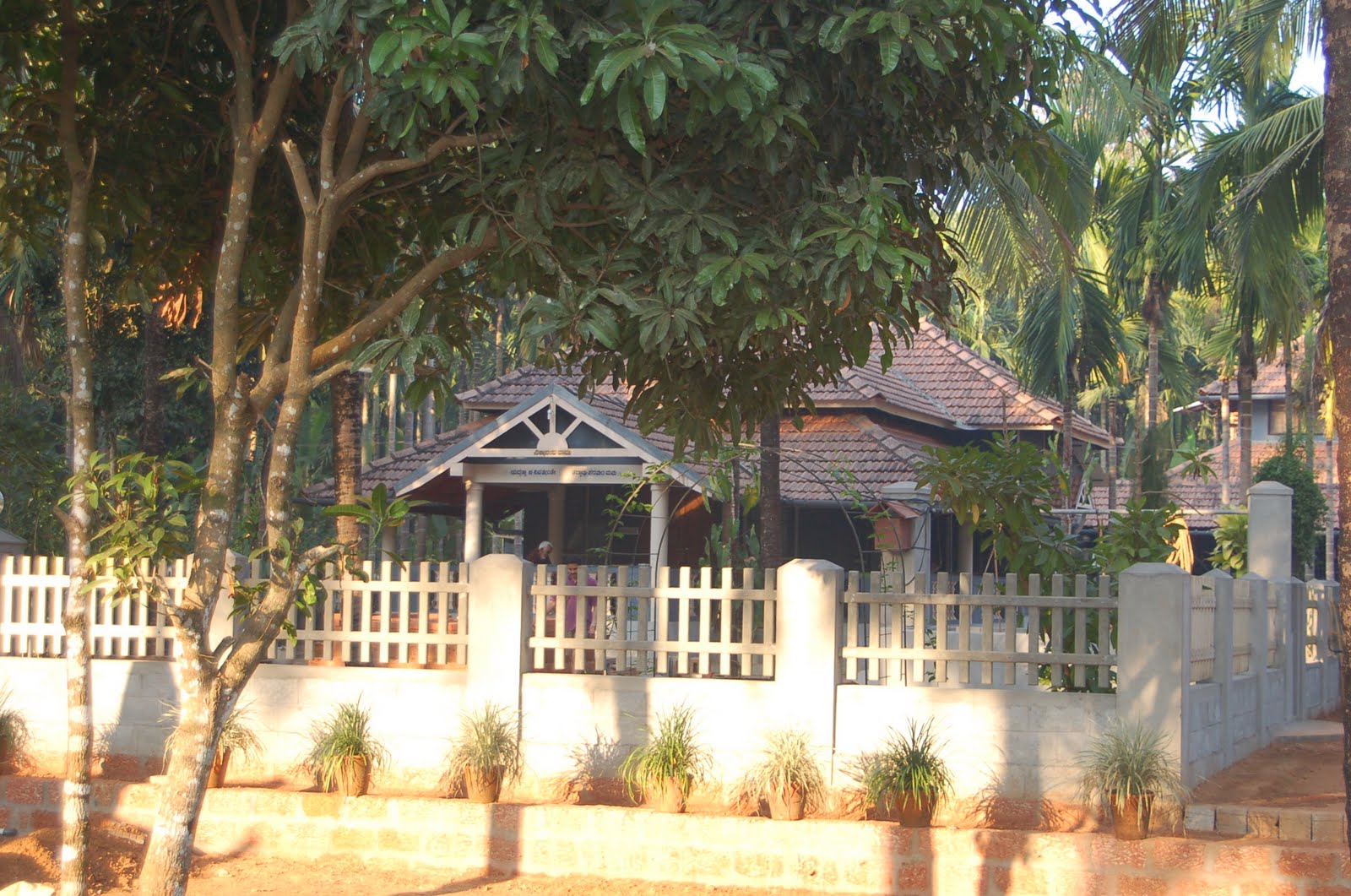
As we entered the ashram, we could see people gathered on the porch of the house. We were told to hurry up and join them. We struggled to take off our hiking boots and detach ourselves from our backpacks, then made our way to the porch. We were there only briefly. We were then told to have lunch and that we would be able to meet with Ajja later.
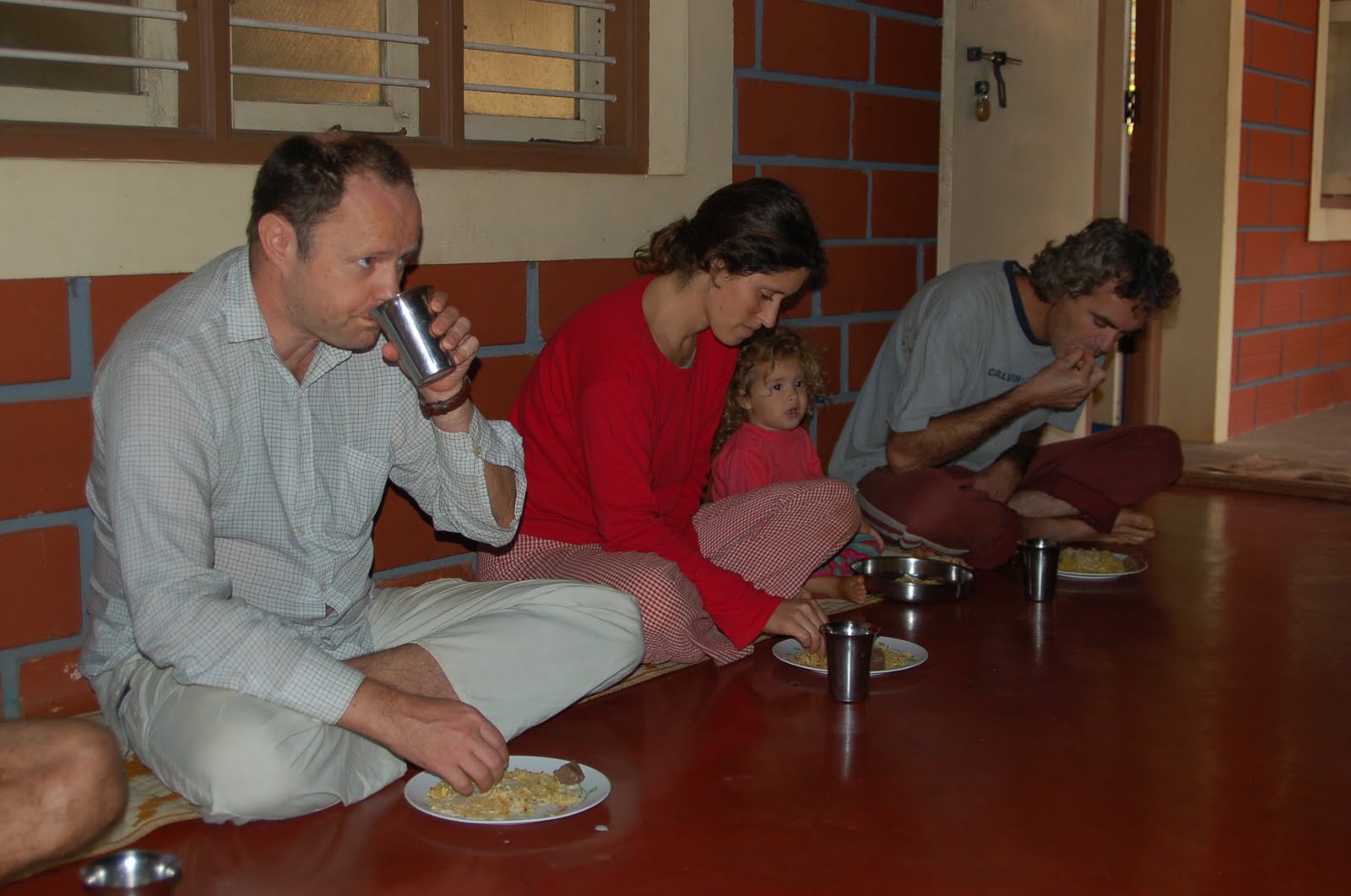
Meals were eaten seated on the floor, and were served by a couple of lovely women devotees of Ajja. Most people ate with their hands; we were offered spoons. (Thank you!) Every meal was intensely delicious – cooked and served with love. Love was the fragrance.
Afterwards, a man called Srinath showed us to our room and gave us several thick blankets to sleep on and some lighter blankets for covers. We were in a building for visitors. Most were Westerners, but within a few days some Indian devotees joined us. With their arrival, Purushottama and I were separated in order to create a room for men and a separate room for women. I struggled with the separation. It forced me to do an immense amount of work with attachment!
Dr. Satish – he might have been the secretary to Ajja – spoke with Purushottama, asking him to consider whether he had any questions for Ajja, so as to make better use of his time with him. This proved to be a useful device for Purushottama. He worked with it, identified his question and in his meditation saw it dissolve.
Purushottama describes his insight in his book, Meetings with Two Remarkable Men:
“…it was an opportunity to explore the question about a question. And when I sat with that for some time, I found that I did have a question. I was aware of a sense of awareness which somehow I could physically relate to the area at the back of my head. And I was also aware of an energy, a sense of being, that I would say somehow related to the area around my heart. My question became – what is the relationship between these two? It was not very long after formulating this question that it was answered in my meditation.
“It seemed that the awareness of awareness was not an activity; there was no movement. But the energy that I felt around the heart was active, not static. What seemed to happen was the awareness gave attention to the energy, and with this attention, the energy became less active. It gradually settled, and when it had completely settled, it felt as if it was absorbed by the awareness. That is the best way that I can describe what took place. In that merging, that joining, that absorption, there were no more questions. The question was answered in dissolving. And in that dissolving of the question there was light and bliss.”
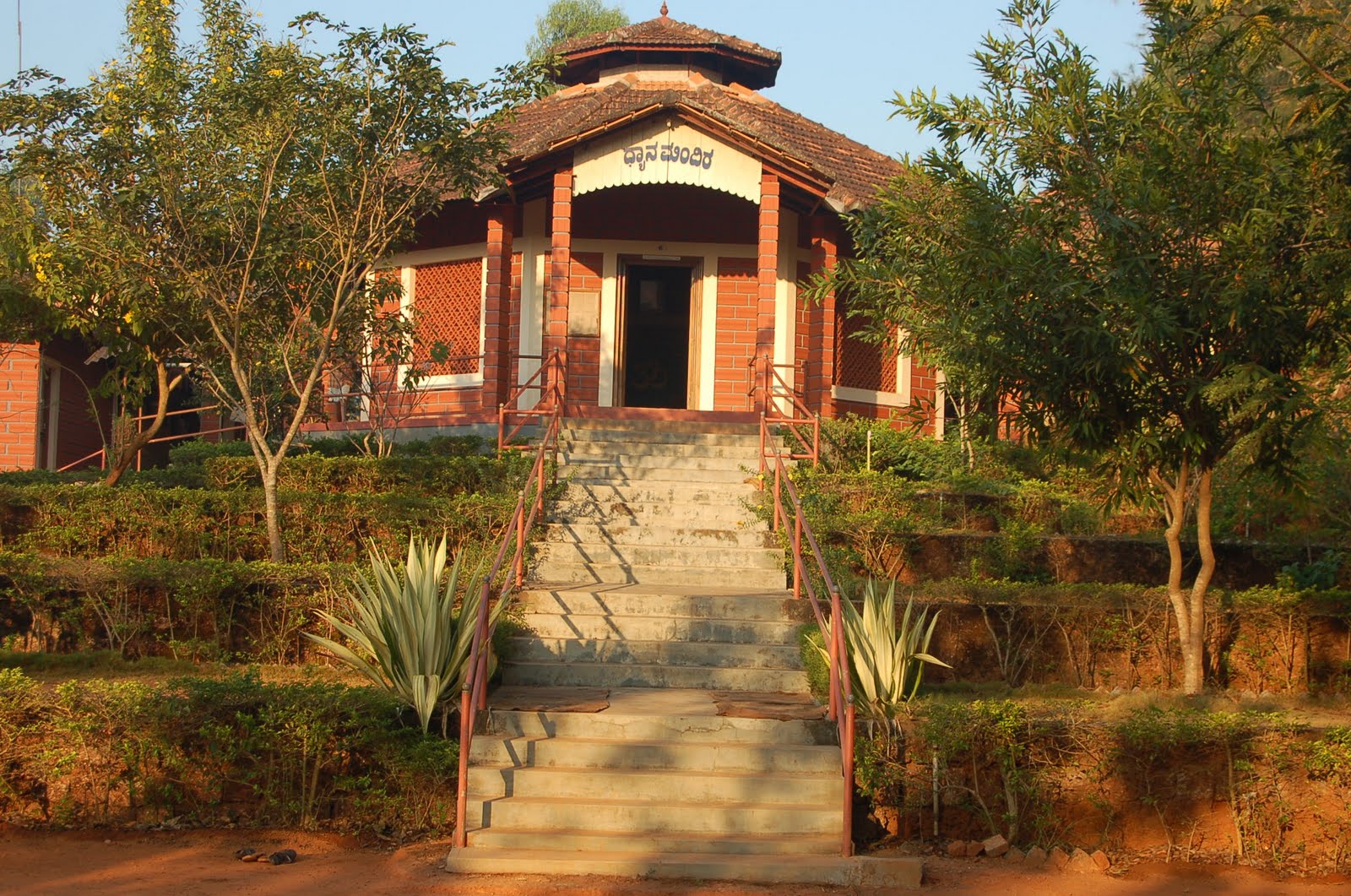
Morning chanting began at 5 am. I also participated in the chanting that occurred several times a day in the Meditation Hall. Generally, several women devotees attended. They carried the chanting and I would join in oh so quietly. But one day there were only two of us, the person leading the chanting and me. “Om Shree Krishna ya namaha.” She would sing the chant and I would repeat it… at first barely audible, then stronger – feeling that I am not the voice, I am not the body – the sound just poured through…!
Two beautiful cows lived in a shed next to the kitchen. Their dung helped create the fuel used for cooking. Their gentle mooing provided a musical background to the chanting and meditation. They had the most wonderful eyes. In the evening, Srinath would take them for a walk. He wore so many hats.
On several occasions after lunch, Ajja received guests from town on his porch. The Westerners all flocked there to see if they could sit with him too. Every day he said to the Westerners in Marathi, “Go to the Meditation Hall!” Only Purushottama, Ingrid, a lovely Swedish woman, Hans, a young German man, and I complied. It was the most beautiful place to meditate. A large om symbol decorated the wall facing the entrance, and filtered light entered through latticed windows. It was cool inside on the brick floor.
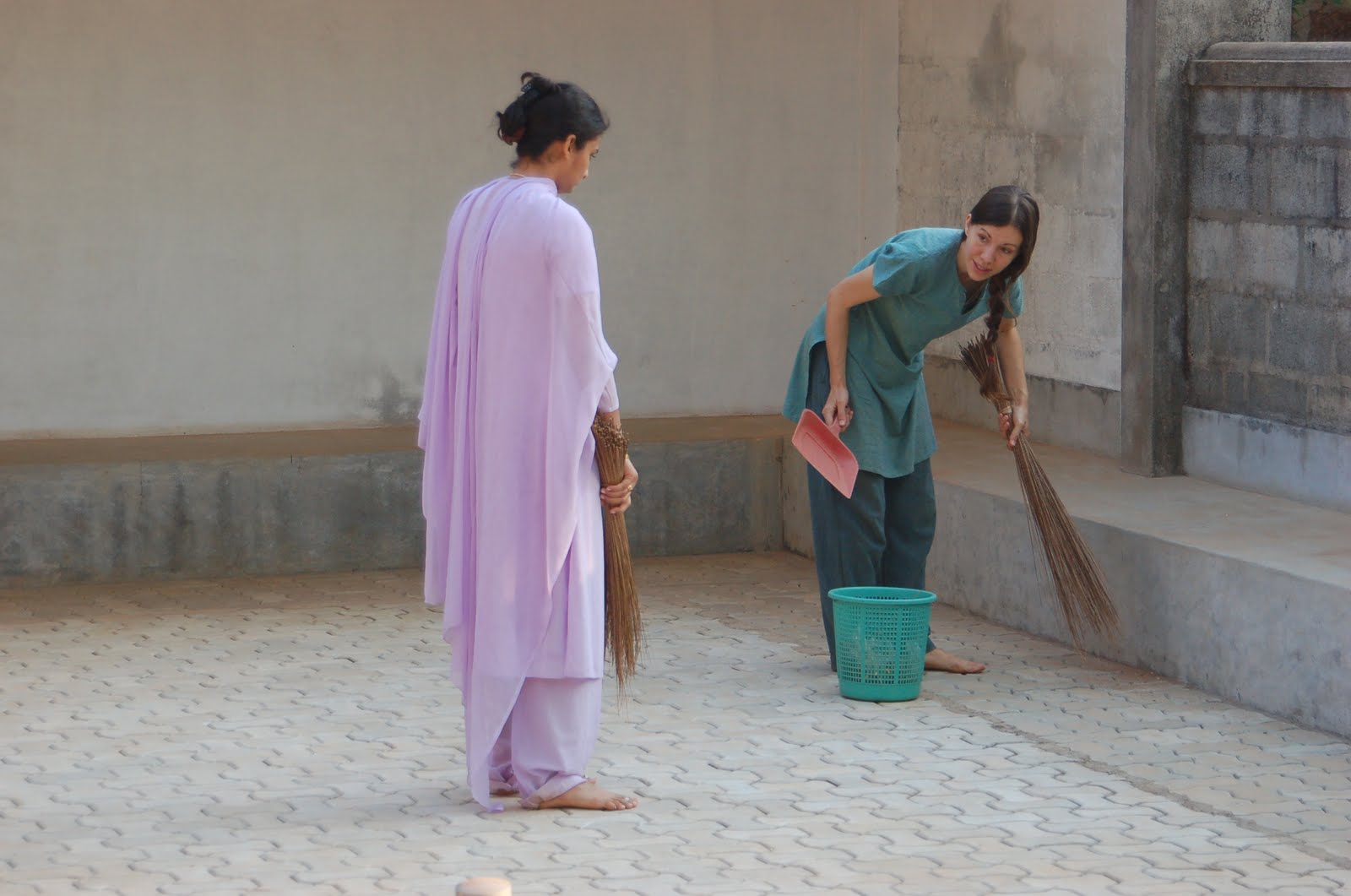
After breakfast, Thea, the young woman sweeping in this photograph, would give us tasks to do, not at all arduous; for example, sweeping in front of our building, sorting betel nuts harvested from the property…
One day we were taken to the pathway in front of Ajja’s house and asked to pick up litter. Ajja was sitting on his porch. Each piece of rubbish seemed like a thought. In slow motion I would pick it up and throw it into a small container. At first the pieces of rubbish were very visible, but then I found more hidden pieces, concealed by leaves or stones, requiring me to look ever more deeply, and to sink into the silence and stillness. We were then given something to eat – something sweet – it’s just so heavenly to eat something sweet in the presence of a Master… prasad.
On another occasion, four of us – Thea, Ingrid, Purushottama and I – were invited to Ajja’s room. He had gone into town. We were to work in pairs; Purushottama and I teamed up. We were to clean the grout between the tiles in his room… such a fragrance… the scent of presence… so reminiscent of being with Osho… the stillness and silence… And afterwards we were invited to the back of the house and again given something to eat by the woman who looked after Ajja – and again that sensation of imbibing something so much more than food…
There was a small library that contained several Osho books. Often in the afternoons we would sit out on the porch in front of our building and explore them. Put mindstuff in such inexpressible fineness above, below and in your heart, was the one out of Shiva’s 112 meditations illuminated by Osho in The Book of Secrets that struck me most profoundly. Such beauty in this telegraphic communication. I have worked with it intermittently since then.
Sunday was a day when many visitors arrived from out of town. It was also full moon. We all assembled in a two-storey bamboo hut. Westerners were directed upstairs and below were Ajja and his Indian devotees. Music was played, bhajans sung; it was such a delight. Then Ajja asked through the flooring by way of an interpreter if the Westerners would sing a song. I could think of nothing in spite of the fact that ever since arriving at the ashram songs we used to sing in Pune endlessly circulated in my brain! Thea, the ethereal, delicate young British woman started to sing – Lord of the Dance. It was so perfect.
The next day Purushottama received another visit from Dr. Satish, who asked about our plans. Purushottama found himself saying that we would be leaving the following day. We both felt that we had been given so much, and felt such gratitude, even though the promised darshan had not materialized. What more could be received?
Celebrations were planned for the afternoon and evening. The area in front of Ajja’s house was covered with bamboo mats for seating and we all gathered there after lunch. Ajja asked everyone to move forward a little; he didn’t want anyone sitting under the coconut palms for obvious reasons! I found this so touching. And then a dialogue from the Ramayana was performed. Even though it was in Hindi and I couldn’t understand a word, it was so compelling – the passion of the speakers, their gestures, the intensity. After it ended, there was music and Ajja started encouraging everyone to get up and dance; he danced with some of his devotees. He danced with Purushottama. Then masala dosas were distributed. They had been delivered from town. We were told they were a favorite of Ajja’s (mine too). Again, that sense of timelessness, of being present when in the presence of someone who lives out of time.
The next day we prepared to leave. Dr Satish came to inform us he was making arrangements for us to have darshan, but nothing was guaranteed. Then mid-morning, a young woman named Kavita came looking for us. We were to meet with Ajja.
We sat in front of Ajja on his porch. Several Indian devotees were also present. Kavita translated a few questions Ajja had for us about our backgrounds; then we all sang bhajans. Ajja turned to us and asked us to sing a song. Fortunately, thanks to our experience the day before in the Music Hut, we had a song in mind! A song we used to sing in Osho’s ashram:
May the love we share here spread its wings
and fly across the Earth and sing
its song to every soul that is alive
May the blessings of your grace Bhagwan
be felt by everyone and may we
all see the light within, within, within
Asalaam aleikum, Aleikum asalaam
Asalaam aleikum, Aleikum asalaam
Asalaam aleikum, Aleikum asalaam
It was a little difficult to get going but we did it!
Ajja seemed really interested in our choice of song and asked how we knew it. Purushottama explained we had learned it in Osho’s ashram. Ajja said it was related to his name, Bhagavan Arabbi Nithyanandam. Although his upbringing was in the Hindu tradition, the ‘Arabbi’ in his name relates to Islam as he feels connected to the Sufi tradition as well. Purushottama comments in his book From Lemurs to Lamas: Confessions of a Bodhisattva: “[Ajja] transcends demarcations like Kabir, or Sai Baba of Shirdi, and so many Sufis of India.”
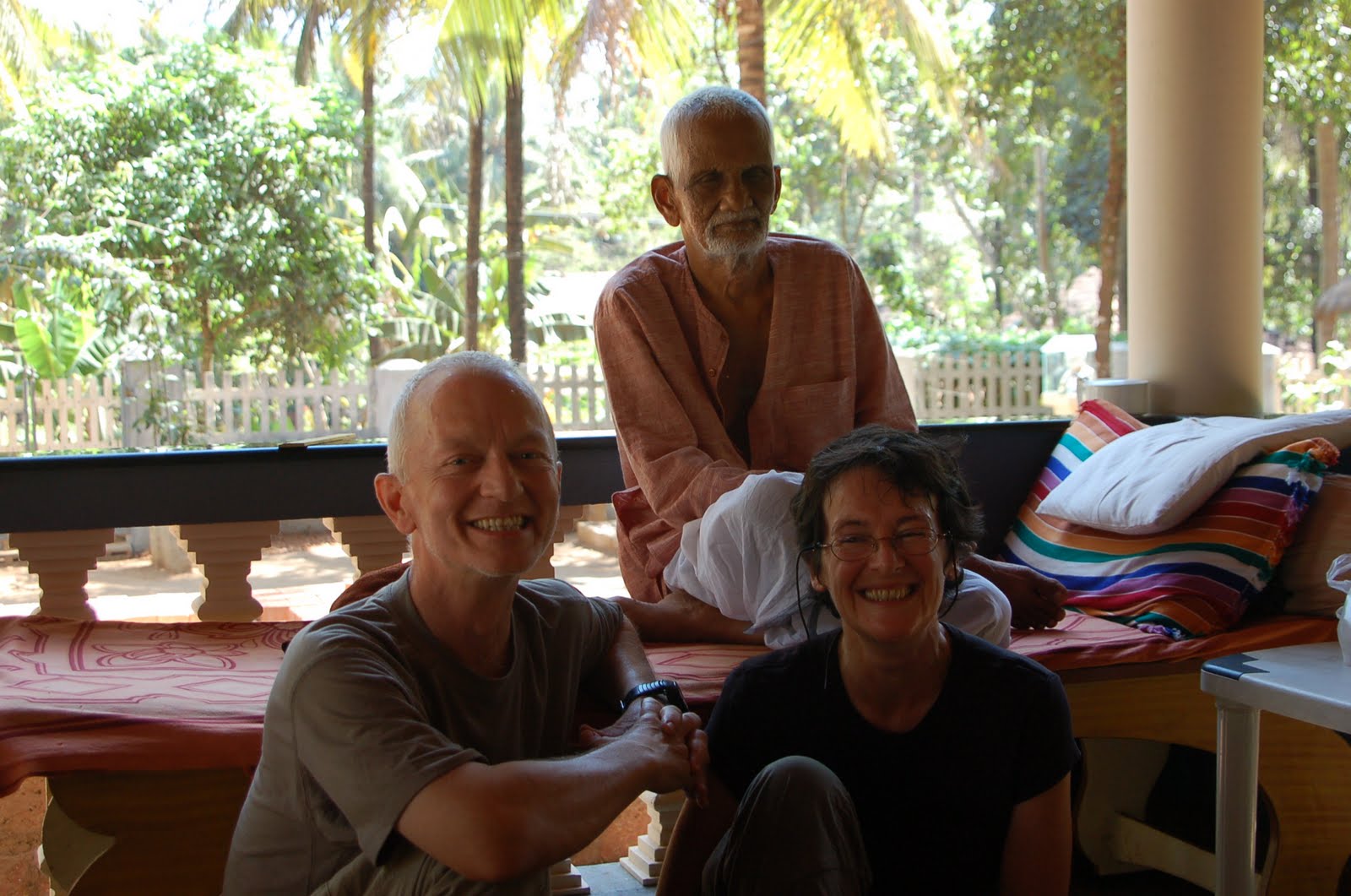
Ajja then asked if we had any questions. We said no. Purushottama’s question had dissolved some days before, but he did ask if he could take a photo of him. Ajja agreed. Someone took this photo of Purushottama and me with Ajja. You can see from the smiles it was a moment of profound bliss.
More bhajans were sung and then little cartons of ice-cream were distributed. Once more, the external sweetness combined with the inner sweetness of being in the loving presence of Ajja… no words.
Then it was time to go.
As we left Ajja’s ashram, I felt such a strong feeling that life would never be the same again! I felt as if I was walking in slow motion through thickened air. He had given us more than we could have ever imagined. Life was carrying me. One of the other people in the darshan arranged a rickshaw for us and ensured that the driver knew where to take us. We needed thirty rupees. I reached in my pocket and had the exact change. It may not sound like much, but it felt as if the whole of existence fitted together perfectly. Everywhere I looked I saw beauty, softness, kindness. Even when we arrived at the busy bus station, everything remained fresh, illuminated, gentle.
I had always wanted to clean Osho’s room and deeply regretted not being present when he left the body. Somehow this time with Ajja took care of those longings. Purushottama had never danced with Osho. He had been in Germany during that time at the Ranch. He had his opportunity with Ajja.
We caught the bus to Madikeri through the lush green hills of the coffee country, and then on to Bengaluru to visit U.G. Krishnamurti. We had the address from Thea. Unfortunately, the whole world wanted to stay in Bengaluru that night and we had a hard time finding somewhere to sleep. We had to resort to calling someone we had met at Ajja’s who was now in Bengaluru and had given us his phone number! He invited us to stay at his place. His wife and mother were there too. They were leaving for the UK early in the morning, so we left early too.
U. G. Krishnamurti
After finding a guesthouse, we made our way to the place where U.G. Krishnamurti was staying. Many people were gathered around a television in the living room, and eventually we spotted U.G. amongst them. They were watching videos of U.G.!
Purushottama had read some of U.G.’s books; I had not. He was very keen to meet him and was aware that U.G.’s age meant there might not be many more opportunities. We knew that U.G. had been part of the Theosophical Society as had J. Krishnamurti. (I’d met present-day members of the Theosophical Society in Amsterdam after the Ranch ended; I’d cleaned their houses. They were so lovely to me. I was still recovering from the shock of it all.)
We joined everyone else on the floor. The video ended and general conversation ensued between U.G. and his followers. Ingrid was there; she too had travelled to see U.G. from Ajja’s. She found herself sitting on the sofa next to U.G. Purushottama remembers that we tried to alert her to the fact that U.G. was not your typical Indian guru. We could see she was uncomfortable with the way U.G. spoke to some people, apparently harshly at times, and using the word “bitch” quite a bit while addressing a young Frenchwoman – it just rolled off her though – she remained in her still center. When Ingrid left, at Purushottama’s suggestion I took her place on the sofa next to U.G. It was lovely sitting there in his presence – I was somehow very much inside myself, quiet.
Purushottama’s experience of being with U.G.:
“First of all, there was the heightened sense of presence, the same presence that I have experienced with Osho, Jean Klein, the 16th Karmapa, J. Krishnamurti, and also with Ajja. That presence was at the core, at the center. If you came out of that center, you could get caught up in the whirlwind that blew around his words. He used language that could easily throw you off your center. And it was not just the words, but the energy had an appearance of anger at times, and yet if you stayed in the center, it was love. […]
“It was interesting to watch those who had spent a lot of time with U.G. They seemed to rest at the center. Others would get caught up in what he was saying. That can be seen on some U.G. forums where people actually believe what he was saying about J. Krishnamurti or Osho. To me, he was just shocking people out of their conditioning, but he also seemed cognizant of how far he could go without really hurting someone. He seemed sensitively outrageous. […]
“I was so happy that we had managed to meet U.G. before he left the planet. As it turned out, this was his last visit to Bangalore. When we bid him farewell, it was namaste, and I felt that we had connected with an old friend. The entire time he was so welcoming and loving in his unique way.” (Meetings with Two Remarkable Men)
Purushottama and I went for lunch with a Spanish sannyasin woman. She had translated many of Osho’s books into Spanish and was also a long-term friend of U.G. I have a vivid recollection – perhaps she asked Purushottama when we would be leaving – but when I heard him say, “The next day,” I had no shadow of the usual confusion, no wondering if it were the right time, just a sensation of total trust, not only in him but in existence. A dropping in and an opening up!
In the evening of the second day, we were all sitting in the living room with U.G. A young devotee was reading from a book he was writing about his experience of being with U.G. It became very still in the room. The active restless part of the mind had something to focus on, and being in U.G.’s presence we were all very settled within. I experienced a glimpse of the double-pointed arrow that Osho talks about not infrequently: somehow being in my interiority and at the same time aware of what was on the periphery. Another gift from the timeless presence of an awakened one.


L: U.G. Krishnamurti. R: Bhagavan Arabbi Nithyanandam, lovingly referred to as Ajja. B: This photo was taken during one of the two times that Ajja visited U.G. in Bangalore. There is quite an interesting story about how their lives were intermeshed in a mysterious way! (To read more about that see: Meetings with Two Remarkable Men.)
The young man we’d heard about, the one who had given our friends the information about Ajja and U.G. Krishnamurti, just happened to be visiting U.G. and staying in the same guest house as we were. We had dinner together. What a delightful person! Incidentally, his name was John Always, which seemed so incredibly apt for someone with such a notebook. He elaborated on his meeting with Ajja. He too was told to go the Meditation Hall. As he was sitting there, he experienced such intense anger that he couldn’t stay with it. In fact, he got his belongings and left the ashram. Ajja watched him leave from his porch and somehow, John knew it was all right; everything was as it should be.
We returned to India the following year, intending to visit Ajja and U.G. again. You really cannot step in the same river twice – as Heraclitus said so long ago. We arrived at Ajja’s ashram the day after he left the body.
During the last year of his life he had supervised the building of a beautiful structure to house his Samadhi. He was not cremated, but buried in the traditional lotus Samadhi position. On top of the marble tomb a granite block had been placed with a small hole in it just above Ajja’s head. We participated in the last day of the ceremonies, one of which was continuous chanting around the Samadhi. People took shifts. We chanted for several hours during the night.
Jaya, Jaya Ananda Nithyanandam
Jaya, Jaya Ananda Nithyanandam
Atmananda
Paramananda
Dharmananda
Nithyanandam
We also learned on our arrival that U.G., who happened to be in Italy, had fallen and was unable to get up. He had stopped eating and drinking. This happened on January 31. On February 1, Ajja had a stroke. We were told that when U.G. heard about Ajja he said, “I don’t want to breathe, I don’t want to eat, I don’t want to be in this body.”
“Ajja left his body on March 12. We later learned that U.G. left his body on March 22. No one understands the nature of this strange connection between Ajja and U.G. but it was a blessing to have met them both.” (Meetings with Two Remarkable Men)
Purushottama summed it up so perfectly.
References
- Kerala backwaters – Wikipedia: en.wikipedia.org
- History of Jews in Cochin: keralatourism.org/judaism
- Group of Monuments at Hampi, UNESCO World Heritage Centre: whc.unesco.org
- Hampi on Wikipedia: en.wikipedia.org
- Echoes of an Empire – The historic capital of the mighty Vijayanagara Kingdom, Hampi remains one of India’s most evocative sites of pilgrimage: remotelands.com
- Meetings with Two Remarkable Men – Sat Sangha Salon: o-meditation.com
Related articles
- A pilgrimage – Amido and Purushottama visit India in 2005 – a pilgrimage to places where masters and holy men have lived (Part 1)
- Osho and Kerala – A series of essays by Tarpan



Comments are closed.