

by S D Anugyan
To be realistic we do have to think in terms of a minimum of five dimensions, but let’s start with less and see how we get on:
Three dimensions
It took a lot of work but we managed. It’s big enough to house several people, it’s airtight, and should survive the extreme conditions of outer space.
Pluses: It’s recognisable as a spaceship, we all know what it is immediately we see it, and what it should be capable of doing.
Minuses: We neglected the fourth dimension of linear time so it can’t actually go anywhere, it just sits still and doesn’t move.
Four dimensions
Ah, at last we can move. Not only that, but physics equations work as they should, the laws of thermodynamics and Newton are obeyed. When we get really advanced we’ll develop the Einstein class of ships, and be able to go at a reasonable fraction of the speed of light to visit other planets in our solar system as well as some nearby stars.
Pluses: Still recognisable, but does so much more than the 3D prototype. For a start, it actually goes somewhere.
Minuses: Quite a lot of minuses actually. The Class 1 uses technology that damages the Earth’s atmosphere and requires everyone to look the other way while we do our thing. It also takes a very long time to get anywhere. Class 2, the Einstein Class, may be less damaging but the laws of relativity ensure that once the crew go anywhere interesting, by the time they return everyone they know will have died of old age. As a young student of mine – better at physics than spelling – once wrote, ‘gravity and excelleration both slow down time.’ With both classes of ship there is a definite sense of using space travel to evade any responsibility towards the home environment. A Type 1 civilisation according to the Kardashev scale, implies a certain responsibility to sorting out its own mess. We are not there yet. Still, assuming we are, we can endeavour towards creating higher dimensional craft:
Five dimensions
Now we’re talking. We have designed a craft capable of navigating an infinite ocean of timelessness. Consequently, responsibility for past and future actions has been taken. There are a number of options for an energy source, but the favoured tends to be zero point energy, derived from the space between atoms. As the physicist Richard Feynman put it, there is enough energy in a teaspoon of the stuff to burn up all the world’s oceans five times over. We’re now grown up enough that we don’t do stuff like that, and instead use our resources for benign ends. For example, we have slipped back in time on occasion to visit nuclear missile sites and render their systems inactive. It really annoyed a lot of people.
Pluses: The designs (classic flying saucer or cigar-shaped) still tend to be recognisable as sleek, curved and metallic, capable of moving in any direction instantaneously, and stopping suddenly. Because they are five-dimensional, the occupants are not subjected to horrendous g-forces with these accelerations, nor to time-dilation as with the Laws of Relativity. Gravity and acceleration no longer slow down time.
Minuses: Very few actually, the main one of which is actually quite subtle and that is reflected by the limited shape of the craft, implying rather a staid, rigid approach to discovering the mysteries of the universe. How can something of limitless wonder be represented adequately by what looks like a spaceship from a 1950s B movie?
Six Dimensions
Now we’re talking. We are no longer limited to any perceptions of form. Size is also negotiable, it is possible to get an entire craft with occupants into a drawing room if necessary, or be as large as a small town if we wish to make a grandiose statement. The trick is to build using wave-forms of material rather than particles. This means that witnesses will contradict each other as to what shape we are, photographs and film will be blurry and ambiguous, facts may appear nonsensical. A form may be decided upon – black triangles are a favourite – usually on departure from the mothership, but the sense of mystery will be paramount. Even the zero point drive or similar energy sources have become redundant, as within six dimensions all times and places throughout universes are contained within the ship itself – we don’t have to go anywhere, because we are already there.
Pluses: We are now representing the cosmos in a truer light, even using symbolism in order to impart something valuable – for example, the three lights at the corners of triangles, with one major one in the centre (the three lights often converging/blending into the fourth), being an ancient esoteric symbol embodying the three virtues of Wisdom, Power and Love, with the unnamed and unknowable Fourth combining all three. We ensured a crop circle of similar design appeared in the 1990s, concurrent with the Belgian ‘flying triangle’ sightings. We can also be completely ridiculous and contradictory, e.g. appearing as elves, or foreign invaders, or offering buckwheat pancakes to witnesses. Thus we also offer a reflection of humanity’s mysterious and mischievous self, something which defeats shallow logic.
Minuses: We are still operating within recognisable parameters, even to the point we get confused with contemporary military craft. There is a sort of tedium in this, it’s not much fun, nor is there much love. It’s all about technology and awe.
Seven dimensions
It is only fair to point out this level of spaceship design is not available to just anyone. You have to be invited first. This requires a maturity, a love and a care that only first starts to manifest in a Type 1 civilisation and doesn’t actually flower until Type 4 or later. However, assuming you have got that far (and you can do that overnight if you so wish), what happens next? You have already mastered travel between worlds and different realities.
Well, this is where we start to share less and less, because at this stage it is entirely up to you. You have become united with the universe and eternity enough so that anything you wish will be for the greater good, and not rooted in selfish wishes at the expense of others.
Mystics in your world have referred to what they call Imaginal, rather than just imaginary. This implies an intelligent application of imaginative faculties, way beyond mere fantasy or superficial desires. You have already used this to some extent with the five-dimensional craft, now it is time to go all the way, and design what you really want. What you really really want.
Pluses: So many, oh so very many, you are no longer limited by any time or form paradigms.
Minuses: Only one really, and that is that you still exist. More on this in the next, and final, stage on our journey today:
Eight dimensions
Eight-dimensional craft have been observed by humanity already. They often take the form of recognisable craft such as the black triangles. At times these craft are indistinguishable from the stars, their lights blending in perfectly when you gaze on them from below. Then they move and you see that the stars you thought you were looking at were actually lights on the machine. Or were they? Distant and near space have become indistinguishable from each other. Or in daylight a witness may be looking up at a clear sky and a craft appears right above them, then disappearing again just as easily.
The assumptions from these sightings have always been that the craft were using cloaking devices. This is not so. The occupants and the craft – the two are not actually separate – have realised the frailties of the ego, a gradual development from the fifth dimension onwards, and have the ability to actually disappear from existence. So when these craft disappear they are not going invisible, they simply do not exist. Thus, a tremendous truth has been comprehended and embodied, the troubles and challenges of earlier unformed manifestations of civilisation transcended.
There is more, there is always more, but that is enough for now. Congratulations. You have now built a spaceship in eight dimensions. That was easy, wasn’t it?
For S D Anugyan’s blog post on the recent Disclosure project: sdanugyan.com
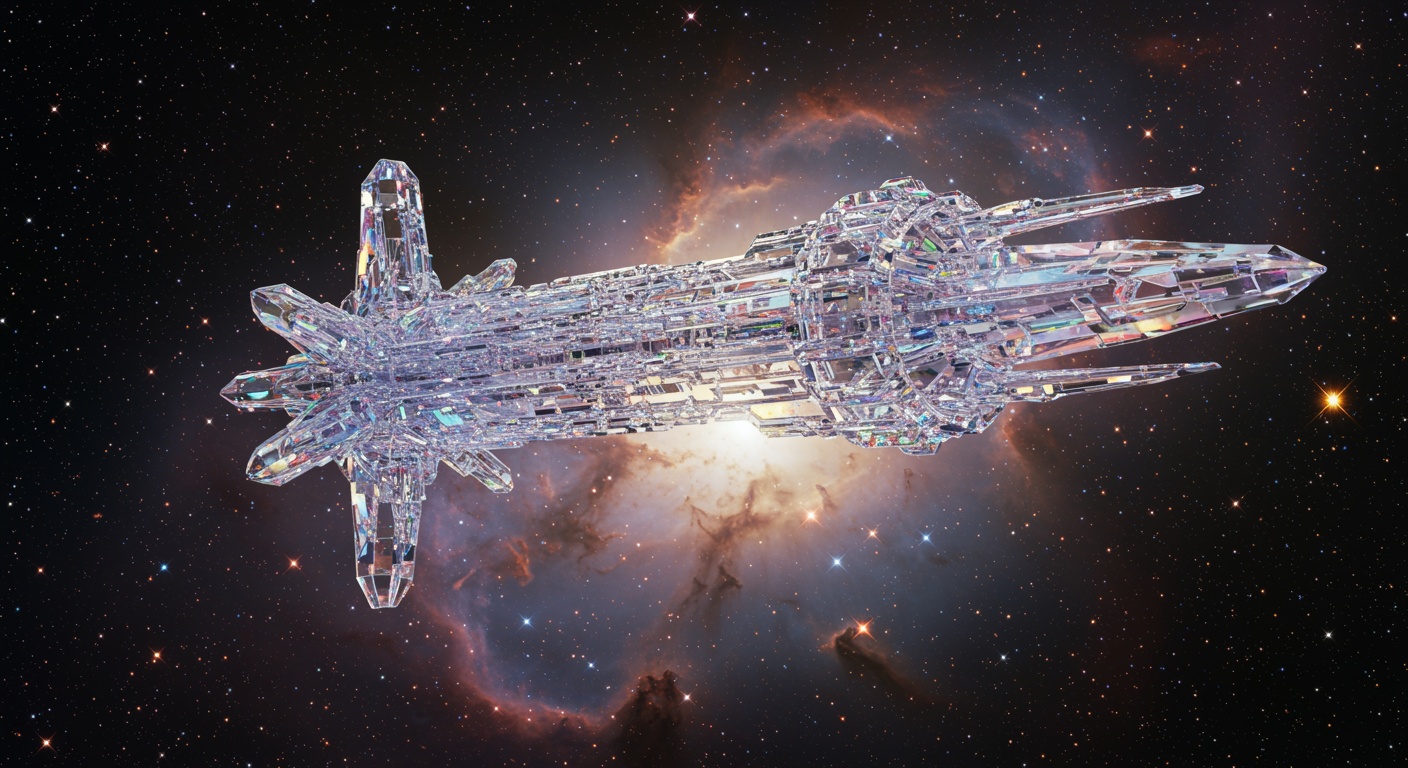
Featured image generated by an AI system, credit to shutterstock.com



Comments are closed.