

After years of research, conversations and visits to centres throughout Germany, historian Martin Papenheim’s Der tanzende Spiegel (The Dancing Mirror) has now been published
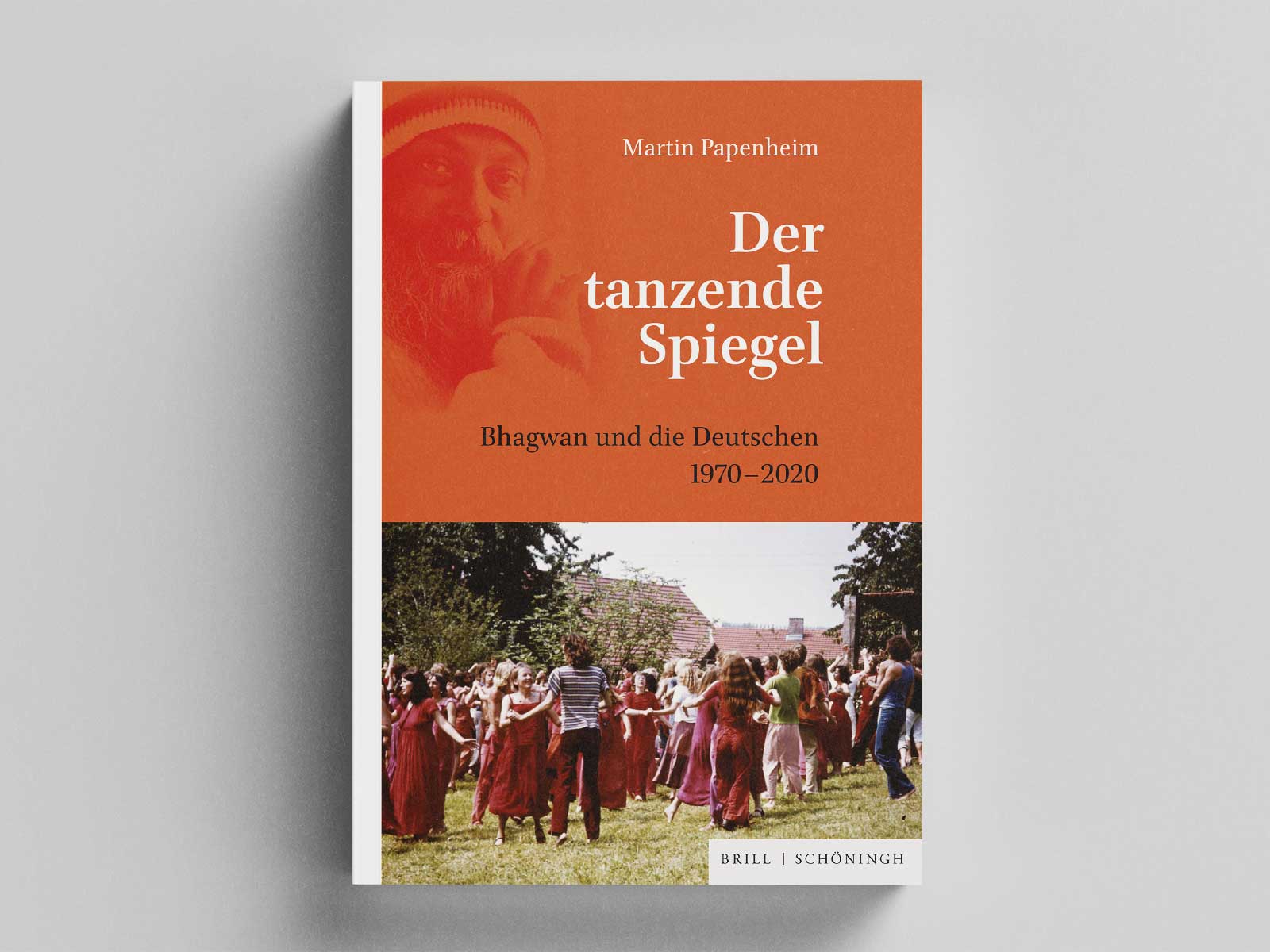
For many years, the story of Neo-Sannyas in Germany has lived primarily in personal memories, community archives and scattered publications. While individual aspects of Osho’s work, the Pune communes and Rajneeshpuram have received considerable attention, no historian had attempted to document the development of the movement in Germany – until now. Running to more than 400 pages, Der tanzende Spiegel – Bhagwan und die Deutschen 1970–2020 (The Dancing Mirror – Bhagwan and the Germans, 1970–2020), so far available only in German, fills that gap.
At its height around 1980, Germany was home to an estimated 30,000 sannyasins – around one third of Osho’s worldwide following. Hundreds lived in communes, meditation centres flourished across the country, and the movement became one of the most widely discussed religious and cultural phenomena of its time. Even after its organisational structures dissolved, its influence continued to shape therapeutic approaches, meditation communities and alternative lifestyles in Germany.
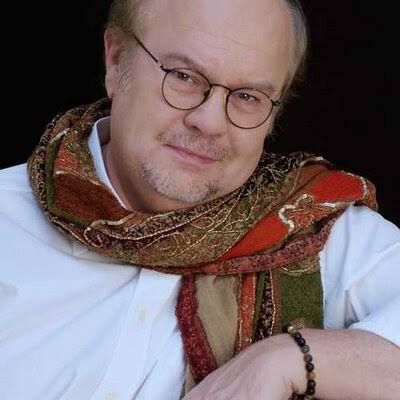 Prof. Dr. Martin Papenheim is a historian and scholar of religious studies at CERES (Centre for Religious Studies) at Ruhr University Bochum. His research focuses on historical semantics and iconography, European religious history (occultism and freemasonry) and, more recently, on the development of new religious movements. The book grew out of a research project supported by the German Research Foundation (DFG) between 2014 and 2018, allowing him to devote several years to gathering material from archives and contemporary witnesses.
What distinguishes this work is both its academic scope and the way it was researched. Rather than relying solely on published sources, Papenheim travelled throughout Germany, visited centres, met many of the first generation of sannyasins and conducted extensive personal interviews. He also spent time in Pune and explored archival material, including publications from the Osho Times. According to people who met him during his research, he approached the subject with genuine curiosity, warmth and respect.
That openness is reflected in the book’s preface, which starts with:
“Anyone conducting research into contemporary history relies on information from eyewitnesses and those directly involved. Numerous (former) sannyasins have actively supported my research into the German Neo-Sannyas movement. I have never encountered hostile rejection or anything resembling a ‘cult mentality’. Instead I was met with great openness and friendliness. Without this support, this project could not have been carried out. The eyewitnesses I spoke to were not only very willing to provide information, but also – often spontaneously – made a wealth of contemporary literature and visual material available to me.” [tr. ON]
At a public conversation at UTA Institute in Cologne in 2023 – two years before the book came out – Papenheim spoke about how the project came about and what he found along the way:
“I was interested in intercultural communication and translation processes between the West and the East. This eventually led to my study of the Bhagwan movement. The reason for this was, on the one hand, that it was the largest new religious movement of its kind – apart from Maharishi Mahesh Yogi, whose movement, however, did not have a comparable organisation with its own centres. On the other hand, the Bhagwan movement had the strongest media presence of its time and was, at the same time, the most controversial. For that reason alone, it was an extremely interesting subject for research. […]
“Although a great deal has been written about Osho and the well-known stories such as Rajneeshpuram, there is still no history of the sannyas movement in Germany. There is no account of what it was actually like here in this country. For me, as a historian, this was of course a stroke of luck – a fascinating research topic. What more could one ask for?
“Added to this was the fact that the sannyasins were extremely cooperative, which is by no means a given. They showed no inclination whatsoever to shut themselves off or to be suspicious of a researcher. My first port of call was Cologne. There I met Anandi, who was working for the Osho Times at the time. I also met Ramateertha and a few others there. I even took part in a course once. So, Cologne was my first stop. After that, I travelled through West Germany and on to Berlin, visiting many of the first sannyasins. […]
“The book, which is now finally nearing completion, is therefore also a thank-you to the sannyasins themselves. Without their help, this book would never have been possible.”
During the Q&A session, Papenheim answers a personal question with:
“For me, exploring the sannyas movement is also a journey into my own past – albeit a past that is not my own personal history. […]
“As a researcher, I must, of course, maintain a certain distance from my subject of research. […] But I can say that, for me, this work has also become a journey into my own spirituality.” [tr. ON]
The book’s blurb and early reviews highlight one particular strength: it places the German sannyas movement within the broader social and cultural changes of the 1970s and 1980s. Rather than treating it as an isolated phenomenon, Papenheim shows how it emerged alongside movements that questioned traditional authority, searched for new forms of community and looked beyond the conventions of family, church and established structures. Meditation, therapy, creativity and communal living became part of a wider exploration that characterised an entire generation – making the German sannyas movement not just an imported spiritual current from India, but a distinctive expression of the cultural transformation taking place in post-war Germany.
Papenheim follows this development through three broad phases, notes the scholarly review by Pascal Eitler published by H-Soz-Kult. “He essentially distinguishes between three phases of development: a phase of formation and establishment lasting until the early 1980s (‘The Dream of a New Life’), a phase of peak activity and restructuring lasting until the middle of the decade (‘Work on the City of the Future’), and finally a phase of gradual dissolution (‘Productive Fragments’).”
For the German-speaking readers of Osho News, the book offers an unusual opportunity to see familiar experiences from a wider historical perspective. Many will recognise places, events and even friends within its pages. At the same time, they may discover how those individual stories formed part of a much broader cultural movement that helped shape spiritual life in Germany for half a century.
Perhaps the greatest contribution of Der tanzende Spiegel is that it preserves a chapter of history that might otherwise gradually disappear. The first generation of sannyasins is now reaching an age at which memories, photographs, letters and personal recollections become invaluable historical sources. By gathering these voices together with documentary evidence, Papenheim seems to have created a record that will remain available both to future researchers and to those who lived through the events.
The title Der tanzende Spiegel is itself intriguing. Readers familiar with Osho’s teaching may hear echoes of two central themes: the joy of celebration and dance on the one hand, and the mirror as an image of self-awareness and inner inquiry on the other. Together they evoke what Osho often described as Zorba the Buddha – the fully human being who embraces life in all its richness while remaining conscious. Whether this association also reflects the author’s intention is a question he may want to answer himself.
Der tanzende Spiegel – Bhagwan und die Deutschen 1970–2020
Martin Papenheim
Publisher: Brill | Schöningh, 2025
Pages: 403
Language: German
ISBN: 978-3-506-79689-9
brill.com – kulturkaufhaus.de – zvab.com – amazon.de
Sources and links
- Reader’s review on Dussman (in German): kulturkaufhaus.de – (Translation PDF)
- Introduction of the book on Ruhr Universitaet Bochum’s website, authored by Dominik Greifenberg (in English): ruhr-uni-bochum.de
- Review for H-Soz-Kult by Pascal Eitler, Centre for Contemporary History in Hamburg (in German): hsozkult.de – (Translation PDF)
- Introduction on Amazon (in German): amazon.de – (Translation PDF)
- Osho und Sannyas – gestern und heute – 2023 interview at UTA Institute Cologne (Papenheim and Ramateertha, moderated by Ishu) (in German): youtube.com
- Martin Papenheim’s Bio on Wikipedia (in German): de.wikipedia.org


Comments are closed.