

The smartphone, of all things, is supposed to help with meditation? This month, an experiment gets under way that approaches a contradiction of our time in earnest and turns it into research, writes Dwariko Pfeifer
We know the scene: someone sits on a cushion with closed eyes, seeking stillness, and beside them… the display lights up. A notification, a vibration, and the peace is gone. The smartphone is seen as meditation’s enemy, a machine of distraction that pulls us out of the present moment many times a day.
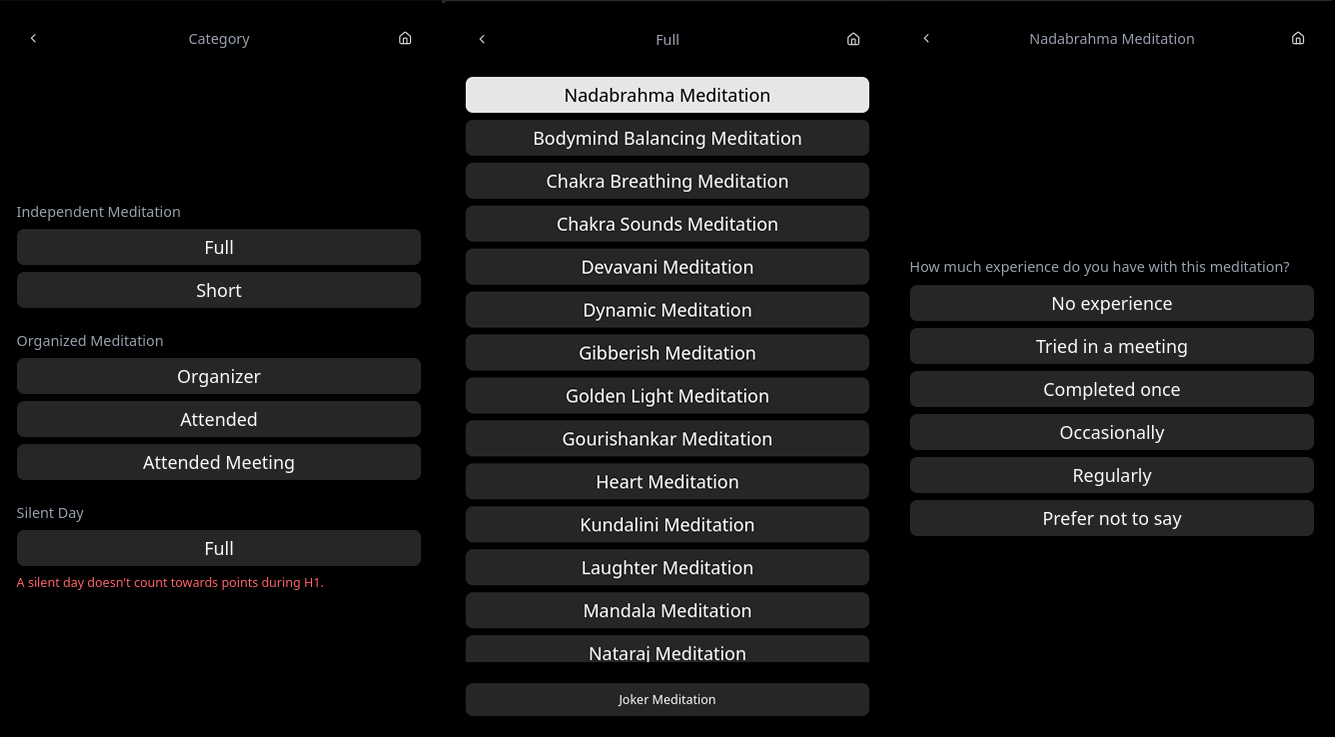
And yet the newest tool for meditation is – an app. Permamedi, created by the association Perma – Verein für nachhaltige Naturlebensräume (Association for Sustainable Natural Habitats; ZVR 1644988734), isn’t meant to be yet another wellness application with forest sounds. The web app wants to do justice to two things: the person who lives with a device in their hand anyway, and the age-old question of what actually happens inside a person when they meditate – day after day.
The Problem with Memory
Anyone wishing to understand meditation scientifically faces a mundane yet persistent problem: memory is unreliable. Until now, students on meditation courses have kept logs, usually retrospectively, sometimes weeks later. When exactly did they meditate? For how long, really? At home or in the lecture theatre, alone or in a group? Dates were missing, rounds of corrections took up researchers’ time, and the data remained inaccurate.
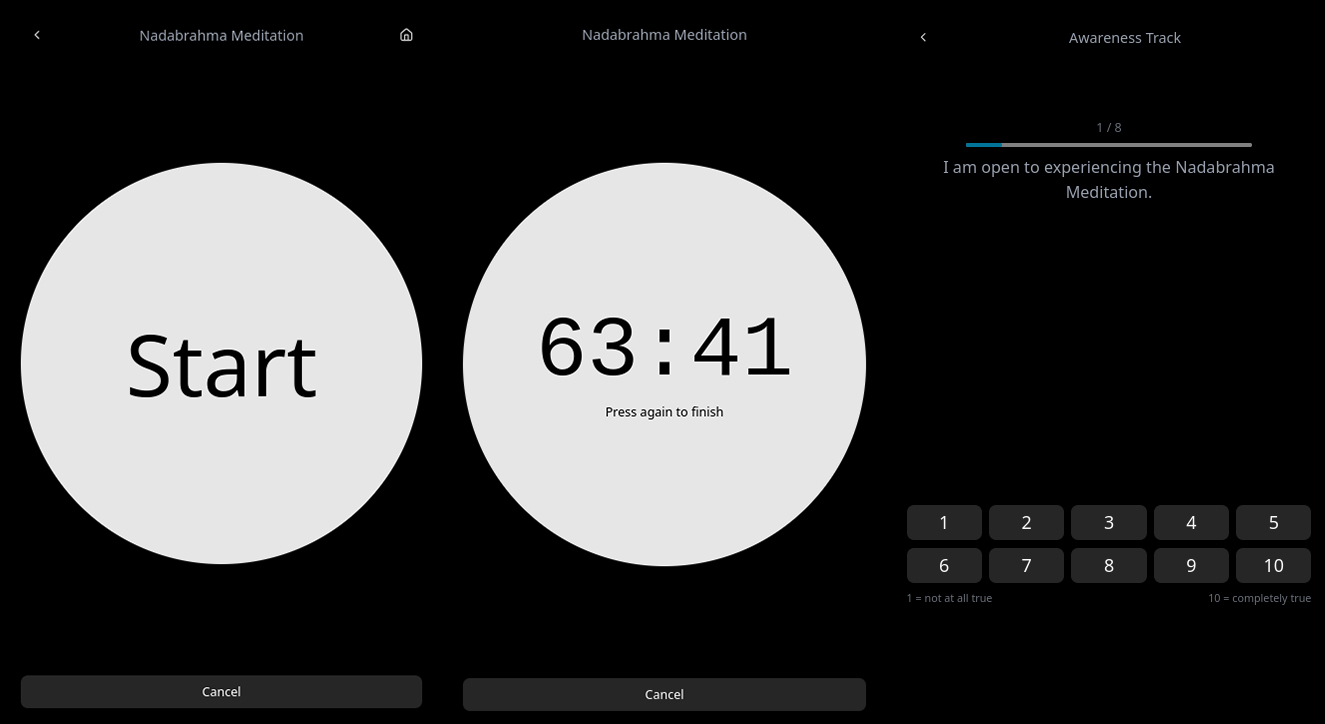
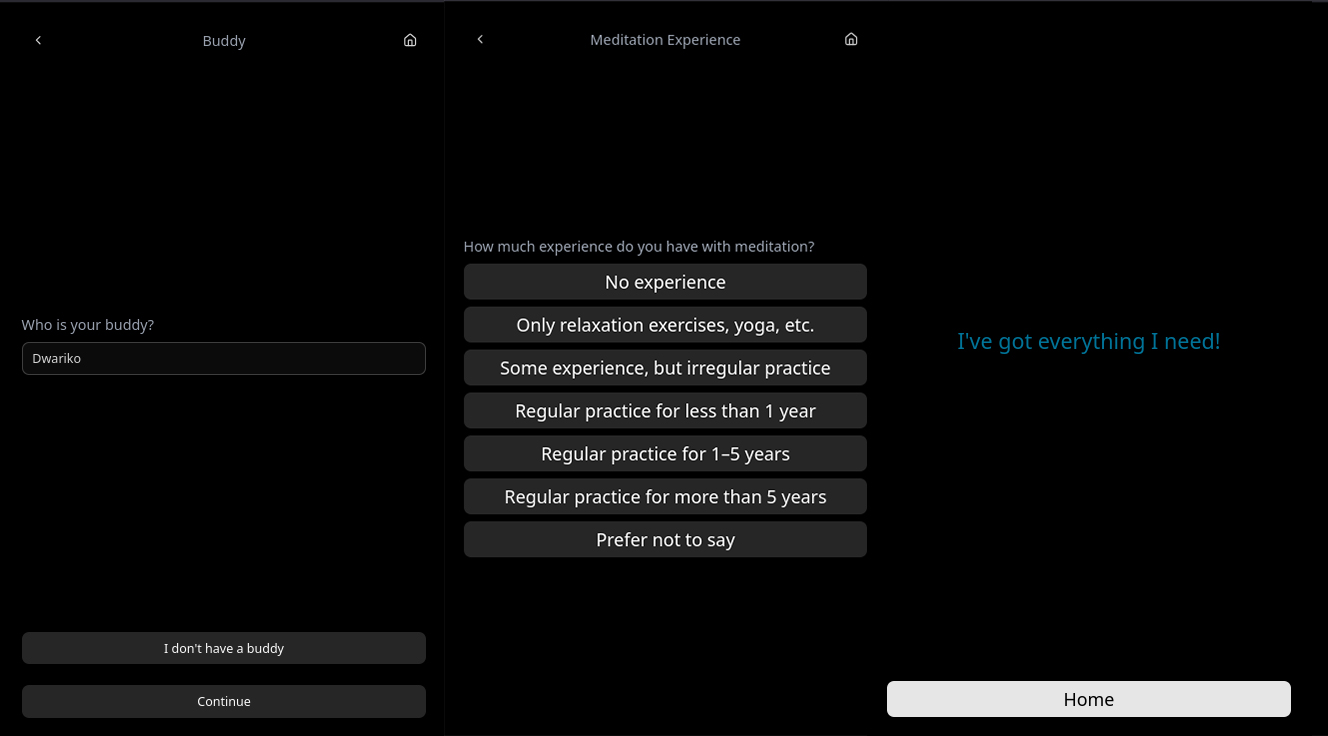
Permamedi turns this on its head. Meditation and documentation become a single process. You choose a meditation, start the timer, meditate and end the session. At that very moment, whilst the experience is still fresh, only a few questions pop up. First comes a diary question chosen by the participant. Then: Were you alone? Were there any disturbances? The app picks up details such as the current time and asks only for information it doesn’t already have. So the retrospective estimate becomes a real timestamp; the vague memory becomes an immediate perception.
Zen Design Against the Noise
The contradiction remains, though: how do you stop the app itself from becoming a disturbance?
The answer lies in reduction: the interface deliberately follows a Zen style, with few steps, clear colours and no distractions. The transition out of silence shouldn’t be interrupted by an overloaded menu. The device becomes a threshold instead of a vortex.
Christopher Niravo Conrad, who tried out the app in the pretest phase in August 2026, describes it like this: ‘From a user’s perspective, the app has absolutely won me over. […] It really is a wonderful tool for personal meditation. The introductory texts set the mood beautifully, and the user interface is brilliant.’
Perhaps that’s the real point: if the smartphone is there anyway – and it always is – it can just as well become a reminder of silence rather than an escape from it.
Meditation for the New Man
The context in which Permamedi is being used is remarkable. Since 2023, the course Awareness and Meditation (AuM) has been offered at a technical university for prospective engineers, computer scientists and architects. For the winter semester there are more than 60 enrolments, and the course is again fully booked.
Meditations are offered in a variety of formats – short and long, active and passive. Osho’s Active Meditations, the full-length meditations of one hour, are particularly popular with the students. These aren’t silent sitting meditations in the traditional sense, but methods specifically developed for modern, restless people: shaking, dancing, breathing, humming, laughing, gibberish – and only then comes the silence. Dynamic, Kundalini, Nataraj, Whirling, Gibberish, as well as Vipassana and Zazen are all featured in the app’s catalogue. But the numerous short sessions are also popular, as they can be slotted in between lectures and lab sessions.
It’s an approach that doesn’t want to pull people out of their present, but meets them where they are: stressed, connected, full of energy that first needs to be released. The app fits this logic as a tool for a generation that learns meditation not in a monastery but in everyday student life. Then there is something very old: community. The students practise with buddies and in sanghas – couples or small groups who carry and support one another and share their experiences. Regular meetings accompany each person’s individual practice. The technology doesn’t replace this community; rather, it reveals whether and how it is having an effect.
21 Days Under the Microscope
The study is scientifically designed by Dr Dwariko M. Pfeifer. She is a cooperation partner of the AuM course and has been researching Active Meditations since 2015. On Dynamic Meditation alone she has studied 256 participants, and on Kundalini Meditation 609.
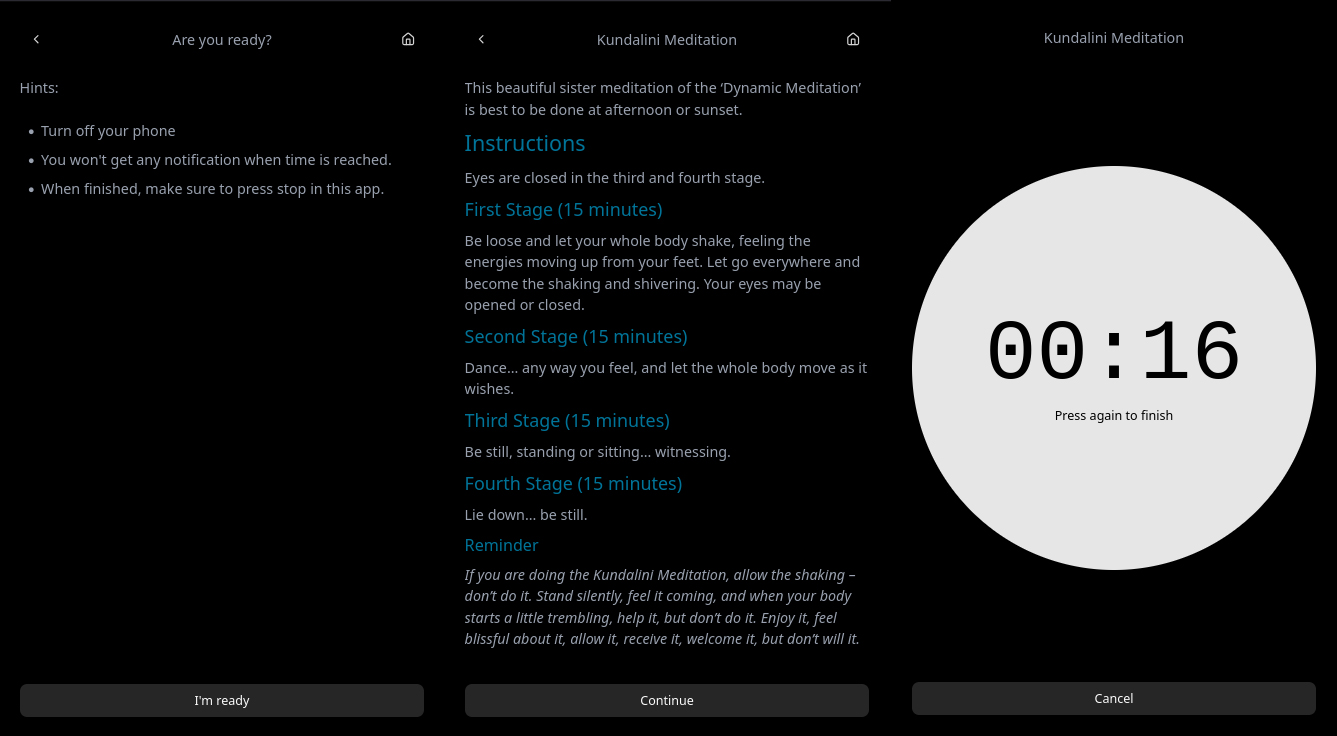
In the winter semester of 2026, the focus will be on three 21-day processes: Kundalini with shaking and dancing, Nadabrahma with humming, sound and slow movements, and Devavani with voice and movement. Three very different paths – and the question is whether they also have different effects on the inside.
Every day during the 21 days, a perception questionnaire – the Awareness Track – records how the experience changes. This is supplemented by data automatically collected by the app and a meditation diary. In this way, the entire journey becomes visible for the first time, not just the beginning and the end: When do people actually meditate? When do they give up, and what brings them back?
But… the app is only half of the story. The data, combined with the diaries – at technical universities usually called ‘logs’ (Protokolle) – don’t simply end up anonymously in a database. If the student wishes, Dwariko Pfeifer reads every single one and replies personally to each of them. The machine collects the timestamps, but a human being responds to the experience. Perhaps that is the real resolution of the contradiction: technology creates room so that human connection finds space again.
The researchers call this ‘process research’. One could also say: for the first time, the focus is on the journey itself rather than merely on the goal.
A Tool Sustained by Idealism
The figures behind the project are astonishingly modest. Phase I was budgeted at around €6,500 and was made possible only through a great deal of voluntary work, among others from the sannyas community, and through funding from the Sammasati Foundation in Cologne (sammasati-stiftung.de).
Phase II, from October 2026 to February 2027, is estimated to cost around €8,600: more meditations, more questionnaires, and later on versions for Android and iOS, as well as a chat for reminders, buddy exchange and invitations to meditate together.
The vision reaches even further. In the long term the platform is to be expanded so that it can reach many more people and enable comparative studies, for example, across several universities. But these visions need servers. The running infrastructure costs of the sponsoring association Perma come to at least €1,300 a month, which is more than a project-based grant can sustain in the long term. The project is therefore looking for further sponsors and, in particular, members who can provide annual support. Anyone wishing to support the project by becoming a member can do so easily at onboarding.perma.health
The Paradox as Method
That leaves us still with the question: isn’t a meditation app a contradiction in itself?
Perhaps it is. But perhaps that is precisely its value. Modern people won’t put their smartphones away just because they’re advised to. They could, however, learn to use them differently: as an alarm clock for mindfulness, as a diary of their inner journey, and as a silent instrument that asks just a few questions for self-reflection after the meditation.
Permamedi is an attempt to put technology at the service of consciousness rather than play it off against it, with a human being at the other end who is listening. Whether this succeeds will become apparent – measurably, day by day.
App (membership required): www.permamedi.at
Translation from German by Osho News
Related articles
- Osho Mystic Rose: A study of participants’ experiences – Swami Vee, who was commissioned by Osho Dham in New Delhi to evaluate the long-term impact of Mystic Rose, shares his findings (July 2026)
- PermaplanT – Plan your garden and join a community – An Austrian software developer is building an app to help people plan permaculture gardens in harmony with nature – and grow a community around it (April 2026)



Comments are closed.