

Madhuri reviews Dr Chris van Tulleken’s book, subtitled ‘Why Do We All Eat Stuff That Isn’t Food… and Why Can’t We Stop?’
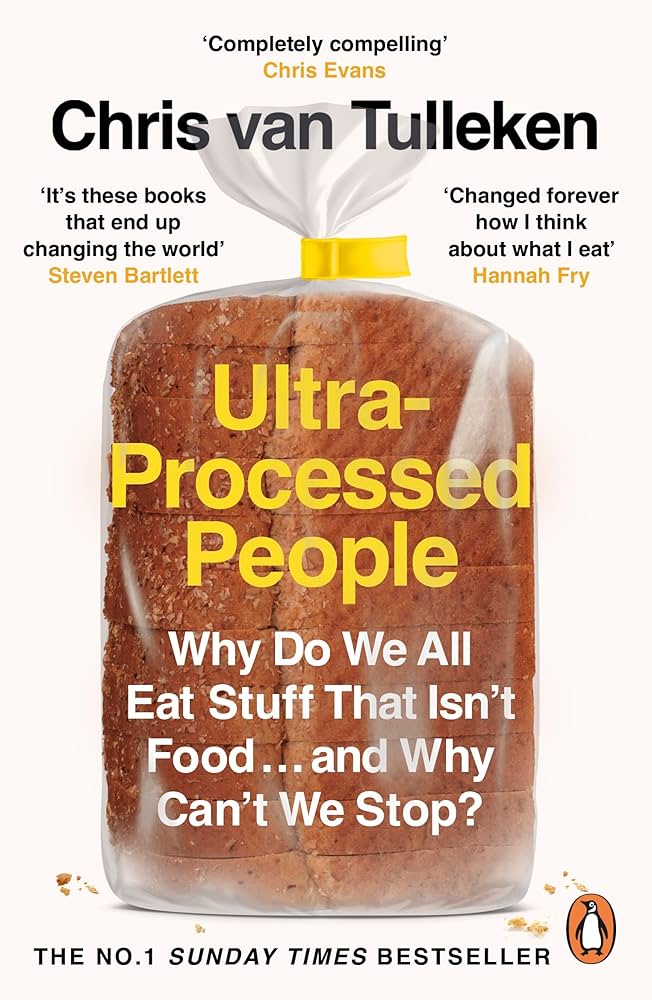 Ultra-Processed People
Why Do We All Eat Stuff That Isn’t Food… and Why Can’t We Stop?
by Dr Chris van Tulleken
Cornerstone, 2024, 406 pages
ISBN: 9781529900057
Hardcover, paperback, Kindle and audiobook: amazon.co.uk – foyles.co.uk – waterstones.com – hatchards.co.uk – pigeonbooks.co.uk
Audiobook: audible.co.uk
This book is so fascinating – and so vitally important – that I fear I won’t be able to do justice to it in a small review. I read through it during my dinner times, underlining copiously and turning down page-corners to mark especially-arresting bits. I was so glad, each evening, that what I was eating was real food: broccoli, brown rice, quinoa, salad, etc; organic, cooked from scratch by me.
When I go into the Morrisons down the road from my flat, to get loo paper and kitchen towels, a refrain tends to go through my head: “This doesn’t strike me as being exactly food.” This is because, it turns out, those shelves and shelves full of Pringles and candies and other snack stuffs – which is mostly what the shop sells, besides alcohol, bad news, and ready-made sandwiches and frozen ‘meals’ – are not precisely food; they are ‘food-like substances’.
It works like this: governments subsidise the growing of a few crops: corn, soya, wheat. Rainforests far away are burnt down to make room to grow the crops. The subsequent yields are thus cheap, and scientists in labs run by huge international food conglomerates tinker with an infinite number of unregulated, untested chemicals to try to make ‘pretend-food’ for you out of mashed, fractionated, isolated, etc, plants (and also some animals, likewise exploitatively reared). The resultant gloop is extruded into shapes, and dosed with more chemicals to add exciting colours and tastes. The additives which make it taste like anything – the word ‘flavour’ denotes this on the label – trick your body like this: flavour, in real food, signals nutrition. Your mouth tastes the taste, and your body primes itself to receive nutrition. But the nutrition never arrives. The body is confused – 200,000 years of human evolution never prepared it for this – so it eats more, because maybe the next mouthful will have the nutrition in it?
But it never comes… and after you’ve eaten the whole package, you feel weird and bad… and still hungry. So you eat something else too. And gain weight.
Artificial sweeteners tell your body that energy will arrive – and it doesn’t. So you keep drinking, your pancreas confused, insulin doing weird things. (And 65% of British babies are given sugar-free sodas!)
Government nutrition boards are heavily infiltrated and funded by Coca Cola, Nestlé, etc. So they are meaningless. A few governments are taking steps: Chile, with a tremendous obesity problem, requires warning labels on junk food, or UPF: Ultra-Processed Food. This has definitely helped drive sales down.
It seems that food doesn’t like being messed with too much – a label might say such-and-such amount of protein, but if the protein is in the form of soya isolates, the body takes offense. The whole body likes whole food. (I was dismayed to read that even blitzing fruit in a smoothie makes blood sugar spike, as blood sugar does not with a plain apple or peach.)
And get this: Nestlé and other big companies target poor countries (the rich ones being already saturated.) All across Africa and South America Nestlé has deliberately addicted poor people to its UPF snacks and baby formulas (which formulas poor people then water down, resulting in infant deaths from bad water). Fake ‘nurses’ go around handing out free formula, or sell it cheap; as soon as the mother stops lactating the price goes up. Traditional foods come to be regarded as old-fashioned. Everybody becomes sick and obese. (The author even went to the Amazon to witness first-hand the damage done there by Nestlé.)
The author himself, an NHS doctor, in the course of the book goes from being addicted to UPF to being abstinent. The first edition of the book made a big splash, whereupon junk food companies offered him huge amounts of money to give talks to their employees… with contracts specifying that he could not say bad things about their products! He not only refused, of course, but he busts them in the final Afterword.
Some interesting points:
· The author has been involved in studies on infant formulas, and speaks a lot about the subject. Basically, for a healthy baby, if you can possibly manage it, breastfeed! The statistics are very, very clear – if the formula-fed baby survives, many points about his health will probably be worse long-term.
· The first UPF was created during WWII by Nazis: fake butter was made from paraffin – a coal industry by-product. Faux butter taste was added via diacetyl (still used in microwave popcorn!). The Nazis were so thrilled that they could now feed this stuff to their submarine crews (whose life expectancies in any case were 60 days from time of boarding) that they granted the half-Jewish scientist who invented the stuff full Aryan status. It was of course tested on concentration camp victims. Dogs refused to eat it.
The Brits found the factory right after the war; a fat sausage of the fake butter was sticking out of a machine. They thought the stuff was great.
· Our bodies get accustomed to our cultural foods before birth! If a cultural food is cola, the growing child will then know which cola is the right one!
· We need these things called ‘micronutrients.’ Processing removes chemical complexity. Micronutrients are way more beneficial embedded in a whole food than they are in supplement form. “Whole foods contain thousands more molecules than manufacturers add back in, and it is these molecules’ more subtle health effects that could be responsible for the well-established benefits of eating whole food: protection against cancers, heart disease, dementia, and early death.” In fact, consuming vitamins and supplements can sometimes be immensely detrimental.
· In the States, big food companies effectively are unregulated – they can create and sell whatever they like. And the companies are often frankly evil: DuPont knew that the ‘forever chemical’ PFOA, used in Teflon, was causing birth defects in its own employees’ babies, but it went on dumping hundreds of thousands of pounds of it into the Ohio river. Litigation just caused the company to create other companies it could offload the litigation onto, and then those secondary companies could declare bankruptcy. (This is a popular trick among corporations.)
· Preservatives, xanthan gum (which is bacterial slime), other gums… mess with our microbiome, the bacteria in our gut, to cause ‘leaky gut’ where bacteria enter the bloodstream and the gut is inflamed. (Yes, the book goes down through the list of additives that might be in your UPF – and they are pretty much all bad.)
· One ‘food’ company argued in court that its breakfast cereal should have a lower sugar rating “because everybody puts milk on it, and with the milk each spoonful is less sweet.”
· UPF production also adds significantly to global warming.
 At the end the author – citing many valiant experts he has met – lays out a plan for a better global food system, and better government oversight, completely divorced from the UPF industry funding. “The relationship cannot be one of partnership.” It must be adversarial. The companies are here to make money, not help kids be healthy, no matter what BS they put on their websites.
I had not realised just how reliant people had become on things like ‘ready meals’, but it seems that many people don’t really cook any more. I have certainly wondered how anybody could get enough nutrition if they only shopped at the Morrisons (I think it’s a special ‘poor people’s’ Morrisons). There are only a very few poor old shrink-wrapped vegetables and fruits there, shipped from well-sprayed greenhouses in Spain manned by desperate Moroccan slaves. Nor could anyone grow their own veg in this estate – gardens are tiny strips, perimeters sprayed with herbicides by the landlord. And it’s so easy to just nuke a square of frozen shepherd’s pie, I guess… with 52 ingredients in it, maybe 4 of which you’d see in a cookbook.
Something is very, very wrong.
Dr Chris van Tulleken is an infectious disease doctor at University College London Hospitals and Associate Professor of Infection and Immunity at UCL. en.wikipedia.org


Comments are closed.