

Phoebe’s new series, Nuggets, will be a reminder of the wisdom found in Osho’s books, so needed in our digital age
On most mornings before I start the day I like to lie in bed and read a chapter in an Osho book. I’ve accumulated a library of them over the years starting with the earliest that were acquired in the 1970’s, and returned to many more than once. I’ve found that, when one re-reads one of his books after some years of life experience, one brings to it a deeper understanding of the wisdom it contains. So I hope this series will attract readers to return to, or buy hard copies of Osho’s books. In this digital age where we tend to spend too much time reading things online, we can miss the felt experience of holding a book in our hands, turning the pages, and pausing to deeply savour its nuggets of wisdom.
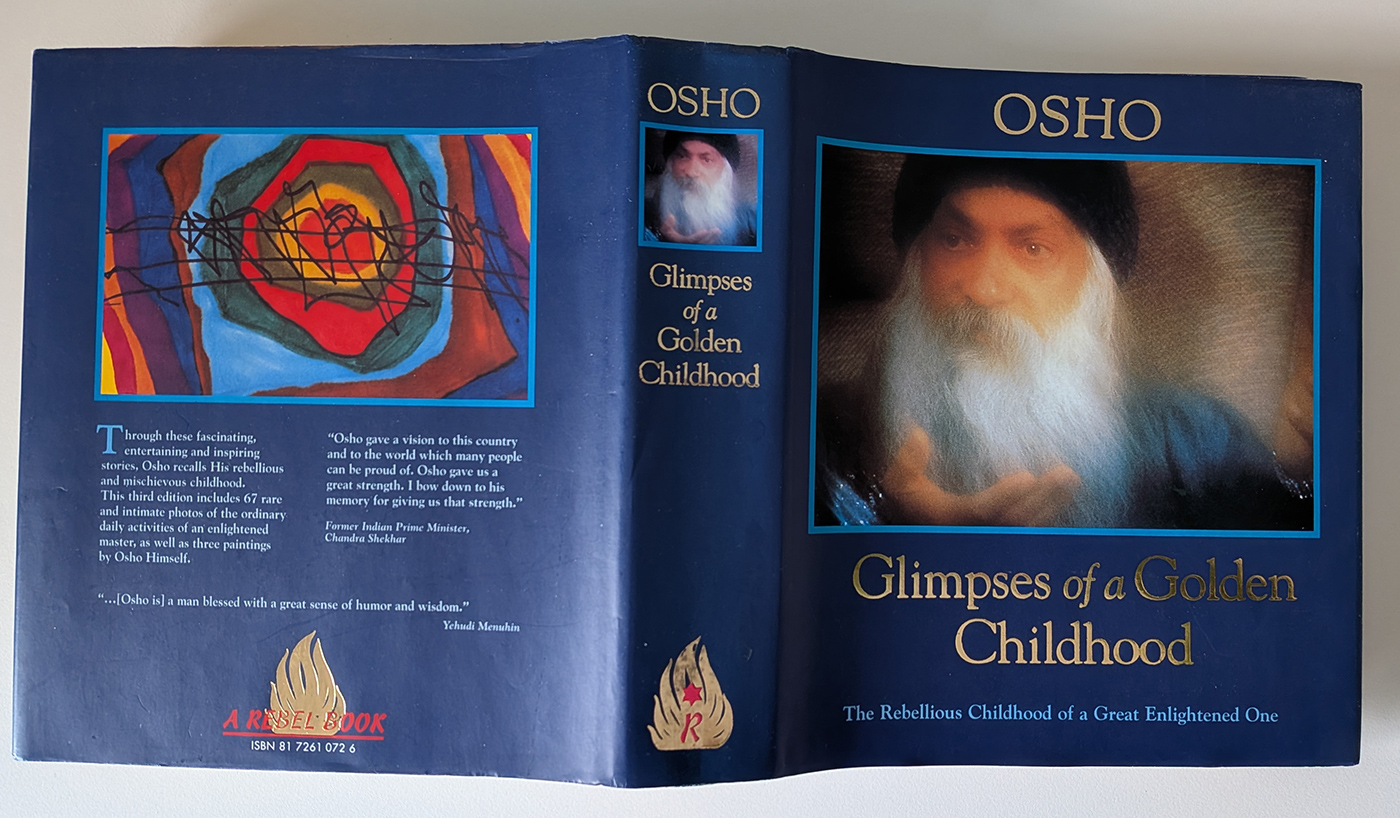 I have chosen a very special book for the first one in this new series of essays in which I’ll feature some of my most unforgettable Osho books – his ‘Glimpses of a Golden Childhood’. It’s an autobiographical account of Osho’s childhood and youth that he himself dictated during 50 sessions in the dental chair while his dentist, Swami Devageet, took notes.
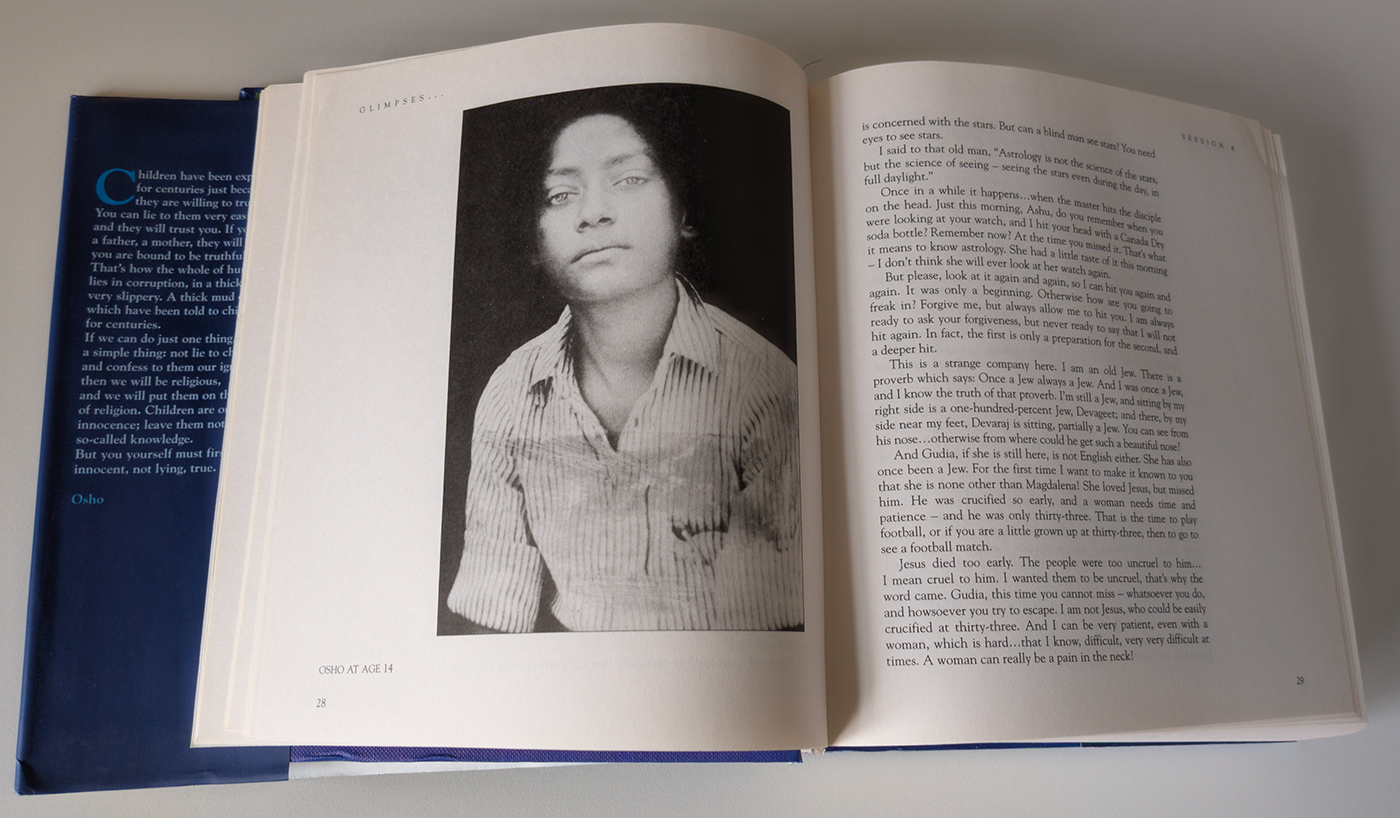
My treasured copy is from a beautiful hard-cover edition published by the Rebel Publishing House in Cologne, which includes some rare photos of the young Osho that few have seen or know exist. Among them is a striking picture of him as a fourteen-year-old that pulls at my heart strings each time I look at it. There’s such a softness and vulnerability in his physical demeanour and such a depth of compassionate knowing in his eyes that together make this photo unforgettable for me.
It also stands out as it seems to be in direct contrast with the impression of Osho as a young child and teenager created by the book as a whole, which contains many tales of the young Osho as a rebellious mischief-maker. He loves to wind up pompous authority figures through arguing with them till they lose their temper. For example, I particularly enjoyed the scene where he exposes a popular guru in front of his band of followers. This enthroned Swami became so worked up by Osho arguing with him that he totally lost his cool, and revealed the unenlightened mess behind the façade.
How wonderful to experience Osho as a small child acting like a seasoned Zen Master!
Osho’s golden childhood began as the firstborn of a young, quite ordinary Jain couple who lived in a small town in central India, where they ran a family business. With so much responsibility, they had no time for child-rearing, so they gave Osho to his maternal grandparents, who were childless, to bring him up. The couple lived some distance away in the countryside, where they owned a large estate with fields, woods, and a lake.
It turned out to be an ideal arrangement for Osho as he tells us that they both loved him dearly and he loved them dearly in return. His grandmother, who he called ‘Nani’, was an unusually emancipated woman for the India of those days. She was also physically beautiful, strong and wise. Above all she trusted Osho from a very young age to wander alone in the fields and woods all day, playing at the lake and only returning home in the evening. Thus, because of Nani’s tolerance, the normal restrictions of a young child’s upbringing were not imposed on Osho who was given the freedom to bring himself up!
The crunch came, however, when Osho reached school age and was summoned to attend the first class at the local primary school. The man who taught this beginners’ class, who they called Kantor Master, was extremely intimidating. To begin with, Osho tells us, he looked scary as he had a very ugly face and only one eye. His nature was such that he could not tolerate resistance of any kind from anybody, and would become violent if he was disobeyed. Osho, who must have been only five years old, was not intimidated and started arguing with him in front of the class.
He flew into such a violent rage that the headmaster was hurriedly brought in to intervene. But, as Osho tells us, he was also terrified of Kantor Master and was therefore incapable of managing the situation. As a consequence of this incident, the school authorities were informed. The Kantor Master lost his job, which ended his teaching career, while the headmaster, who had mismanaged the situation, was transferred to another school.
That was Osho’s first day at school and when he arrived on the second day he found a transformation. The children were dancing with joy. They told him that if Kantor Master dies they would distribute sweets for the whole town and burn thousands of candles in their houses!
According to Indian custom, when Osho was born an astrologer was given the task of drawing up a birth chart for him. What resulted must have been a shock for his parents as the astrologer pronounced that it was almost certain he’d die when he was twenty-one. Moreover, every seven years he’d be confronted by death. This forecast, as Osho tells us, had some truth in it. When he was seven, his maternal grandfather, whom he called his ‘Nana’, died and he was so close to his grandfather that it felt as if he were experiencing his own death:
“I would not eat for three days continuously and would not drink water because I felt that if I did so it would be a betrayal – I loved him so much, he loved me so much! I survived but those three days became a death experience. I died in a way and I came to feel that death is impossible.” 1
The setting of this incident was unusual. Osho’s Nana did not die at home in his own bed, but while travelling in a bullock cart with Nani and Osho. They were leaving their country estate and moving to Osho’s parents’ home in a small town some distance away. In another session in the dental chair, Osho describes the experience:
“That was my first encounter with death and it was a beautiful encounter. It was not in any way ugly as more or less happens for every child in the world. Fortunately, I was together with my dying grandfather for hours and he died slowly. By and by I could feel death happening to him and I could see the great silence of it. I was also fortunate that my Nani was present. Perhaps without her I would have missed the beauty of death because love and death are so similar – perhaps the same. She loved me, she showered her love upon me and death was there slowly happening. 2
“My Nani was holding my hand and I was completely dazed, not knowing what was happening, utterly in the moment. My grandfather’s head was in my lap. I held my hand on his chest and slowly, slowly the breathing disappeared. When I felt that he was no longer breathing I said to my grandmother, I’m sorry Nani but it seems he is no longer breathing. She said, that’s perfectly okay. You need not be worried. He has lived long enough. There is no need to ask for more. She also told me to remember because these are the moments not to be forgotten. Never ask for more. What is, is enough!” 2
“The other day I was telling you that my grandfather’s death was my first encounter with death. Yes, an encounter and something more. Not just an encounter, otherwise I would have missed the real meaning of it. I saw the death and something more than that was not dying, that was floating above it escaping from the body, the elements. That encounter determined my whole course of life. It gave me a direction, or rather a dimension, that was not known to me before. I had heard of other people’s deaths but only heard. I had not seen, and even if I had seen they did not mean anything to me. Unless you love someone and then he dies you cannot really encounter death! Let that be underlined.” 3
To be continued next month…
Sources
- Osho, Glimpses of a Golden Childhood, Appendix, p. 488
- Osho, Glimpses of a Golden Childhood, Session 12
- Osho, Glimpses of a Golden Childhood, Session 13
Related
- All articles in Phoebe’s series: Nuggets

Comments are closed.