

Part 2 of an interview with Dharmen, where he spoke about Amsterdam’s Zorba the Buddha Disco, the Press and Sheela’s meetings – given to Punya in 2019, transcribed and edited by Srajan
Read Part 1: Osho’s Centres and Communes in the Netherlands


(Click on images to see fullscreen)
Zorba The Buddha Disco
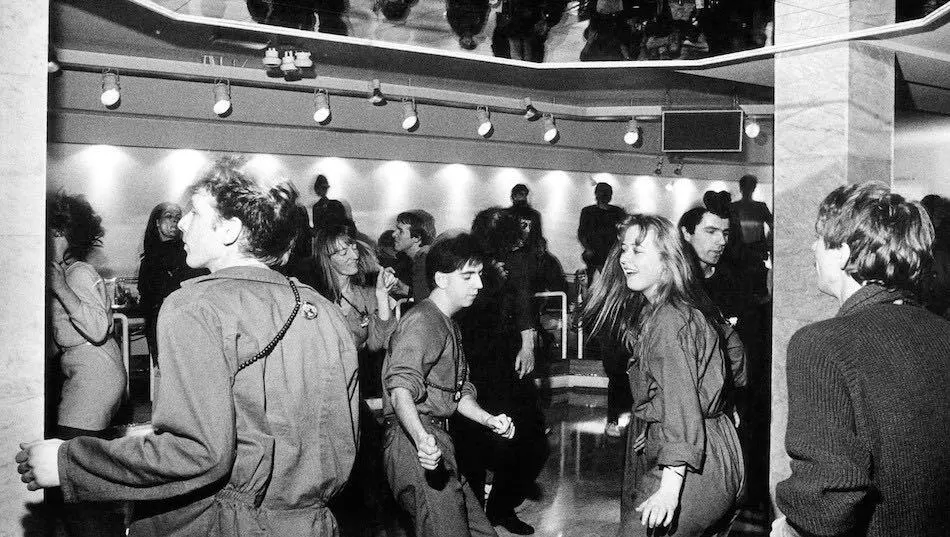
We opened the disco when the commune was still in the jail, before we moved to the monastery. We rebuilt the whole place, we redid everything. And it became a really big disco, for 900 people.
Sannyas discos had already been opened in many cities in Germany. There were two discos in Cologne alone; the big one and the little one, as they would call them. It was a good way to make money to send to the Ranch.
The disco became really quite famous and popular in Amsterdam. You would always find a line of people waiting to get in.
“Considering we were in the red light district — with the prostitutes, the Hells Angels, junkies, pimps, that kind of people (the area is world famous with tourists) — despite all this, the parents were happy to see their daughters and sons come to our disco. They said, “Your place is clean. Your place does no drugs.”
There were no drugs. There was no violence. It was really just about dancing. Students came, some people with a lot of money. The 16–17-year-old school girl. All kinds of people would come to Zorba the Buddha. And never a problem. Never aggression. No drugs. Nothing. *
At the bar downstairs you could see all the prostitutes, the pimps, the drug dealers – not just the little drug dealers, but the big dealers too. And they knew: no business in here! That’s exactly why they came. That was their place to have a drink. Off duty. “Let’s go to the Bhagwan’s for a beer.”
“We go there for the fun. We go there for dancing. For ourselves. We come because it’s a place where we can leave everything behind.” And they were behaving nicely.
Everybody liked it. If you walked in at 1 o’clock at night into the toilets: spotless. Every hour the toilets were cleaned. We really took care. Really beautifully. And Zorba became famous because we took good care. That was the place to go. You can go there without any hassle and without any aggression.
Helping out as a Bouncer
My main job was with the books, but sometimes I would help out in the disco as a bouncer, although I’m not a night person who can keep going until dawn. Sometimes people needed a break from working at the disco and would get another job for a while. “Go and do some cleaning.” In those days also, people were still smoking indoors, cigarettes, of course, so the place was always full of smoke.
We had women at the door. The rest of the red light district had men at the doors like the Hells Angels who had a bar opposite our disco. Bouncers, guys with shaven heads, huge guys, you know. We had two women at the door, but if somebody pushed these women aside and walked in, then it was my job to come round the corner and – “biff” – throw them out.
We basically said yes to everybody. We didn’t check for drugs at the door. If somebody walked in with drugs in their pocket that’s okay. As long as it’s in their pocket, it’s not our business. The moment they start taking it out and using it, then we would come and say, “Hey, you gotta go.”
I used to be a guard in Poona 1, not a samurai, a Krishna guard. We regularly trained in karate. I was there when Vimalkirti had the stroke and fell. It happened in that same class. We were very good.
That was my job in the disco. It just happened once that somebody was rude to one of the women at the door. We had agreed that if somebody gets really rude they would just step aside, let them in, and that I would come and take care. It happened only once.
To have women stand at the door was already sending out the message of: “This is a different kind of place.” We are not into drunken English tourists – they would not be let in. It was really a dance palace. For dancing and for having fun. And we did that in the toughest neighbourhood of the Netherlands: Amsterdam’s red light district.
The disco was going really well. Sometimes it was crazy; you would walk in there at 2 or 3 o’clock at night, and there was this table full of money. On a Saturday night hundreds of people would have come. 2.50 for a beer. 2.50 for a cola. Heineken put a tank in there; I think it was like a 3,000- or 5,000-litre tank. You could just press a button and no beer was wasted. Really hi-tech, a new system that saved money.
So in the office there would be this table full of money, with people counting and putting it in plastic bags. And then you hear, “Is somebody going to the commune?”
“Yes, I am going.” And then, “Here. Take this bag with you.”
This person would then ride home on his bicycle with 15,000 or 20,000 guilders. It was a crazy time – but really beautiful.


Osho’s bad press
The disco was going really well and of course that started to get known. At a certain point we started talking to business people about opening a second disco in a prime location – Rembrandt Square in Amsterdam was one idea.
At that time the press started writing about Osho, misquoting him on something he had said about Hitler. It gave him bad press. It was in the headlines. ‘Osho likes Hitler’, which was completely taken out of context.
We were in talks with a Jewish businessman. He was shocked. So we explained to him: “Listen. This is what the newspaper writes but this is what Osho actually said.” When we showed him what Osho says about Hitler, he looked at it and said, “Yeah. I see the point. The press is distorting. But I still have a problem. I have many businesses. If I go into business with you I will lose on my other businesses. So I am out.” And he left. We could understand him; he was a big businessman.
We said, “Okay. What a pity, this press coverage. Because we could have made good business.”
“Yes, I know because I can see it in your disco. In the red light district. It’s a good business. You guys make a lot of money,” he replied.
We were all working there without getting paid. In fact, Osho had perhaps 10,000 people working ‘for him’ – seven days a week. Twelve hours sometimes. Around the world. Nobody asked for money. You can imagine how much you can make that way. I mean you don’t have to pay wages. You don’t have to pay contributions or insurances. We were completely self-sufficient. **
And with that money we would fly 100 people in one go all the way to Portland or Seattle for the Festivals. Nobody needed to pay anything for the trip. We could take care of ourselves really well.


Ramses Shaffy
While Zorba was quite popular, Osho got bad press worldwide. There was one swami, Ramses Shaffy, who was famous in the Netherlands. That was his old name. When he took sannyas, he wanted a new name, but Osho gave him the same name: Swami Ramses Shaffy.
He was famous, both as an actor and singer. He had number one hits in Holland. He always managed to present Osho in a positive light. I noticed that anything in the press about Osho was always bad, except when Ramses gave interviews.
He knew how to give the journalists a positive outlook on Osho. He told me about that later, and this is something I don’t think many people know. When we were on the Ranch for a festival, one day Ramses was asked to go and see Osho. When he was there, Osho thanked him for managing to get positive press about him.
I don’t think Ramses ever told anyone about this meeting. I think I am the only one who knows. He died a few years ago. He was quite a wild character. But everyone in the Netherlands knew him. He was a beautiful man, and he is still loved by many people.


Sheela’s Meetings
It was all going really beautifully with our centre and the disco.
Sheela came to Europe to visit the communes to give us Osho’s message about AIDS. This was in 1984. She had come earlier – in 1982 I think – to Heerde, with the message to close down the smaller communes and create a larger one. But I remember in particular when she came to Stad Rajneesh in 1983.
At the time we didn’t hear much about Osho. He was in silence, far away from us on the Ranch.
So Sheela comes to Stad Rajneesh, and I go to this meeting just to ask how Osho is doing. That’s my main concern. “How is he?” We hadn’t heard about him. But she couldn’t tell us anything. She didn’t know. Strange. She talked about her shopping trip in Hong Kong instead, and a sailing trip in Australia. And I thought, “Yeah. But this is not what I came here for.”
You know, it’s nice to go shopping in Hong Kong and sailing is beautiful, but what about my question, “How is Osho?” She didn’t know. Okay.
At that time we were really doing well, we were making money and had a beautiful commune. We were on top of the mountain.
A few months later Sheela comes to Amsterdam again, after the whole thing on the Ranch had blown up. (There had been the June 1983 bombing of the Hotel Rajneesh in Portland, and we had started protecting Osho with machine guns.)
I said, “Well, I don’t feel like listening to Sheela. Let me stay in reception. If somebody phones, I can pick up the phone.”
The rest of the commune went to the meeting. When people came out of the meeting they told me what Sheela had said. “We should no longer go out alone. We should only walk around Amsterdam in groups. And we should start getting guns.”
I said “What? I have been walking alone in this town for years without a problem. I don’t knowwhat problem she sees. I don’t see a problem. There is no problem. This is all nonsense. And about carrying a gun – this is not America! This is Amsterdam and here it’s forbidden by law to carry a gun. If I carry a gun the police can arrest me and send me to jail. So, I am not going to carry a gun. And if I want to walk out of the door alone I’ll walk out.” I found that really strange.
Dipo, Sheela’s Swiss Husband
Then there was this guy Dipo who had come along, her husband. He was Swiss. We had an office on one of the canals, on Prinsengracht, where I was working. Dipo was sitting there on a couch, throwing all kinds of people out of the commune. One by one people were asked to go and see him. He was a strange character. Why was he throwing them out? We never found out.
I didn’t like that! One man was thrown out because he had a girlfriend who was not living in the commune – he would sometimes spend the night at her flat rather than in the commune. Dipo said to him, “You have to make a choice. Either you drop your girlfriend or you leave the commune.”
“What kind of nonsense is this? You want us to go out in groups? You want us to carry guns?”
Well, that man had replied to Dipo, “Well, I am not going to give up my girlfriend. I am not going to give up my freedom. Then I will leave the commune.”
So many people who had spent years in the commune and had contributed in such a beautiful and positive way to building everything up were suddenly thrown out for some strange reason.
This Dipo, I thought this guy was strange. Like all the other people around Sheela. There was another German guy, he was strange too. She seemed to love strange people.
Sheela’s Strange People
I was still visiting Cologne for my book business and there I met friends from the Ranch who also found Sheela to be difficult. She had sent them to Cologne or to other European communes, like Nivedano. A few of them had also come to the Amsterdam commune.
As an aside, on one of these trips to Cologne I met – by pure coincidence – an old friend of mine. The last time I had seen him was on the Ranch, where he had designed Osho’s garden. He had left the Netherlands for the US some time earlier and had started a gardening business there with his brother. I heard that after the Ranch he returned to that business, where he became very successful. I knew him from Holland because we had lived close to each other – even before I took sannyas. In fact, he was the first person I ever met wearing a mala. He had just come back from India and started talking to me – that’s actually how I ended up going to Poona, through him.
Then things changed. Osho started speaking again and nobody was interested in Sheela anymore. Osho mentioned that, because of this, she was now wanting to visit the communes in Europe more often. Osho said, “I made her a queen of a whole kingdom of sannyasins all over the world.” 1 and “As I came out of my silence, Sheela started going to Europe, to Australia, to Japan; and she will not stay here.” 2
Here role was finished.
Sheela then left the Ranch and Osho started exposing everything she had done. All criminal acts. Absolutely.
Sheela escaped to the Frisian Islands off the north coast of Germany. You can get there on a boat from Hamburg. I actually saw the news of her arrest on the 12 o’clock news on German TV – I will never forget it. It was broadcast only once, at 2 o’clock, and never repeated.
And who did I see by her side? Vidya. Sitting at a table – a big table. A policeman standing next to her, and on the table a mountain of pills. I thought, “My God, look at that. These people. How many of them were there? 10 or 15 altogether, with Sheela. Just ten people with such a quantity of pills of uppers and downers?”
They were arrested because the US wanted to arrest Sheela. That’s why the German police were there, but then they found all these pills… What were these pills all about? Also, this whole gun story… I know that in Hamburg sannyasins had actually been looking to buy guns. They went out on the streets to buy guns because Sheela wanted them to. It was really crazy. Ugly.
Osho started to expose everything, and later he was arrested.
Interview to be continued…
Sources
- Osho, From Bondage to Freedom, Ch 12 (1985-09-26-am)
- Osho, The Last Testament, Vol 3, Ch 3 (1985-09-24-pm)
Note
- * A recent documentary on Dutch TV showed that XTC was introduced in the Netherlands in… the Zorba Disco. People enjoyed it in a beautiful way, dancing and celebrating, as it was a mild, clean drug with no adverse side effects. It was a hype, but as soon as organised crime realised a lot of money could be made they started taking it over. Today much of the drug is contaminated by producers and abused by users.
- ** The Amsterdam Centre and Disco were economically so successful that they could pay social security and unemployment insurance for all their 200 members, including a yearly trip to Rajneeshpuram for the Summer Festival – flight ticket and accommodation – which was itself a further contribution to the Ranch.
Related articles on Osho News
- Seekers from the Low Lands
- Dharmen (1956-2023)
- Ramses Shaffy (1933-2009)
- Interview with Dharmen
- Berlin by Night – Marc remembers living and working in Osho’s Berlin commune, Vihan (May 2013)
External links
- Ramses Shaffy (sannyas.wiki)
- Ramses Shaffy plays in Wajid Centre (sannyas.wiki)
- Video with English subtitles, De Meester en het echte leven De Nieuwe Mens (docu Frank Wiering 2004) (youtu.be)
- Zorba the Buddha, de Bhagwandisco – in Over Amsterdam, 18 oktober 2017, in Dutch
Images from archive (Osho News, Srajan, Veet Gyanam, Devabodhi), and Peter Elenbaas (elenbaasvisuals.nl)[


Comments are closed.