

This is a further excerpt from Hafiz Ladell’s book ‘I Am Cooking Something Else’. In celebrating his creation, Oxford’s legendary Magic Café, he wishes to show us where his inspiration came from. In this chapter, we learn about his sojourn at the Pune Ashram in 1987–88 [Long Read]
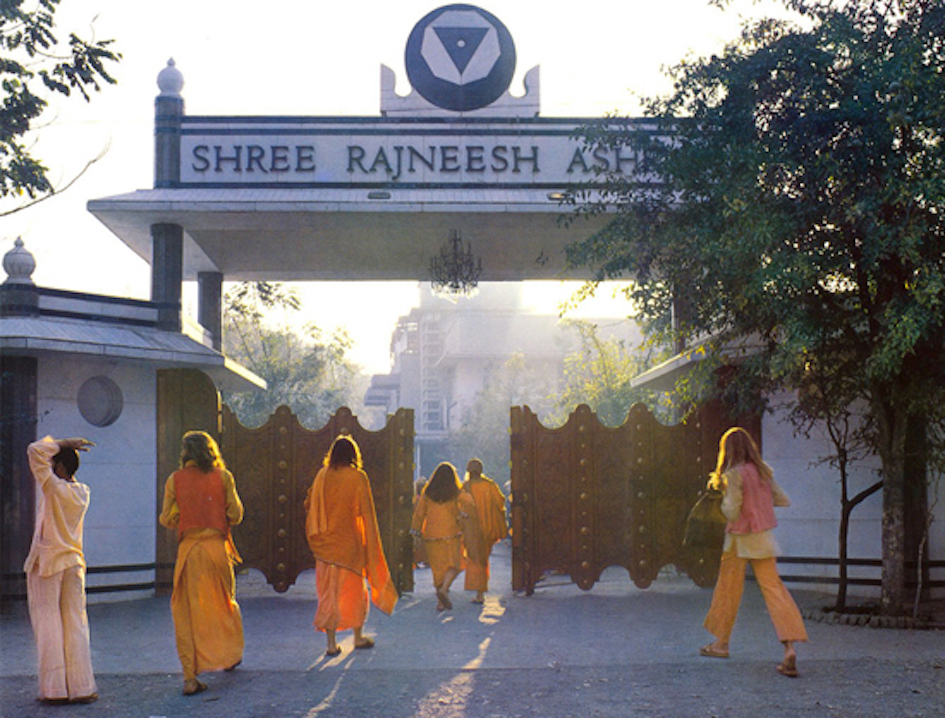
Does it surprise you, dear reader, that I am making such a song and dance about this guru of dubious repute? Wasn’t this supposed to be a book about a lovely café?
It’s a fair point. Having just navigated, for your benefit, the shenanigans of the Sheela era – a veritable white-knuckle ride – I am still aghast at the enormity of the Ranch debacle. Why on earth didn’t I simply cut my losses, as so many did; shuffle back into place on the conveyor belt of normality?
Perhaps my best answer is that the account I have just provided has been written very largely in the voice of the intellect – she’s good with words, that dear Old Nag, even if she doesn’t always understand what’s going on.
Something about that beardy chap with the questionable taste in robes had gripped my attention on a quite different level. I felt a compulsion to persevere with this relationship, however apparently nonsensical. I knew I could never forgive myself if I walked away at this point. Although I never felt able to lose myself in unquestioning devotion – unlike so many of my female colleagues – I was certainly hooked, fascinated.
Here was a real-life Zen master, precisely the type that had excited my attention as a curious teenager, coming across the slim volume of koans, “Zen flesh, Zen bones”, for the first time: a teacher who might recklessly overturn convention and decorum in order to provoke an over-earnest disciple into enlightenment – whacking them with a big stick, or even hurling them out of an open window. Encouraging the establishment of a model community, the summation of collective desires and dreams, then permitting it to self-destruct through its inherent contradictions: did this not display the essence of a Zen Master’s practice?
I can feel the shock reverberating through me yet; I still feel deeply uncomfortable about the spate of poisonings which blighted the latter days of the Ranch, betraying the espoused principle of open-hearted welcome. Should I share complicity? I had chosen to abdicate responsibility for my actions, to place trust in my designated pseudo-parents. I had certainly received a powerful lesson – but it wasn’t the same as becoming enlightened.
Then again, the profound experience of community in which I had participated, wherein I had pooled my best efforts, had sounded a deep chord, a resonance, a heart-connection. I simply loved the idea of a community that lived and broke bread together: here was a manifest alternative to the atomistic, dispersed society of individuals and small families, as championed by the likes of Mrs Thatcher. This, after all, was why I had returned to Dörfchen, despite the apparent hollowing-out of its spiritual mission. Now I was resolved to check in at ground zero.
Half-way across the world: the time of the Elephant Rains is just commencing. Our coach drives between airports through the torrential downpour, past an endless shabby shanty town. Another flight, and then we descend to our destination. I share a hotel room with a fellow pilgrim I’d only just met, and then take my bearings. The rickshaw drivers know where to take me: “Ashram”. Stepping through the “gateless gate” – actually a very security-conscious checkpoint – I present my AIDS test, and declare my wish to help out in the kitchen. Not interested in signing up for any expensive courses, Swami? Just so – I know that kitchen worship will be all the encounter group I need.
Our induction talk is given by Bhagwan’s doctor Amrito. He shows us an apple: “you need to consider that this fruit is covered in toilet paper”. It’s an important point he is making. In my first few days I occupy a room in a dingy tenement, and make the rookie’s error of brushing my teeth in water from the tap. It takes a few days for my distressed tummy to sort itself out; thereafter I make a point of filling my water bottle only from the purified supply in the ashram.
I have come half way around the world, passing through teeming streets bearing witness to a very different culture, in which signs are written in indecipherable squiggles; now, in this bio-secure enclave of adventurous occidentalism, I am all set to put into practice all that I know about satisfying the Germanic palate. My skills are welcome.
The ashram kitchen comprises two quite separate operations. One concentrates on preparing meals for the ashram staff and workers, which is served in a canteen around the back of Buddha Hall. When I arrive, this is largely conducted by Indian disciples, producing spicy indigenous dishes. Visitors must purchase food vouchers, which can be exchanged for a selection of dishes prepared and served on the other side of the small estate. There is a valiant effort to provide food that our predominantly European and American guests can recognise.
Masterminding proceedings is a voluble and strong-willed Italian, Swami Sarjano, intent on putting on a good show. He has had a new idea: a crêpe bar. “You know how to make crêpes?”, he asks me, daring me to display my ignorance. “Sure – just give me the recipe”, I answer. With barely withheld scorn, he obliges, and it is left to me to make this fantasy work. Short-order crêpes, with a variety of fillings: four food vouchers each.
It’s the first of a series of challenges, as I grow more familiar with this slightly ramshackle system, improvising as best we can within the limits of what seems possible. There is a wonderful camaraderie amongst my fellow worshippers. Moving on from the crêperie, Sarjano institutes a system whereby various teams take responsibility for an individual dish – perhaps fifty portions of each.
I get to know a playful ma called Leela, who may have originally been English, teamed up with her wild-maned Bosnian partner. They have been living on the cliffs in Hawaii and on Goa beach, long-term hippie pioneers. She assembles beautiful composite dishes, with names like “the three treasures”, “four principles”, “the five elements”.
There is a very contained ma, Dolano, in red robe and long ginger hair, whose air of unassailability Sarjano does not dare to impugn. Many years later I discover that she has been recognised as enlightened – “the swan woman living in a hut by the river” – and has attracted her own disciples.
There is a group of Germans who really don’t know what they are doing, whose culinary imagination seems restricted to creating a toasted sandwich. And there is me, with maybe with an assistant or two, not always entirely successful in my intention (tip: never include walnuts in a stir-fry, they will turn the whole wok-full black) but displaying sufficient competence to earn the boss’s approbation: “fa tutto” – he does everything.
Sarjano himself devotes fullest attention to his pet project, a proper pizzeria, offering the genuine item to peckish punters after the evening discourse. Initially, the pizzas are assembled at the ashram and then rushed over to the local German Bakery for completion; eventually a proper pizza oven is somehow sourced, for the freshest, fragrant cheesey slices.
I work a five-hour shift, which is deemed quite enough in these steamy conditions. Not everybody is easy-going and relaxed: it’s actually a highly charged environment, with psyches constantly being challenged by Bhagwan’s forensic insights. He’s pushing us hard, giving discourses twice daily. It can be difficult to stay focussed on the task in hand. One morning, I make a catastrophic blunder: placing my finger inside the casing of an upright fan as it whizzes around. The pain is immediate. What have I done?
I am worried about the consequences of being hospitalized in ill-equipped foreign parts, but fortunately there is no need to leave the ashram. There is an abundance of qualified medical personnel onsite, who today seem to be primarily busy with damaged digits – fingers and toes stripped of their protective nails. I will need to wear a fat bandage for a week or so, but otherwise there will be no serious consequences. Of course, I won’t be able to cook for a while, but I am assured that my food pass will remain valid while I recover; in the interim I can make myself useful checking the vouchers in the canteen. I feel valued, part of the team.
I live a couple of miles away, sharing a flat with other sannyasins in a very basic concrete block erected in the middle of a field. Most likely the owners have moved out to less salubrious accommodation, making the most of the tourist windfall. It’s a useful base, but mostly I spend my time within the ashram bounds. I cycle in through the early morning, enjoying the stillness of the air, the dew-bedecked fields glinting beneath the rosy-fingered dawn.
Come lunchtime, with my dish of the day awaiting customer inspection on the café counter, I am just about done. The afternoon is mine to while away; I can look forward to attending the evening discourse.
The ashram occupied a single plot in what was, at least in part, quite an affluent suburb of Poona. For such a haven of tranquillity, it was in a constant state of development and reinvention. When I arrived, the large marble platform which constituted the principal auditorium – Buddha Hall – was in process of having its improvised roof of canvas and bamboo replaced by a soaring cantilevered canopy. Local construction workers scurried around amidst the sauntering outlanders: two separate realities compressed into a single location.
What had been the main building now housed a plethora of offices, session rooms, the visitors’ canteen, plus a fancy boutique where all manner of pricey trinkets might be purchased. The area across to Buddha Hall was cordoned off, to allow the installation of an impressive water feature. Around the back of the main house an enclosure protected the Master’s residence and garden from prying eyes. Adjacent to this were various legacy buildings incorporating the ashram workers’ restaurant. All of these densely-packed structures were enveloped in a lush park-like environment: the abundant greenery of the sub-tropical monsoon season.
A relaxed babble of many languages filled the air. Old friends greeted one another in familiar sannyasin style, with hugs a-plenty. Patient queues formed to sign up for the latest groups and courses. An air of conscious spiritual endeavour prevailed. All these people were here for a definite purpose.
This was most apparent as time grew closer for the main event: participating in the presence of the Master. Lining up outside Buddha Hall, filing slowly past the sign, “shoes and minds to be left here”, then passing between the gatekeepers diligently sniffing for undesirable odours before dispersing into the hall to choose the vantage point of choice: close to the musicians, not too many rows behind the Principal Disciples – there where the energy might be strongest. I carried a small cushion with me, to ease the discomfort of the hard marble floor. Nonetheless, it would be a marathon of endurance.
With the entire space jammed full and settled at last, stillness descends. The sound of an approaching engine is heard; the car halts, the door opens. . . and then Bhagwan appears around the side of the marble backdrop, always accompanied by his constant companion, Vivek. He greets us all, slowly turning in namaste, then gracefully settles into his comfy chair, places one leg over another, rests a small crib-sheet on his lap, and commences to speak. For the entirety of the discourse, he maintains the same position.
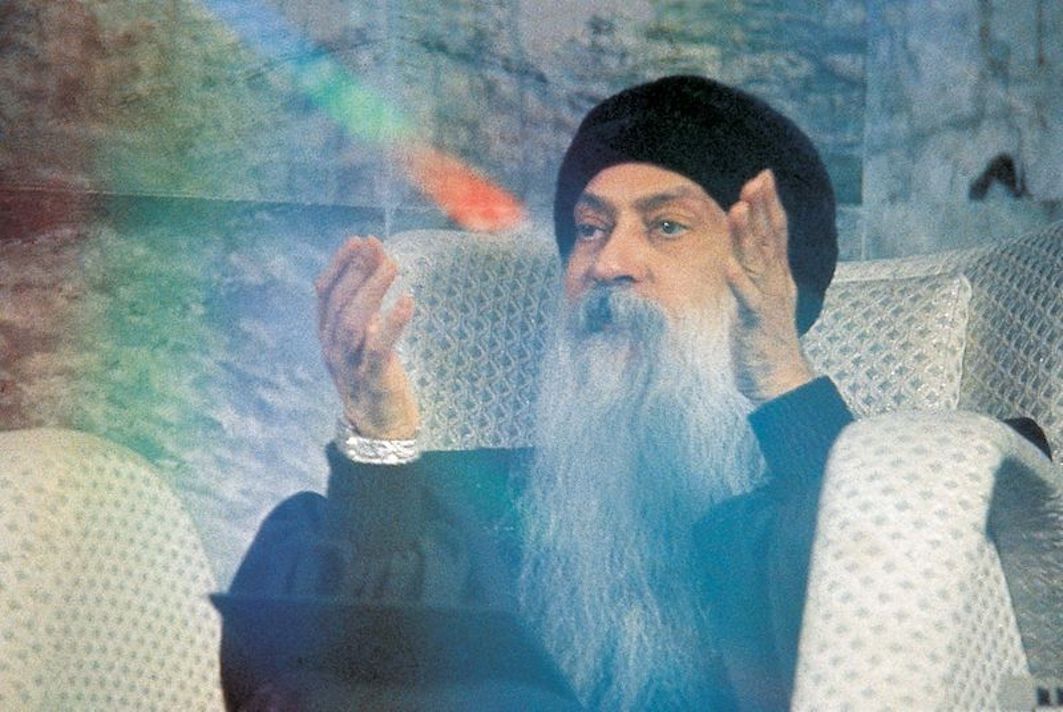
This was a very different experience from watching a video. All in that great gathering were devoting their fullest attention, gripped by the drama of spiritual elucidation. Should the proceedings ever risk becoming over-holy, Bhagwan might puncture such preconceptions with a smutty joke, consulting his notes before delivering the outrageous punchline with resounding aplomb. When he considered that enough had been said, at least for today, he would signal to the musicians. The drum would thump, and the mood would shift into carefree celebration as Bhagwan rose from the chair, raising his arms in exhortation before disappearing back behind the marble screen. It was a bravura performance.
Trust that heartbeat better than emotion
Feel I’m drowning, but do I need saving?
Feel like I’m going down, ah don’t let me drown
In my ears a rushing, like ocean raging
Listen to that sound, how it crashes and pounds
No time to argue or try to persuade me with reason
I can’t see nobody gonna take me on the life raft that he’s on
I just don’t have a notion
But it’s my heartbeat, and I trust it better than emotion
When I’m sinking in the depths of that deep dark ocean
Feel I’m dreaming, wishing I was waking
Waiting for the new day, for those dreams to fade away
For that sunrise bursting, that daylight breaking
Time just to play – nuts in May
And those shadows of the night hiding creatures of imagination
Are seen to be nothing more than hallucination
‘Cause it’s my heartbeat, and I trust it better than emotion
When I’m sinking in the depths of that deep dark ocean
Feel I’m spinning, beyond fear of falling
Arms swinging wide, sinking deep down inside
Down to that clear spot, hear the master calling
Nothing to hide. . .
And in the stillness at the centre of the cyclone that rages around me
I feel the pulsing of the heartbeat as protection and wrap it around me
To quiet all commotion
– That heartbeat, I trust it better than emotion
When I’m sinking in the depths of that deep dark ocean
Towards the end of that year – after I’d been at the ashram for several months – it was announced that Bhagwan needed to take a break. His health was increasingly fragile; there had been suggestions that unspecified indignities had been inflicted on him during his detention by the US prison service, from which he had never quite recovered. Discourses were to be suspended until further notice.
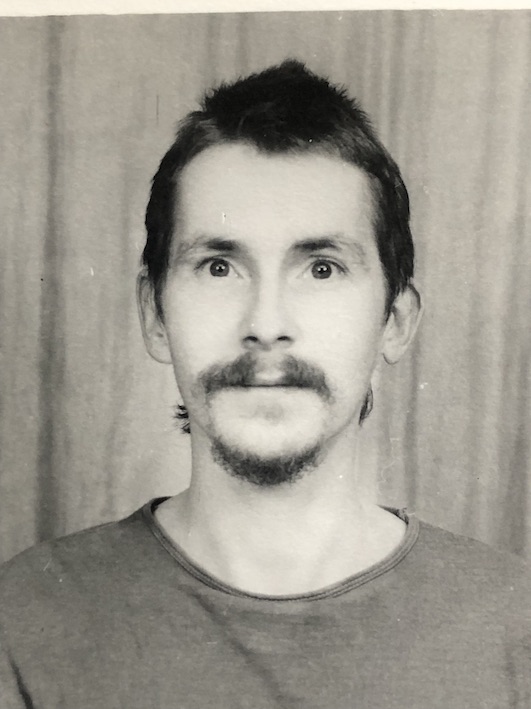 Many took this as their cue to head for Goa, or to seek some other means of distraction. The ashram was suddenly much quieter. I considered joining an expedition to Kathmandu; for this purpose I had my photo taken at a studio on MG Road. I’m displaying a steady, serious gaze, together with some mystic facial hair. But what was the attraction of Kathmandu? Raucous distraction and top-quality hashish? I decided that it would be folly to abandon this place of wonders, even if the Master had gone into retreat.
The catering operation had been reconfigured, with the separate workers’ kitchen being amalgamated with the principal cooking area – which freed up valuable space in the main house. I was asked to join the team preparing the workers’ food, first of all on a morning shift, responsible for breakfast and lunch.
Breakfast centred around an enormous pot of pseudo-porridge, in which cracked wheat took the place of more difficult to source oats, plus sundry dried fruit and spices. My experience with the Munchies and Slurpies stood me in good stead. Something quite new to my experience was an order for several hundred hard-boiled eggs. The result, frankly, was a bit of a mess, in which the platonic ideal proved hard to recognise amidst a mass of blobby fragments.
My favourite component of breakfast was an exotic fruit compote, some compensation for the near-complete avoidance of uncooked ingredients, in view of the danger of infection. This was the special responsibility of Amareesh, a musician part-timing in the kitchen. He lived in the same block of flats as myself; some mornings I woke up to the sound of him practising his scales. Many years later I discovered that I had inadvertently purchased a recording of him duetting with Pandit Hariprasad Chaurasia, the acclaimed flautist.
Hariprasad was a noted friend and admirer of Bhagwan. While I was there, he and his colleague, tabla maestro Zakir Hussein, offered to play for us in Buddha Hall. What a marvellous concert! I realised that our daily practice in silent attention had established the ideal conditions for musical transmission, removing all the barriers between performer and listener, enabling a mutual transport of delight. It was an immersion in blessed limpidity such as I never experienced again – until I started to attend Oxford’s Catweazle Club, justly fabled for its fierce discipline of listening.
The summit of my ashram cooking career came with my appointment to the afternoon crew, responsible for the main evening meal, sufficient for several hundred servings. This was a massive undertaking. Heading the team was another Italian, Paritosho, whom I had first met at Medina, a genial and practical manager. Our mainstay was a formidable powerhouse, Ayo, a sometime Royal Marine. With his partner Vayo, he had spent many years in Goa, wheeling and dealing. Now he was contributing an awesome degree of competence and drive to enable our daily miracle of manifestation.
Job done, we would load the massive pots onto a trolley and trundle it across the ashram. It would hold its heat for the next couple of hours. There would be time to clean up, put on some fresh clothes, and get in line for the evening discourse.
Bhagwan had commenced speaking again, albeit in a less demanding format. Discourses were now given in Chuang Tzu Auditorium, essentially a glorified veranda at the side of his residence. No need for all that malarkey with the limo! Here was just room for a couple of hundred faithful, squeezed together extremely tightly; it was a great privilege to be allocated tickets.
I became aware of how much of the time, sitting there in some discomfort, just a few yards away from the Master casting his spell, I was actually daydreaming about clothes I might have run up at the tailors on East Street from the colourful lunghis I’d purchased. Of course, I needed to watch my spending now. . .
Had I plopped out of the vortex? Sometimes, in my afternoons off, I was quite bored. For all the easy friendships I enjoyed, I had formed no deeper attachments. It had started to feel as though life were on hold. And funds were running disconcertingly low; I had remained in India for far longer than originally intended.
My original return flight ticket had been sold on – which involved travelling to Bombay with the purchaser, checking in, then ducking behind a pillar to hand over my boarding pass. I had managed to extend my visa, courtesy of Philip, the local Mr Fixit, who knew how to negotiate the complications of Indian bureaucracy: the essential lubricant was, of course, cash – preferably foreign currency.
A couple of months further on, in that “time out of time”, there seemed no escaping an impending financial crisis. I had trusted the sannyasin who flew back to London in my name to send me our agreed price on his arrival back home; I had found assurance of his good faith by looking into his eyes. . . but I was to wait in vain for the promised money. Now, as I turned away from the safe deposit office on the ashram, opening my requested envelope, my expression must have been easy to read. A voice beside me remarked: “You look like someone staring at his last 100 Deutschmarks.”
A friend kindly bailed me out. I was able to buy a second-hand ticket, travelling in tandem to Bombay to perform the shifty exchange. And then I was at Heathrow, in my light summer clothes, shivering in the chilly spring breeze. I had precisely a fiver in my pocket, the cost of a coach fare to Reading. I turned up at my mother’s house, much to her surprise. Ah – those long-gone days before the mobile phone!
Excerpted from the book:
 “I Am Cooking Something Else”
The story of Oxford’s legendary Magic Café
by Hafiz Ladell
ASIN : B09JRGGLPB
Publisher: Independently published (18 Oct. 2021)
Paperback: 252 pages
ISBN-13: 979-8492328382
amazon.com – amazon.co.uk – amazon.de
Photo credits
- The Poona ashram had been more-or-less mothballed during the Ranch adventure. This photo dates from 1979, being used in the documentary film “Ashram in Poona”, which shocked many by its portrayal of unfettered encounter group practice. When I arrived, the orange robes were no longer apparent, and the prevailing atmosphere had become far less confrontational; otherwise, the built environment was substantially the same. (sannyas.wiki)
- Osho seated (sannyas.wiki)
- Studio portrait, MG Road (author)
Related articles
- The Crunch: my life in the European Commune – In the last days of 1984, Hafiz, together with four others, is dispatched from Medina to join the Rajneesh commune in Freiburg, via the ferry from Harwich to Hook of Holland… (Part 2)
- Hejira: my journey to Medina Rajneesh – In this Long Read, Hafiz recalls his early taste of sannyas at the English commune – extracted from his memoir, “I Am Cooking Something Else”: The story of Oxford’s legendary Magic Café (Part 1)
- “I Am Cooking Something Else”: The story of Oxford’s legendary Magic Café – Hafiz Ladell’s introduction to his book


Comments are closed.