

Marga explains the Human Design Channels between the Ajna and Crown centers

Here we are at the end of our journey through Human Design channels and we close with the last 3 “projector” channels, connecting the Ajna center to the Crown.
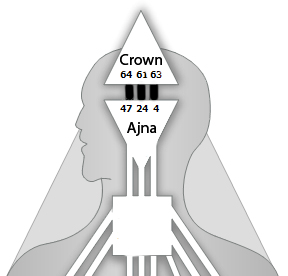
In Human Design, the Crown and the Ajna together form what we commonly call the “mind”: a receptive processing system.
The Crown, like an antenna at the top of the system, receives inspiration, and applies pressure to know through questions, doubts, confusion, and every other form of mental uncertainty.
The Ajna processes, conceptualizes, and gives structure to that mental input organizing the pressure into concepts, frameworks, and interpretations.
The channels that connect these two centers are never about action, survival, or emotion, or at least not directly, but they are about how reality is understood, digested, and made intelligible.
 For this reason, the Mind in Human Design is never a decision-making authority, but rather a data-processing device. In Osho’s words this would probably translate in something like, I quote by heart, “the mind is the servant, it is not meant to be the master.”
There are only three channels connecting the Crown to the Ajna and they represent the three fundamental cognitive modes available to human consciousness. Two belong to the Collective Circuit: one is abstract, experiential, and past-oriented, one is logical, pattern-based and future-oriented, while the third belongs to the Individual Circuit of Knowing, expressing insight that is unique, discontinuous, often disruptive, vertical, and not bound to time.
These channels are:
- 64–47: The Channel of Abstract Thinking (Collective – Abstract Sensing)
- 63–4: The Channel of Logical Thinking (Collective – Logic)
- 61–24: The Channel of the Thinker (Individual – Knowing)
Together, they form the complete mental spectrum: past, future, and the timeless inner axis, also called the present time. They do not provide truth, but coherence. Their role is not to prompt action, but to analyze, interpret, and render experience intelligible.
Let’s explore them one by one.
Channel 64–47: Abstract Thinking
Circuit: Collective (Abstract Sensing)
This channel represents the abstract, experiential mode of thinking. It processes life not as data or facts, but through memory, imagery, and lived impressions and experience. Gate 64 brings mental pressure in the form of confusion: unfinished stories, unresolved impressions and feelings, fragments of the past seeking meaning. It is not confusion as mental failure, but as raw material processing method. Gate 47 transforms this pressure into sudden realization: the moment when the fog clears and a coherent narrative emerges, allowing experience to crystallize into insight.
Abstract thinking is inherently retrospective. It looks backward along the timeline, digesting what has already happened. It does not seek certainty; it seeks sense. Meaning here is never immediate; it arrives only after experience has been fully lived and metabolized. This is the cognitive mode of storytelling, existential philosophy, psychology, myth, and reflection. That’s why this channel cannot be rushed: insight comes in its own time.
When aligned, this channel produces deep experiential wisdom that can be shared with the collective. When misaligned, it can become trapped in mental loops, emotional recollection, obsessed with explaining the past, or creating premature meaning.
Key Themes
- Shadow: Rumination, mental overwhelm, forcing insight, fixation on the past, anxiety about unresolved experiences.
- Alignment: Allowing time for realization, and for insight to mature, trusting experiential digestion, sharing wisdom through storytelling and reflection.
Channel 63–4: Logical Thinking
Circuit: Collective (Logic)
This channel represents logical cognition, protocol and pattern-based mode of thinking. Gate 63 brings doubt, not as negativity, but as a functional skepticism that questions reliability and consistency. Gate 4 seeks answers and formulates solutions: hypotheses, explanations and conceptual models that can be tested over time.
This is the mind of science, systems, mathematics, and strategic planning. Its purpose is not to explain the past, but to predict the future by identifying repeatable patterns and regularities. However, its answers are always provisional. Logic in Human Design is probabilistic, not absolute. Logic refines itself through repetition, testing, and correction.
When aligned, this channel contributes clarity, structure, and strategic thinking to the collective. When misaligned, it can become rigid, dogmatic, paranoid, anxious, or trapped in conspiracy theories, endless doubt or dehumanizing protocols.
Key Themes
- Shadow: Chronic skepticism, mental rigidity, confusing hypotheses with truth and opinions with facts, conspiracy theories.
- Alignment: Testing ideas over time, respecting uncertainty, offering logical clarity without attachment.
Channel 61–24: The Thinker
Circuit: Individual (Knowing)
This is the most inward and private of the three mental channels, and expresses a way of thinking that is not derived from experience or logic, but from inner pressure toward truth. Gate 61 brings the mystery: the unknowable, the existential question, the urge to understand what lies beyond form. Gate 24 attempts to give this inner knowing a conceptual structure, often returning again and again to the same thought until it stabilizes internally and clarity arises. This channel is fundamentally present-oriented. It does not process past or future, but moves vertically, seeking the ultimate.
It is not rationalization, nor logical explanation. It is a private, inward process of contemplation. Insight here is sudden, personal, and often impossible to translate fully into language. The mind circles back, not to convince others, but to integrate knowing within itself. This channel belongs to the Individual Circuit, and therefore operates independently of consensus or validation. When aligned, it gives rise to original philosophy, mysticism, and genuine insight. When distorted, it can collapse into mental fixation, isolation, or false certainty. This is the channel of the philosopher, the mystic, and the original thinker. It is not meant to convince; it is meant to know. Because of this, it can appear obsessive, repetitive, or detached from common sense reality.
Key Themes
- Shadow: Obsessive thinking, withdrawal, mental loops, mistaking inner insight for universal truth.
- Alignment: Honoring mystery and inner inquiry, allowing silence, sharing insight without attachment to being believed, returning to insight without forcing explanation.
Conclusion:
The Mind as a Three-Dimensional Instrument
These three Crown–Ajna channels form the total architecture of the human mental ecosystem, each offering a different way of understanding reality:
- Abstract Thinking (64–47) looks to the past, distilling meaning from lived experience and reflection.
- The Thinker (61–24) seeks inner truth through mystery and insight; it moves outside of time, moving along a vertical axis.
- Logical Thinking (63–4) looks to the future, building models to explain and predict patterns in life, and finding solutions.
When these three dimensions operate together, the mind functions with depth, flexibility, and coherence. Past, future, and inner knowing inform one another without confusion of roles.
Human Design reminds us that the mind is not here to decide how we live, but to interpret what life presents. Its true function is to observe reality, organize experience, and make life intelligible. When the mind is honored for what it is—and not mistaken for authority—it becomes a powerful ally: a translator of experience, a generator of insight, a contributor to collective understanding and a refined instrument of awareness.
Related articles
- The whole series by Marga on Osho News: Three Channels a Month
Marga offers Human Design readings:
you can contact her on whatsapp 0091 9503332918 or margajee@gmail.com
Featured image: AI generated using ChatGPT with prompts by the author


Comments are closed.