

Shivananda remembers a touching event from 1981 – as told to Punya
One of Osho’s wishes was to have the whole production of his books done inside the ashram. So a two-storey house from wood was specially built for the bookbindery. It was next to Buddha Hall; when you came out of Lao Tzu House, turned right as if walking to Mariam Canteen, right there – where the Multiversity Plaza is now.
The bookbinding was, until then, up on Jesus House roof, just below the silk-screen department. We had created a small bookbinding department mostly for hand binding; for books from Osho’s library with his signature in it, boxes for Laxmi and various boxes for department heads to store letters or files. Also items for Osho like his writing pads and those boards he used in discourse for the questions and sutras.
The bookbinding department had to move to a bigger place because we were getting machines! (Someone else was involved in the purchase – they had even bought two printing machines – which in the end never got used.)
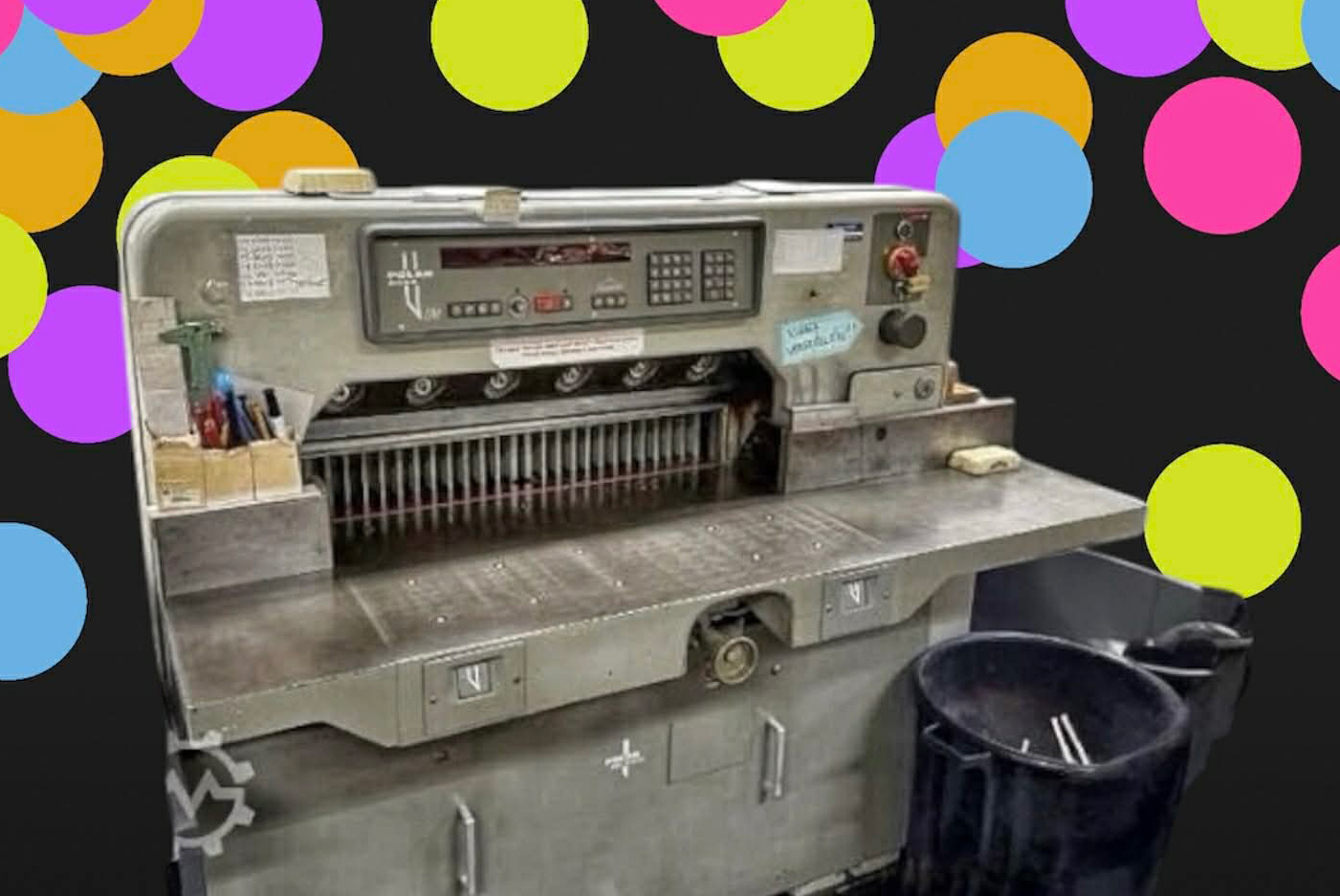
Among them was this Polar paper cutting machine! It was of very good German quality, with the latest computer technology. A wonderful machine! And then there was a three-side cutter, which was used to cut the books on three sides, from East Germany, two sewing machines from Switzerland, and a folding machine, also from East Germany. All good quality machines.
I was there when they arrived. I was in awe. I was mesmerised.
As I was part of the hand bookbinding, which was upstairs in the same building – a totally different world – I was not directly involved with them, but I was immediately fascinated by these high-tech machines and felt this strong desire to work with them, especially with the cutting machine.
We already had a cutting machine, but this one was like, “Wow.” The two were worlds apart. In the past we would share it – it was an old Indian one – but now if we had to cut something, we had to ask an authorised person to do that for us on the new Polar.
It was a period when I was not feeling very well. I felt a bit lost. I don’t remember exactly what I wrote to Osho. I just know that I needed a change. Then Osho’s message came, “Go and see Teertha.” So I booked a session with him.
Teertha was sitting in his comfortable chair opposite me and I was sitting, also in a comfortable chair. He asked, “Where do you work?”
“I work in the bookbinding.”
“Isn’t that the place where they have these new machines?”
“Yes,” I replied.
He closed his eyes for a moment. Then opened them, looked at me and said, “Just love the machines.”
When he said that I started crying. I cried and cried. It was as if somebody had said, “It’s okay to love your beloved. It’s okay. You have the permission to love your beloved.”
I was so touched and moved. He then also said that the love for a machine is not a one-way affair. It’s a two-way affair – the machine responds to you. He spoke a lot about machines. He said that we can also feel it with cars. Especially with those new high-tech machines. They can feel even more as they are more sensitive.
When I came out of the session, I had the feeling that somebody had finally realised that I had fallen in love with these machines. When I got back to work I didn’t say anything to anybody. But two days later Pratima, who was in charge of Publications, called me to her office. She said to me, “From today on you will be in charge of the machines, but not of the people who work on the machines.”
I was very happy to hear that, Wow, what a gift. Still, I could not quite figure out how it would work – not to be in charge of the people but to be in charge of the machines. So I asked her, “How can I be in charge without being in charge of the people?”
And she replied, “You are with the machines and if you feel that some machine is not being treated right by somebody, you come to my office and we change the person, or we do something about it.”
I thought, “Okay.”
So then, of course, I was transferred from the hand-binding department upstairs to the downstairs department with the machines. I remember when these big sheets came from the printers and how they went through the folding machine first. Then came the sewing, the cutting and then the gluing. I still remember the first book we made. It eventually grew to a big department.
For me, the most memorable is my love affair with the Polar machine. It became so strong that many times I went to the bookbinding department at night, when nobody was there, and lay on the Polar cutting machine, crying. I could feel the machine. It was as if my best friend was the Polar cutting machine. It was absurd.
I was lucky to have a girlfriend who could understand me. She understood what was going on with me, because she was also working there – she was actually in charge of the department. It was a beautiful relationship.
I was totally in tune with the machines, especially with the folding machine. It worked with these big printed sheets. It did four folds. One fold, second fold, third fold. It went very fast. When the machine was working it sounded like beautiful music. But as soon as there was something that didn’t work properly I could hear it immediately.
Whenever I was sitting in discourse and listen to Osho speak, at the same time I could hear the sounds from the machines. I knew whenever there was something wrong with one of the machines. I could hear it immediately. I was like, “Ah, okay. On the third fold there’s something that’s not right. I could hear the machine being stopped – someone must be fixing it. Then the machine restarts. Everything is fine again. “Ah, now on the second fold there’s something which is not right…”
There were two other persons who worked with me on the folding machine; it was English Satgyana, who has since died, and American Toshen. And on the sewing machine there was a French-Swiss woman whom I had met in Goa before. And on the cutting machine there were different people.
I had a deep bond with the people in the department who were good with the machines. We became very close through the machines because we had the same love affair, the same sensitivity. After a while it was easy to know who would fit with the machines and who would not.
One day it dawned on me that my father was a real genius with machines. He was a machine tool mechanic. He made tools and worked for the SBB, the Swiss Railways. He was always around machines. Actually, he was so good with machines that everybody in the village brought their broken machines to him. Anything, you know; radios, fridges, cars, bicycles. The house was full of broken machines. And he would fix them! Later on, after he retired he had a bicycle shop in the house.
Because I felt so much hatred towards my father I never wanted to have anything to do with machines. Nothing. I wouldn’t even touch a bicycle. A total reaction.
When I was a child I once received a gift. It was a metal construction system where you could screw bits of metal together with bolts. It was called Meccano. I loved it. But that was the closest I came to machines.
Now I realised that I had rejected this quality in me, this talent. It came out in that instant. Now when I see something is not working on a machine, I don’t think that I have nothing to do with it. I feel I can actually handle it, that I can fix it. Also with computers. If something is not working, I am confident I can sort out the problem, with any machine; my iPhone, my iPad, my computer.
The time I worked with the bookbinding machines was a big part of my life in Poona. I was so happy to be with these machines, to figure out how they worked and to fix them. It was amazing.
I was constantly in tune with the machines. If I’d had my choice I would have been there twenty-four hours a day, but I also had to leave in order to eat and sleep. But that was my whole life. Later we started to have 24-hour shifts in the bookbinding. Basically I was always on a ten-hour shift or a twelve-hour shift, and next day another twelve hours.
Then one day I came out of the bookbinding and saw all these people hanging around Lao Tzu Gate. I saw the Rolls-Royce coming out. I asked, “What’s happening?” And they said, “Osho is leaving” “What?” I had no idea. It was the day Osho left for America.
A few days later Pratima came and said, “Now we will have to sell the machines.” So one by one the machines got sold to Indian companies. At this point most people had already left for the West or for America or wherever. I was still in Pune because there was still the Polar cutting machine. It was still there. Then one day this huge truck came with cranes. It was very heavy, this machine. And they took the Polar cutting machine with them. “Now it is going.” I was just wishing it would find a good place.
When the truck was leaving the Ashram, Pratima walked up to me and said, “That’s it Shivananda. Now you are free.”
And that was the end for me in Poona.
heartsinging.ch – shivananda.ch
Related articles
- And Another Story… – Shivananda’s collection of stories published on Osho News



Comments are closed.