

Osho comments on anecdotes about Zen Masters Ekido, Mu-Nan and Nansen, in the discourse series Roots and Wings – by Phoebe
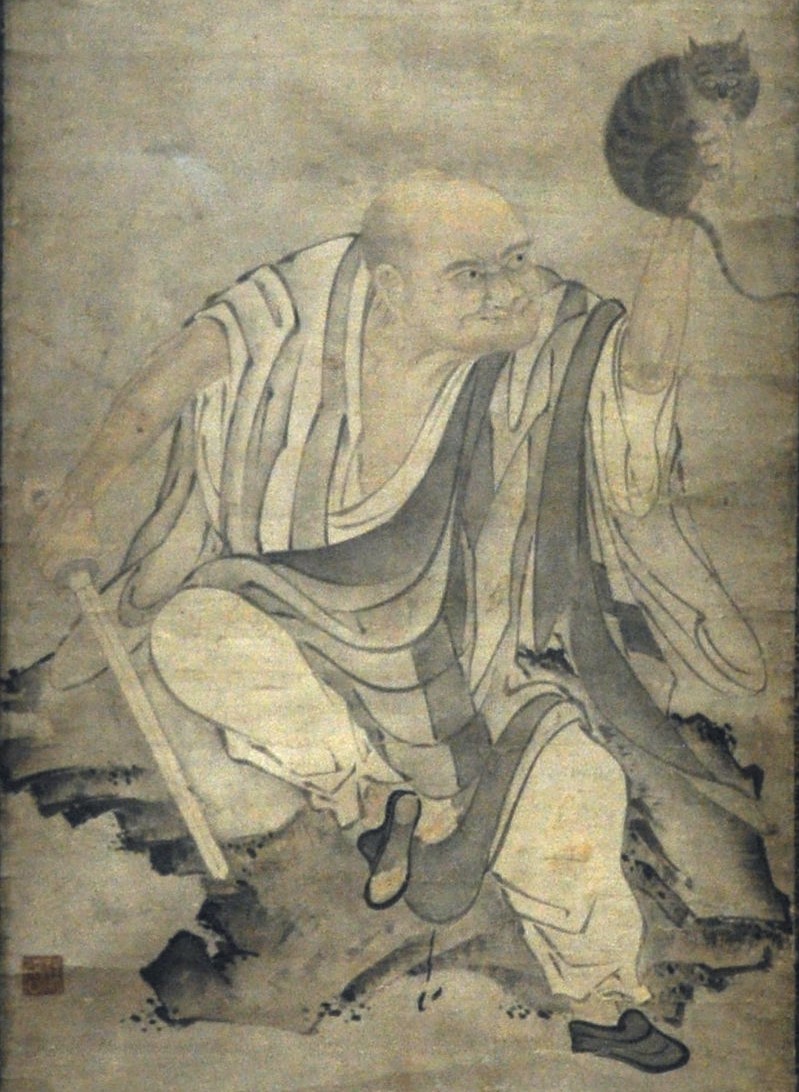
Zen Master Ekido – The Seventh Talk
The seventh talk introduces us to Zen master Ekido who was feared because of his ultra-severe teaching methods. One day the monk who had been given the task of beating the monastery gong missed a beat when a beautiful girl passed by the monastery gate. He hadn’t noticed that the master was standing close behind him. Ekido struck him a strong blow with his staff which stopped the monk’s heart and he fell down dead. Afterwards Ekido was discredited for this action by the public at large, but went on to produce ten enlightened successors!
Osho tells us that Ekido’s act was not one of cruelty but of compassion in its highest form. The aim of the monks who join a Zen monastery is not self-development but self-transcendence. They understand that, though bodies die and are exchanged, the inner being is eternal. Osho suggests that Ekido, who recognised that this monk was close to enlightenment, took this opportunity of giving him a final hit. The blow was therefore not meant as a punishment for being distracted from his task but as a great gift. It released him from his body and even from his mind with its compulsion to return.
“The mind goes on following you like a shadow. The mind is the problem, not the body. Through the mind you have become one with the body and unless the mind disappears you will go on getting into newer bodies, into newer vehicles, and the wheel of life will go on and on.” 1
It is significant that shortly before his death the monk was diverted from his task by the sight of a beautiful girl passing the monastery gate. As Osho tells us, her beauty triggered his desire, so he lost his alertness and missed a beat whereas up to that point he had not faltered. In Zen monasteries the monks meditate during their everyday lives through practising staying continuously aware in the moment as they go about their daily tasks. The monk beating the gong had an important role in the community as the gong’s regular beat helped to support alertness in the other monks.
Osho explains that thoughts about sex are the mind’s way of maintaining itself. He claims that we think about sex, and how to get more of it, most of the time. For example, when we are planning ways to become more wealthy our unconscious motive could be in order to enjoy more sex. When our ego is thinking about how to get more power over others, the mind says because then I’ll be able to use it to get more sex. So what to do about this basic human trait? Osho gives us the following advice:
“Move into desire with full awareness. Try to be in the sex act but alert. By and by you will see the emphasis changing – the energy will be moving more into alertness and less into the sex act. Now the thing has happened, the basic thing has happened. Sooner or later the whole sex energy becomes meditative energy. Then you have transcended.” 1
When this monk missed a beat on the gong, the master who was waiting behind him hit him so hard that his body fell to the ground, but his inner being awoke and he regained his alertness. Osho concludes that it was in this state of awareness that the monk died.
“When you come to a master be ready to die. Beating any gong, falling in desire, following a girl – the master can hit you any moment. If you have not surrendered the hit will be useless. The master will not hit you because you will miss. It will not be of much use. This disciple must have been one of the closest, most intimate, and so surrendered that he would die but would not complain. He fell down without a complaint, as if the body dropped like an old dress, and inside there was light, more light. He entered that light!” 1
Zen Master Mu-Nan – The Eighth Talk
The eighth talk is a tale about the Zen master Mu-nan who had already picked his chosen successor from the community of monks – Shoju. After Shoju had completed his training, Mu-nan, who was old by then, formally invited him to take over as his successor. To mark the occasion, he offered Shoju a valuable book which he said had been passed down for seven generations from Zen master to Zen master, and which contained the monastery’s teachings.
Shoju refuses the book explaining that he’s received the teaching without writing, but nevertheless, Mu-nan thrusts it into his hands. Shoju immediately reacts by flinging it in the fire that’s burning in the grate beside them. Mu-nan shouts angrily, ‘What are you doing!’ Shoju shouts back, ‘And what are you saying!’
Our understanding of the deeper meaning of this tale hangs on our interpretation of the behaviour of Shoju, and also the reaction of Mu-nan, who in this scene is testing Shoju before officially declaring him his successor. It seems it’s the normal procedure in a Zen monastery that, when a master becomes too old to continue in his role, he hands over to a chosen successor who he expects to continue his good work. In this context, at the hand-over point, Mu-nan provokes a situation.
Shoju passes the test with flying colours. He doesn’t even yield to his natural curiosity and glance into the book before burning it, which would have meant for those brief minutes he was in his mind. Instead, he rejected the book outright by throwing it into the flames, which appeared to anger Mu-nan who shouts loudly, ‘What are you doing?’ Even at this point Mu-nan stays aware and shouts back, ‘And what are you saying?’ Osho comments that Shoju answered in the right coin and so became Mu-nan’s successor.
Our take-away lesson from this tale is to avoid being pre-occupied with teachings that are conveyed to us in words, either as lectures given verbally by experts or as the abstract ideas preserved in books. Alas, when I was a student, and a typical product of the education system in those days, I developed the habit of making a plethora of notes, preserving them in too many folders that I never opened again. I’ve also in my life bought too many books in the hope of possessing the abstract ideas that were fascinating me at the time – all which I’ll now consign to Mu-nan’s fire. However, I’m not quite there yet, maybe tomorrow… and so I go on procrastinating.
“All books are dead, and that is how it should be. They cannot be alive. All scriptures are graveyards. They cannot be anything else. The word the moment it is uttered goes wrong. Unuttered it is okay. Uttered it is falsified by the very utterance. Truth cannot be said, cannot be written, cannot be indicated in any way. If it can be said, you will attain to truth just by hearing it. If it can be written, you will attain to truth just by reading it. If it can be indicated, you will attain to truth by mere indication. This is not possible. There is no way to transfer truth to you. There exists no bridge. It cannot be given; it cannot be communicated… What is the mind? It is the past, the memory, the accumulated experience. But the moment you have experienced the thing it is dead. Experiencing is in the present!” 2
Zen Master Nansen – The Ninth Talk
This talk is about the Zen master Nansen who one day found two groups of monks squabbling over the ownership of a cat. Nansen went to the kitchen and came back with a chopper. Then he picked up the cat and said to the monks, ‘If any of you are able say a good word you can save the cat.’ But the monks remained silent. So he cut the cat in two and gave half to each group. Later that evening Nansen told Joshu what had happened. Joshu’s reply was to put his shoes on his head and walk out, while Nansen called after him, ‘If you’d been there, you could have saved the cat!’
Nansen was speaking not through words but through direct action. In his commentary on this story Osho explains why words from the mind are useless in a situation of emergency. Powerful direct action to avert the consequences was needed. The monks sitting in their two opposing groups failed the test as they were in their minds, trying to think what to say. When Joshu on returning later to the monastery was told by Nansen what had happened, he demonstrated a suitable reply by putting his shoes on his head and walking wordlessly out of the room. With this absurdly irrational action Joshu gave Nansen not an intellectual, but a total response in the moment.
I also see what he did as symbolic. To balance his shoes on his head as he walked out would have taken a high degree of awareness, and the two shoes, unified on the top of his head, also symbolised the oneness that the two groups of monks needed to seek. Joshu therefore gives us an example of thinking wordlessly, using the power of the imagination to respond rather than planning a verbal reply. Our imagination – provided by the right side of our brains – balances out the ability to think logically, which belongs to the brain’s left hemisphere.
Osho suggests that the monastery building consisted of two separate wings, so the monks were spatially divided. It was a situation that fostered divisiveness rather than inclusion within their community. We have an ingrained habit of thinking dualistically – self and other, male and female, friend and foe for example. We automatically identify the self as subject and see other people as objects. This fosters division in our minds between those we accept and those we reject, those we see as our friends and those we see as our foes, those who are superior and those who are inferior etc., and this divisive habit becomes the root cause of all wars.
Osho also points out that, although these monks may have left their worldly possessions behind when they entered the monastery, they had not left behind their possessiveness. It came out in their rivalry about trying to possess the poor cat. In other words, their egos were still intact, although they were Zen monks. The ego is behind all rivalries:
“Whenever possession comes in, fighting, violence and aggression are bound to be there. Whenever you possess you are fighting because that which you possess belongs to the whole. You cannot possess anything, you can use it, that’s all. How can we possess the sky and how can we possess the earth? But we possess and that possession creates all types of conflict, struggle, wars, violence and so on… If you possess you have started a war with the whole!” 3
“Why is the mind always in search of a fight? By fighting ego is accumulated, becomes stronger. Through fight your ego grows, if you don’t fight ego disappears… Ego exists in fight. It is a consequence of fight. The more you fight the more ego exists. If you alone remained on earth, nobody to fight with, would you have an ego? You would not have an ego. The other is needed to create it, the other is a must… Wherever love is fight ceases, ego drops. This is why you cannot love. It is difficult because to love means to drop the ego, to drop yourself. Love means not to be!” 3
Sources
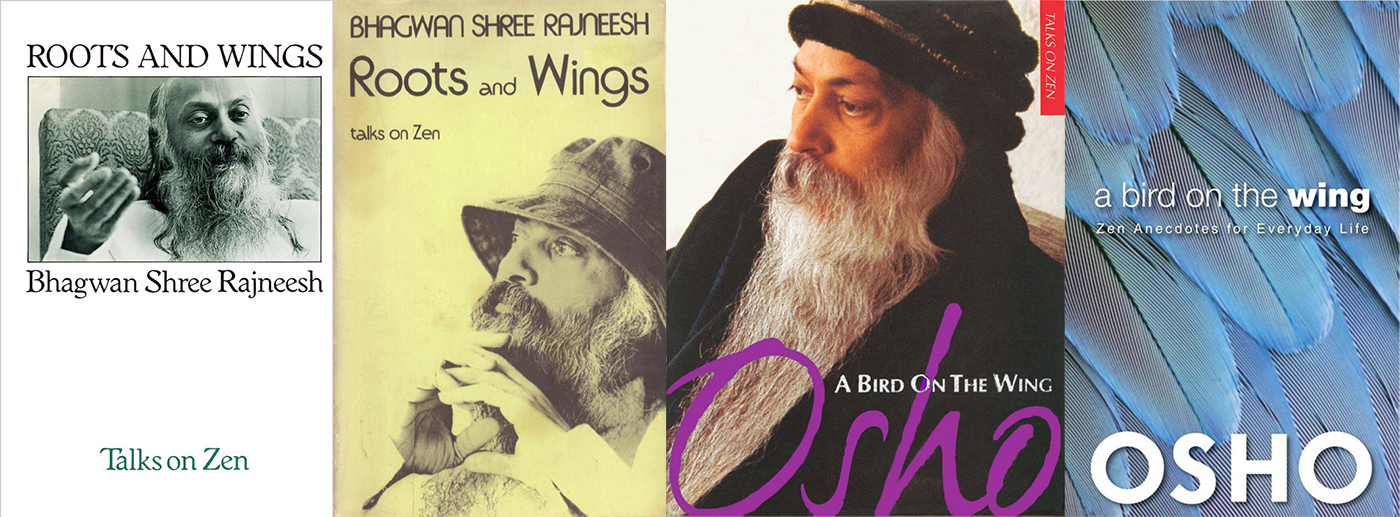
- Osho, A Bird on the Wing, Seventh Talk (more excerpts)
- Osho, A Bird on the Wing, Eighth Talk
- Osho, A Bird on the Wing, Ninth Talk
A Bird on the Wing
Osho Media International
Hardcover, 258 pages
ISBN-13: 978-0880502078
Kindle, 746 KB
ASIN: B00BVTW4EY
Related articles
- All articles in this series: Nuggets


Comments are closed.