

Amido (text) and Purushottama (photos) remember their 2006 visit to Rajasthan. They visit the cities of Jaisalmer, Jodhpur and Pushkar (Part 5)
Jaisalmer
Our next destination was going to be Jaisalmer, still in Rajasthan. We both remember how cold it was at night and particularly in the early morning when we arrived… but what a picturesque city! We stayed in a guesthouse within the walls of the old fort, which used to contain the entire settlement. With a population increase in the seventeenth century, development started to spill over. Even today, a quarter of the town resides within the fort’s walls.
(Click on images to see fullscreen.)


L: One of the four gates that provide access to Jaisalmer Fort, its scale emphasized by the diminished figures of the women who have just passed through. R: A view of the fort from our room.
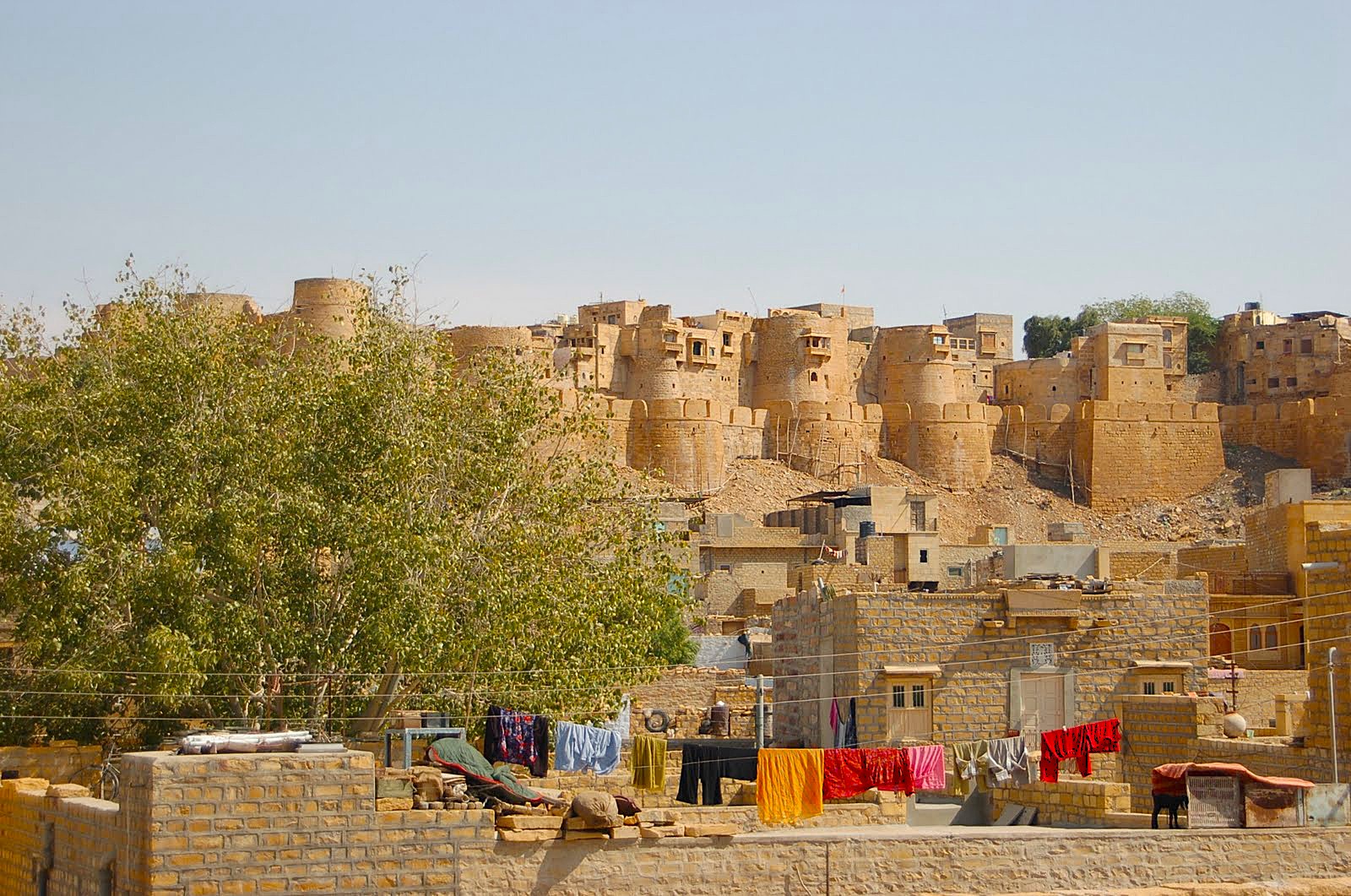
Jaisalmer Fort – built by Emperor Rawal Jaisal in 1156 on Trikuta Hill – is the second oldest fort in Rajasthan and considered one of the most extensive fortifications in the world. It is one of the seven forts in Rajasthan listed as UNESCO World Heritage Sites since 2013. Constructed from massive blocks of golden sandstone, it blends into the surrounding desert.


Counter-clockwise 1: An ornate door decorated with flower motifs within the fort. 2: …and let us walk through that doorway to better see what is beyond. 3: The simplicity and symmetry of this door creates a moment of stillness.


L: No other people, save possibly the English, enjoy their newspapers as much as Indian men. R: This young woman is bedecked in jewelry from head to toe. Every piece has traditional and cultural significance. As I read about it, it seems mostly related to binding a person to the past, to society, and to her husband’s family.
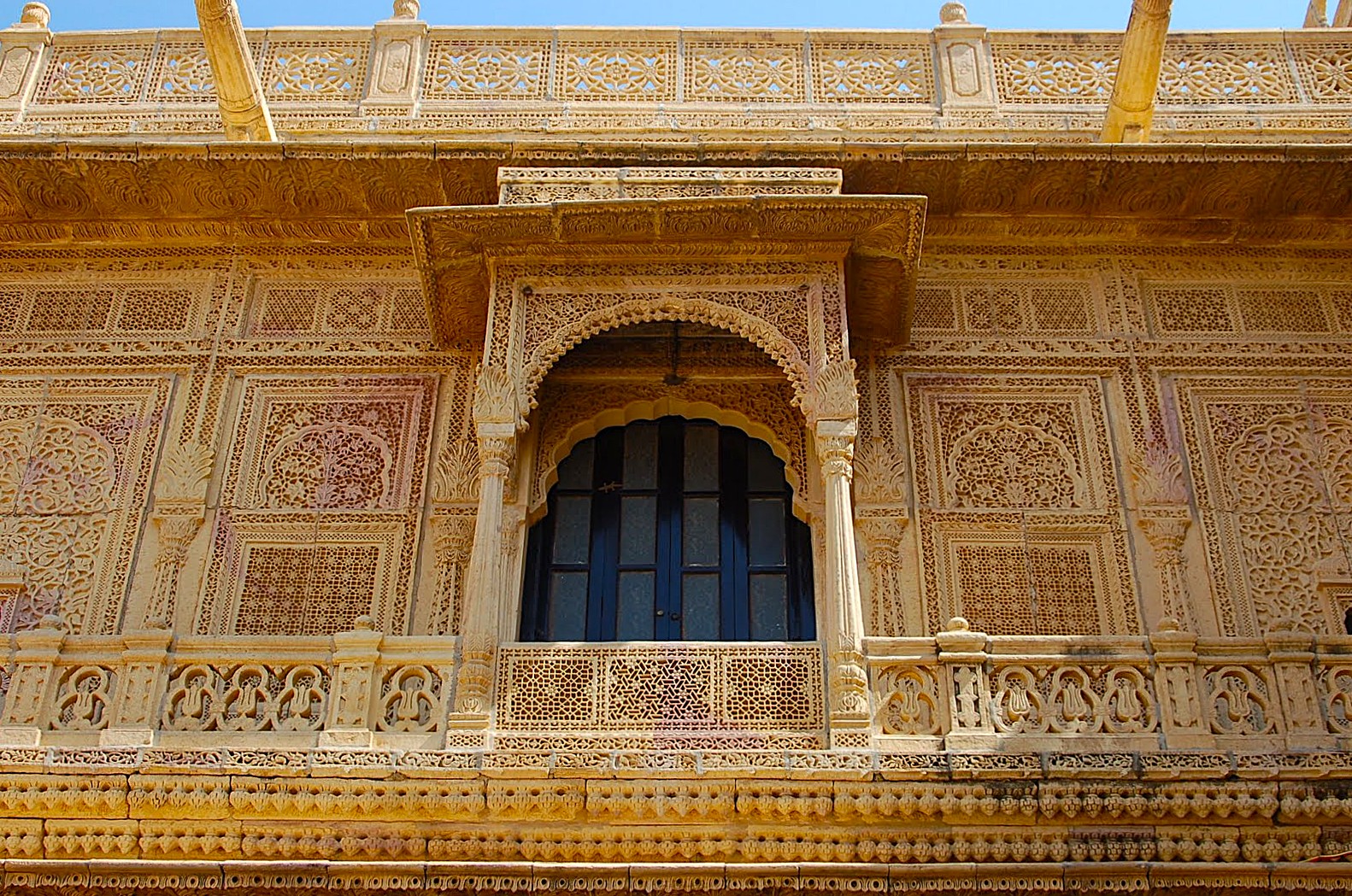
Jaisalmer was at the crossroads of several significant trade routes, one of which was the network known as the Silk Road. For a time it was a very wealthy city. This five-storey group of five interconnected mansions, Patwon Ki Haveli, was built in the first half of the nineteenth century by a wealthy trader, Guman Chand Patwa, for his five sons. The sandstone carvings, arched windows, and those so-very-delicate jharokhas (balconies) define this blend of Rajput and Mughal architecture.


The women of Rajasthan provide such a vivid splash of color. Here one is peering out of her jharokha at the street below. And what a nice arrangement, to have a platform outside your house to sit on and contemplate, or relax with friends and neighbors and receive friendly cows.
Jailsalmer is the farthest west we traveled.
Jodhpur
Next up was Jodhpur; it took about six hours by bus to cover the 175-mile (280-kilometer) distance.
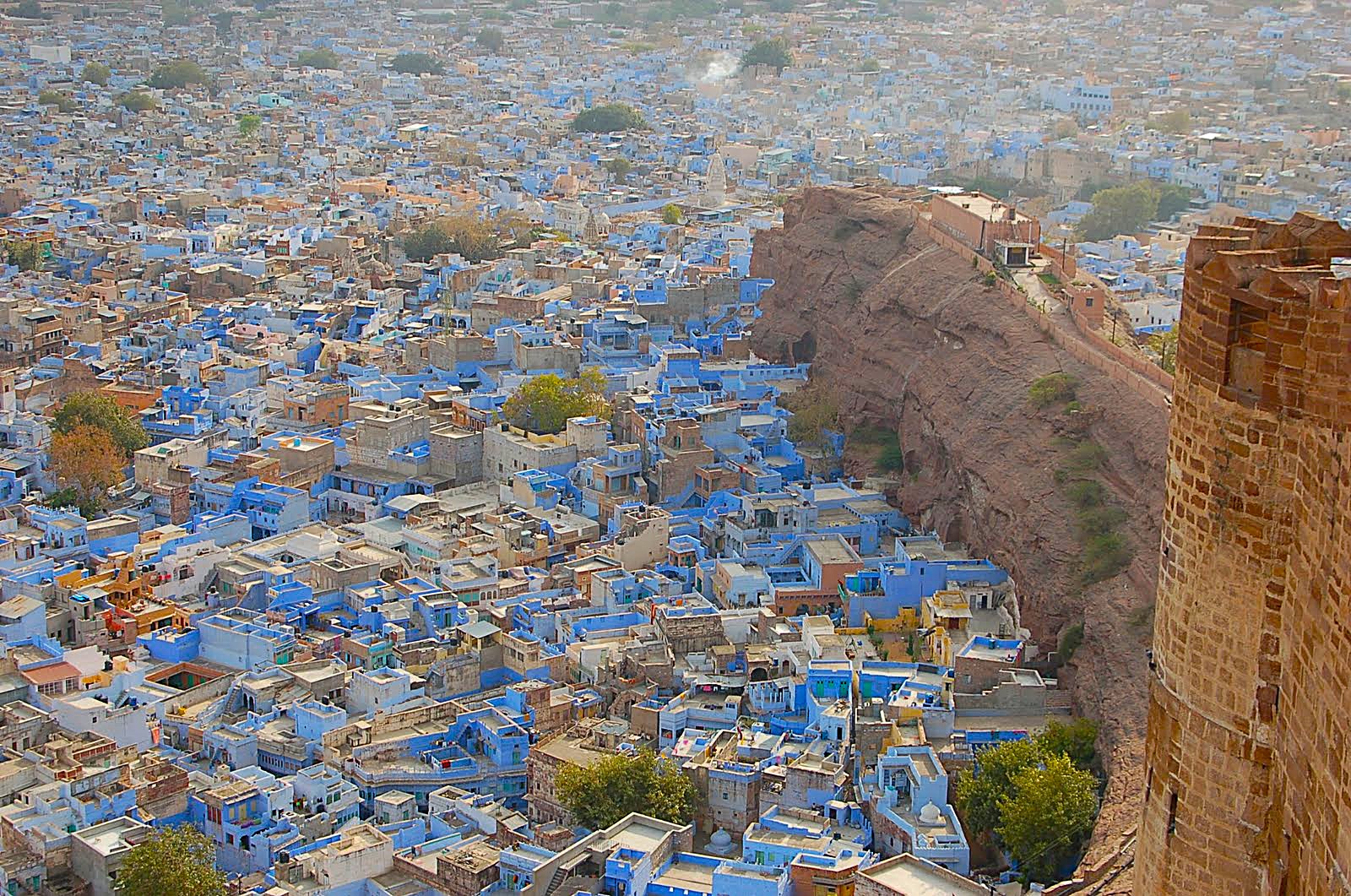
Jodhpur is referred to as the ‘Blue City’. The blue paint, basically a lime wash with copper sulfate added, helps to cool by reflecting the sun and protects from termites and other insects; it also acts as a fungicide. Jodhpur’s massive Mehrangarh Fort creates an imposing presence.
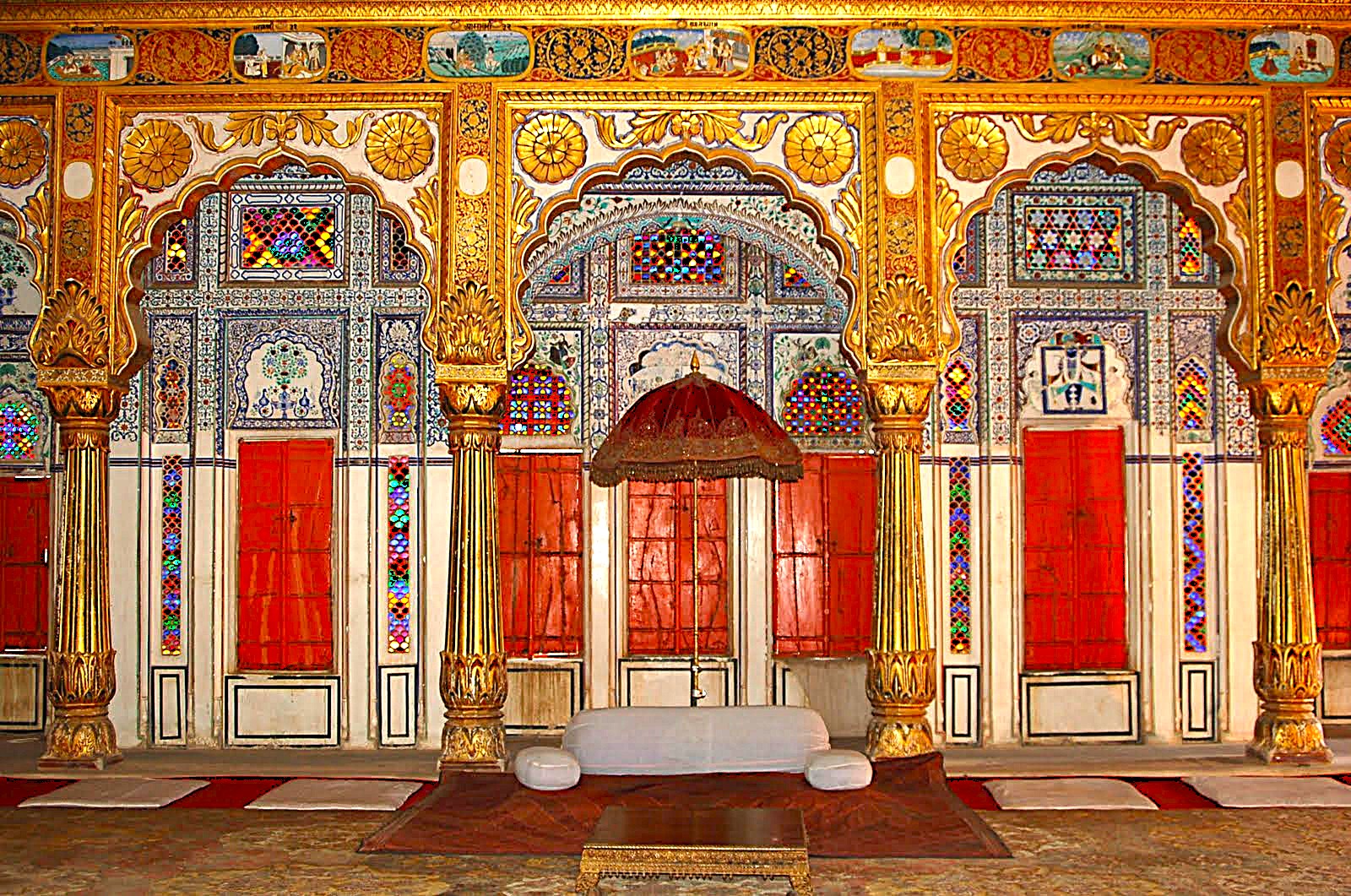
A sample of the fort’s ornate interior.
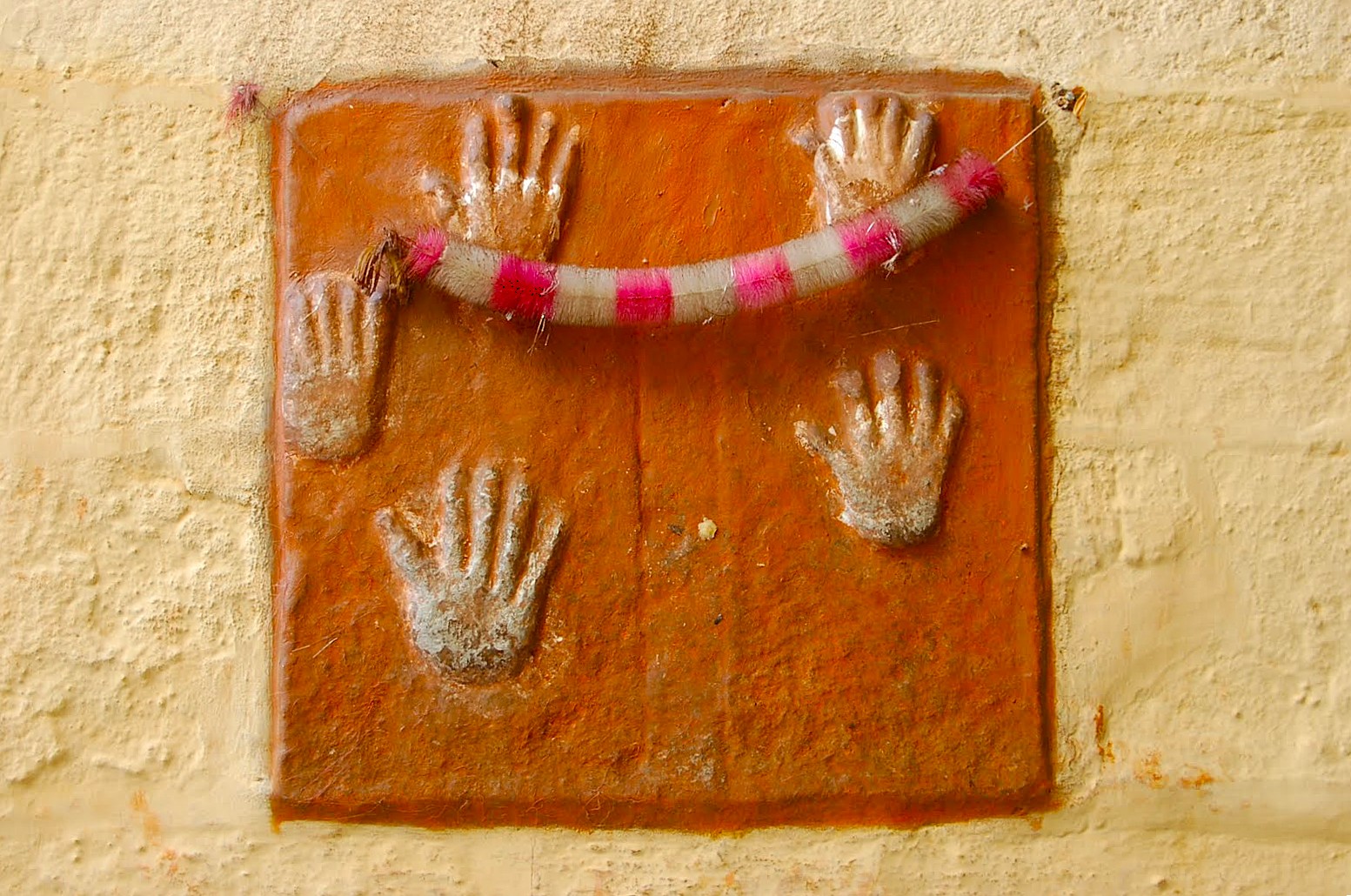
These are handprints of fifteen queens who practiced sati – when their husbands died they would join him on the funeral pyre. The British colonial government outlawed this practice, but isolated incidents continued late into the twentieth century. The Indian government passed the Sati Prevention Act in 1987, criminalizing the aiding or glorifying of sati. Seeing these small handprints and reading their significance is deeply disturbing.
Pushkar
Our last stop in Rajasthan was Pushkar. The name means ‘blue lotus flower’. 1
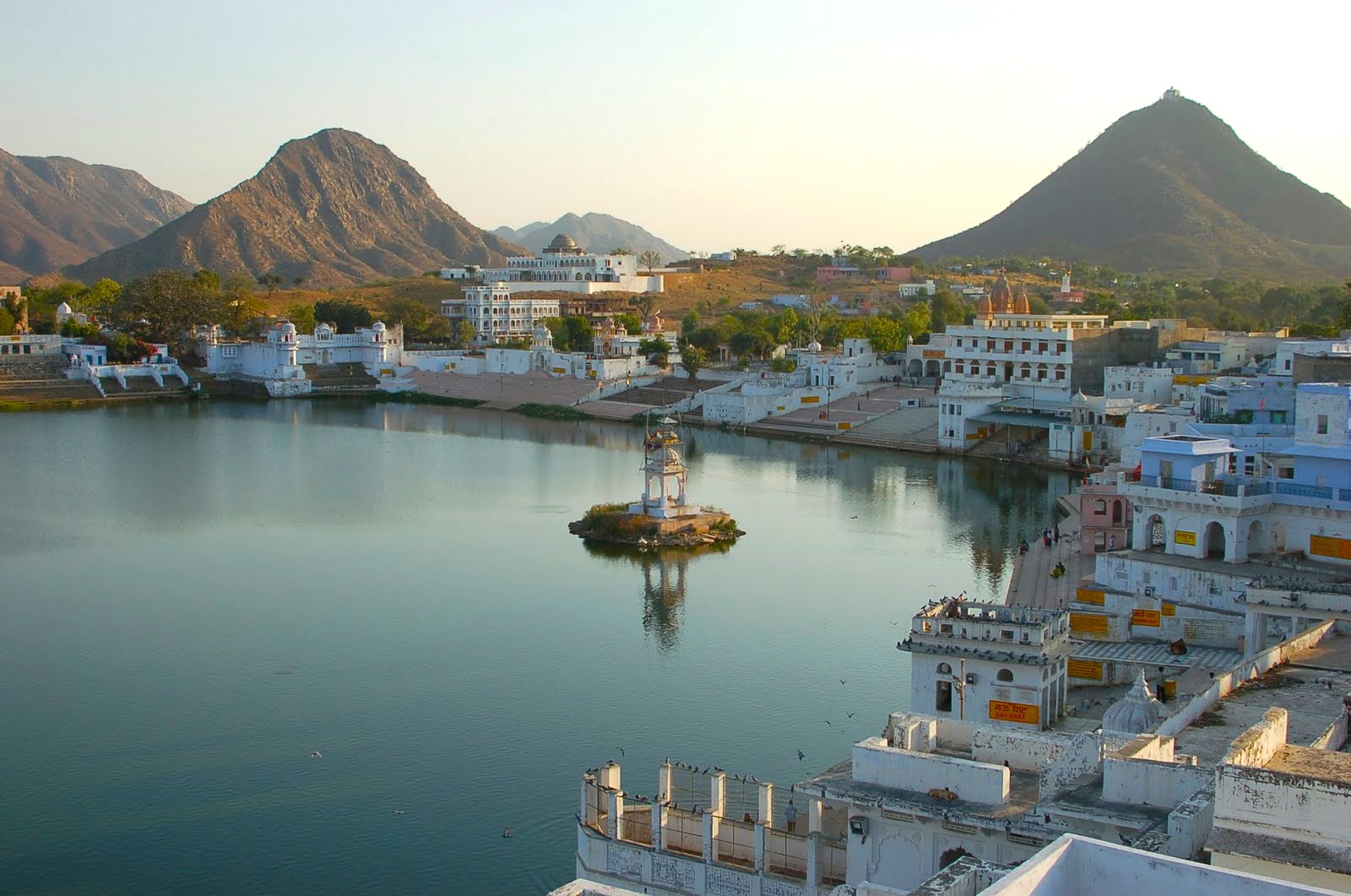
Another incredible gem with its central lake surrounded by a galaxy of temples. The view from rooftop restaurants is mesmerizing.
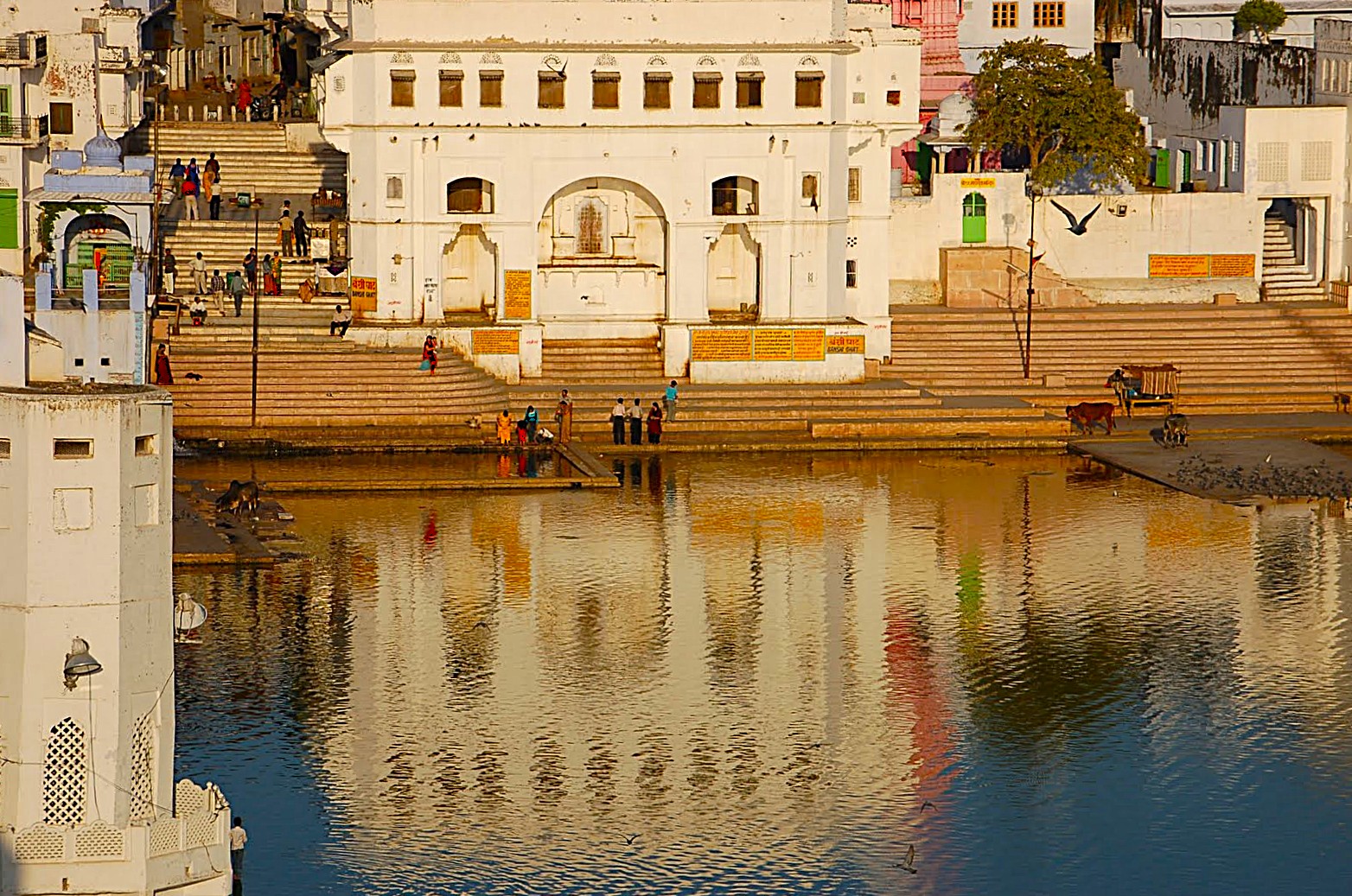
The ancient city of Pushkar has a beautiful myth associated with its creation – Brahma, the creator of the universe, dropped a lotus flower on the ground from which a lake emerged, the waters of which contain the essence of existence. Pushkar has one of the few temples in India dedicated to Brahma. It is an important pilgrimage site and bathing in the sacred waters is an essential purification ritual for visiting pilgrims.
An overnight bus with bunk beds conveyed us to Delhi (290 miles [470 kilometers]) where we stayed for a couple of days. We sought out Chaitanya Keerti at the Raj Yoga Osho Meditation Center. He is an old friend of ours; Purushottama had worked with him in Buddhaghosa on the Ranch. Keerti pointed out that it was Enlightenment Day the following day (news to us as we were clueless about the date!). He invited us to spend the day at Osho Dham for the celebration, and he kindly arranged transportation for us.
Osho Dham is about 30 miles (48 kilometers) south of central Delhi on the southwestern outskirts. It was beautiful then, in 2006, but the plants and trees along the pathways were not yet mature. It must be a paradise now twenty years on. The day was a mix of meditation, listening to an Osho discourse, and some gentle group work. It was a lovely place to be on such a day.
Sources and related links
- The Legend of Pushkar: wikipedia.org
In the same travel series: A Pilgrimage
- A woman sage and the City of Lakes – Amido and Purushottama travel to Rajasthan, Udaipur and Mount Abu, where they visit Vimala Thakar (Part 4)
- The end of the Pilgrimage (for now…) – Amido and Purushottama visit the samadhis of Osho, Hazrat Babajan, Ramesh Balsekar, Sai Baba of Shirdi, and Meher Baba – plus Nisargadatta’s flat and the Ajanta and Ellora caves (Part 3)
- The Pilgrimage continues… – Purushottama and Amido visit Kerala and Karnataka – and two holy men, Ajja and U.G. (Part 2)
- A pilgrimage – Amido and Purushottama visit India in 2005 – a pilgrimage to places where Masters and holy men have lived (Part 1)


Comments are closed.