

Amido and Purushottama remember their 2006 travels: visiting the samadhis of Osho, Hazrat Babajan, Ramesh Balsekar, Sai Baba of Shirdi, and Meher Baba – plus Nisargadatta’s flat and the Ajanta and Ellora caves (Part 3)
(click on images to see fullscreen)
How to start the journey?
The journey has already started; you are not to start it. Everybody is already in the journey. We have found ourselves in the middle of it. There is no beginning to it and no end to it. Life is journey. The first thing to be understood is that it doesn’t need to be started now. It has always been going on. You are in the journey.
Osho, The Beloved, Vol 1, Ch 4, Q 1 (read full question)
Pune: Osho and Hazrat Babajan
We left Bangalore (Bangaluru) by train, destination Mumbai, after spending a couple of days with U.G. Krishnamurti (The Pilgrimage continues…). Many hours later, we heard the conductor announce that the next station was Pune. We had not expected the train to take this route as we were heading to see Ramesh Balsekar first and visit Pune before our excursion to Shirdi. It was in the early hours of the morning, and, checking our watches, we realized it was my sannyas birthday. We spontaneously jumped off the train.
So we found ourselves in Pune, at 2:30 in the morning. Pune does not sleep; the station and nearby streets teemed with people. The food-stall cooks sent up clouds of steam as they prepared snacks for the nocturnal.
Luckily we had our (gigantic) Lonely Planet India weighing us down! We made our way to a nearby guesthouse, of course not open at this time, but we sat on the porch so comfortably for several hours until the sun came up, and then made our way to Koregaon Park. We had picked out a few possibilities of places to stay. But what was calling more strongly was breakfast – which we ate at Prem’s when it opened.
Once rid of our luggage in our chosen guesthouse we headed toward the Resort. We walked through the morning streets, which were quiet, sparsely populated and, yes, there they were… the banyan trees, the bougainvillea, the parrots, the haziness of those mornings warning of the heat to come, memories of which had so often visited me in the intervening years. Purushottama had some hesitation about entering the Resort. Twenty-five years had passed since we had last set foot in the ashram and so many things had changed in the intervening time.


L: We walked and walked in those early hours through these Koregaon Park roads, which stirred up memories and helped sort out the present. Eventually, all became clear – as it does when space is given. R: We bought ourselves a couple of maroon robes and entered.
Garimo was the first person we saw and then Devageet; he was so loving. We had our blood tests and bought our three-day passes, and there we were… the trees so much taller, the buildings grander… but the feeling, well… the fragrance of Osho lingers on… love is everywhere… a sense of slowing… and that being at home is being within.
A troupe of langurs were visiting; one studied herself so carefully in a mirror set up in the space that had been the Buddha Hall.
I met Baul who, at the end of the Ranch, had been so kind as to rent me a room in his flat in Amsterdam, and was so understanding of the sense of loss I was experiencing. I was now able to introduce him Purushottama, whom I had left Amsterdam to be with.
At the Resort we were most strongly drawn to Osho’s samadhi, spending as much time there as possible.
We meditated in the pyramid – the Osho Auditorium. What I had found so beautiful about doing Kundalini in Pune 1 was the openness of Buddha Hall to its surroundings – the early evening scents and sounds, the birdsong, a sense that the business of the day was winding down – those scheduled for darshan would be getting ready… Within the pyramid, however, since it is completely enclosed, the focus was more strongly inward.


Osho Teerth Park beckoned us, and we spent many an hour wandering its pathways and photographing its beauty. (This was 20 years ago. No doubt it is even more lush now.)
One afternoon we went in search of Hazrat Babajan’s samadhi. Osho has mentioned her in his discourses. She assisted Meher Baba (who grew up in Pune) on his journey. The following paragraphs briefly describe their interconnection.
“One day in May of 1913, while on his way to Deccan College in Poona, Merwan (later affectionately called Meher Baba by his lovers) was beckoned by a very old woman sitting under a neem tree. She looked radiant and her eyes beamed with divinity. She wore only a rough blanket wrapped around [herself]. This was Hazrat Babajan, one of the five God-realized Perfect Masters of the time. At this first meeting, Babajan embraced Merwan, and the effect of this contact led him to lose all worldly interest. He took to sitting with her regularly for hours, especially at night.
“Then one January evening in 1914, Babajan kissed Merwan on his forehead, between his eyebrows, and made him realize in a flash the infinite bliss of Self-realization (God-realization). Merwan lost consciousness of everyone and everything, except the infinite bliss of his own Eternal Existence,” writes Bal Natu in Hazrat Babajan and Meher Baba.


We found that very neem tree. It had been severely cut back, only the trunk and one thick leafless branch remained. We watched how a Muslim man was so beautifully caring for Hazrat Babajan’s samadhi, which was under the tree.
We entered the samadhi and sat for a while. Then Purushottama started weeping uncontrollably, he was wracked by sobs that came wave upon wave. Once the storm had abated, it was as if nothing had happened! The Muslim man was not the least disturbed and was just offering silent support.
Back at the Resort, we met old friends, absorbed the vibrations, and so enjoyed being in this familiar-yet-different environment. It was exciting to see so many people from those countries that had not had the opportunity to be in the ashram before, such as Israelis, Eastern Europeans, Russian, Iranians, and of course the new generations of all nations… now able to be here and imbibe Osho’s presence and absorb everything the Resort has to offer: Osho’s discourses, books, meditations, groups and therapies. It was good that the old-timers like us had made room for this new generation of Osho lovers!
After three days we resumed our journey, traveling to Mumbai by bus. En route I discovered I had left my journal behind – on the kitchen table in our guesthouse. When I took sannyas, Osho had said, “The past is dead.” Somehow, in spite of my intermittent regret at having lost the journal, it seemed very appropriate to have left it in Pune!
Mumbai: Ramesh Balsekar and Nisargadatta
Mumbai, what a city! Potentially totally overwhelming. We walked across the Maidan, where Osho had given the famous talks – which were then translated and published as From Sex to Superconsciousness.
We checked out the Victoria train station (renamed Chhatrapati Shivaji Maharaj Terminus), a building of great beauty (no wonder it’s a UNESCO World Heritage site), walked to The Gateway to India and saw the Taj Mahal Hotel, where Purushottama had stayed prior to heading to New Jersey to help prepare the Castle for Osho’s arrival in 1981.
We visited Ramesh Balsekar one morning. Quite a crowd had gathered in his substantial apartment. He had been one of the translators for Nisargadatta, and authored many books himself. We sat with him for an entire morning session, and by the end of it, we knew we would not be returning. Purushottama found that he did not appreciate the man as much as he had appreciated his books. I was not drawn to him.


L: Meeting Ramesh Balsekar, and on the wall behind him a photograph of Nisargadatta. R: The building where Nisargadatta lived and received his devotees.
We did, however, go in search of Nisargadatta’s flat, and found the building where he had lived and met with visitors, and where he had owned a beedi shop downstairs. We knocked on the door. The woman who answered said she was his niece. She showed us into the room where Nisargadatta used to receive devotees. Her young son was riding up and down on a small tricycle, but nothing could disturb the depth of silence, the stillness, that filled the space. We sat there for a while. So gracious of his niece to share his presence with some random strangers.
Purushottama had read Nisargadatta’s I Am That in the 1990s and had encouraged me to read it too. At that time I could not understand it, but by now I was reading everything of Nisargadatta’s I could get my hands on. I particularly enjoyed the books edited by Jean Dunn.
There is a wonderful story that ‘Big’ Rama told us. He and another sannyasin were going to Mumbai, sometime in the late seventies, on printing business and were given an assignment. I scribbled down the story so as not to forget it and then wrote this poem:
The Beedi Baba
One day, the Master asked
Two disciples to visit the Beedi Baba
They rendezvoused with Vivek
In front of Lao Tzu house
To obtain directions
They found his shop
“Smoke?” he asked
They nodded
“American?” he asked
Again, assent
All sat in the smoking area
Silence descended
And met silence ascending
Silence unrelated to sound
The silence of another dimension
He left
So did they
What transpired
Remains
A mystery
And the Beedi Baba was Nisargadatta Maharaj.
(‘Big’ Rama’s obituary on Osho News)
I remember the train we took out of Mumbai. Overcrowded to the max, ancient, dilapidated, a relic from a former time. It was a local train. Fortunately, the further we traveled the emptier it became. We were heading to Nasik; we thought it would be a convenient place to sleep prior to visiting the samadhi of Sai Baba of Shirdi.
Sai Baba of Shirdi
Sai Baba of Shirdi was a revered Saint, known for teaching love, forgiveness, and devotion. He had been born into a Brahmin family, but was brought up by Muslims. He practiced rituals from both paths and attracted Hindu and Muslim followers. He encouraged the development of faith and patience and the indiscriminate love of all living beings.


L: This photograph is familiar to many who have lived in India. Every rickshaw driver, at least in Pune, had it posted on their dashboard. R: Sai Baba of Shirdi’s samadhi.
Sai Baba’s samadhi was beyond popular – and this was 2006, when India’s population was much lower than it is today. The serpentine line created an immense human river, twisting and turning as it flowed. Back and forth, until finally it was our turn to stand before the samadhi. Each person was given seconds because there were so many of us. Nevertheless, that brief time was enough to receive a wave of energy and absorb the sweetness that emanates from the samadhi of this Sufi saint.
Meher Baba
One of the beauties of this interior and exterior journey was discovering the connections between these Beings who shed light in the world.
For example, Meher Baba (who was born Merwan Irani) met Sai Baba in 1915. Hazrat Babajan had told him he would meet a Hindu Sadguru who would help him grow, and “earn name and fame – and you will be the lighting for many lives.” So the young Merwan started searching. (How Meher Baba Met Sai Baba In Shirdi)
Sai Baba’s devotees report of an energy transfer that occurred once, when Sai Baba gave Meher Baba a stern look. Meher Baba felt inexplicable joy and a sense of rejuvenation. He felt an undefined connection that confirmed that Sai Baba was his guru. Meher Baba, however, also felt some confusion because Sai Baba was dressed in Muslim clothes. Understanding this, Sai Baba directed Meher Baba to a realized disciple of his, Upasani Maharaj, who after an absence had just returned to a nearby temple in Shirdi. It was from him then that Meher Baba received self-realization… by looking into his eyes.
Our next mission was to visit Meher Baba’s samadhi. Purushottama had connected with him when living in Kansas City, Missouri, prior to becoming a sannyasin. He felt that Meher Baba (even though he was no longer in the body) was his first guru, and that that connection had prepared him for meeting Osho.
From Shirdi, a bus took us to Ahmednagar (renamed Ahilyanagar), the town closest to Meherabad – a journey of 54 miles (86 kilometers). A rickshaw ride completed the journey.
The driver first took us to Lower Meherabad, where the Mandali Hall, Baba’s Hut, the Dharamshala (rest house) and Hazrat Babajan School are located. Everywhere seemed devoid of people, until we noticed that they had gathered in the Mandali Hall to sing devotional songs. We understood from some signage that they were celebrating the day of Meher Baba’s birth. We peeked in but Purushottama – although he had a personal heart connection with Meher Baba – since he had never been part of the community, didn’t want to insert himself into a devotional celebration.
We quietly withdrew and asked the rickshaw driver, who had agreed to wait for our return, to take us to Upper Meherabad where the samadhi is located. Since everyone was in Lower Meherabad, we had the samadhi to ourselves. This is such a special place. Sacredness, piercing sweetness, his presence abides; my heart opened. Even though Purushottama’s connection with Meher Baba at this time went back thirty years, this was his first visit to his samadhi. After his experience at Hazrat Babajan’s samadhi, he had wondered what the experience at Baba’s would be like. It was a sweet, silent peace without the explosion that had occurred at Babajan’s.


L: My favorite photograph of Meher Baba. R: His samadhi in Meherabad, Maharashtra.
Nearby lies one of the small spaces in which Meher Baba used to isolate himself for months at a time, taking only warm milk and a little coffee for sustenance. Such isolation and the restricted diet enabled him to perform his “universal work” without interruption.
And then, onward to Aurangabad, launching pad for visiting the caves of Ellora and Ajanta. The distance of seventy-five miles (120 kilometers) took about 2 hours by bus. Aurangabad, originally named after the Mughal Emperor Aurangzev, has now been renamed Chhatrapati Sambhaji.
Ellora and Ajanta
Ellora and Ajanta were both listed as UNESCO World Heritage sites in 1983. They are located about sixty-two miles (100 kilometers) apart. Aurangabad, where we spent the night, sits between them; some 20 miles (30 kilometers) from Ellora and 63 miles (100 kilometers) from Ajanta.
The Ellora caves are dated approximately between 600 and 1000 CE whilst the Ajanta caves were created much earlier, between 200 BCE and 500 CE. Both sites are inspiring for the intense devotion such a labor must have entailed.
We took a bus the next day to Ellora. The name Ellora is an anglicized version of Elapura (or Elloorpuram), which means “city of caves” or “temple on a hill.” It perfectly describes this archaeological site of thirty-four caves dug along a 1.6-mile (2-kilometer) stretch of the Charanandri Hills of Maharashtra. (There are in fact over one hundred caves, but only 34 have been excavated and made accessible.)
There are 12 Buddhist, 17 Hindu, and 5 Jain caves. The caves are a mix of viharas (monasteries) and chaityas (shrines, usually with a stupa and prayer hall).
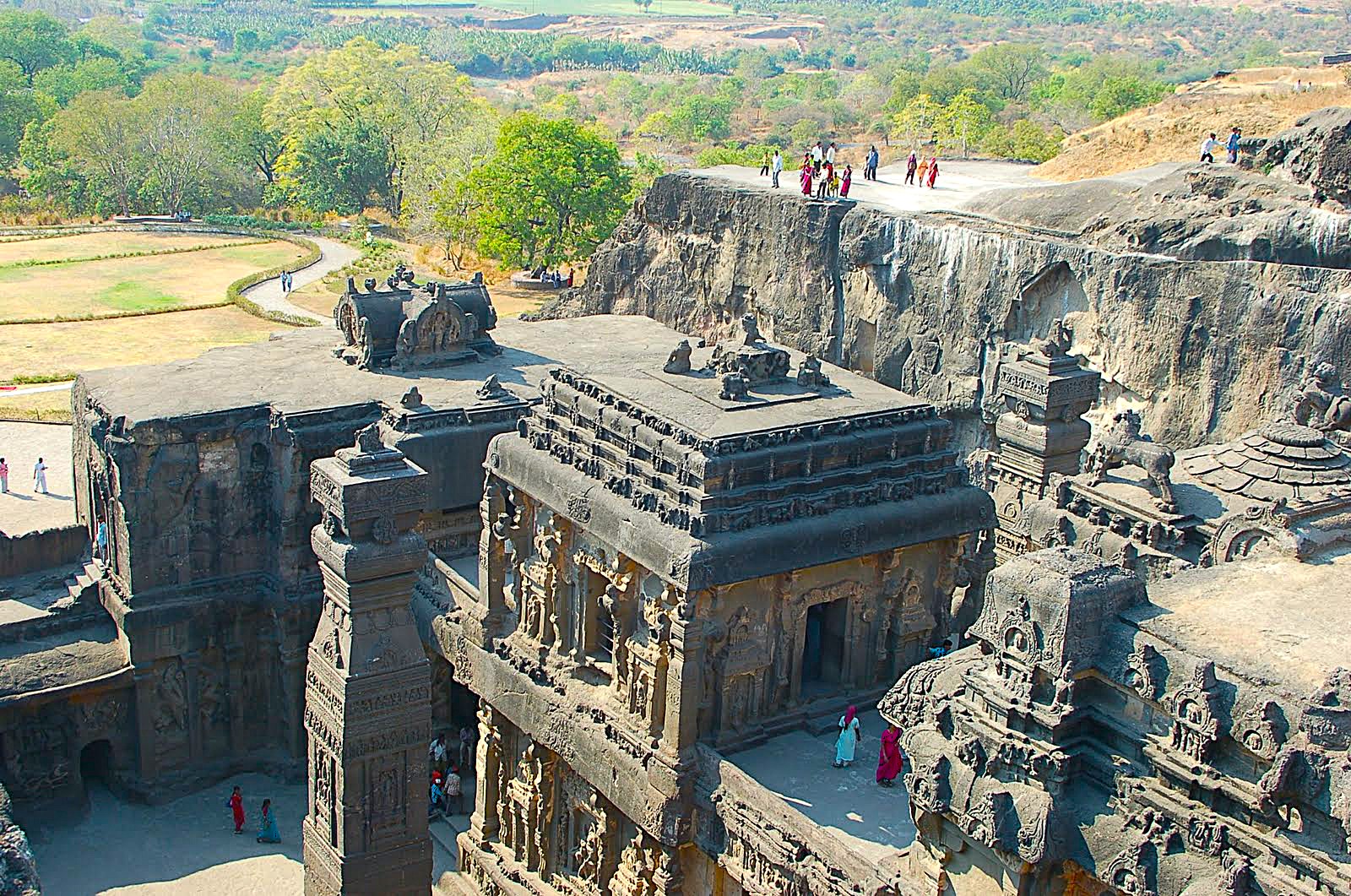
The most impressive creation is the ‘reverse’ of a cave, the Kailasa Temple, carved top down out of a monolith (single slab) of basalt. No room for error in the removal of rock, and what complex oversight must have been in place to ensure the symmetry. The temple is twice the size of the Parthenon in Greece. Artisans removed 200,000 tons of rock. An intense labor of patience, skill, and devotion.
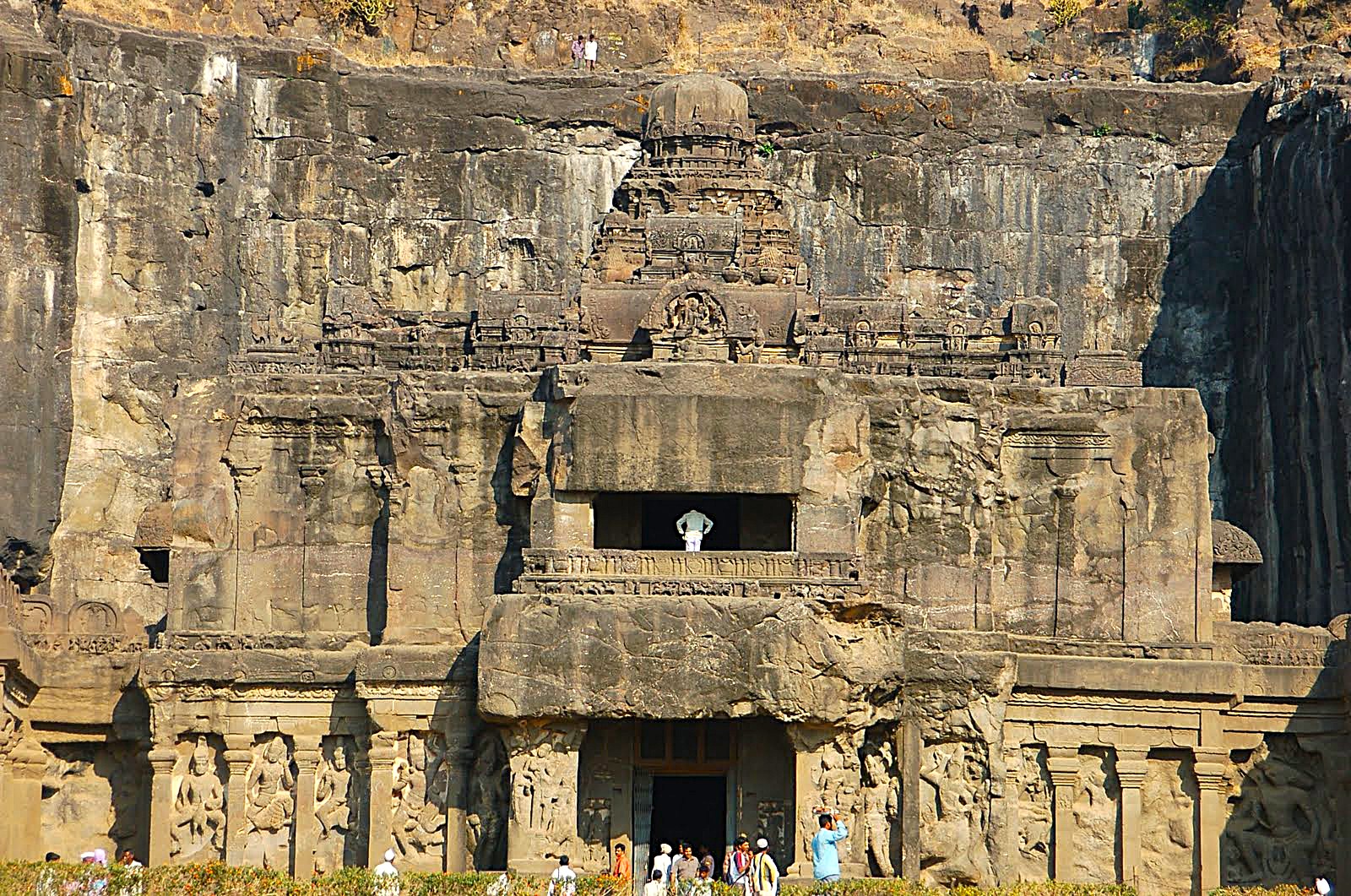
The intricate carvings on the facade of Kailasa Temple illustrate the skill of the artisans.
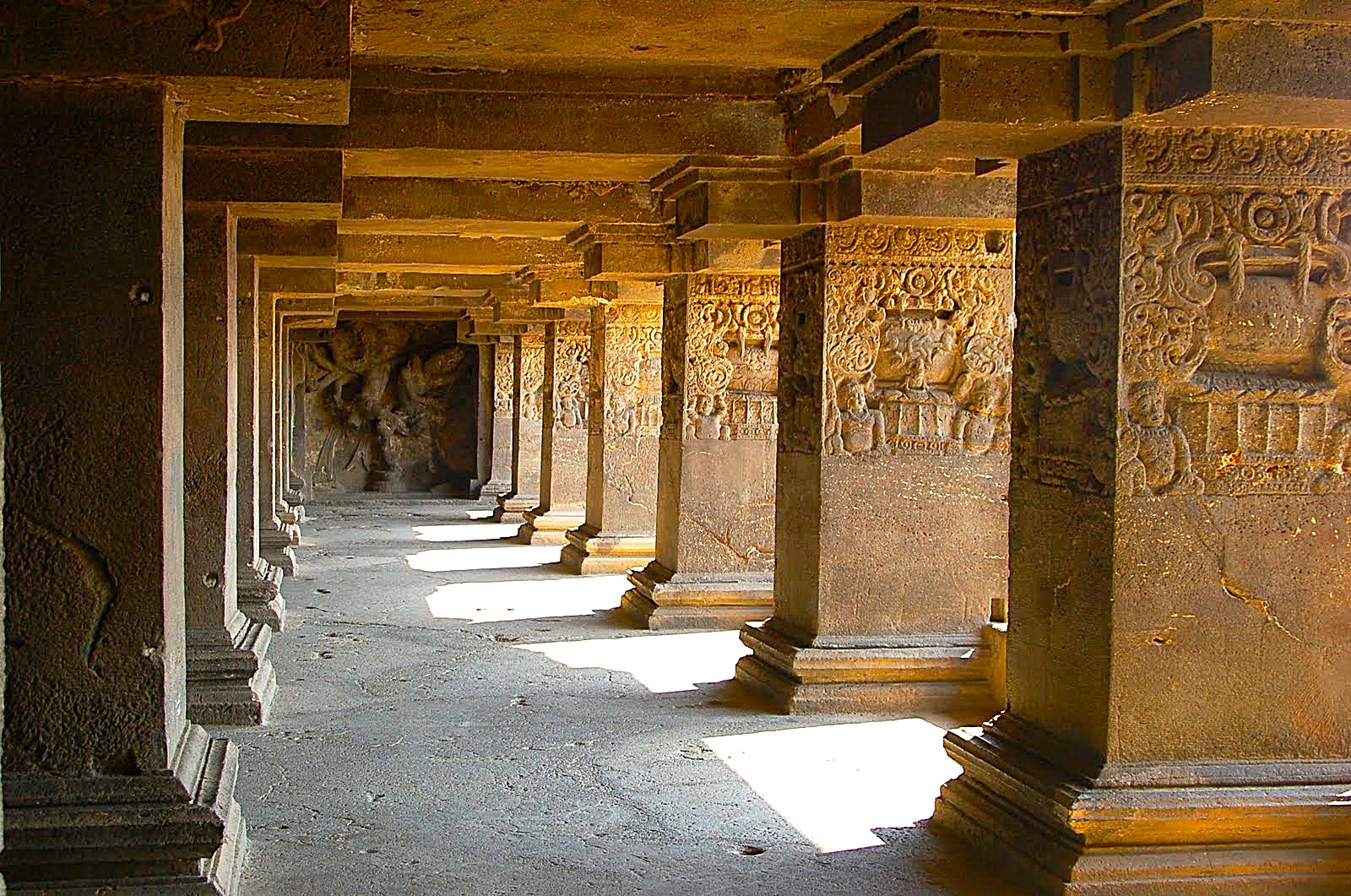
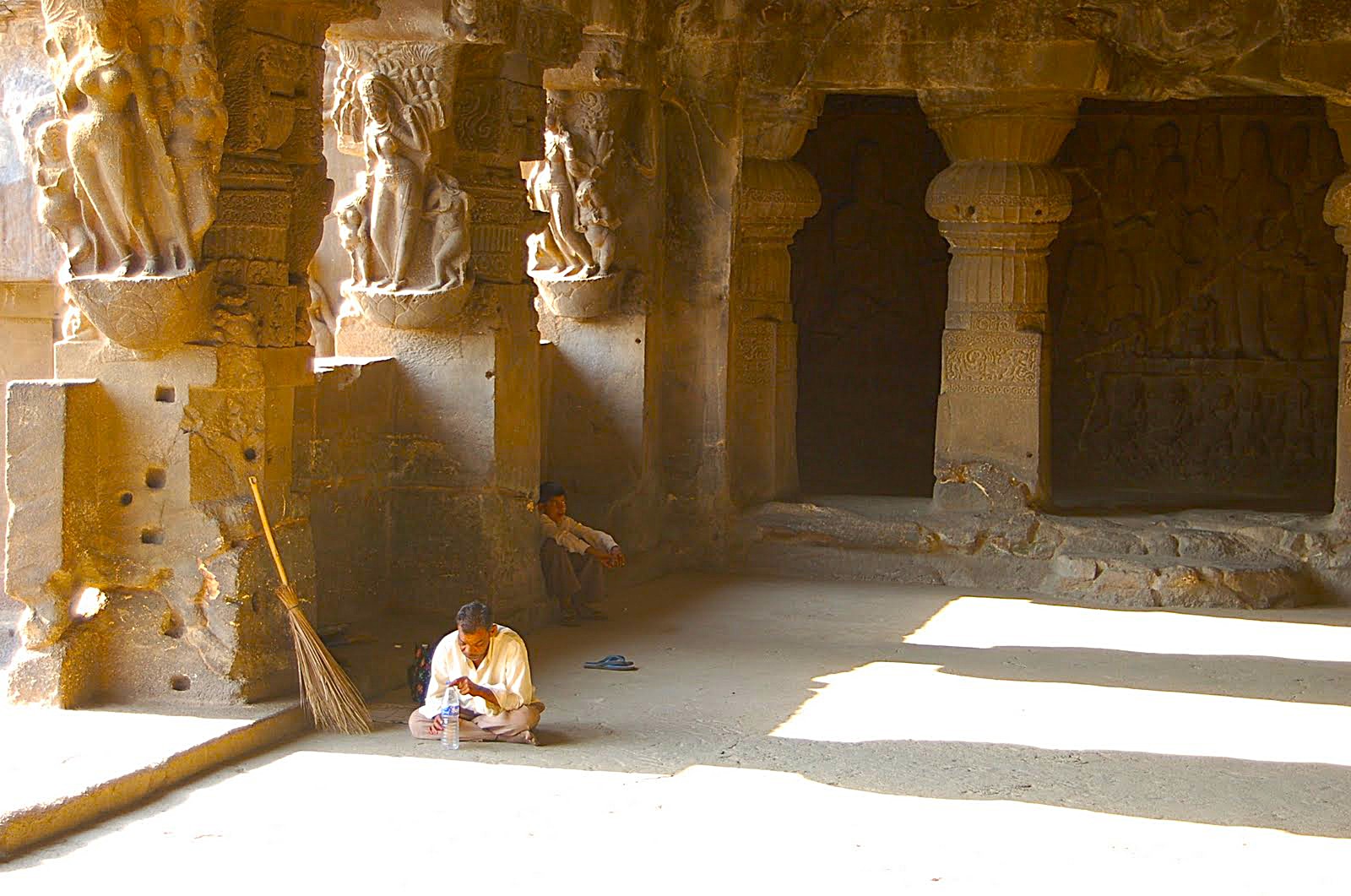
Time for a break among these elaborately decorated pillars.


L: Cave ten, built in the eighth century, is the highlight of the Buddhist caves at Ellora. Described as a chaitya vihara (a prayer hall containing a stupa and a monastery), it is three stories tall at its center with a vaulted ceiling. This has been chiseled to resemble wooden rafters. The sculpture of Buddha is fifteen feet tall and depicts him in vitarka mudra (teaching pose). R: Reclining at the feet of the apsaras.
After spending a day exploring the caves of Ellora, we took a day off! Walking around Aurangabad we came across a beautiful (and famous) Sufi Shrine, at the Panchakki site, a medieval watermill.


L: The mujawar (caretaker/guardian) of the samadhi of the Sufi saint, Dargah of Hazrat Shah Musafir. R: The interior of his samadhi. Purushottama was allowed inside; only men could enter. The mujawar was so gentle in letting me know, and gestured that I could sit in the doorway. He gave both of us rose petals from the samadhi.
Next day, on to Ajanta, some 60 miles (100 kilometers) by bus. I found the caves of Ajanta more intriguing than those of Ellora – possibly because they are entirely Buddhist, and illustrate the transition from aniconic (symbolic) to iconic (human) representations of Buddha.
The caves were built in two distinct phases: the Symbolic (aniconic) Period from the second century BCE to the first century CE, when Buddha’s presence was represented by an empty throne, footprints, the Bodhi tree, the Wheel of Dharma (Dharmachakra), and stupas – an effort to convey ultimate emptiness – resulting in caves simpler in design.
The Human (iconic) Period occurred in the late fifth century and coincided with the rise of Mahayana Buddhism. A sculpture of Buddha in human form was more relatable for followers. It allowed them to see Buddha as a historical figure who lived, suffered as we all do, yet achieved the ultimate flowering.
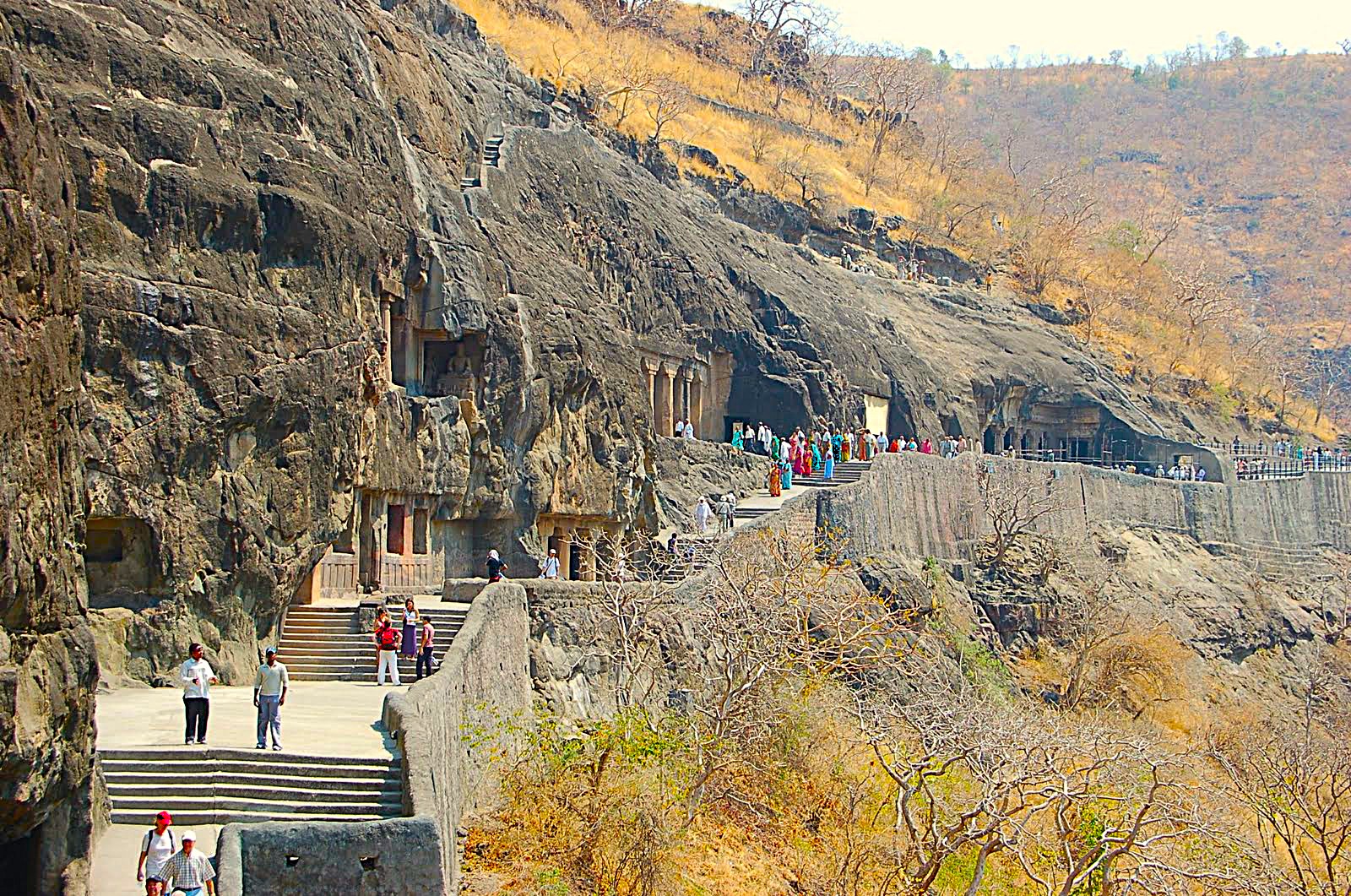
An overview of the caves at Ajanta. Apparently they were “lost” for 1,400 years until an Englishman on a tiger hunt was shown into one of them by a nearby villager. Monsoon floods, mudslides, and dense jungle growth had concealed them and kept their treasures safe from vandalism. (I find these stories of “lost” places misleading since they were not lost to those who lived in their environs.)
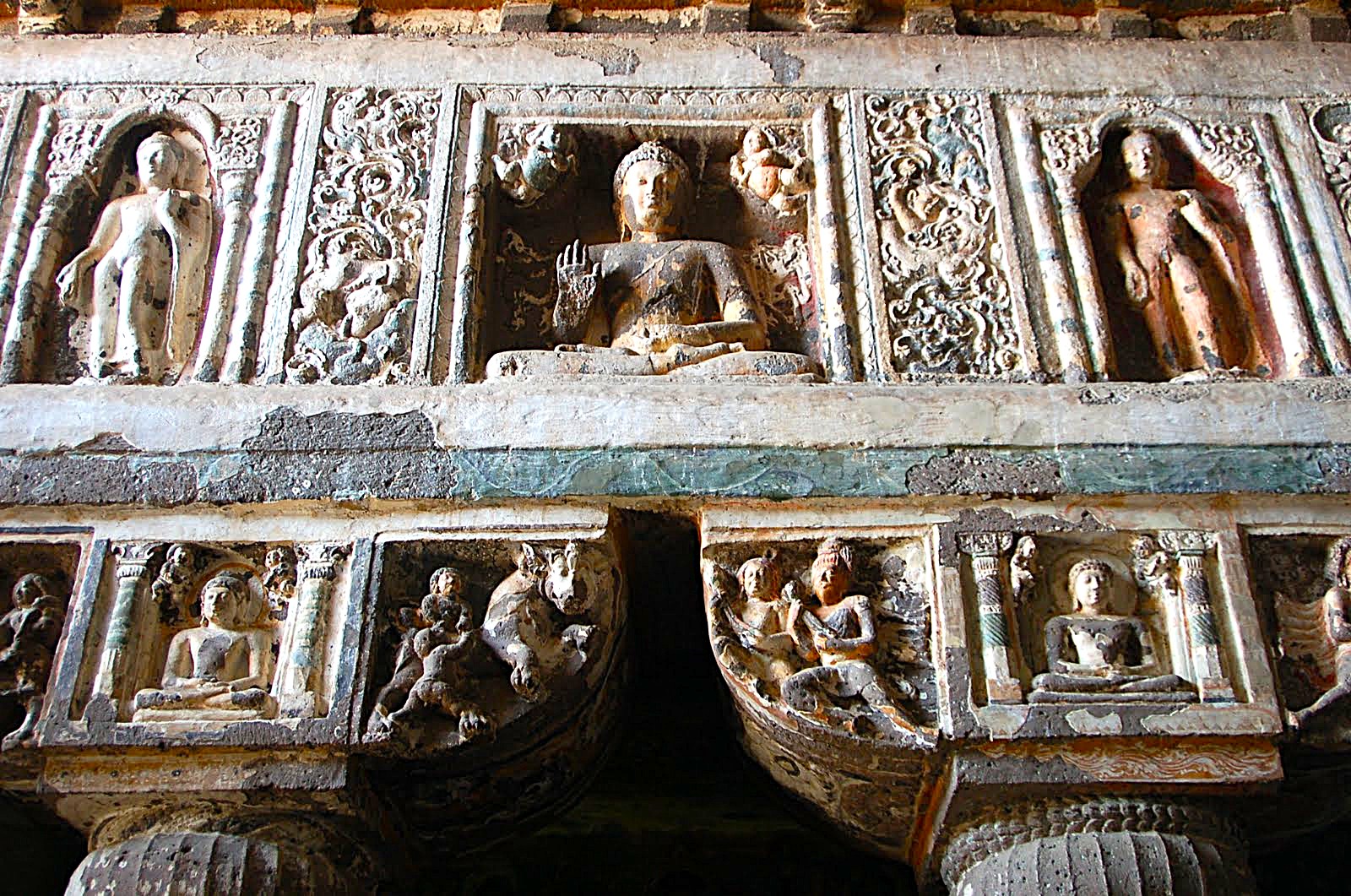
Intricately-carved sculptures on the facade of a cave. The central Buddha’s mudra signifies protection.


1: Several saffron-clad monks were visiting the caves. Purushottama caught this one in an attitude of prayer.
2: Cave nineteen. A chaitya with stupa and standing Buddha. The ceiling is vaulted with the appearance of wooden rafters, though is carved from rock. Some caves are thought to have originally had rafters made from wood that have long since disintegrated. Murals can be seen on the pillars and upper walls, as well as sculptures.
3: Ajanta is most famous for its murals, but these are hard to catch on camera – between the dual challenges of the dimness of the light in the caves, and the crowds. The murals depict the past lives of Buddha based on the Jataka Tales (birth stories of Buddha).
The stone of sculptures and reliefs was colored. A mix of mud, clay, cow dung, and rice husk was applied to the stone and was then smeared with lime plaster – the foundation upon which the paint was applied. Colors such as red and yellow ocher, terre verte (green earth, derived from minerals), lamp black (derived from soot), and lapis lazuli were used to integrate the reliefs with their surrounding murals.
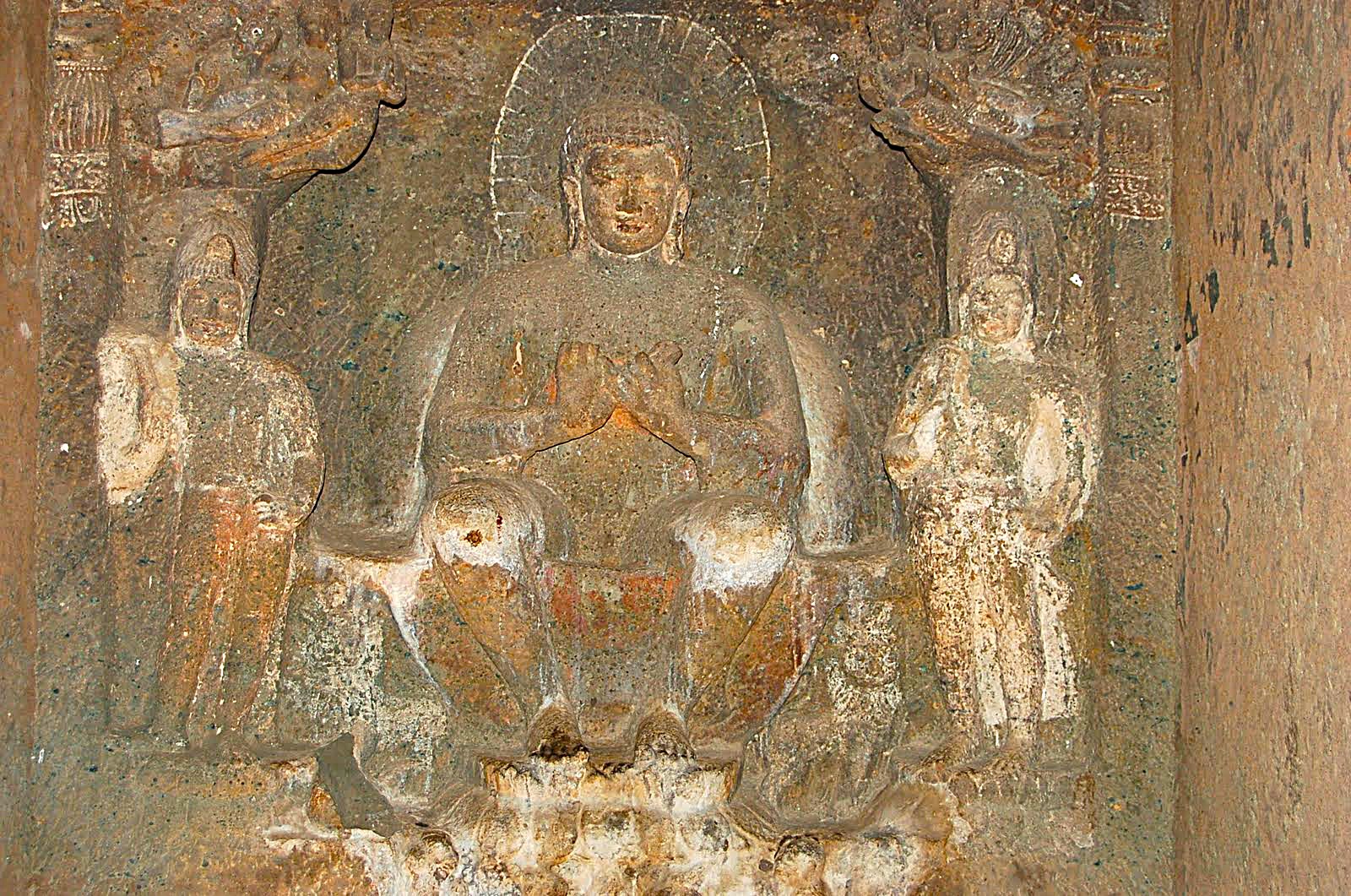
A bas-relief of Buddha teaching.
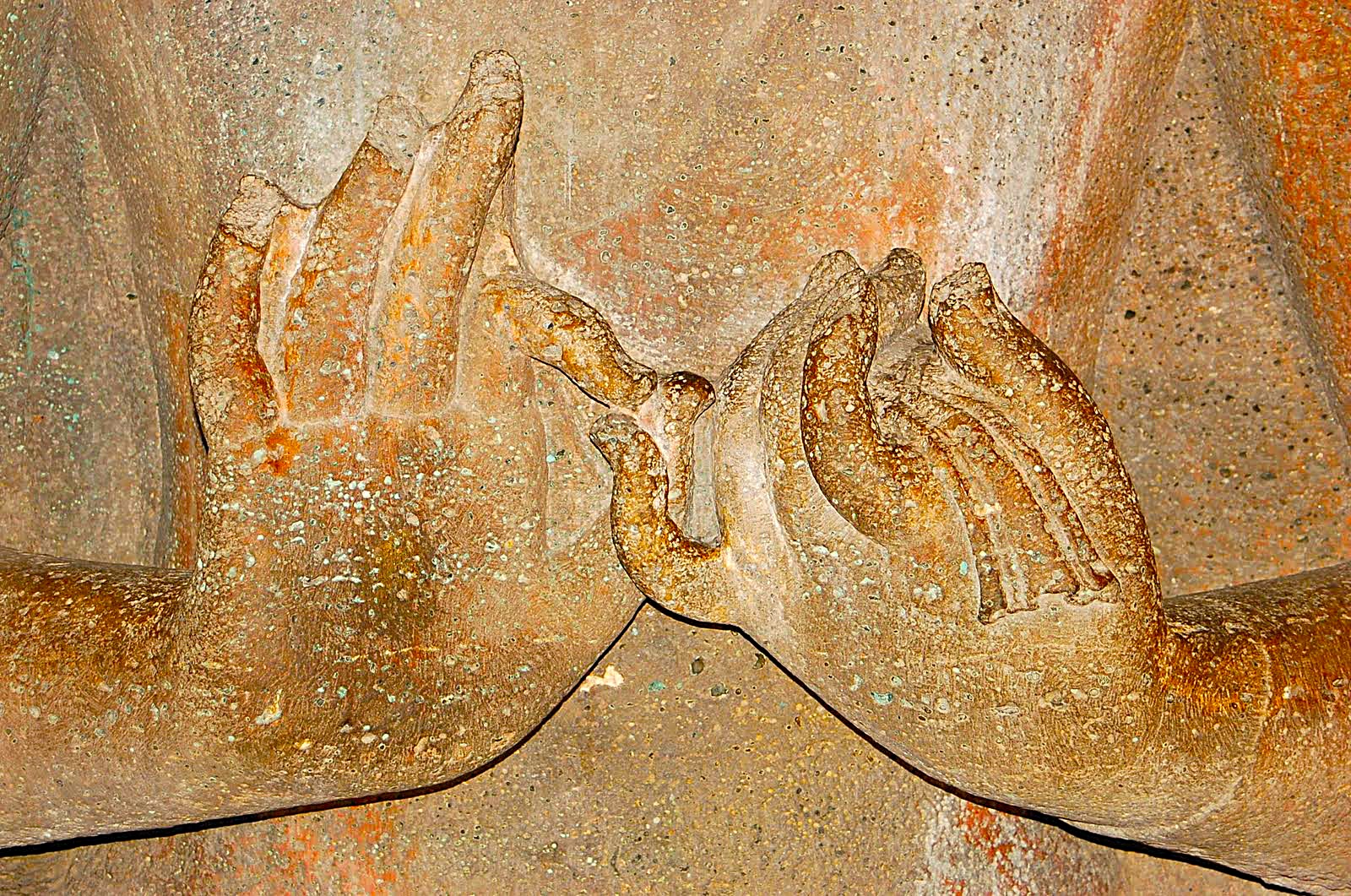
The hands are so graceful, and each finger positioned with such intent by the artist.
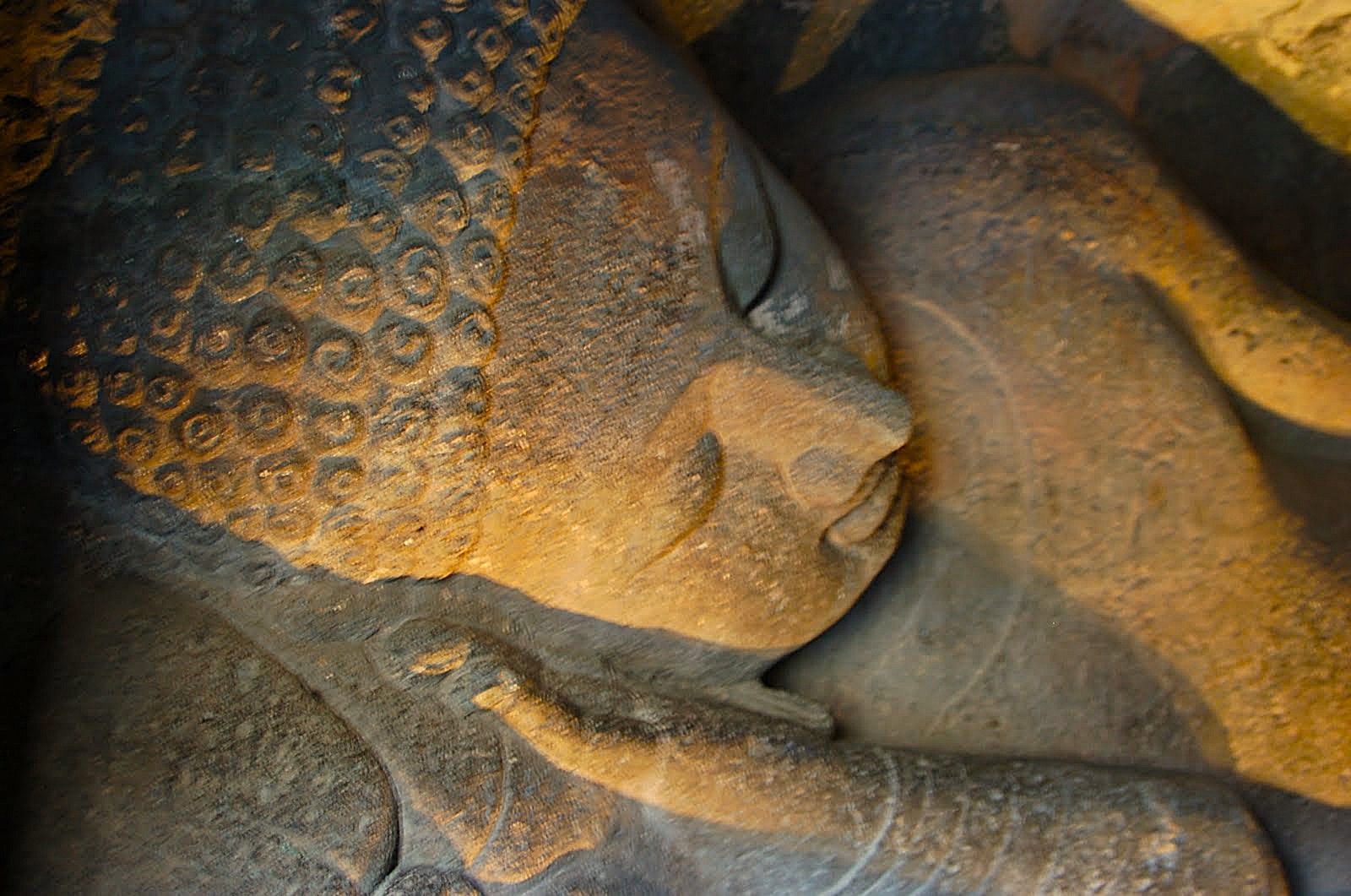
Cave twenty-six, an iconic reclining Buddha. His expression calms us, and those exquisitely-carved curls deserve appreciation.
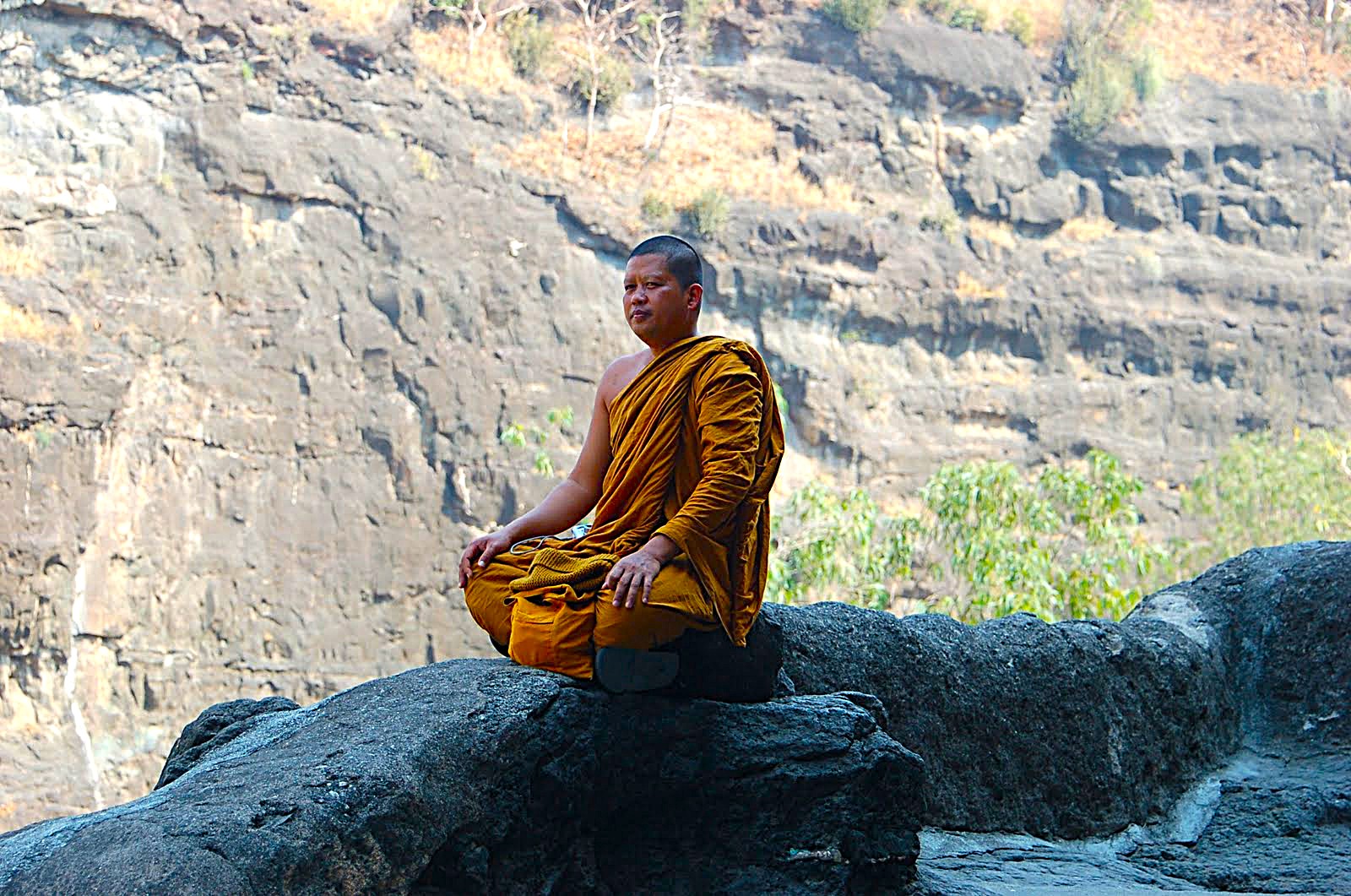
And finally, the whole purpose of the place… to bring peace, settle the spirit, and support meditation.
The following is an inscription from an Ajanta Cave:
One should (therefore) set up a memorial on the mountains
that will endure for as long as the moon and the sun continue.
References
- Hazrat Babajan and Meher Baba: jaibaba.com
- Osho Speaks on Hazrat Babajan: oshonews.com
- Sai Baba of Shirdi: wikipedia.org
- Meher Baba – Sat Sangha Salon: o-meditation.com
- Vignettes of Ajanta & Ellora — Google Arts & Culture: artsandculture.google.com
- Ellora Caves: wikipedia.org
- Archaeological Survey of India – Ministry of Culture: asi.nic.in
In the same travel series
- The Pilgrimage continues… – Purushottama and Amido write about their 2006 travels, when they visited Kerala and Karnataka – and two holy men, Ajja and U.G. (Part 2)
- A pilgrimage – Amido and Purushottama visit India in 2005 – a pilgrimage to places where Masters and holy men have lived (Part 1)



Comments are closed.