

“Meditation has to become something synonymous with your life; it has to be like breathing.”
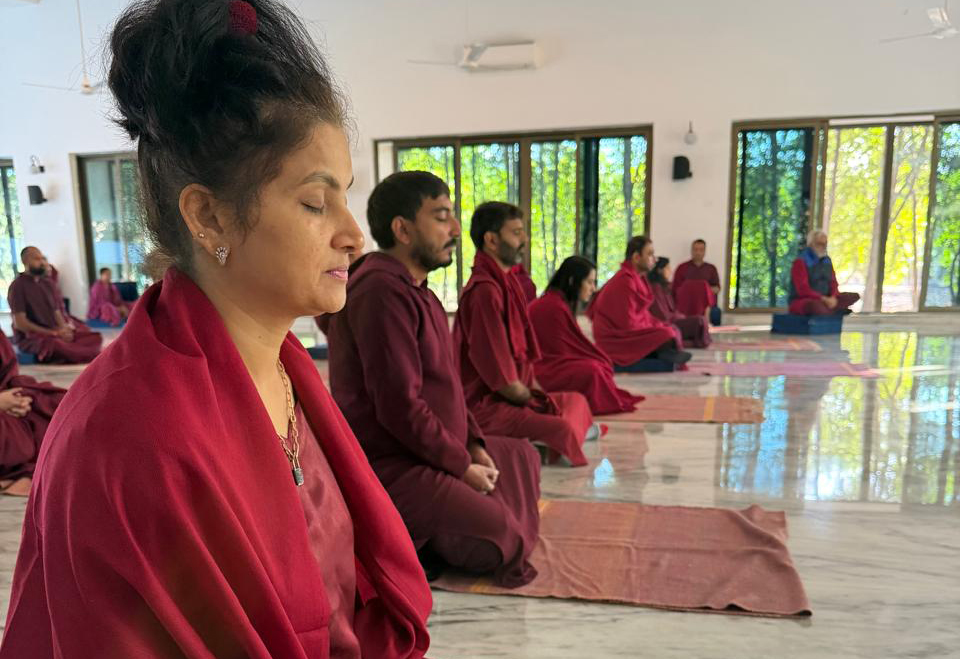
Existence has given you the magic mirror – it is within you.
I have heard a beautiful parable; it must be a parable, it cannot be an historical phenomenon:
When Alexander the Great came to India he collected many valuable treasures. And when he was leaving he came across a fakir, a naked fakir. He asked him, “Do you see my treasures? Have you ever seen anybody with so many treasures?”
The fakir said, “All your treasures are nothing, but I can give you one thing that will really make you rich!”
Alexander could not imagine what this naked fakir could give him. In his begging bowl he had a small mirror. He gave the mirror to Alexander.
Alexander said, “This mirror will make me the richest man in the world? You must be mad!”
The fakir said, “First look in the mirror.”
And Alexander looked into the mirror: it did not show his face – it showed his inner being, it showed his interiority, it showed his subjectivity. His being was reflected in the mirror.
He touched the feet of the fakir and said, “You are right – all my treasures are nothing before this mirror.”
And it is said he kept that mirror continuously with him.
The parable is beautiful. That mirror represents meditation. The fakir must have given him some meditation because only meditation can make you aware of who you are.
But Buddha says meditation has to become something constant. Buddha brings a totally new vision of meditation to the world. Before Buddha, meditation was something that you had to do once or twice a day, one hour in the morning, one hour in the evening, and that was all.
Buddha gave a totally new interpretation to the whole process of meditation. He said: This kind of meditation that you do one hour in the morning, one hour in the evening, you may do five times or four times a day, is not of much value. Meditation cannot be something that you can do apart from life just for one hour or fifteen minutes.
Meditation has to become something synonymous with your life; it has to be like breathing. You cannot breathe one hour in the morning and one hour in the evening, otherwise the evening will never come. It has to be something like breathing: even while you are asleep the breathing continues. You may fall into a coma, but the breathing continues.
Buddha says meditation should become such a constant phenomenon; only then can it transform you. And he evolved a new technique of meditation.
His greatest contribution to the world is vipassana; no other teacher has given such a great gift to the world. Jesus is beautiful, Mahavira is beautiful, Lao Tzu is beautiful, Zarathustra is beautiful, but their contribution, compared to Buddha, is nothing. Even if they are all put together, then too Buddha’s contribution is greater because he gave such a scientific method — simple, yet so penetrating that once you are in tune with it, it becomes a constant factor in your life.
Then you need not do it; you have to do it only in the beginning. Once you have learned the knack of it, it remains with you; you need not do it. Then whatsoever you are doing, it is there. It becomes a backdrop to your life, a background to your life. You are walking, but you walk meditatively. You are eating, but you eat meditatively. You are sleeping, but you sleep meditatively. Remember, even the quality of sleep of a meditator is totally different from the quality of the sleep of a nonmeditator. Everything becomes different because a new factor has entered which changes the whole gestalt.
Vipassana simply means watching your breath, looking at your breath. It is not like yoga pranayama: it is not changing your breath to a certain rhythm – deep breathing, fast breathing. No, it does not change your breathing at all; it has nothing to do with the breathing.
Breathing has only to be used as a device to watch because it is a constant phenomenon in you. You can simply watch it.
Featured image: meditators at Osho Vatika, photographed by Natraj
Series compiled by Shanti
All excerpts of this series can be found in: 1001 Tales


Comments are closed.