

In this final instalment of a three-part interview with Osho’s childhood friend Sukhraj, life itself becomes the teacher. A drunken welcome, a near-fatal accident, a devastating flood – and one sentence transforms everything

An Unexpected Guest in the Deep Woods
For six years, Sukhraj lived in Satdhara, deep in the forest along the banks of the Narmada River, about fifty kilometres from Gadarwara. There he ran a large wood-contracting business employing five hundred people. Whenever Osho visited Gadarwara, Sukhraj would invite him to Satdhara. Osho always accepted, but the visit never materialised.
In 1970, when Osho’s younger brother Niklank was to be married, Osho arrived in Gadarwara the day before the ceremony. The wedding procession had already left for Sagar that morning. Osho told the family he would stay overnight at Sukhraj’s house and travel to Sagar the following afternoon.
That evening, friends from Kareli village arrived at Sukhraj’s house with bottles of alcohol and ice. Sukhraj was a warm and sociable man and had many friends. It was a lively gathering.
“Suddenly we heard a horn behind our house – a car crossing the Narmada bridge. The car stopped right in front of our home. I was a little tipsy and a vulgar word slipped out of my mouth. I wondered who this spoilsport was, coming to ruin the fun.”
As he stepped outside, he recognised the familiar white Fiat with a blue stripe. He was stunned. The door opened and Osho stepped out, accompanied by Ma Yoga Kranti, his secretary. Sukhraj stumbled forward towards the car.
“Why have you come without warning?” he asked curtly. Then, collecting himself, he added, “I am sorry, bhaiya. I am a little drunk.”
“No problem, Sukhraj,” Osho replied. “Don’t worry. We are staying here for the night.”
Inside, the party was in full swing. Everyone fell silent on seeing Osho. Whether from alcohol or excitement, Sukhraj became even more agitated, speaking nonsense: “Our fate is great… we invited you… your grace… thank you, thank you.” He rushed about, asking questions, giving confused instructions to servants, trying desperately to play host.
Osho sat down quietly on a chair. To ease the tension, he began telling a few slightly naughty jokes – then another. Within minutes, everyone was roaring with laughter and the embarrassment dissolved.
After some time, Osho drank a glass of milk and went to sleep on a cot in the courtyard under the open sky. Sukhraj sat nearby on a pallet, worrying. It was too hot, there was no electricity to run a fan, and the mosquitoes were relentless. He silently prayed they would spare his friend.
“You won’t believe me,” Sukhraj says. “My prayers were answered. A cool breeze began to blow. The night turned chilly and I had to cover everyone with blankets. The usual battalions of mosquitoes did not appear.”
Osho lay with a blanket near his feet. Sukhraj tiptoed over to adjust it when Osho said, “Sukhraj, I am fine. Don’t bother.”
Startled, Sukhraj whispered, “Are you awake, bhaiya?”
“No,” Osho replied serenely, “I am asleep.”
Breakfast
The next challenge was breakfast. The night before, Sukhraj repeatedly telephoned his manager, ordering him to bring generous supplies from the nearest bazaar. Finally, the manager protested, “Sir, you have told me this six times. I have written everything down. It will all arrive in the morning.”
In the morning, in Sukhraj’s cluttered office, Osho performed the bullworker exercises he was practising at the time. In the kitchen, Bharti, Sukhraj’s wife, churned curd to make buttermilk and prepared sweets and other delicacies.
Osho, who was constantly experimenting with different diets, was at that time living mainly on orange juice and cereal. Seeing Bharti’s efforts, Kranti said, “You are wasting your time. Osho does not eat these things.”
“No,” Osho interrupted gently. “Today I will eat everything. I have come to Sukhraj’s house and I will eat what has been prepared.”
At breakfast, Osho enacted a playful drama. Each time he picked up a morsel, he exclaimed, “Sukhraj, see how delicious this is,” and placed it in Sukhraj’s mouth. Another bite was accompanied by, “I have never tasted anything like this in my life! Just try it!”
“In this way,” Sukhraj says, “he went on feeding me, and I ended up eating everything that had been prepared for him.”
It’s No Genius’ Work
After breakfast, Osho asked about Sukhraj’s life. Sukhraj confessed that he was increasingly dissatisfied with the wood business in Satdhara. It was expanding rapidly and becoming difficult to manage, especially because of government contracts.
His enterprise had grown enormously: forty office staff, five Mercedes-Benz cars and four hundred labourers. Osho’s expression showed he understood Sukhraj’s boredom.
“How long will this go on?” Osho asked.
“After this tender, I will close the business,” Sukhraj replied. “I will wind it up in two or three months.”
Turning to Bharti, Osho asked, “Do you think he will finish it in three months?”
“Not a chance,” Bharti answered. “Yesterday he accepted another contract that will keep him busy for two more years. And now he is dreaming of producing a film. A scriptwriter from Mumbai has been staying at our house. Big plans are being made.”
Osho looked at Sukhraj and said quietly, “It’s no genius’ work – this is not work worthy of your intelligence.”
“I will never forget that sentence,” Sukhraj says. “Afterwards it followed me like the tail of a comet.”
Journey to Sagar: The Accident
The following morning Osho was to leave for Sagar at ten. His brother Niklank would travel with him, along with Kranti.
“Come with me,” Osho said to Sukhraj.
“Your car is small and already full,” Sukhraj replied. “You go ahead. I will follow later.”
“Then at least send your son Shekhar with me,” Osho suggested.
But Sukhraj declined and insisted on travelling separately. Osho repeatedly urged him to reach Sagar by four o’clock.
“It often happens,” Sukhraj reflects, “that Osho’s clairvoyant eyes see something and we, blinded by our limited vision, begin arguing. He never imposes. His words stand delicately between certainty and uncertainty – like a subtle suggestion. Whether we accept it or not, it is our freedom.”
They were already an hour late because Sukhraj’s writer friend, lost in a haze of marijuana, could not be found. It took hours to gather everyone. Three hours later, they finally set off.
“As our jeep turned out of the gate and had barely gone a few feet, a speeding bus collided head-on with us. The jeep was about to overturn, but to my surprise it remained upright. One wheel detached and rolled nearly five hundred feet. None of us was injured. The bus, however, slid under the bridge and fell fifteen feet below. Thank God it did not plunge into the water. All the passengers were injured. Chaos erupted. The road was red with blood.”
In Sagar, Osho repeatedly asked about Sukhraj and finally said, “He has got himself into a big mess.”
Back in Satdhara, the summer heat scorched Sukhraj inside and out. He felt trapped in the disorder of his own making. Osho’s words haunted him: “It’s no genius’ work.”
“What Does This Sannyas Mean?”
That year, the monsoon arrived with fury. The Narmada overflowed its banks, sweeping away Sukhraj’s cars and five trucks, flooding his house and destroying six years of investment. He later said the river stopped just short of the place in the courtyard where Osho had slept.
Standing amid the devastation, a voice arose within him: “How do you take this, Sukhraj – in sorrow or in joy?”
Another voice answered immediately, “In joy. Say ‘in joy!’”
He burst into laughter, turned to Bharti and asked, “How do you take it – in sorrow or in joy?”
Together they chose celebration.
“We prepared halwa puris, invited five Brahmins, gathered the villagers and held a feast. Then I understood why Osho had come to Satdhara.”
A year later, in 1972, Osho sent two malas for Sukhraj and Bharti. Sukhraj knew nothing of meditation or religion, but because it came from his bhaiya, he accepted. Still, he returned the malas, requesting that Osho give them personally.
Two months later, at a meditation camp in Mt. Abu, Rajasthan, he arrived expecting special treatment.
“I felt that since my bhaiya had become a great man, I must have become great too.”
Instead, he received the same mala as everyone else – “the same as rickshaw pullers and taxi drivers.” His ego remained restless.
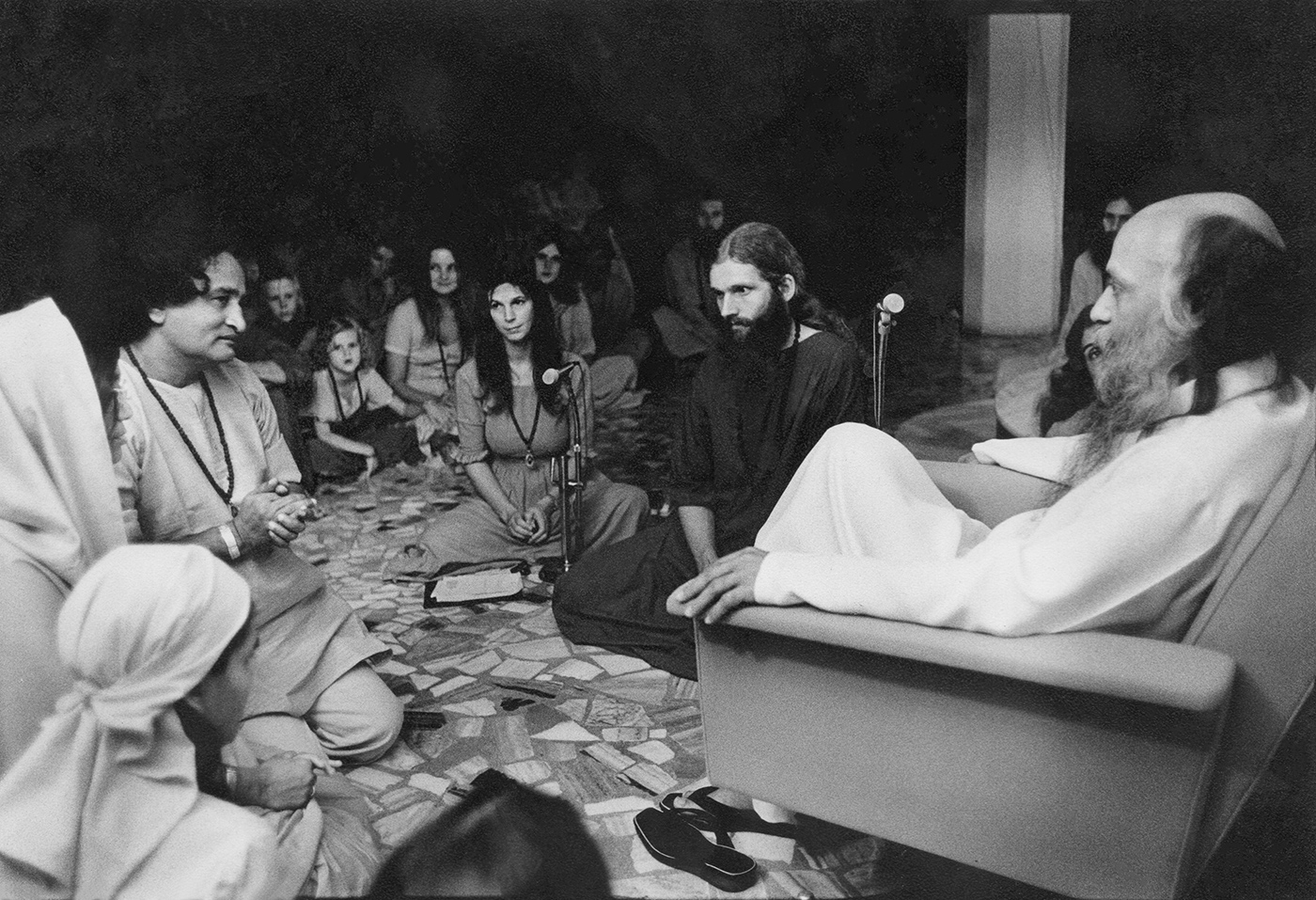
On the final night of the full-moon camp, Osho ended with kirtan meditation. As Sukhraj danced ecstatically, he approached the podium.
“In that heightened state,” he recalls, “I asked Osho to dance with me. He waved me away. Later I tried again: ‘Come, let’s dance!’ He gently pushed me aside and said, ‘Sukhraj, be sensible. Don’t you see what is happening here?’”
When the camp ended, Sukhraj asked, “You still have not told me what I am supposed to do. What does this sannyas mean?”
Osho laughed. “You are not supposed to do anything. Just wear orange and a mala. What has to happen will happen on its own.”
“I was so happy to hear that,” Sukhraj says with his characteristic laughter, “because I am very lazy.”
“And to this day,” he adds, “I have followed his instructions to the letter. I have done nothing!”
Text based on an interview from September 1987, first published in the Hindi Rajneesh Times (25 May–10 June 1988) and in the Rajneesh Times International (1 June and 29 July 1988), as well as on an extended article published in the Hindi Osho Times International (1 December 1998).
Thanks to Anuragi from Osho Resources Centre (oshoresourcecenter.com – facebook.com)
Related articles
- Meetings with a remarkable boy – In this first part of an interview with the Hindi Rajneesh Times in 1987, Sukhraj Bharti remembers his childhood with Osho, the games they played, the mischief they made, and the early signs that something unusual was already present in his friend
- A bhaiya, a brother becomes a Bhagwan – In the second instalment of this interview Sukhraj Bharti reflects on the dawning recognition of his childhood friend as Bhagwan – and on the strange intimacy, pride and playfulness that continued between them
- Sukhraj Bharti – (1 June 1934 – 2 January 2021)


Comments are closed.