

This month Madhuri reviews books by Brian Masters, Charlotte Uhlenbroek, Rosamunde Pilcher, Andrew Terrill, Michael Connelly, Sarah Penner

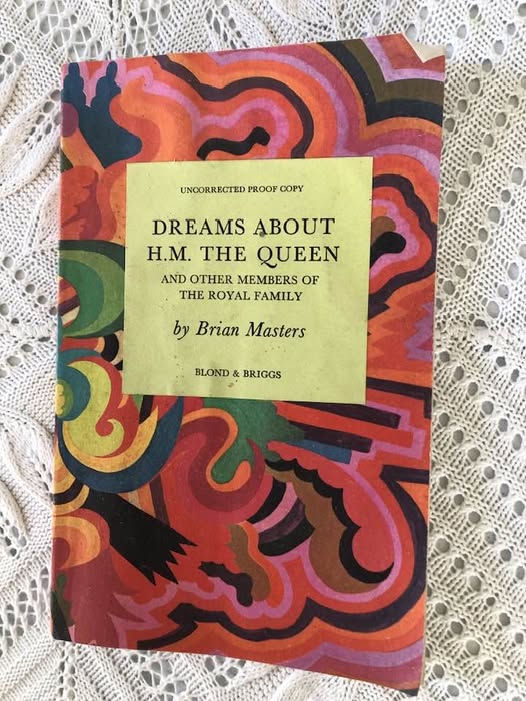 Dreams about H.M. the Queen
And Other Members of the Royal Family
by Brian Masters
I picked up this peculiar book because of the wonderful psychedelic cover. Turns out it was published in 1972. It is a discussion about, and many many samples of, dreams that people had about the Queen and/or the other Royals. The discussion is erudite, often witty, full of classical references, and, especially at the end, larded through with psychiatric speculation.
An example: “The Royal Family came to tea. It seemed I had nothing for them to eat, so having dyed an old blanket dark blue, I cut this up and made sandwiches with it, hoping they wouldn’t notice it was a blanket.”
Another:
“Prince Philip and Princess Anne came to visit us unexpectedly. My mother said, ‘Won’t you draw up a chair?’ and was mortified to see that there was nothing for the Prince to sit on but a large basin filled with farmyard straw and a heavy, strong-smelling manure. The Prince sat right in it, without a murmur. Mother and I we’re both beside ourselves with embarrassment, and didn’t know where to look. The Prince noticed our discomfiture, and sought to reassure me. ‘Don’t worry’, he said, ‘we take everything in our stride.’”
Especially in the last chapter, “What Does it All Mean?”, where the author speculates but wisely does not conclude, I kept thinking of my own simple dream-unlocking method [How to understand your dreams, ed.], and how the many dream books published since the first known ones, in Ancient Egypt, are pretty useless in comparison…
An interesting exception being the rare Prophetic Dream, also discussed at length, and with many historical examples, in the book. If you use my method on one, you might just get a sense of mystification, until the foretold thing happens, and then you understand.
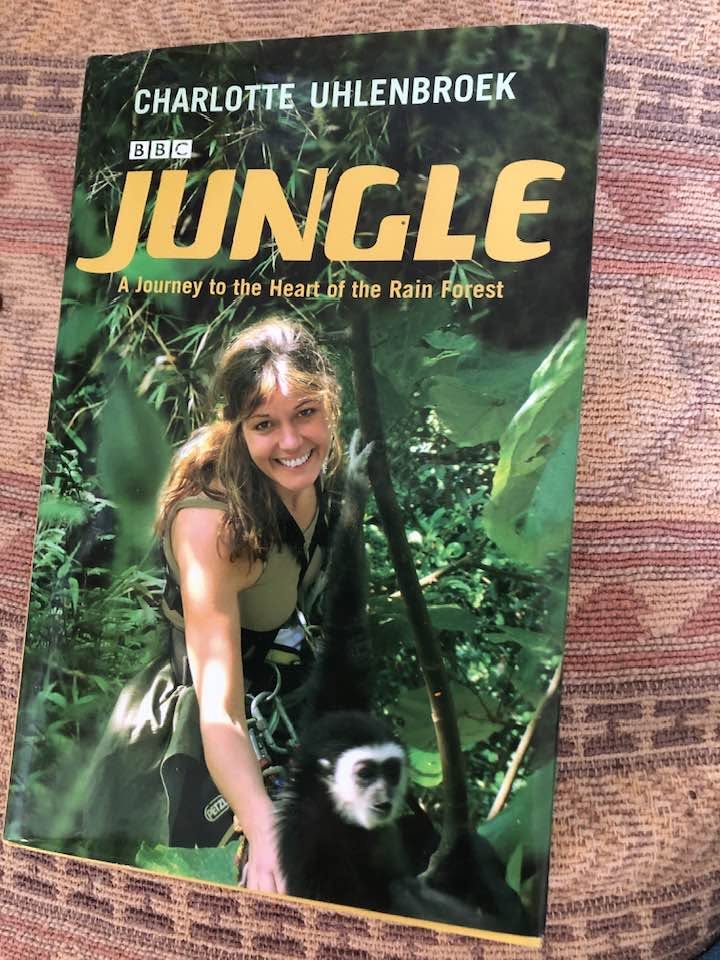 Jungle
A Journey to the Heart of the Rain Forest
by Charlotte Uhlenbroek
In the book booth I often find books by people “off the telly.” Since I have never owned a telly, I don’t know who they are. But sometimes they are really good anyway. Like this one – a young zoologist, with a BBC crew, goes into jungles in Borneo, Africa, and South America to film and narrate. The adventures in the high tree canopies, entire ecosystems up there, were fascinating, as were encounters with insects, for example driver ants, which swarm and eat everything in their path (the crew finally figured out that duct tape with the sticky side out, swathed around the tops of their wellies, worked to keep them out when nothing else did).
There are also encounters with jungle elephants, monkeys, etc, and then there are microscopic species: a handful of jungle soil contains up to 50 billion creatures belonging to more than a million different species.
I really enjoyed the book – I liked the chatty yet learned tone, the travelling misadventures the crew had, the lovely meetings with forest people, and the great number of things I learned that I hadn’t known before. And of course the book is a call for conservation and ecological awareness.
 The Blue Bedroom
and other stories
by Rosamunde Pilcher
This writer’s novels finally became annoying for me – insipid, namby-pamby, lots of friendly indulgence towards domestic messiness, a disturbing tendency to marry very young girls off to much older men. But as a short story writer she comes into her own.
The shorter form demands a more pointed focus, and characters have to drop in on you and depart, and still have their impact. This seems to rein in some of the vacuousness, whilst leaving the slight sentimentality intact. And I didn’t mind it. Many of the stories have to do with childbirths, the fraught kind, which is interesting enough, at least for me. The last story is the best – it’s got a punch line, but gets there effortlessly so that it doesn’t feel gimmicky.
On the whole I enjoyed visiting this rather stately, very human, friendly, very British-isles world.
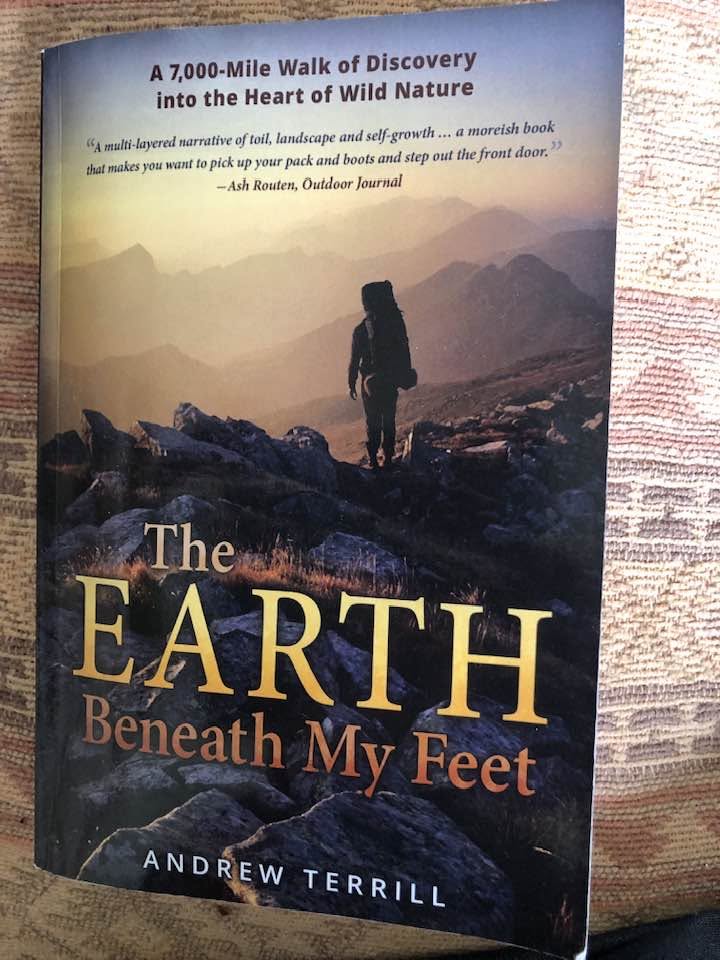 The Earth Beneath My Feet
by Andrew Terrill
In 1997, a young Englishman who lives with his parents and has a bad stutter, quits his job and sets out on a long walk: from the southernmost point of Italy to the northernmost point of Norway. Carrying a hugely heavy backpack. It’s really a vision quest, though he doesn’t call it that. It’s a young man making his own acquaintance, and that of all the gods of Earth, one footstep at a time.
I really loved it. The writing is good, the nature descriptions wholehearted and gorgeous, the suffering well-described, the doubts fulsome… and the ecstasies astonishing in their freedom. This is just volume 1, where he gets as far as Salzburg. I was fascinated by his experiences in Calabria, for it seems the Italy of sunny holidays has nothing to do with the inhospitable wildness of the southern appennines – in whose brambled fastnesses lurk mafiosos doing their dark work. The young man meets some…
Then, a bit further north, he’s in sheep-raising country (he is trying to do the walk as much in mountains and over peaks as possible, in no hurry, taking a year and a half for the whole trip) and it’s open and wild and gorgeous. And he keeps meeting shepherds who are in serious states of ecstasy – running about laughing and singing, in their rags and carrying umbrellas for the sun. These men are often refugees from wars and genocides in Eastern Europe.
The young man is true in his mission and truly he discovers what he’s seeking – his own footsteps, one by one, on this Earth – and it is a very beautiful journey he takes us along on. He is also doing it as a charity walk for the homeless, and his parents are managing the English end of things. And all this functions well.
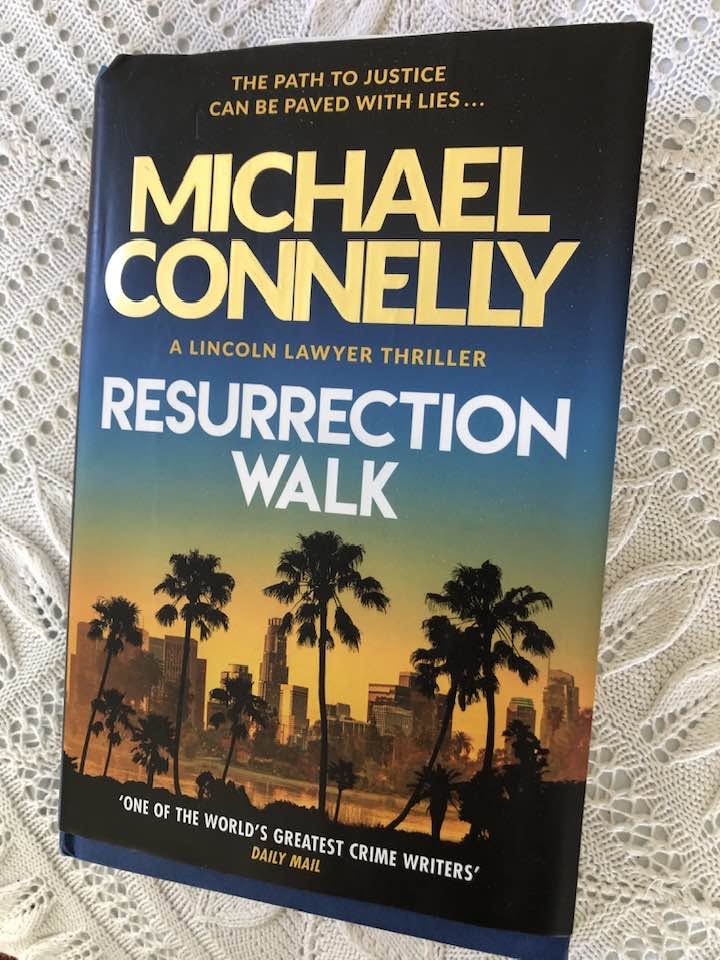 Resurrection Walk
by Michael Connelly
Besides The Lincoln Lawyer, this is the best Connelly I’ve read. No gimmicks at the end, great courtroom drama, only bad people get killed, and then only two of them. It’s about innocent people being imprisoned and how they might be freed. It’s got Mickey Haller in it, discovering his true calling as a liberator in this way. It’s got Bosch undergoing cancer treatment and uneasily but ardently working for the defence. It’s got Ballard and Bosch’s daughter and, oh, everybody. Since it’s set in LA many characters are Hispanic, which I find very agreeable. I liked many of the characters. Even Bosch was easier to like since he got sick and old.
The wife of a murdered cop has been imprisoned for five years for his shooting. But the cop belonged to a cop gang. And it looks like a setup. Haller is going to do his best to get her out. Bosch is investigating, and a team forms… but the cop gang doesn’t like it and nor does the prosecutor, and they will do whatever they can…
I just thoroughly enjoyed the story, the action, the writing, and a sense that the author was bringing things together for some reason that felt like ‘old guy testosterone wearing off, let’s bring something soft in somehow somewhere.’
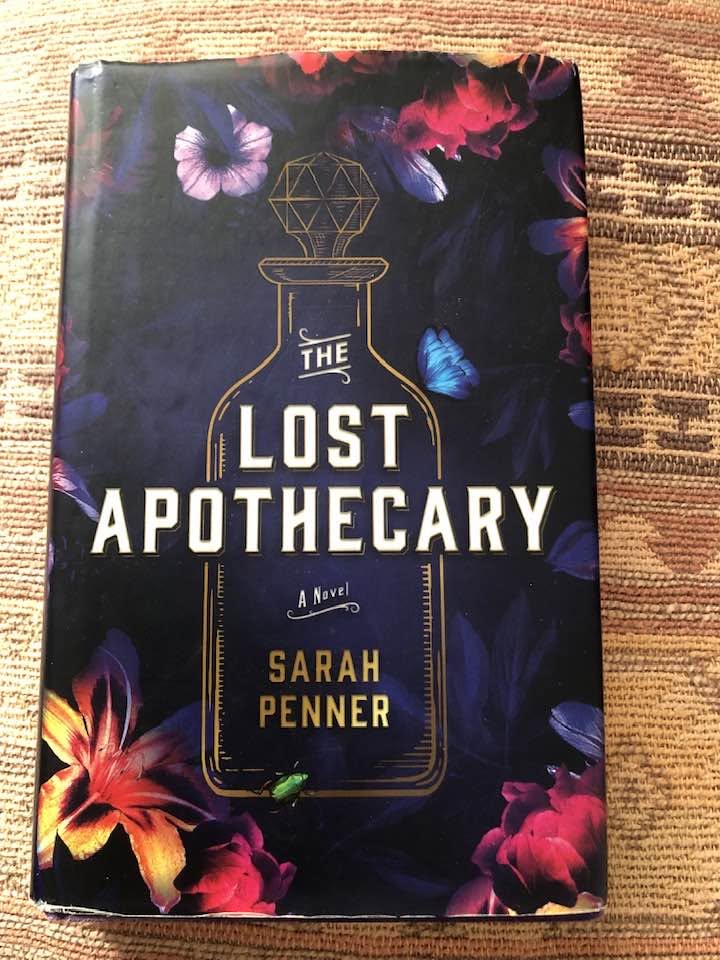 The Lost Apothecary
by Sarah Penner
An ingenious story, with a streak of stylistic awfulness. I was wondering how a young woman from Florida could write a convincing piece of historical fiction set in 1790’s London… and the schoolgirlishness comes through indeed. But the plot is so good you can almost forgive her, though not quite – there is also a certain puzzling coldbloodedness in the basic idea: an apothecary, betrayed by her lover, begins a backstreet career of supplying poisons to women, to be used on nasty men. (In fact, there are a few recipes at the back.) A young servant girl gets mixed up in the plot, and a modern American woman, who has just discovered her husband’s affair, flees to London and discovers this old story via a bottle she finds mudlarking in the Thames mudflats at low tide. So we switch back and forth between 1791 and the present day, which works well. (The young woman was a history student who had dropped her studies for marriage.)
The writing isn’t bad – or not so bad that I abandoned it early on – but really, I do object to posh Lady Clarence saying, in 1791, “How terrible that maid is, and how cowardly! If she had any smarts, she would have stolen the jar itself to give to the police…”.
Like, “had any smarts”? Or maybe that’s an archaic expression after all?
The descriptions of the modern-day marriage – the straying husband comes looking for his wife – are pretty good, though. The book is being translated into eleven languages, which says something about slipping standards, I think. Weirdly, the poison-recipe section includes a recipe for (nontoxic) rosemary shortbread. All a bit strange.
These reviews were previously posted on Facebook by the author, reproduced here with permission.
Featured image thanks to Clay Banks via unsplash.com/@claybanks
Related articles
- How to understand your dreams – A useful technique shared by Madhuri
- Madhuri’s collection of short reviews: Late Evening Reading



Comments are closed.