

Amido (text) and Purushottama (photos) end their 2006 pilgrimage in India with a visit to Varanasi, Darjeeling, Rumtek and Kalimpong (Part 7)
What possessed us? We decided to travel from McLeod Ganj – where the temperature was comfortably cool – to Varanasi, (a distance of 870 miles [1,400 kilometers]) with a reputation for being hot and dry in April, which it was! Ah! I remember. We wanted to visit the home of the 16th Karmapa in Rumtek, Sikkim, and the route passed through this ancient city.
First we caught a local bus to Pathankot that took care of about 60 of those miles (90 kilometers) – a journey of 3 hours or so, and then a train to Varanasi for the remaining 810 miles (1,300 kilometers) which we covered in about 20 hours. Time is distance kept drumming in my head accompanying the rhythm of the train.
Varanasi, Uttar Pradesh
Varanasi, the spiritual heart of India and the earthly home of Lord Shiva, is believed to be the oldest continuously inhabited city in the world. It is about 3,000 years old if archaeology is the indicator but 5,000 years, or thereabouts, since Kashi is frequently referenced in ancient religious texts. Hindus believe Lord Shiva founded it 5,000 years ago.
A city of many names: Varanasi combines the names of two tributaries of the Ganges, Varuna and Assi, and has been the official name since 1910, however, the name Banaras or Benares (the English variant) has endured for centuries.
Kashi is the oldest and possibly most popular name, derived from prakash meaning light. And Kashi – with its extensive spiritual history – is a veritable melting pot of global religions.
Sarnath, where Buddha gave his first sermon, is a mere 6 miles (10 kilometers) away; Kashi is the birthplace of four Jain Tirthankaras; Islam has a centuries-old presence and has scattered across the city the dargahs (shrines) of Sufi saints; and then to be mentioned is that the renowned, enlightened mystic poet Kabir was born here.
And Guru Nanak, the founder of Sikhism, visited Varanasi in 1506, where he held dialogues with religious scholars, challenging the relevance of rituals by insisting on the importance of the internal remembrance of god. He also gathered the poetry and writings of earlier Bhakti movement figures, such as Kabir, integrating their writings into the Sikh scripture.
Predictably, a diverse group of pilgrims are attracted to this City of Light. (click on images to see fullscreen)
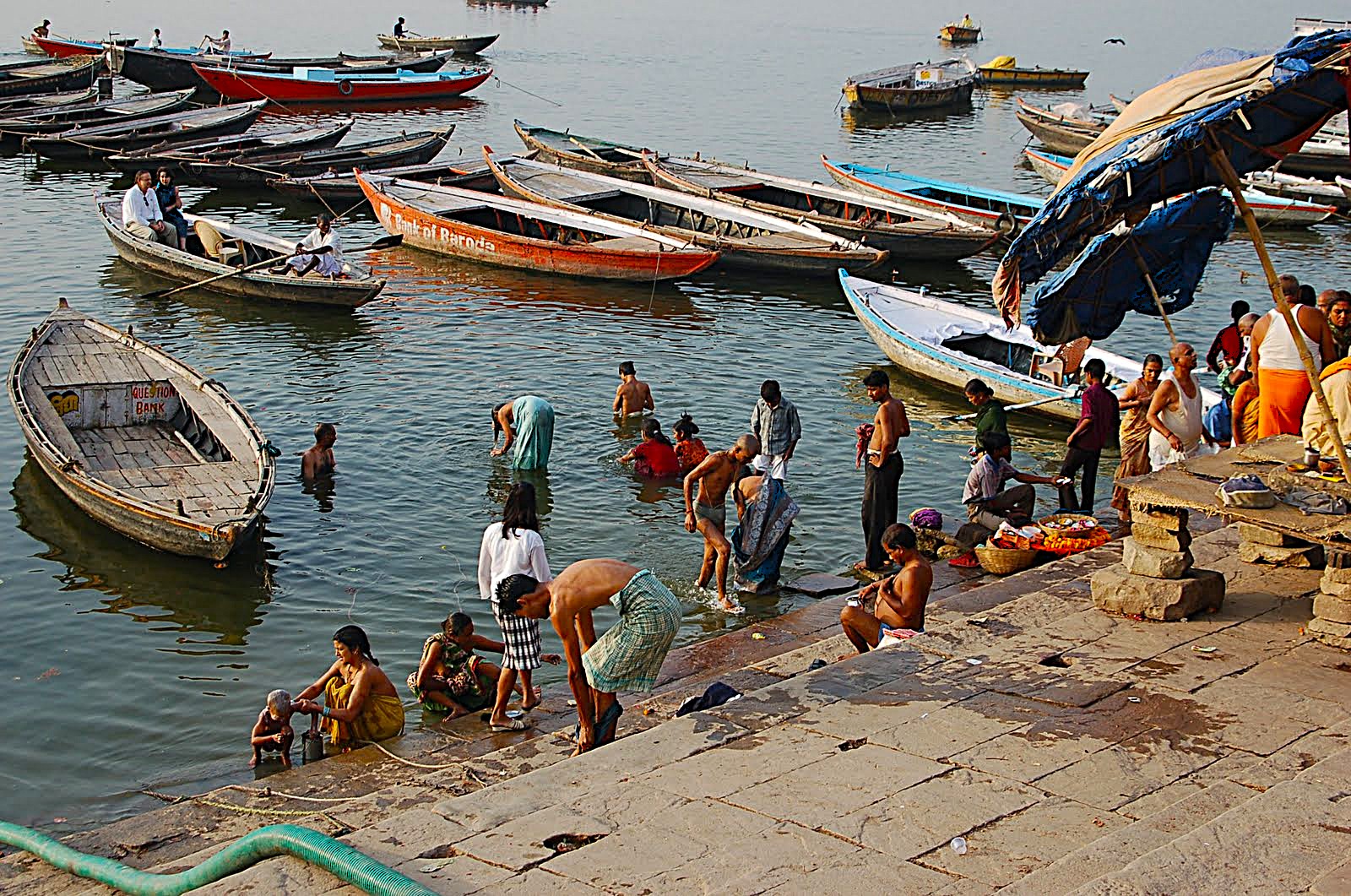
The River Ganges runs through Varanasi and is one of the most revered places to bathe away karma and receive blessings. Varanasi is also the place to die; the Jabala Upanishad explains that Shiva whispers a mantra in the ear of the dying and that person is released from reincarnation. 1 Ghats line the river; a couple of ghats operate 24 hours a day, the main one being Manikarnika Ghat.
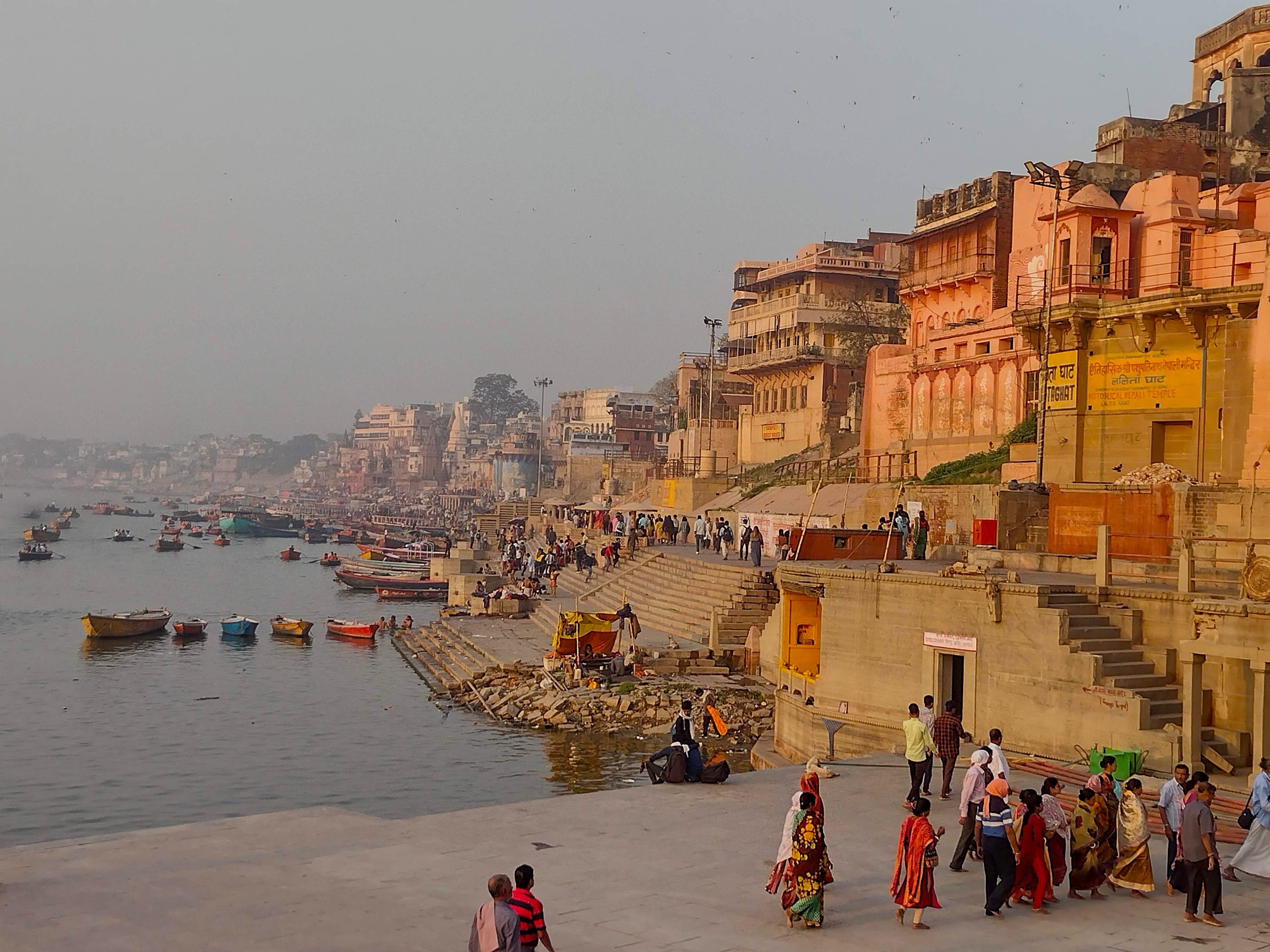
Hindu Temples situated behind the ghats follow the river.
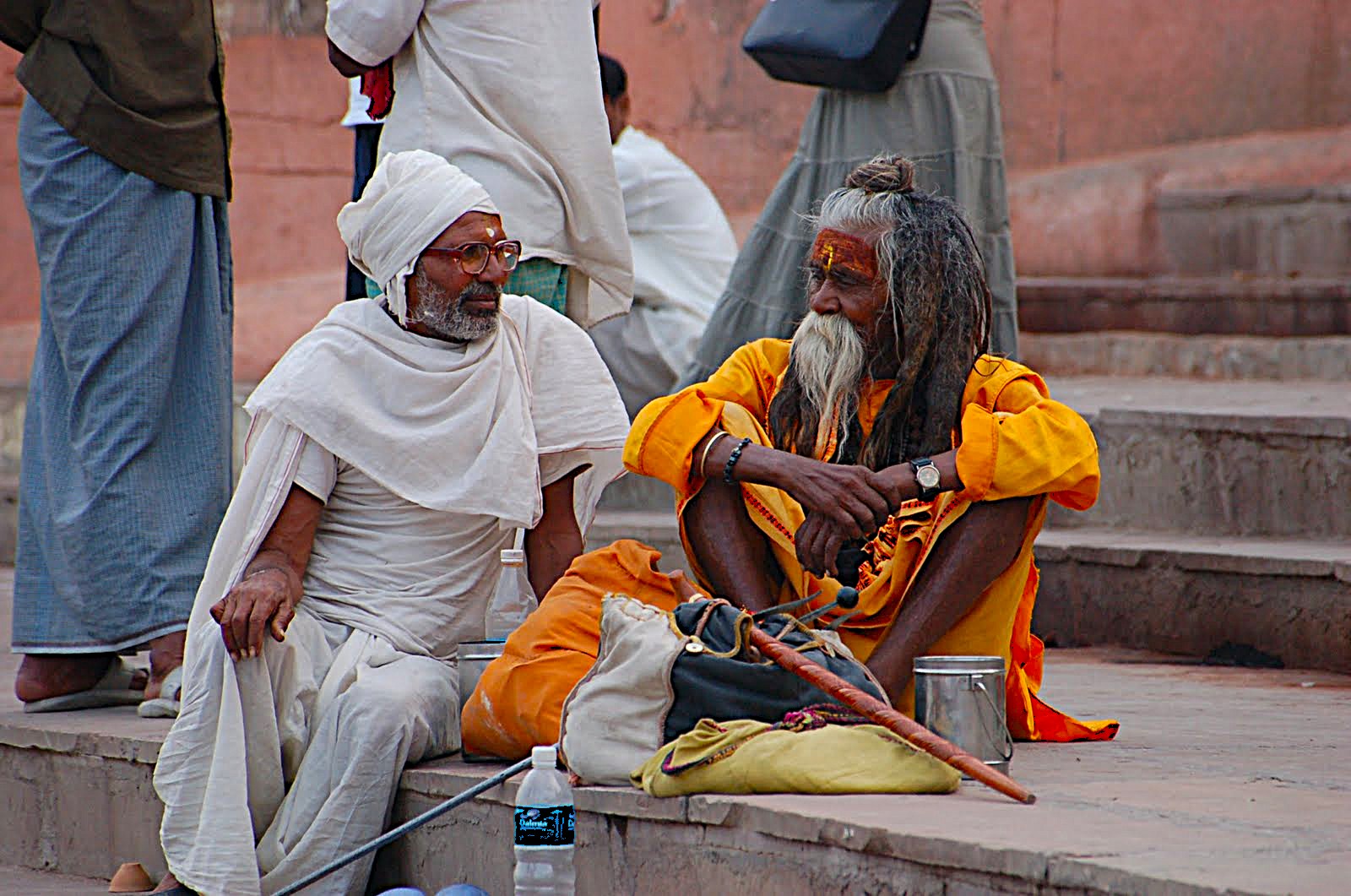
A pilgrim and sadhu in deep conversation on the riverbank. Such a contrast of colors. The saffron represents Agni, the fire god, who burns away ego, desire, and ignorance. It identifies the wearer as a spiritual seeker. The white clothing of the pilgrim is an outward indication of an inner desire for purification.
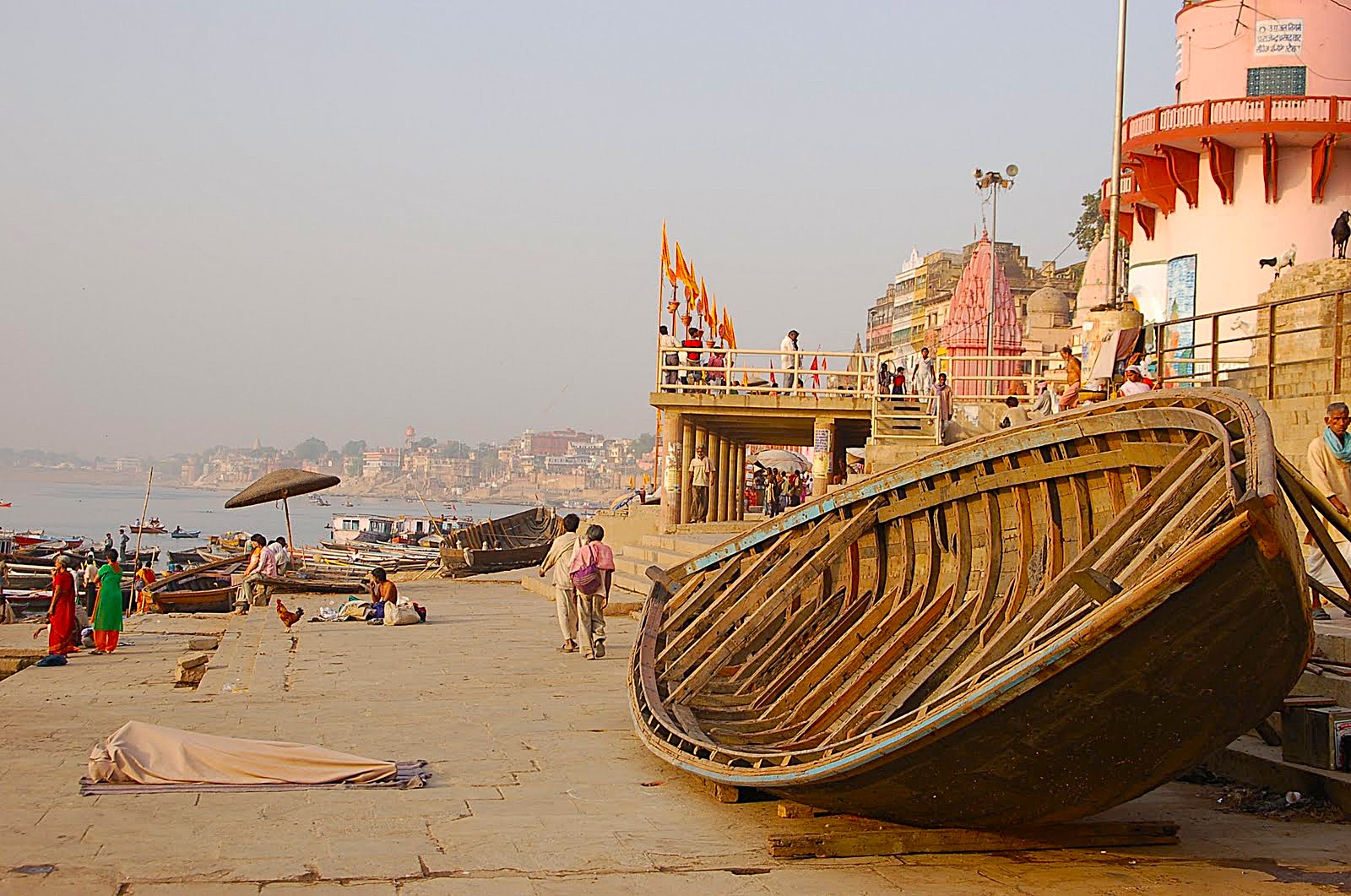
The ghats are such an integral part of the city. Here someone is sleeping stretched out under a blanket, a rooster is checking out the river, an immense amount of toing and froing occurs as people head to work, or consider a sacred morning dip. India never disappoints with the colors that randomly punctuate the scene.
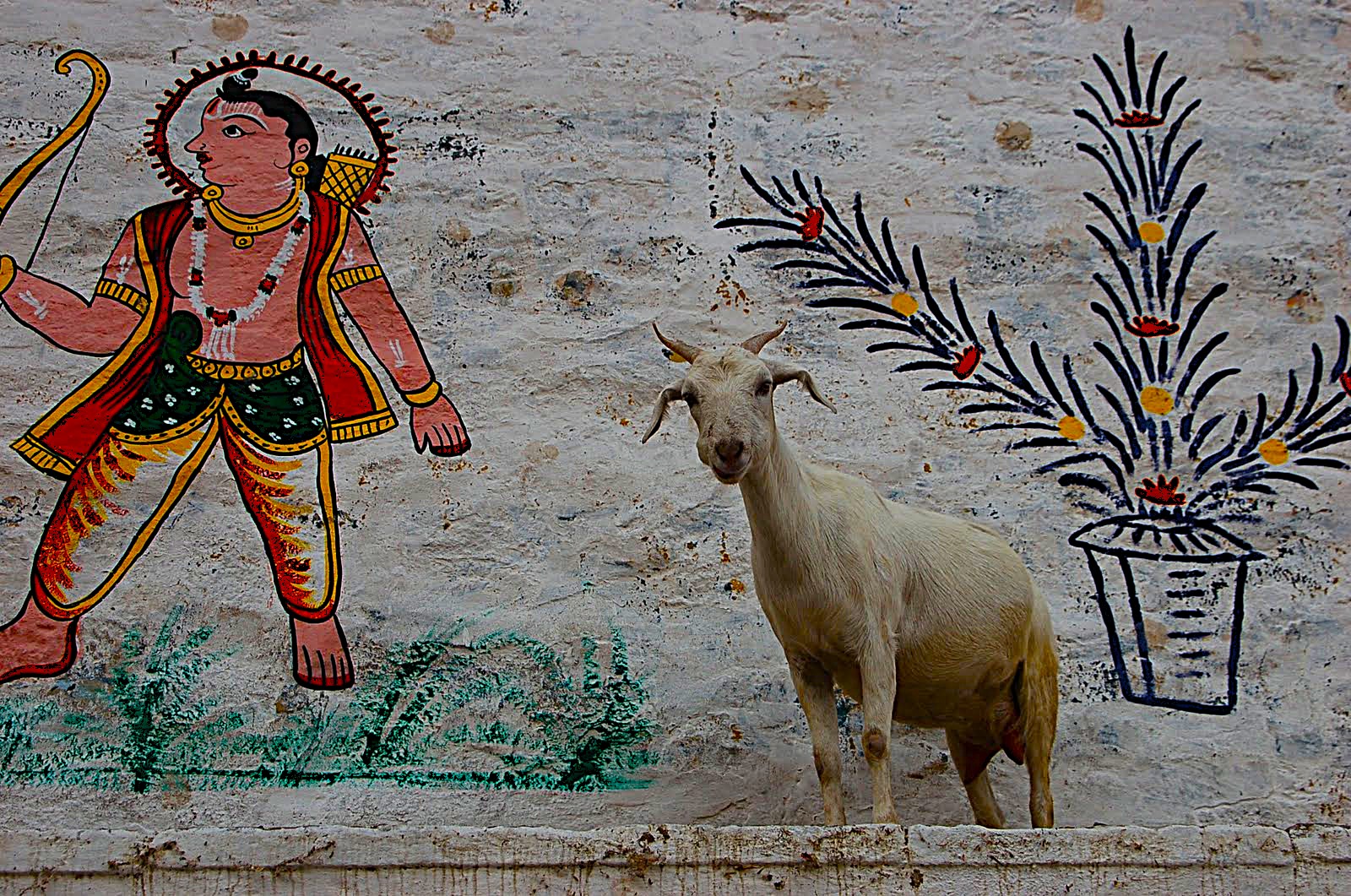
The curious goat adds a three-dimensional quality to this street art depicting Lord Rama.
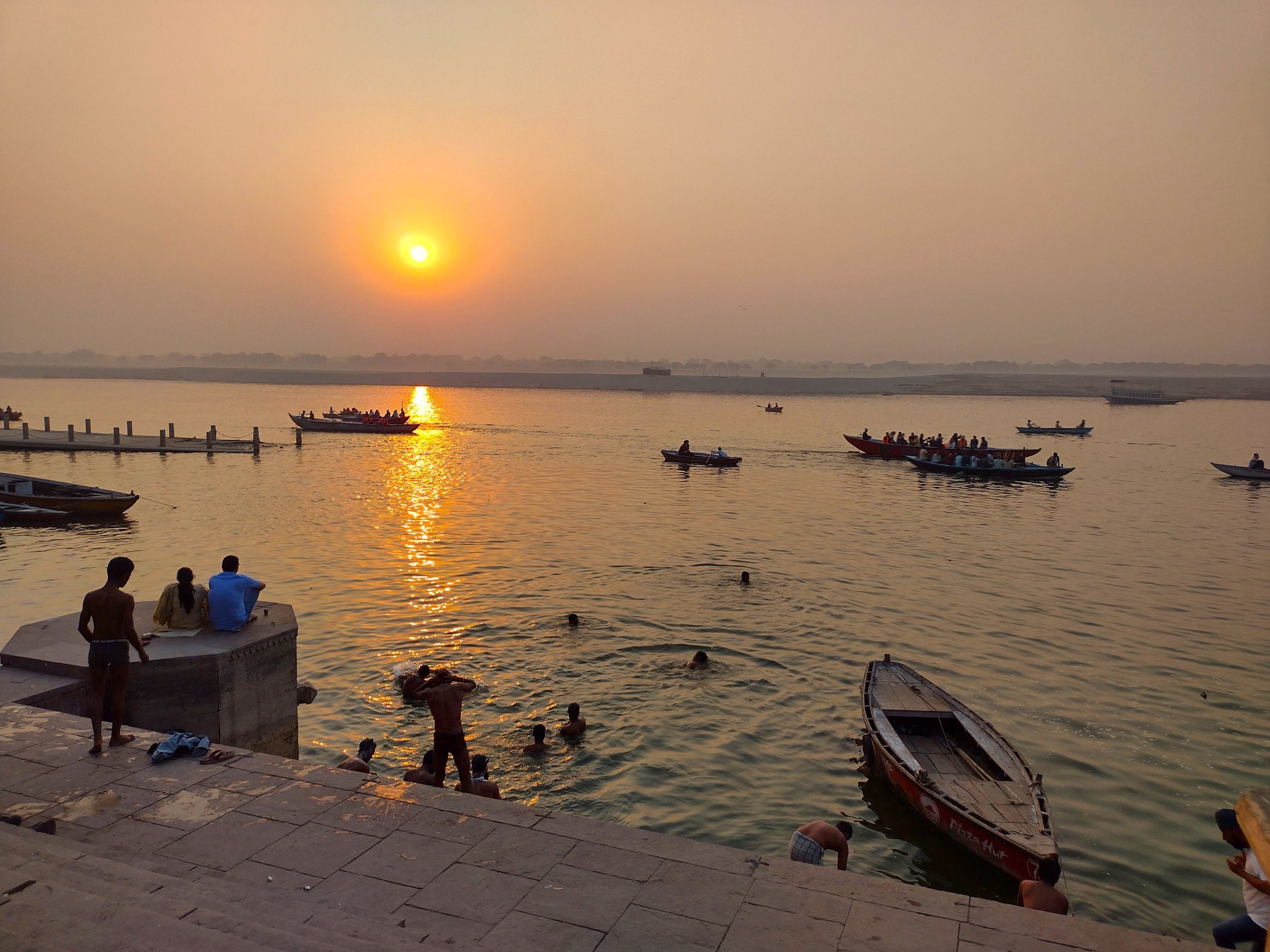
A sunrise or sunset boat ride when the rising or setting sun washes the ghats in golden light is considered the defining experience for tourists visiting Varanasi.
We had arrived in time to enjoy the blazing sun of mid-April! Hot! We slept under a fan, which was perfectly comfortable until a power cut occurred. No electricity, no fan. Hotter! Making a lungi damp and covering oneself with it helps greatly.
Our guesthouse was situated in the narrow winding alleys lined with eateries, homes, businesses and other guesthouses, alleys shared with motorbikes and cows – quite a challenge for pedestrians, especially as motorbikes have right of way!
The best time to wander the ghats is early morning. Such beauty in this relationship between people and their spiritual aspirations and the river – the river is the mother – and in the understanding that nature and humanity are not far apart but intimately integrated. I don’t think I ever saw this in the Catholicism I was born into.
(J. Krishnamurti created a study center and school outside the city which he would visit when in India and give talks.)
Darjeeling, West Bengal
On the way to Darjeeling, we stopped briefly in Kolkata to buy our return ticket to Thailand. We estimated that a couple more months of traveling in India would be enough. We caught the overnight Darjeeling Mail train from Sealdah Railway Station to Siliguri (still in West Bengal). There a shared taxi transported us to the station where we could catch the narrow-gauge Darjeeling Himalayan Railway train to our destination.
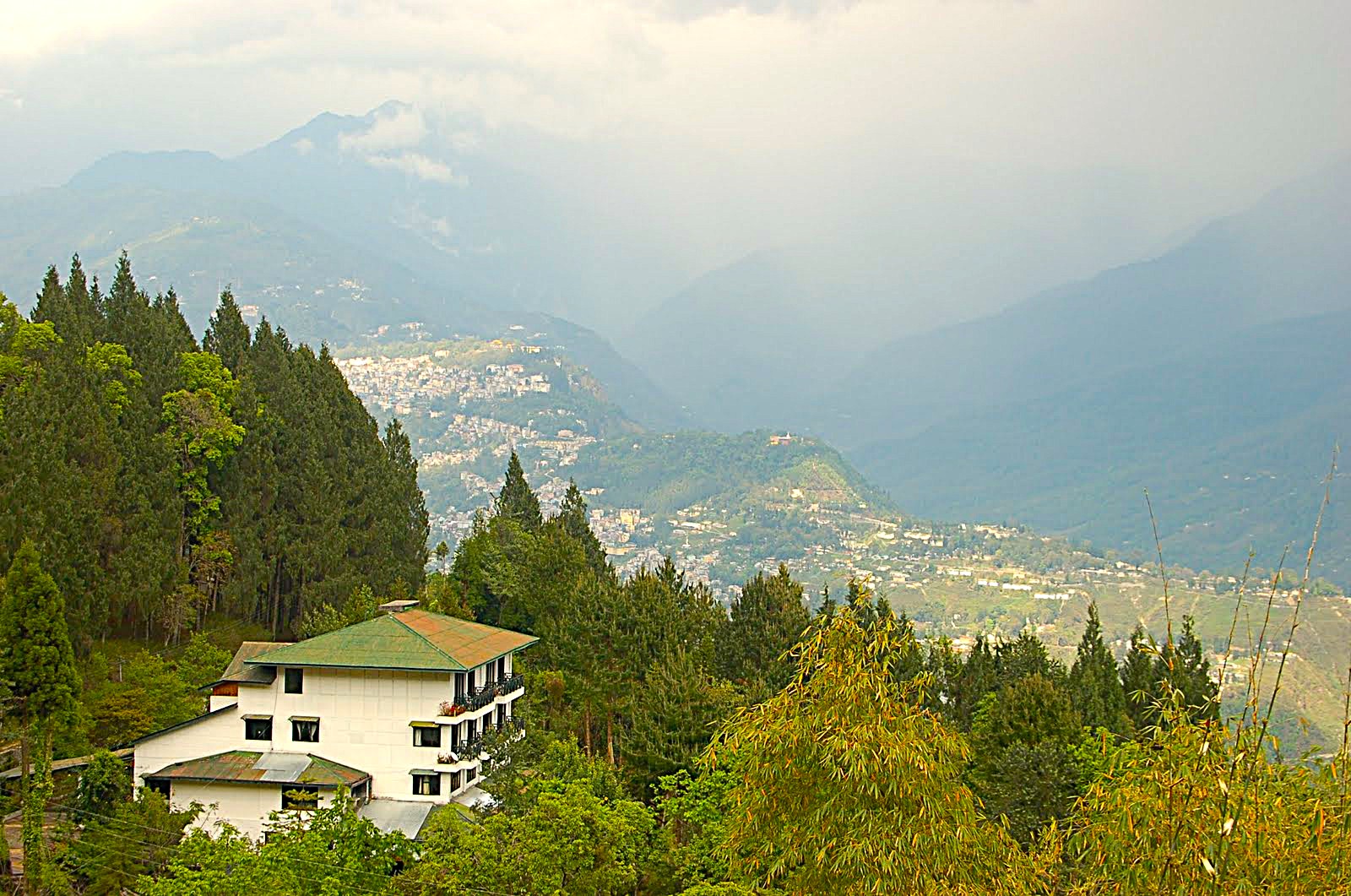
Darjeeling, a place where you could spend a lot of time if all was well with the world but, no water no shower. Our guesthouse, like the rest of the town, relied on pick-up trucks to fill its roof tanks. They didn’t come by the morning we were there. It is a truly beautiful place though. People are keen gardeners planting flowers in pots to decorate the exterior of their homes. The air is hazy verging on foggy. Growth of everything is luxuriant. We went to a lovely afternoon tea place. We might have had scones! Certainly something appropriate! But we couldn’t stay in a place with no water so, after obtaining our permit to visit Sikkim, we headed to Gangtok, the capital of Sikkim, and then on to Rumtek. Mountain views were becoming pretty impressive by this time.
A shared jeep was the preferred mode of transportation. The narrow rough roads that wind up and down the mountain ridges were unsuitable for buses. The journey of 61 miles (100 kilometers) took about 6 hours.
From Darjeeling the narrow road snaked down through the tea plantations of West Bengal to the Teesta River Valley below. Then a drive though the valley following the river to the bridge to cross the border with Sikkim. Foreigners had to exit the vehicle and have their Inner Line Permit (ILP) stamped. The road on the Sikkim side was even steeper and more rugged passing through dense forest to the top of the ridge and Gangtok. Phew!
And the next day, on to Rumtek, a mere 15 miles (24 kilometers) away but over challenging terrain. Both Gangtok and Rumtek sit on a ridge, so again a descent into a valley and a steep winding switchback drive up the opposite mountain face. It took about 90 minutes through a landscape of scenic villages and terraced paddy fields.
Rumtek, Sikkim
The day we arrived the sky was a wonderful clear blue; the sun, brilliant. The shared jeep dropped us at the entrance gate. We walked inside and on the right was a lovely guesthouse with a room for us; and on up the hill, the complex of the 16th Karmapa. It truly felt like a homecoming. Such beautiful surroundings enhanced by the presence of Tibetan Buddhism symbolized by the prayer flags and prayer wheels, and young monks running everywhere.
We started this journey in Kolkata, where Purushottama had met the 16th Karmapa in 1976 and written about in Osho and the 16th Karmapa, and we both very much wanted to use this opportunity to visit the temple and monastery complex the Karmapa had founded in these mountains. The Karmapa is head of the Karma Kagyu Sect, the second largest of the four Tibetan Buddhist sects. 2
The 16th Karmapa left Tibet in February 1959, just weeks before the Dalai Lama’s departure. He understood that in order to preserve the Dharma, he had to leave. An entourage of 160 lamas, monks, and lay people accompanied him; they transported the lineage’s most sacred treasures.
The Kagyu Sect has a historical connection with Sikkim. The 9th Karmapa established three monasteries here in the late 16th and early 17th centuries.
The 16th Karmapa visited Sikkim on pilgrimages in the 1940s and early 1950s and developed a close bond with its King, Sir Tashi Namgyal, who offered him land and an abandoned monastery in Rumtek where he could take up residence. At that time, the Karmapa declined the offer but promised he would return when he would need it. And so it came to pass. When he fled Tibet, the king stood by his offer and more. Sikkim’s royal family and the Indian government provided financial assistance to build a new temple and monastic complex: the Rumtek Dharma Chakra Center was inaugurated in 1966.
In 1980 the 16th Karmapa embarked on a world-wide teaching tour, conducting sacred ceremonies and empowerments. He was in the States when he fell terminally ill. During his last few weeks, the people who attended him, including the doctors and nurses, marveled at his good humor and concern for those around him concomitant with his indifference to the pain that invariably accompanies such a physical condition as his (metastasized stomach cancer). 3
He left his body on November 5, 1981, in the American International Hospital in Zion just north of Chicago. The State of Illinois gave special permission for his body to remain in the hospital after death. It is reported that he went into the meditative state Tibetans call Tukam (tuk means mind and dam, samadhi). His body remained flexible and did not develop the stiff coldness of rigor mortis; the area around his heart remained warm. After three days his body was flown to Rumtek to be prepared for cremation.
Some unusual occurrences took place during the cremation on December 19, 1981. I will mention only one. As the pyre started to die down, “a fleshy red lump” rolled out that was identified as the heart relic. It is enshrined in a small stupa in the Shrine Room on the top floor of the building behind the main temple which contains the Karmapa’s relics. 4
The shrine room or reliquary is a powerful place to sit and meditate; it absorbs sound, is light-filled, and has a strong gravitational pull inwards. We spent a lot of time in the environment of this heart-filled space.
We so enjoyed watching the young monks in the afternoons in the temple courtyard engage in intense debate in pairs; the questioner stands, claps his hands when he has finished talking, and then the other monk, seated, answers, and again claps when he is finished. They are so loud and so dramatic!
I went to a Tibetan Nunnery a few times in the afternoon. The nuns were young with just one older person who looked after them. They were waiting for papers, permission, whatever it took to go to Europe or elsewhere abroad. I liked sitting in on the clashing thunder at the end of the chanting.
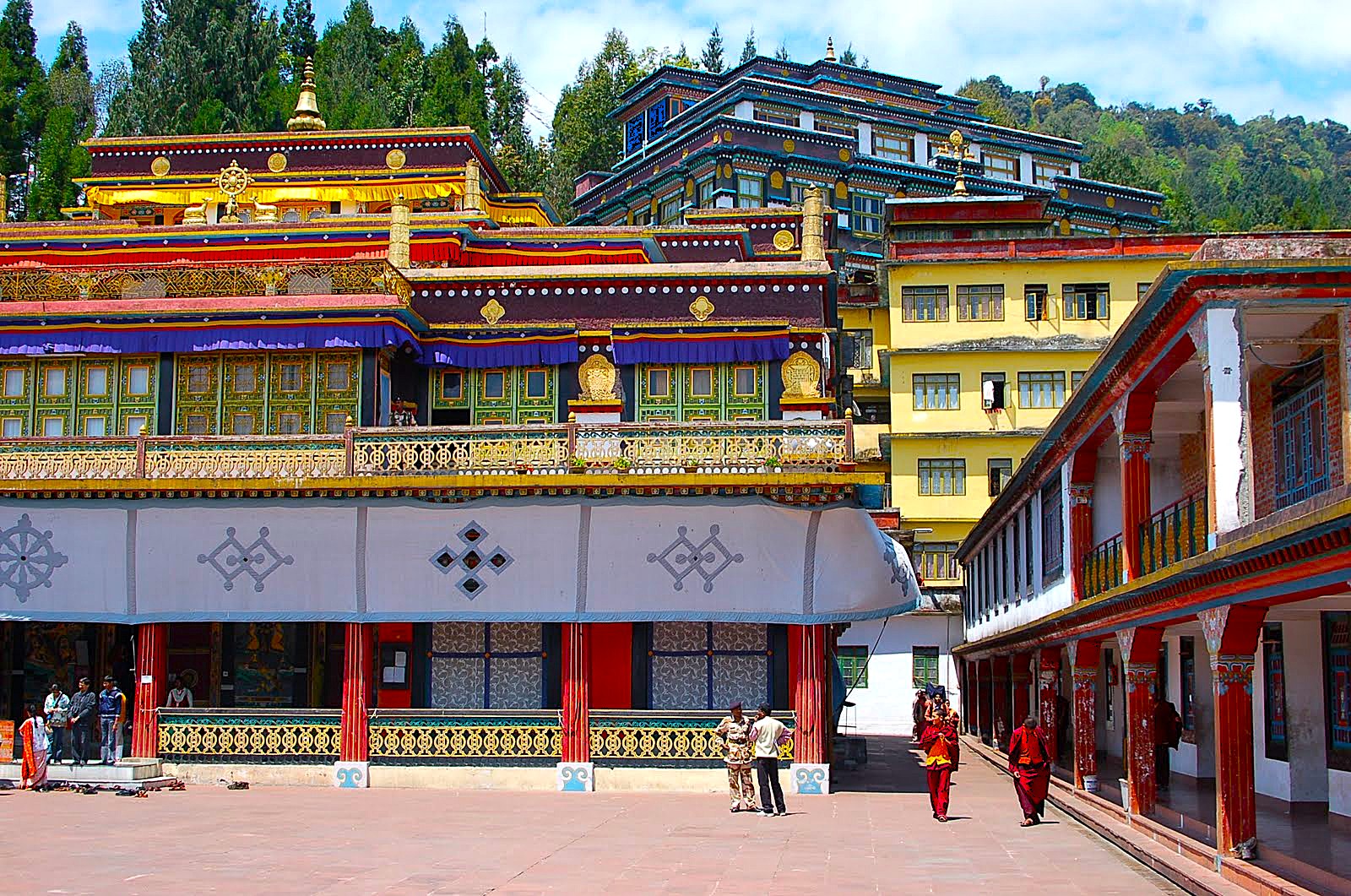
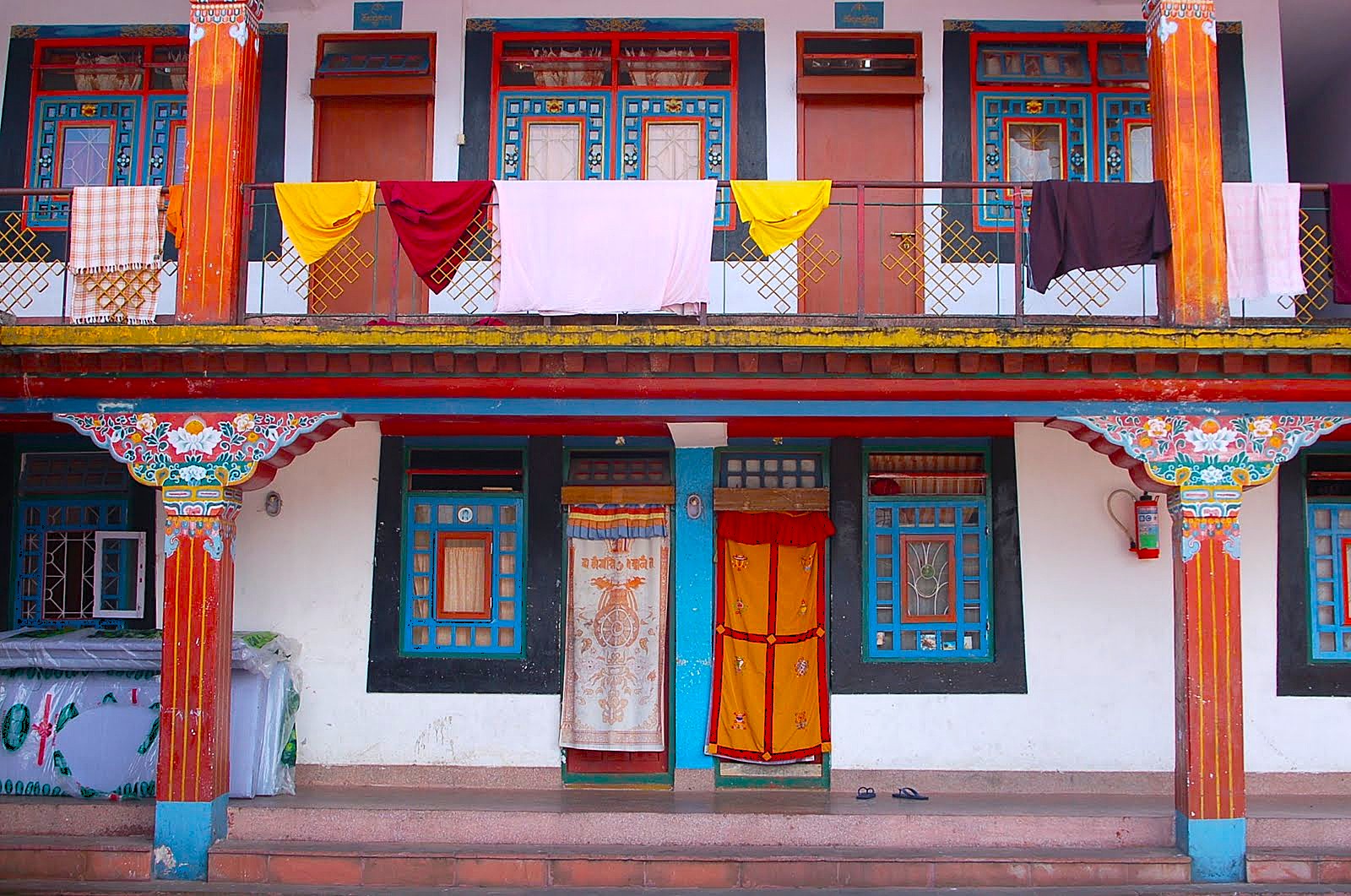


The Karmapa’s temple and monastery complex, Rumtek, Sikkim. R: The age range of the monks varies greatly – some are very young boys. This monk is studying a Buddhist text, obviously very sincerely, avoiding all distraction.
We explored Sikkim using the shared jeep system. Luggage goes up on top and sometimes gets wet, though we escaped this fate. In some places parts of the road had eroded and in others repair work was visible – large rectangular cages filled with rocks were attached to the mountain side and secured, just well enough to bear the weight of passing vehicles.


L: The scenery is compelling. Kangchenjunga (28,169 feet; [8,586 meters]), the third highest mountain in the world and, until 1852, considered the highest, is at times visible. The Great Trigonometrical Survey of India revealed that Peak XV (later renamed Mount Everest, 29,031 feet; [8,848.46 meters]) was in fact much taller. This photo captures Kangchenjunga (translated from Tibetan as the five treasures of the great snow) in all its splendor.
R: Yuksom sits in a high-altitude valley at an elevation of 5,840 feet (1,780 meters). It experiences a temperate humid climate and is a bio-diverse hotspot. The summer monsoon provides a plentiful supply of rain. Yuksom’s surrounding vegetation ranges from dense mountain forests to organic agricultural crops. Maize, millet and barley, and some rice grow on the terraces. Small homestead farmers cultivate cold-resistant vegetables such as potatoes, cabbage, peas, and radishes. And the main cash crop is Black Cardamom (used in savory dishes); apparently the environment is perfect with its moist, forested hills and shaded slopes. Ginger and turmeric add to the mix.
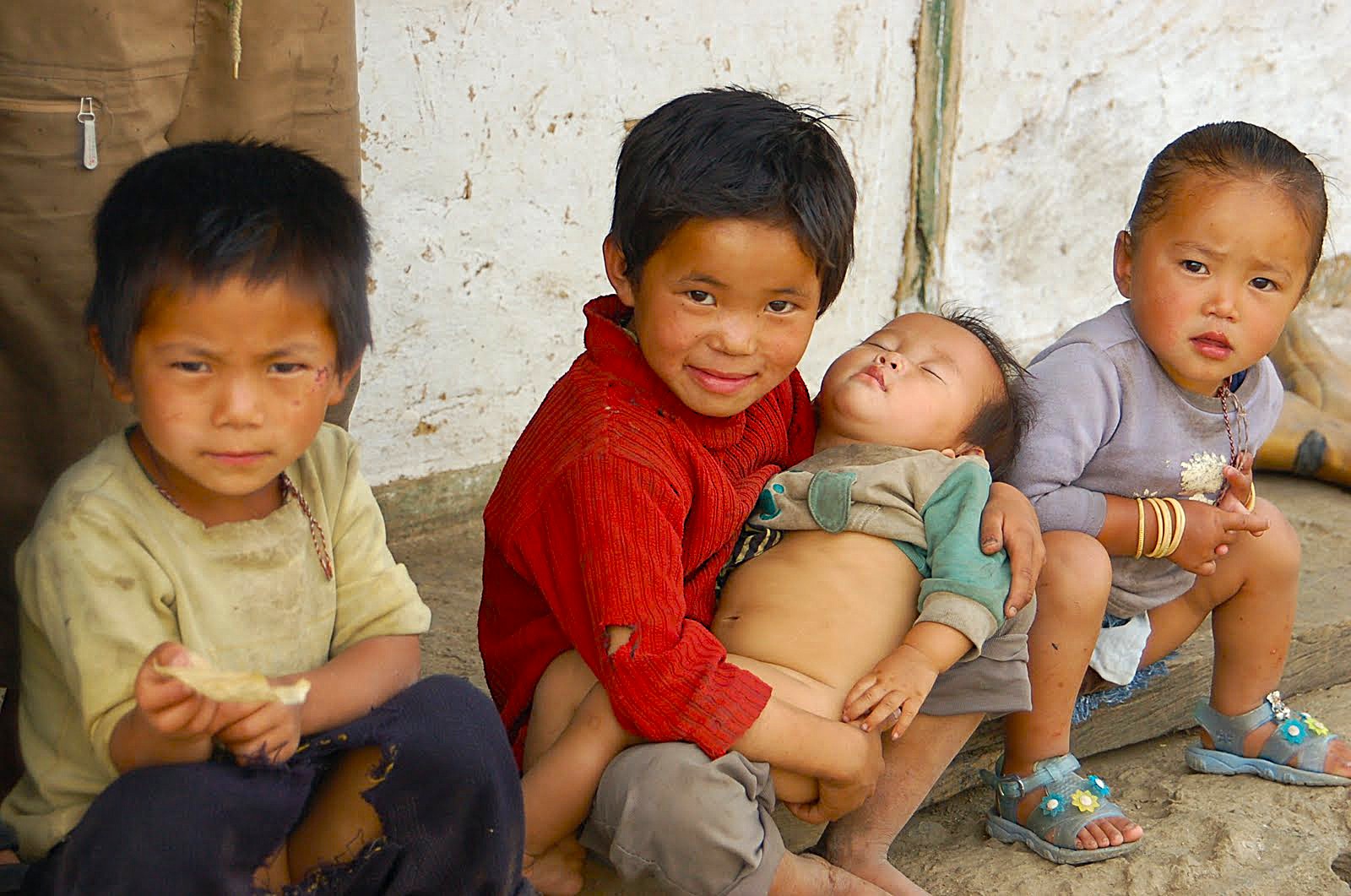
A product of this land. Curious faces – perhaps a little suspicious of these weird-looking people that we are!
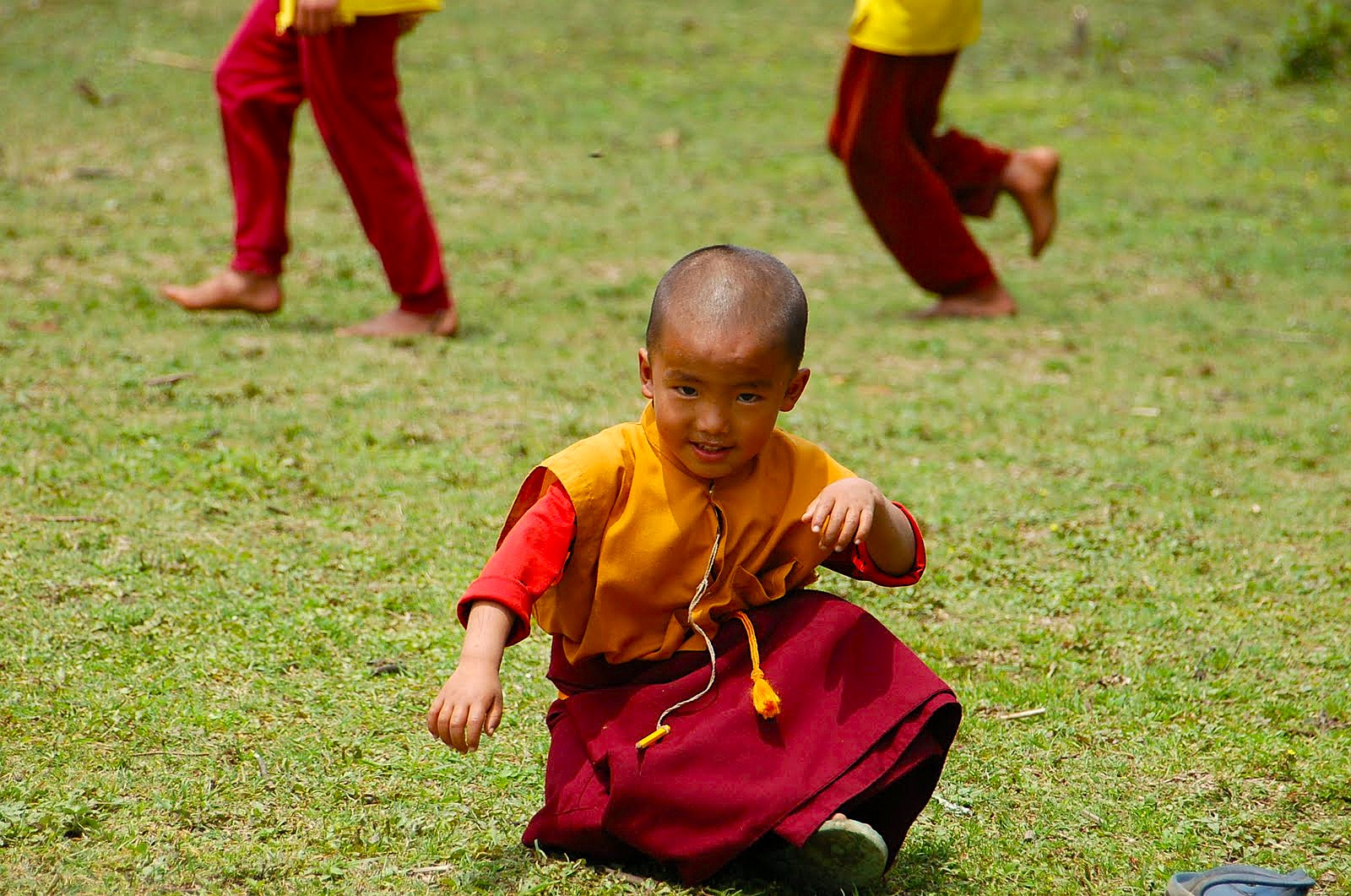
Lovely to see the young monks playing and running around. Life is not all study.
Guru Padmasambhava, the name meaning ‘born from a lotus flower’, is a legendary Indian master who introduced Vajrayana Buddhism to Tibet. “He taught secret tantric methods for rapid awakening.” 5 In the 8th century, Padmasambhava traveled with his followers to what is now Sikkim. Legend has it that, wishing to find a sacred spot, he shot an arrow into the air and it landed on a hilltop, below which two rivers converge. He walked to that spot, placed his feet on the ground, and recognized its sanctity. He declared it to be “the heart of holy places in Sikkim – a central point from which blessings radiate throughout the land.”
Centuries later, in 1641, the Tashiding Monastery was built on this very hill. The Thong-Warang-Dol stupa is its most famous feature. Its name translates as ‘savior by mere sight’. One only has to look upon this stupa, regardless of one’s beliefs and without any of the usual purification rituals, to be cleansed of all sins. The power of the stupa is greater than the devotion of a pilgrim. 6 & 7
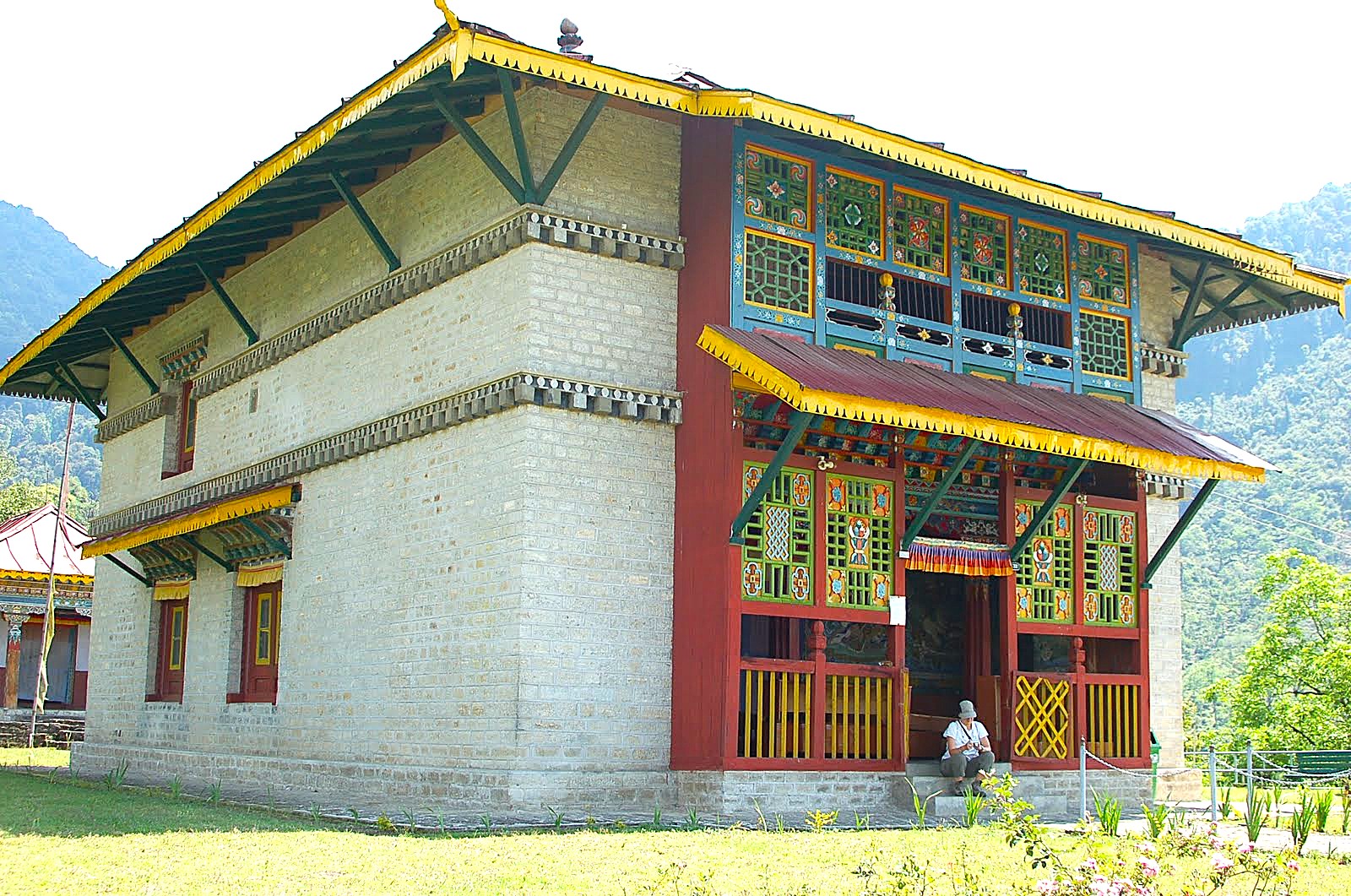
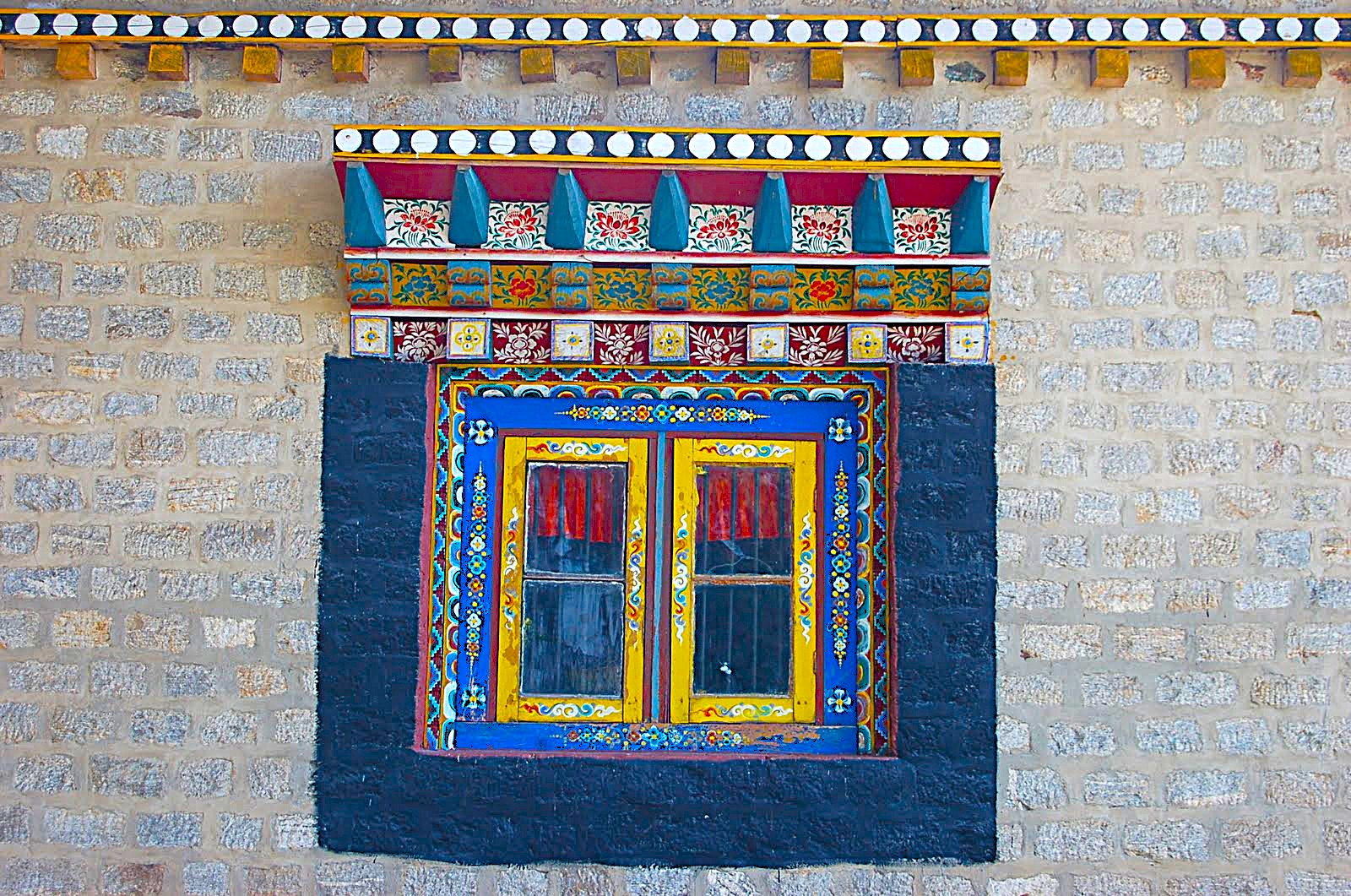
Tashiding Monastery, the heart of Sikkim.
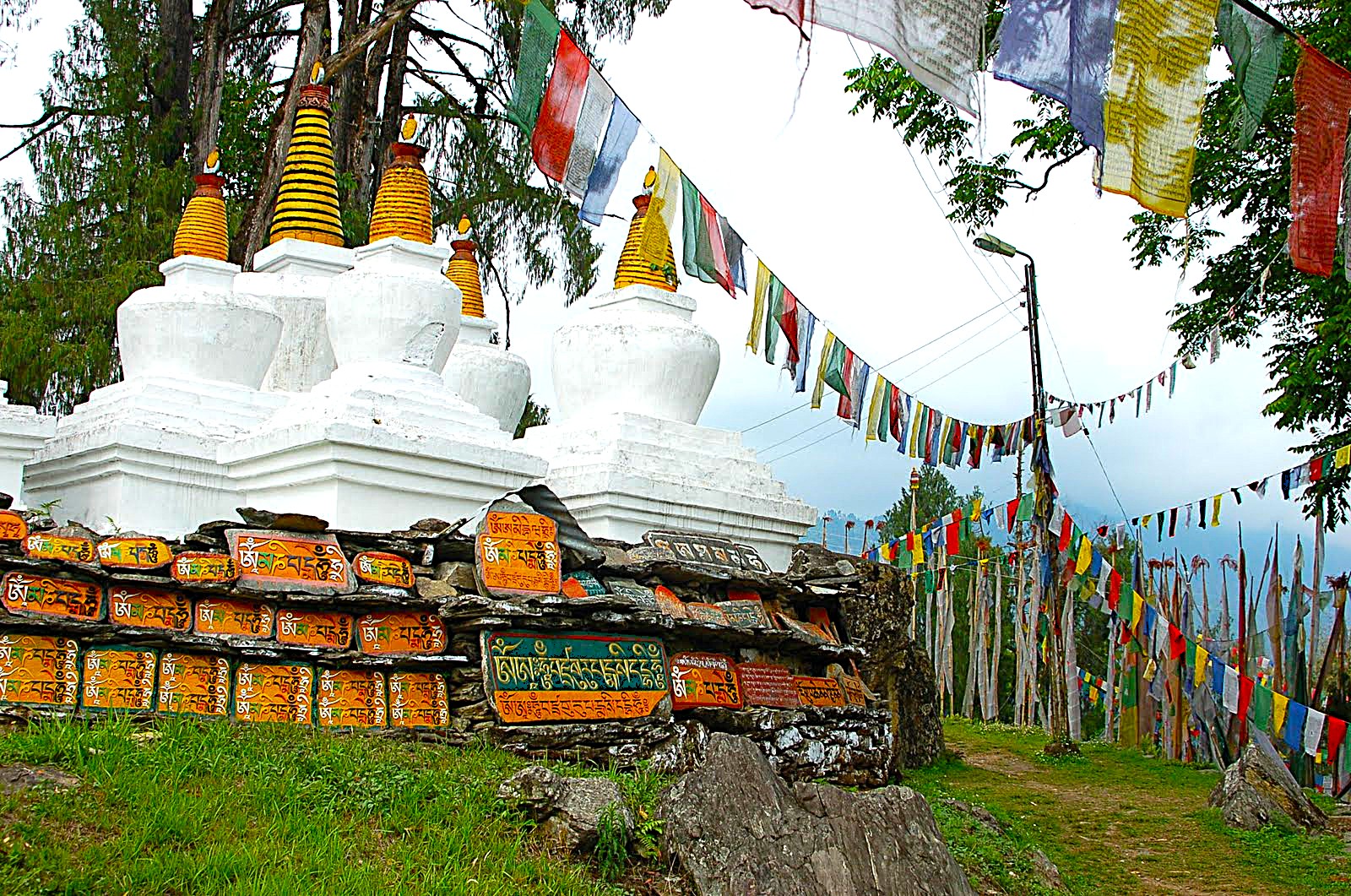
We visited several monasteries in Sikkim. Tashiding, however, remains strongest in my memory. We were there in the late afternoon to early evening. Prayer flags and stupas filled one section of the grounds. The steep walk up had prepared us for the stillness. I remember listening intently to the sounds of the early evening. As I couldn’t remember exactly what I was listening so intently to, I investigated through a search and was informed of what Tibetans traditionally call ‘the wind chanting prayers’. The sound is made by the play of mountain winds on thousands of pieces of cloth, the prayer flags; both the vertical white ones and the horizontally strung type (the lungta, meaning wind horse) create a continuous rhythmic rushing sound that mimics rolling waves.
We completed our circuit of Sikkim returning to Rumtek for the final few days before catching a shared jeep to Gangtok and on to Kalimpong, in West Bengal: Rumtek to Gangtok, 14 miles (22 kilometers) taking about an hour; Gangtok to Kalimpong, 47 miles (74 kilometers) taking three to four hours.
Kalimpong, West Bengal
We had a month before our flight back to Thailand, so we decided to stay in Kalimpong with a family in a small separate house next to their new home. The arrangement was that they would serve us breakfast and dinner and we would be on our own for lunch.


L: The grounds were lovely; the colors of the flowers intense in this high altitude air. The view was ever-changing, almost always misty, always different trees would break through, or different hills.
R: Purushottama spent an afternoon photographing the people in the market in Kalimpong. Of the many photographs he took, we chose this one. Completely oblivious to the camera, not a young face but one of beauty and presence.
There were two servants, both so sweet; the older one would serve our breakfast and bring us afternoon chai to a small hut outside with a magnificent view. The grandmother of the house generally prepared our dinner which we ate in the big house. Sometimes a wren would hop in to visit. There were two dogs. The larger one remained in a cage all day but would roam the property at night keeping us all secure. He would sleep on the mat outside our little house but was ever alert for intruders. We became friends. The smaller dog seemed more like the family pet than a working dog.
A spider lived on one of the windowpanes of our living room. I observed how he had adjusted his web periodically, sometimes pulling it more together – reducing the space between the different circular strands – and sometimes stretching it out more. How he did it I couldn’t see! I was fascinated!
In retrospect, it was a month-long retreat. Each day we listened to the few Osho discourses we had. I did some chanting, accompanied by Krishna Das, since we had his music on our mp3 player. We meditated and walked and did yoga. The walking was a real meditation! Lots of trucks tore down the road in front of the place where we were staying, horns honking. You had to be really alert walking along the side of the road to remain in the body! The noise was so awful I tried wearing earplugs but that felt too dangerous. I needed to hear those trucks coming… Despite this, it truly was a lovely, relaxing, integrating, settling-inside time for both of us, bringing to a close our journey in India.
Thank you existence,
thank you Osho,
thanks to all the people met along the path – for all
and everything is an invitation to become more conscious,
more authentic, and more joyous.
I bow down in gratitude.
Sources and related links
- Jabala Upanishad: shaivam.org
- Osho and the 16th Karmapa: o-meditation.com
- 16th Karmapa, Rangjung Rigpe Dorje: wikipedia.org
- The Last Funeral Rites of the King of Yogis – A Testimonial of the 16th Karmapa’s Cremation 5. Dhagpo Kagyu Ling: dhagpo.org
- Padmasambhava: wikipedia.org
- Tashiding Monastery: wikipedia.org
- Tashiding Monastery — History, Location & Teachings: tibetanlibrary.com
In the same travel series: A Pilgrimage
- Sadhus, monks and mountains – Amido and Purushottama’s pilgrimage takes a turn toward the north, to the Himalayas, where they explore Rishikesh, Shimla, Manali and McLeod Ganj (Part 6)
- Castles in the sand – Amido and Purushottama visit the cities of Jaisalmer, Jodhpur and Pushkar (Part 5)
- A woman sage and the City of Lakes – Amido and Purushottama travel to Rajasthan, Udaipur and Mount Abu, where they visit Vimala Thakar (Part 4)
- The end of the Pilgrimage (for now…) – Amido and Purushottama visit the samadhis of Osho, Hazrat Babajan, Ramesh Balsekar, Sai Baba of Shirdi, and Meher Baba – plus Nisargadatta’s flat and the Ajanta and Ellora caves (Part 3)
- The Pilgrimage continues… – In 2006 Purushottama and Amido visit Kerala and Karnataka – and two holy men, Ajja and U.G. (Part 2)
- A pilgrimage – Amido and Purushottama visit India in 2005 – a pilgrimage to places where Masters and holy men have lived (Part 1)

Comments are closed.